
Leeham News and Analysis
There's more to real news than a news release.



The airliners of tomorrow: understanding the opportunities
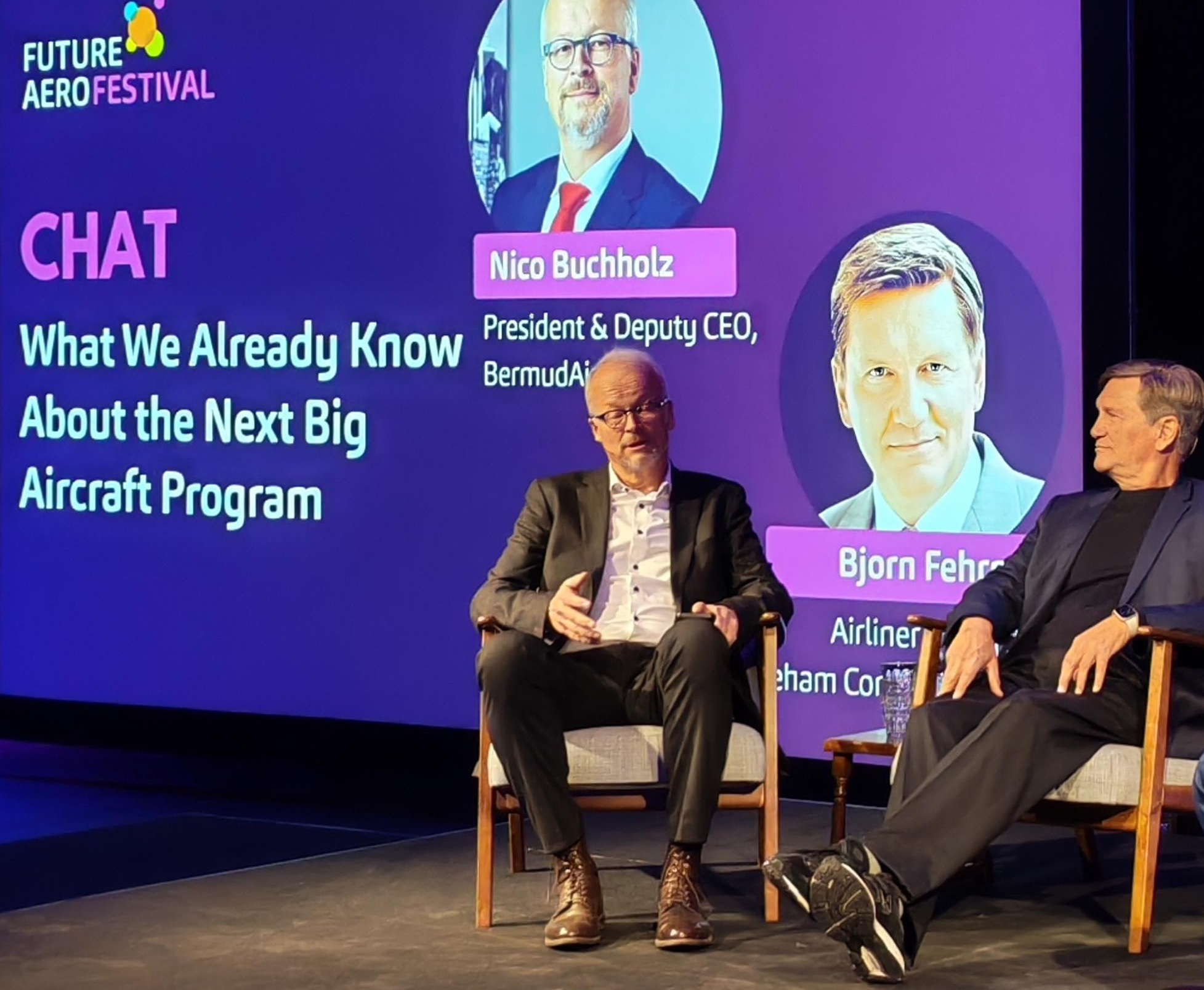
Bjorn Fehrm (right) discusses the industry’s challenges with Nico Buchholz (left). Credit: Charlotte Bailey, Leeham News.
By Charlotte Bailey
Dec. 2, 2025, © Leeham News: As aerospace companies, investors, and industry analysts gather in Amsterdam for the second iteration of the annual Future Aero Festival, the attributes and advantages offered by clean-sheet aircraft concepts are in the spotlight.
The first program point was when Bjorn Fehrm, analyst and consultant at Leeham Co., and Nico Buchholt, president and deputy CEO of BermudAir, were interviewed by Sustainable Aero Lab’s founder and CEO, Stephan Uhrenbacher.
The ’next big aircraft program’: a simultaneously inevitable yet somehow elusive concept OEMs and airlines alike are already considering with a view to future operations. Certainly, the scale of the challenge facing aircraft developers is significant.
From alternative propulsion strategies to entirely clean-sheet designs, industry insiders agree that tomorrow’s airliners are likely to be substantially different from currently operational concepts. But how are these ideas starting to shape up, and what is currently understood about commercial aviation’s future direction?
An aircraft is a “production tool for an airline: it exists to satisfy a certain need,” clarified Nico Buchholz. Although Buchholz has personally participated in the launches, demo flights, and entry into service of more than ten aircraft types, “on the other side, we see the slowness” of development, he added.
Fehrm of Leeham Co believes that a combination of motor, generator, and battery “makes a lot of sense on turbofans and turbofan engines,” he said, citing complexities with gas turbine acceleration and deceleration. “You actually have to design the engine a little less efficiently because of that. So, if you have the electrical motor in there to help, you can actually make a more efficient engine.”
Cars and airplanes are very different
Although there are notable technology parallels between automotive battery advancements and aeronautical applications, “a car case is very different,” said Fehrm. In particular, with no ‘stop-start’ elements of “stop lights in the sky,” the constant energy requirements mean that “hybrid [powertrains] in the sky have a much tougher task.”
Potential electrification is far from the only consideration. With aircraft development cycles typically running at around nine years, could contemporary advancements in technologies, such as the application of Artificial Intelligence (AI) speed up aircraft design and development?
“It doesn’t seem very promising,” suggested Fehrm. “One of the reasons is that for AI to do something consistent and reliable, it needs to train on real data.” However, OEMs are understandably cautious about releasing that proprietary data for applications such as these.
Incremental advancements in engine efficiency are also unlikely to provide further substantial leaps in performance, with powerplant technology having already addressed what Fehrm termed the “low-hanging fruit.”
An example of this is the replacement of the V2500 engine (powering the Airbus A320ceo family) with the A320neo’s Pratt & Whitney Geared Turbofan (GTF). This technological initiative doubled the powerplant’s bypass ratio, increasing the engine’s efficiency. However, Fehrm cautioned that a similar future doubling of bypass ratio can no longer be achieved with a so-called ‘normal engine,’ necessitating architecture such as the Open Fan concept.
“The reason why [developers] are pushing for the Open Fan is that you actually [increase] the bypass ratio six-fold, instead of increasing at half the time what you can do with the turbofan,” he explained.
This, admitted Buchholz, “would need someone to commit to it,” questioning whether OEMS would be reticent to adopt something “where they’re not 100% sure of the maturity”. However, he believes “it will happen, [albeit] in combination with a new [clean-sheet] aircraft.” This combination of engine and airframe is, understandably, of key concern for OEMs.
Replacing the A320neo and 737 MAX
The change from the A321 and the Boeing 737 MAX to the next generation of narrowbodies is going to materialize in the form of “change that has never been done before,” Fehrm said. What are the most significant challenges of such a program? “Is it the development cost, which is around $50 billion, perhaps? No, it’s not,” he cautioned.
Instead, the sheer volumes of aircraft involved present perhaps the most significant obstacle to adopting clean-sheet innovation. At the end of the 2030s, an estimated 20,000 in-service units of the A321 and 737 MAX combined will represent a fleet far surpassing the 1,500 units that Fehrm estimates are usually impacted by a fleet substitution. With expectations necessitating some 1,000 copies a year (or 300 units a month), “that’s a 30-fold increase,” he stressed.
Tim Clark’s desire
What of the hypothetical Airbus A380neo that Emirates CEO Tim Clark has publicly pushed for? Buchholz believes it ultimately comes down to how a flight schedule is split up, comprised of either “one A380, or two A350s or two [Boeing] 787s. I have the same seat mile cost in both aircraft today. I get a better quality of schedule, I get a better yield, but my profitability is significantly up when I have the two flights versus one flight,” he mused. “If Airbus would have taken the A350 or 787 engines, they would have saved a couple of percent of fuel. Is that trade-off enough to bring it back? It needs some aerodynamic [attention], and therefore you come to a couple of billion in development costs.”
Ultimately, what could be the quickest way to bring a new aircraft to market? Buchholz stresses that apart from technical innovation, the supply chain, industrialisation, and product support are all imperative from an operator’s perspective. Fehrm added his opinion that the industry has, on the whole, “lost about 10 years.” Despite announcing back in 2014 that its prototype two-seat electric E-Fan aircraft would go into production, this was cancelled just three years later.
However, with this “hype curve… on the way up,” the future for alternative-propulsion aircraft (such as Beta Technologies’ platform) is looking more positive, he concluded. The nine-seat commuter sector is also likely to be an early beneficiary of advancements in battery technology, which will incrementally increase in range as the technology matures.
Boeing and Airbus knows thermoplastic fuselages/wings, robotic build, Unducted fans and single pilot in cockpit certification for a 250 seater will come as technology matures and can be certified. No point of doing a new aircraft now until it can be realized while research in trotting along. The economic impact on airlines and its suppliers will be huge.
The issue is Tech advances never stop. Aerodynamics incremental these days, but computer control is moving far to fast.
EASA has stated 1 person cockpits are not going to be certified. I agree.
A good study would be to determine what having a 2nd FO in the cockpit would do for safety. A detached observer who can take in the big picture.
That said, you have to freeze your program at some point. Waiting for a 1 person cockpit looks to be a loosing proposition.
For those who think you can do automatics, AF447 is worth pondering.
Airbus portends the flight envelope protection is an end all and be all. Crash rates between Airbus and Boeing do not support that.
So what happens when you loose the Pitot in the Airbus system? Auto pilot goes off, control laws go to alternate and suddenly relaxed pilots startle and do the wrong thi9ngs.
Using a simple model, the computers know you are at altitude, you are in cruise mode, why go to alternate law? Its not a crisis.
Instead it could be programed to go to the 5 deg attitude and 85% thrust that maintains a safe configuration, announce to the pilots what is going on and they can determine any action needed or if pitots will clear.
Why Airbus chooses to drop out of a safe mode into a degraded one is a mystery. But they do.
If you can’t do that, then you have a current problem as well as a future one, you then have to program all that in and determine who overrides who (or what in the case of computers)
When peoples lives are at stake and the arena LCA operate in, its a whole different thing than a drone that puts along and when it fails, no harm no foul.
“Airbus portends the flight envelope protection is an end all and be all. Crash rates between Airbus and Boeing do not support that.”
This doesn’t seem to be based on facts / statistics i’ve seen. Since 2000 Boeings 737 has had more accidents then Airbus A320.
The 737 has had a higher rate of hull losses and fatalities compared to the A320 family when looking at overall numbers.
Boeing 737: accident rate per million flights: 0.24
Airbus A320 accident rate per million flights: 0.09
Significant, maybe no one dares to mention. Even AI is downplaying 😀
All the numbers I have seen they are equal.
I expect that is what AI is telling you.
737 pilots are better, they actually have to fly the bird.
The best systems in the world don’t save you from pilots incompetence. Having done at least one seriously stupid stunt in an airplane, I can testify to that (pretty sure the statue of limitations is over on that one!)
I am not even sure you can compare the two aircraft in equal terms (kind of like Tanker contests). The early jets had a lot more crashes. It took Boeing (who after all was the top producer then) time to figure out jets were not just smooth machines going at prop job speeds.
Airbus came along after the pioneering work was done and used that experience others had (and all too many died to acquire).
The main point is that automation is not an answer by itself. You need to train people.
When I was getting my commercial license we had an incident where a foreign student flipped a C-152 upside down. What he did next was hilarious (they survived so it could be). He put out a sentence in his language and folded his arms across his chest.
The instructor took that to mean, I got us here, you are paid the big bucks, its up to you to get us out of here.
Can you fly once your automation starts to shift to alternate control laws?
“737 pilots are better, they actually have to fly the bird.”
Who got blamed by BA for the two 737 MAX crashes? 🤡
In cockpit systems help single pilot in cockpit but if flight/systems deviate over set limits the main controller will be on ground taking over with its computer systems to help. It will be like flying the Global Hawk from a control centre in Texas that has been done for over a decade with updated systems and safety. A number of accidents would have been avoided if the systems was in place (like when pilots have a mental issue)
I think you are out over the ends of your skis on that one.
The drones have had a lot of crashes and in the case of Global Hawk, decisions are not needed as its all orchestrated.
The reality is the remote controllers are looking through a Soda Straw. All they do is issue instructions, if a system goes down, they have no situational awareness of what is going on and how bad it gets other than signals which may or may not tell you and you don’t have eyes and ears on in the aircraft. If its not programed for it its going to come down.
Lets explore the mental issue. Who decides? Do you have a ground controller on each aircraft? Do you have visual? Do you know how the pilot was or is acting now?
You have put in a hugely complex system and you will not know how it worked out until it does not.
There is a reason autonomous cares fail. As long as nothing happens you can program an aircraft to take off, fly to X point, turn and fly to Y point then land.
You have far more faith in automation than I do. I don’t see it happening and any attempt to have a ground controller take over is fraught with costs you seem to be dismissing.
The ability to hack an aircraft remotely is another aspect that is frightening. It can be done and someone will try it.
Even self contained automation is probably impossible to get the same senses and awareness picture a human being brings to the table.
The loss rate of airforce drones is disconcerting to say the least:
2 per month
or
1++ per million miles.
(Airbus A320, per Keesje,accident rate per million flights: 0.09 )
What’s missing from this “either “one A380, or two A350s or two [Boeing] 787s” is that for some destination pairs, it isn’t a choice between one A380 or a pair of A350s or 787s…
I think currently EK has SIX daily A380s into LHR sometimes joined by a 777 i.e. 6 A380 + 1 777 for some destinations it’s the slot availability that is the issue. EK can’t get an additional six slots into LHR to have a total of 13 slots up from 7.
No problem they say, just fly into London Gatwick – well I think currently EK fly three A380s into Gatwick daily, they may be adding a 777 or A350 this winter in addition to the 3 A380s.
DXB to MAN three A380s a day, DXB to BHX only a single A380.
BKK to DXB (Bangkok) five A380s daily.
CDG (Paris) to DXB three A380 daily.
CAI (Cairo) three A380 daily.
AMS, MXP, MUC, MRU, MEL all two A380s daily.
JFK two to three A380s daily.
TC really wanted an A380NEO for a reason.
British airways also use A380 for four flights to the USA daily, two to MIA and one each to LAX and SFO (second A380 to SFO seasonally). A380 LHR – DFW coming back 2026.
Qatar two A380 into LHR daily, Singapore mostly two A380 daily into LHR and Qantas one A380 daily into LHR.
I have a strong suspicion that slot availability at LHR is a bit of a problem, perhaps time for the UK Govt. to finally greenlight the third runway and get on with it?
The third runway, if it materializes, may give some relief late into 2030s?
But there’s no denial that some hubs around the world, including those in America, are close to being saturated, especially if we look ahead like fifteen, twenty years ahead. And premiumization by airlines means bigger aircraft are needed.
I believe airlines like QF, EY are strong candidates for the A350 stretch, if AB goes ahead.
Tim Clark is not getting his A380neo. He is not getting his A350-2000 either. Nobody else wants these flying whales.
I see an aircraft (whatever that is) coming out that will contemplate many opportunities…somewhat with a forgiving architecture that can support a multitude of powerplant options or production techniques.
The point is to produce a chassis that is forgiving to whatever technology drives towards in the future. The B737 is the perfect example of a frame that is boxed out of retrofit.
Well, I think Boeing has sold something around 400-500 of the 777X whale!
No question the bigger the aircraft the fewer it sells.
The most versatile in the Wide Body in the 787 is currently smallest and sells the most.
As long as the engine is a known commodity (Turbo Fan) you can sling as many mfgs under the wing as you want.
But, an aircraft is not a chassis. Its a finely tuned entity to get the most realistic efficient as possible (yes you could lower safety standards and get more – fortunately they are overbuilt and that has saved countless lives)
You try to make it take electric drive, RISE type, any type of TP and various jet engines, you have a failed program, it can’t be done.
That is a big reason why RISE is so off the wall. Its so different that it requires its own wing and probably some to a lot of fuselage differences.
Economics say you have to choose one or the other, both would kill you program wise, no one is going to pay for a two aircraft doing the same thing with to ally different power plant types.
Do you wait for not only RISE but competitors and then go with a GTF anyway? Go with RISE as a sole source?
@TW
There are 622 B777X orders (59 in freighter mode / 563 pax).
Emirates has 270 on order…thats 50% right there. Qatar as 124. Thats 70% in basically two operators. 169 pax aircraft for the rest of the world combined (and how many of those really want this thing after waiting so long). Emirates already has its own aircraft.
On your other note…my point is that you design an aircraft with plenty of space under wing or that can (maybe) support a tail – mounted prop…all with a center of gravity that will support these modes.
I digress…just saying you don’t commit to an “exotic” system unless there is a conventional one that is also compatible.
Big point is no one has cancelled the 777X. So they see it as a future despite it not being in the present.
I don’t get the logic of Emirates has its own aircraft. Yea, and they want to replace them as they age out. The big aspect is are they cancelling and buying other aircraft or are they buying what they can get now and going to pony up the bucks for the 777X when it comes available.
If they are not cancelling then they want the 777X.
I don’t see the idea of dual types that can share a common design. TP goes one way (regardless of its variants, aka RISE) and jets go another way.
If its a common jet engine type, then you can design a pylon that works. TP types do not live on Pylons.
If TC could get an aircraft bigger than the 777-9 he’d order it for sure, EKs current model requires the A380 & the 777-9 as far as capacity goes is a big step back for EK, they will have to work around it.
No Airbus won’t do an A380NEO, that ship has very definitely sailed. Will they do an A350 stretch? I doubt it, they will just keep refining the A350 & concentrate on growing market share for the A350 range.
It’s just an undeniable fact that people want to travel into & through some hubs that are already saturated, LHR is probably just currently the one shortest on slots (highest saturated). Gatwick’s second runway is the most likely to happen & provide some relief for a short while.
Heathrow hasn’t even started building the third runway yet – current estimate if it does go ahead is completion sometime in 2035 – ten years from now a) if it goes ahead right now b) if it isn’t further delayed (it will be).
“Boeing has sold something around 400-500 of the 777X”
not sold.
They have orders for that number. 1/4 is ASC606 tagged.
Majority of customers now seem to have the right to cancel without penalty.
Advances received seem to have been spent already?
Sounds like everything is up in the air, ATM.
Not really, lots of work on robotics, thermoplastic composite, engines and how a 1 man cockpit should work, how the ground station monitoring and can control a fleet of aircrafts. As it matures towards possible certification and the aircraft manufacturer see they can produce faster and cheaper but sell more expensive they will move.
@Claes
I like what you are saying in principle. One of the biggest “opportunities” is for crew reduction / augmentation with AI. Crew costs are not an insignificant function of DOCs.
Good luck getting that past a union vote. I have seen less controversial ideas scuttled.
Most likely the cargo and military first for 1 man cockpit. Maybe Wisk AAM will open the certification of unmanned cockpits. That’s the main reason Boeing bought into the company
In fact the Brits in WWII had one person cockpits.
But one person let alone unmanned is not going to happen.
As autonomous aircraft are certified and flying around the world, there will be leaders, and there’ll be followers… and laggers.
Not sure what an Automatic Teller Machine has to do with anything here, but, I agree with Vincent.
No aircraft mfg is going down a path that boxes them in.
Mitsubishi and Embraer can tell you how that works out (our view is the Scope is going away)
Make that same assumption with a 1 person cockpit and when they don’t allow that, you have a failed program . Like a Scope clause, you can’t get around it once you design to it.
@TW
ATM – at the moment Vincent ?
There are so many TLAs (Three letter acronyms) that now overlap as people can’t be bothered to type things out any more.
Yes- “at the moment”.
ATM?? LLM knows better. Time to ask. 😂
Why would any customers cancel their 777x orders? At this stage, BA is practically giving the aircraft away.
PS: Achkually Etihad’s contract is modified to give the customer the option to opt out of its 777x.
Seriously?
Phew, all contracts have opt out and opt out is in the rear view mirror by a big margin.
Be real.
Have you read the aircraft contracts yourself? Which one.
@Pedro: TW is correct. Contracts have cancellation rights under defined circumstances. SOP.
@Scott
My understanding is that’s not what Etihad said, it doesn’t consider it still has an outstanding order of the 777x!
Etihad ATM has no intention to take delivery of any, ANY 777x!
I don’t think that’s what Trans said.
PEDRO and TRANS
One would think that if Etihad was really interested in getting out of the 777x, GE would have made mention of the need to resell the engine delivery positions or that the engines would be on the secondary market as available. I’ll believe there are larger concerns when I see solid news about model specific BFE contract buyouts or sales. These are separate contracts with separate contractual obligations that must also be unwound
“Delivery position” is highly dependent on when* the aircraft is certified, not only by the FAA, but also EASA I believe.
Initially Emirates was the first customer to take delivery. Has GE started initial production of customer engines?
Everyone in the business knows the Etihad 777x deal is dead. BA doesn’t adjust its book to save face. 😅
@Pedro: You are conflating delivery position with actual delivery date.
All airframe OEMs assign delivery positions upon orders (sometimes a decade out), whether the airplane is in production and certified, or it’s still a “paper” airplane. The customer must know when to expect his airplane (delays aside). No airplane may be delivered until it is certified, after after the program itself is certified. Each individual airplane also must be certified as airworthy before the delivery date. The A320 program was certified in 1988. Delivery positions extend into the 2030 decade. Each plane must be certified before the actual delivery date. This goes for Boeing, Embraer, Gulfstream, whomever.
PEDRO.
DELIVETY POSITION or SLOTS have nothing to do with certification status. Look at all the A350Fs sold to date. Its not certified and yet Airbus is establishing delivery positions for those.
Please explain how somebody can acquire the first delivery position for that airplane without it being certified. Your stance on this is quite puzzling,
“Delivery positions” as @Scott said are what appear in spreadsheets or contracts. True delivery positions can only be established once certification timing is known, not like those projections by BA’s mgmt which are hopelessly optimistic. Earlier this year, from GE’s earnings call, its mgmt said the co. had not started production of the GE9X and engine deliveries weren’t affected (because GE didn’t waste any effort on GE9X customers’ engines)! Tells me the true progress of the 777-9’s certification. If the 777-9 were certified this year, GE would have to start preparing for customers’ engines by then and arrange from suppliers accordingly.😁
@Pedro: Get your terms correct, as I explained.
“Delivery positions” mean one thing.
“Delivery dates” mean something else, as explained.
You’re still conflating the two.
Hamilton