
Leeham News and Analysis
There's more to real news than a news release.



Middle East conflict impact on Airbus, Boeing
By Scott Hamilton
March 10, 2026, © Leeham News: The end of the war in the Middle East appears to be on a path of continued uncertainty and confusion, with no end in sight.
Middle Eastern airlines and lessors have 1,710 airplanes on order. The Mideast represents 9% of Airbus’ backlog. It represents 14% of Boeing’s backlog. Airbus has a 43% share of the Mideast backlog, while Boeing has a 57% share. Embraer is a fractional player.
Although President Donald Trump has already said the war has been “won” and could be over soon, he’s also provided mixed messages. Trump says that a cessation will be done with the concurrence of Israeli Prime Minister Benjamin Netanyahu, a notoriously anti-Iranian leader who urged Trump to engage in the first place, according to multiple media reports.
Trump also said that bombing may continue despite hinting that the war’s end is near.
For the airlines, the continued conflict means vastly reduced service. More of the current fleets are grounded than in service. For lessors, many have airplanes with Middle Eastern carriers, and a few whose home is in the region, some have outstanding orders with Airbus and Boeing. Lenders may face requests to restructure debt payments the longer the conflict continues.
Here’s a snapshot of the backlog exposure Airbus and Boeing have with the Middle East.

Figure 1. The Airbus-Boeing firm order backlog market share in the Middle East. Sources: Airbus, Boeing.
Backlog and 2026-2028 Deliveries
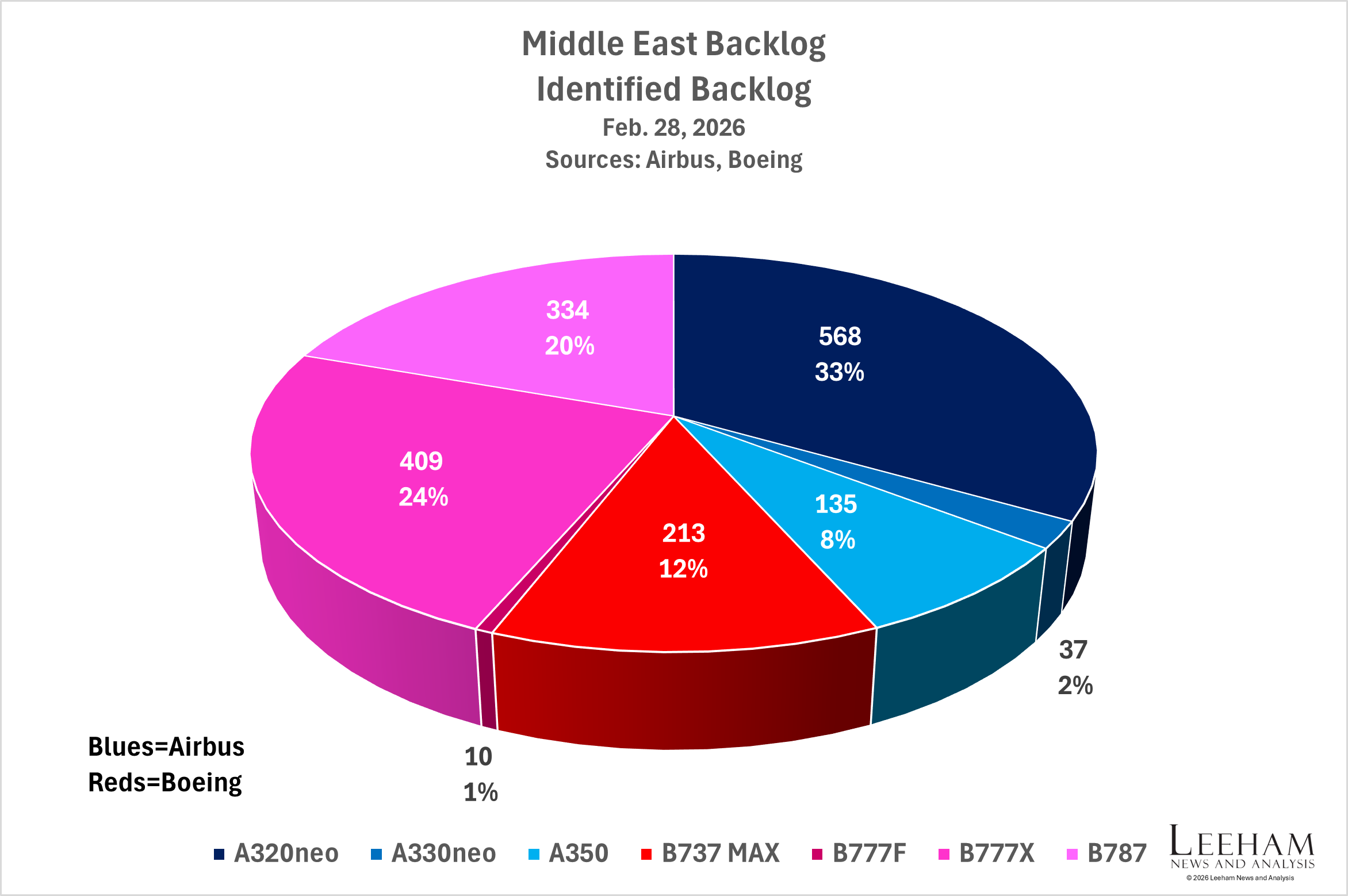
Figure 2. The firm order Airbus-Boeing backlog in the Middle East by aircraft type. Sources: Airbus, Boeing.
Deliveries within the next 18 months are at risk. If the conflict continues well into this year, deliveries in 2028 may become risky.
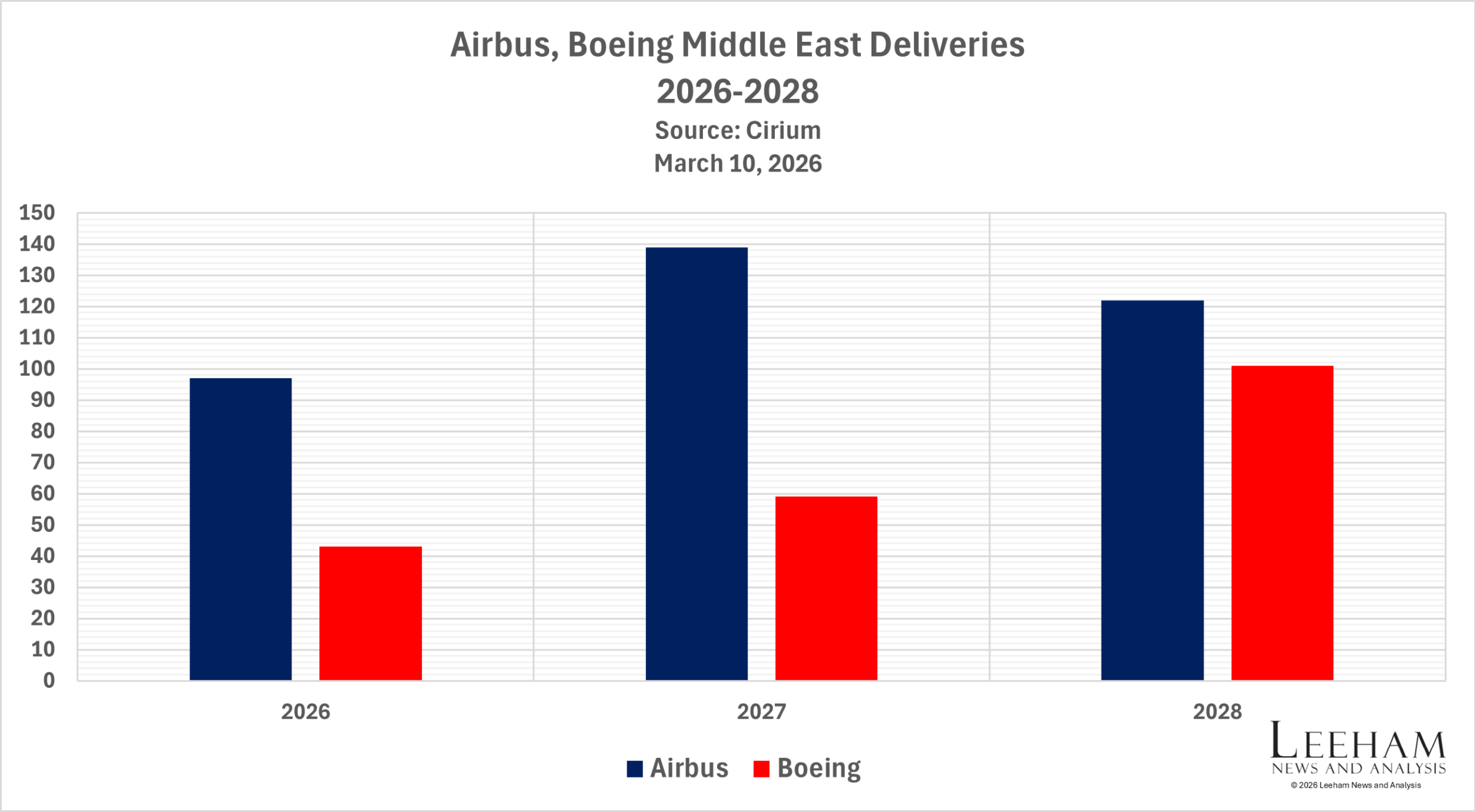
Figure 3. The Airbus-Boeing delivery stream at risk for the Middle East. Data Source: Cirium. Analysis by Leeham News.
Production typically begins within 12-18 months of scheduled delivery. Colloquially, this is known as “cutting metal,” even though Airbus A350s and Boeing 787s are composite airplanes. It’s probably too soon to say that the customers are asking Airbus and Boeing to delay production, in the hopes that the conflict will end sooner rather than later. However, these conversations may not be that far off. Most likely, production will proceed, but deliveries may be delayed.
Airplanes scheduled for delivery this year are already in production. Delays are likely.
First-quarter earnings calls begin in April. Airbus, Boeing, and the engine OEMs may address the conflict’s impact on these calls. Boeing’s CFO Jay Malave speaks at a Bank of America investors’ conference on March 17. He is likely to be asked about the impacts if he doesn’t address them in his opening remarks.
@ keesje posted this article in this week’s open forum, but it’s very relevant to the current article:
“Saudi Arabia And Gulf Allies Reportedly Discussing Withdrawing From US Contracts Amid Rising Iran Tensions”
“Gulf nations reconsider financial agreements with the US as the Iran war impacts their economies.”
https://www.ibtimes.co.uk/gulf-states-reassess-us-investments-iran-conflict-1783633
Marquee aircraft orders were a prominent part of the deals in question.
1) The U.S. has failed to provide a security umbrella for the Gulf states.
2) The Gulf states have got to be asking themselves if the U.S. bases on their territories are making them safer or if they are putting them at more risk.
3) The Gulf states have made enormous investment agreements with Trump’s America and now he’s dragged them into chaos. In short, an unmitigated disaster.
Topic discussed at the The Rest is Politics podcast:
https://www.youtube.com/live/FxX5cXUSvVk?si=bygAlAZbQwga2rjL&t=1055
Not sure this will pass review, but its far more complex than the Persian Gulf issues.
Its a volatile region with a critical resource, otherwise the world would ignore it.
The controlling parties are as bad as Trump.
If not for the US and UK that region would have blown uip a long time ago.
If not for the US and UK, it would have been settled now as well (violantly and a catastrophic approach WWII but settled)
Iran wants to control the region, the rest disagree and that is never going to be pretty.
The US per the citizens, mostly just want to have a decent life (and I believe that is true of most of the world)
What leaders do? Often not good.
None of the Gulf states is any kind of democracy. US and Israel supposedly are but we see where that has us. Nut jobs in charge it makes no difference.
Doubt there will be withdrawals, more likely in short term deferrals of some deliveries. Air travel will bounce back its just the timelines
“Air travel will bounce back…”
The question is when and how. Demand destruction that’s sufficient to balance the disappearance of 20% of the world’s oil supply means it’d be much worse than anything in recent history.
A Middle East that lost its balance of power won’t be one many want to set foot in or spend hours/a day to transit as long as there’re alternatives. Trump brought orders to Boeing, he’s destroying them right in front of us in slow-mo train wreck. Denial is not a solution.
I think it’ll be a year or two before the ME airlines are back on their feet. Most of their businesses is connecting & a lot of S Asian travellers won’t be booking via the ME again in the near future. An Australian friend of mine is stuck in the UK. The bulk of orders can be easily redirected (737s & A320s) but the 777X has just become a big risk for Boeing
Maybe some positive side effect is that the OEMs and MROs get some breathing space for catching up – or narrowing the GAP – with more planes in the ground currently.
I would though caution that a higher oil price for a sustained time – also adding in some of the longer flight zones will push airlines to re-think their fleet planning.
For sure if mid term timeline, away they go.
The iffy part is timing and what happens when and all bets are off at each fork of time line changes.
For right now, the first strategy is to defer if you can. So you take the first defferal point you can get and inform Airbus/Boeing, hold the bacon.
Short term the 777X is not an issue. A350 deliveries can be. 787 included in that, not that many A330s.
Single Aisles probably not an issue but that can change rapidly mid term (if it goes to mid term)
Past that, well as my finance guy and I have discussed, then the only thing of any worth is beans and bullets (gold has no value without an economy).
The last altercation with the same participants gave a precedent:
Attack,
after first week demand unconditional surrender
after second week break off and retreat.
in this round we are beyond “demand unconditional surrender”.
Talk about Iranians using US cruise missle(s?) to shoot at their own school.
Any adults around?
There are. They are called sane people.
They do not control the US Government.
There is no way for the sane people to control what is going on. That also plays out in the short and mid term.
If we can vote in the mid terms, things will change. If not, the world spirals on into insanity driven by the US in this case.
By mid-term, the house (world economy) is half-way burnt down.
Oil is ripping up again.
Good of Scott to address this head on. In aircraft terms it puts the status in very clear terms.
As I put in the Monday opening, too many factors in play. And there are short term, mid term and long term knock offs and each can be its own sub set of branches. I am making zero predictions. My one hope is the clown declares victory. This administration is monumentally both stupid and incompetent, the business metrics alone were predictable (chaos, disruption , price spikes, follow on impacts including ironically the corruption cabal themselves)
Top take off, not that we needed to live it, Children should not be allowed to p[lay with matches.
The US has a great tradition of political cartoons. One of if not THE all time best was from one called Pogo and it was simple, we have met the enemy and its US.
Excellent graphics/stats Scott, an eye-opener on what is at play in this latest Failed scenario, as Transworld cited, of plain Stupidity and Ignorance displayed by this Administration, and the backlash of this Fiasco will definitely have a serious impact for the Global Airline business and Economies.
The US gas and oil business get bigger profits as the war drags on. They are among the biggest Trump admin sponsors. So letting the war drag on until futures contracts for oil and gas deliveries for 2027 are closed at high prices can be an optimal time for the war to end. By some logic those profits should be transferred to Qatar/UAE/Kuwait airlines that suffered the most from US/Israel attack.
@claes:
Not trying to knock you but the most wasted space is “the should” statements. They never happen.
The US oil companies are profits (or will even more so) but they are not driving this.
What is driving this is people voting in a nut job and expecting him not to be a nut job. Please keep in mind it was by a bare 1.5%.
For those who do not understand, the Bidden admiration was denying the impact of price increase. Voters by just enough margin looked at the prices they were paying gong up (and not going to come back down) and voted what they saw, not what history told us Trump would do.
He would not win an election now, but sans a revolution (which destroys as well) we are driven by a narcissist who is also psychotic.
Oil companies are not stupid, greedy yes. Long term, if the world economy goes into the toilet, they loose as well.
“Now, British Airways has announced it will be suspending its services to Abu Dhabi until the end of the year while canceling other destinations for the rest of the month.”
Abu Dhabi is a winter only route for British Airways- thats why it wont resume till … winter months at end of year
Doha, Dubai, Bahrain Tel Aviv etc are only till end of month
Extended
British Airways has canceled all flights to/from Dubai, Amman, Bahrain or Tel Aviv until after May 31
There’s always something coming along
I know it’s much easier said than done,but what if Airbus had just kept the accelerator hard to floor during the Covid crisis?I wish that I had invested in shares in Rolls Royce or companies parting out 737s
Short term the effects of this disaster for the airline industry are being grossly underestimated .Destroying the Iranian oil infrastructure is the dumbest and most counterproductive thing imaginable(even if you don’t care about humanity and environment),this is what is really going to hurt.Apparently it was the Israelis,but it’s impossible that they could have done it without the knowledge and consent of the Americans
On the plus side for Boeing,the Russian market is about to open up again
@Grubbies
Therein lies a historical context. As bad as this war is, COVID will be worse for air travel.
There is a simple truth to consider. Nobody can afford for this war to go on forever, including the US and Iran. One prediction I will put out…all Arab states will put maximum force on pipeline constuction to circumvent the Persian Gulf.
The US campaign in Afghanistan lasted 20 years.
The Iraq war lasted 9 years.
Once the Iranians start using guerilla tactics, any hope of a swift conclusion becomes fantasy.
The US and Israel have created a situation whereby the Iranian regime has nothing left to lose…there’s simply no further downside for them. With minimal input, they can continue to cause havoc.
Also: even if the Strait were to open up tomorrow, it will still take months to get shuttered energy export facilities up and running again. So, unfortunately, there’s still plenty of pain ahead.
While mid or long term that is true it does noting short term.
And by mid term is can be irrelevant one way or another.
>And by mid term is can be irrelevant one way or another
Are we sure there will actually be mid term elections?
But back on topic, do the ME3 have deep enough pockets to be shut down for months? Or maybe their loses will be covered by their respective sovereigns? At the moment there doesn’t appear to be any really viable alternative hub that has anywhere near sufficient capactity to operate from.
In the medium term I gotta think that China will have to buy its oil from places other than Iran where the production capacity is being destroyed. That competition for non-Iranian oil will keep oil prices high for a while (a few years?). And Ukraine is out of options to settle their war now that Russia sanctions continue to be dropped.
Anyhow, air travel prices will go up and stay high for the medium term. I’m guessing 20-25% increase in tickets.
I want to visit Australia & New Zealand next winter, but probably wouldn’t ever have considered travelling alternative routes via N. America. I’m now in a bit of a quandary, though! I flatly refuse to travel to the USA while Trump and his henchmen are in power, purely on the basis of withdrawing my financial input to the USA, as I think that is the best way of hurting him. Could I go via Vancouver, though (and reward the Canadians for their stance!)?
You can just fly from Europe to Singapore direct, and transfer there.
Direct flights make a wide diversion around the Gulf.
I remember travelling to Australia at the time just after Iraq invaded Kuwait, and the diversions that were necessary then, but this time the field of conflict is a lot larger -still not sure I want to go that way!
There’s a bit of a problem,no fuel
Yes. Its poorly understood that Singapore or Bangkok- NOT ME- are the rough halfway points between Europe and the Australian major cities.
Also Qantas does non stop from Perth to London, Paris Rome on the B787-9 which goes over Caucasus and the ‘stans and India . Or on A380 via Singapore stop. British Airways does the same . Flying Cathay via Hong kong is another route
“I flatly refuse to travel to the USA” good point On the other side flying from the US to EU and other parts of the region might not be a good strategy
Before the war, US citizens were not the most welcomed in those regions.
I was in Toulouse speaking at aviation conference when 9/11 happened (I got free lift back to the US from Jet Blue because they were taking delivery of new aircraft, otherwise it would have been stuck in France for 2 week wait)
In 1987, I was in France doing supplier selection when the Iran Missile attack started. I was going around with the customer for two weeks, using puddle jumpers to get around the country. But every time I was looking to board the next flight, the police were there. At the end, the person traveling with me admitted they were checking the small plane because I was an American
That said, I canceled my Iceland trip and will stay in the US this year
@Roger:
You do not affect Trump in any way by traveling through the US.
If you want to affect things, there are many democratic insinuation in the US that are righting the OA you can contribute to.
YVR is loaded with flights to New Zealand and Australia. AC, QF, NZ would love your business. They fly nonstop and many others go direct.
“IEA Launches Record 400-Million-Barrel Emergency Oil Release”
https://oilprice.com/Latest-Energy-News/World-News/IEA-Launches-Record-400-Million-Barrel-Emergency-Oil-Release.html
This record release had barely any effect on oil prices, which are on the rise again (after a drop yesterday).
===
Meanwhile:
“Iran Warns Oil Could Hit $200 per Barrel as Hormuz Threat Escalates”
“The $200 oil price tag warning follows a major Iranian drone strike on Wednesday on Oman’s largest oil storage facility. ”
https://oilprice.com/Latest-Energy-News/World-News/Iran-Warns-Oil-Could-Hit-200-per-Barrel-as-Hormuz-Threat-Escalates.html
“Three ships in Strait of Hormuz hit by ‘unknown projectiles'”
https://www.bbc.com/news/articles/cr5l988qr47o
Quite clear who has control of the Strait — and who doesn’t.
> BREAKING: Iran has reportedly sent more than 11 million barrels of oil through the Strait of Hormuz since the war began, all bound for China, CNBC reported, citing shipping data.
https://x.com/AJENews/status/2031626862699381117
> WSJ: Iran is exporting more oil through the Strait of Hormuz than before the war, showing it is in control of a strategic waterway that it has closed off to the rest of the region’s oil producers
https://t.co/CeZTClmHBa
I’m impressed- though not positively- by the various commenters posting this-or-that link, as though its veracity can be safely assumed. Cui bono?
I’m with Socrates at the moment: I know that I don’t know. To think otherwise in these times seems to me foolish.
Some persons appear to believe everything they read
on this here Internet, especially if it supports their hypothesis du jour.
Mmm.
Here’s a detailed link to @Pedro’s comment:
https://www.cnbc.com/2026/03/11/iran-ships-oil-china-strait-hormuz-closure-.html
Next question: will the USN attack those Iranian tankers before they reach their destination…risking further exacerbation of the situation?
Given that China owns the oil in those tankers and maybe the ships too, I would guess that they would not be happy with a USN attack in international waters. I can’t believe that they would take the risk of annoying China right now. But anything can happen these days.
Yep, I got with what Iran says. Such lovely nice humane people in charge.
I believe that world wide consumption is about 110 million barrels per day, just to give context to the release of 400 million barrels from strategic reserves
Strategic reserves are supposed to be 3 months supply for those particular countries usage- not released to the general market. Thats 1.5-1.6 bill bbls including that already in supply system
IEA members consume 45 mill bbl per day to give the context and many have their own sources of supply, North Sea, Canada, USA etc not effected by the Straits closure for many but not all tankers.
The numbers I have seen is that release is around 1.5 mill bbl per day for the time being.
The market isn’t impressed: Brent/WTI oil traded above $100 in Asia last night, and Brent is currently just below that mark in European trading. Gulf blends such as Murban are currently above $115.
Bearing in mind how long disruption will last — even after normal traffic resumes — this release of reserves is essentially symbolic.
Remember EverGiven…the container ship that blocked the Suez canal for just 6 days back in 2021? Remember the knock-on effects that that caused, for months after the blockage was removed?
“Strategic reserves are supposed to be 3 months supply for those particular countries usage”
Not sure what sources you read say that. What countries meet such a criteria?? Laughable
Reality check 👇
https://pbs.twimg.com/media/HDHG_06XMAAt35U?format=jpg&name=small
According to those who know better, the more relevant factor is the draw rate, how thick a straw you have. For the US, sustained draw rate is roughly ~1.4 mb/d. A much higher draw rate would destabilize the cave structure where the crude is stored, rendering the storage unusable. Furthermore, the US sells to the highest bidder: timing of delivery is controlled by the buyer, not the seller!
Interesting that Australia itself fails to maintain 90 days oil reserves:
> “Resources Minister Madeleine King said the amount of fuel Australia kept in storage was based on cost and practicality.
“The 90-day fuel reserve would be an enormously expensive undertaking,” she said.
“It is estimated to cost about $20 billion if you were to store the suggested amount of fuel.
good info…seems a little early for reserve releases….its time to go back to the 1970s with gas shortage in the US
Google AI summary for 1970s gas shortage
Impact on Daily Life:
Long Lines: Gas stations frequently had lines extending for blocks, with some stations running out of gas entirely.
Odd-Even Rationing: To manage demand, states implemented systems where cars with odd-numbered license plates could only buy gas on odd-numbered days.
High Prices: Gas prices skyrocketed, fueling inflation.
Conservation Measures: The maximum national speed limit was reduced to 55 mph, and daylight saving time was extended to reduce energy consumption.
Economic Impact: The crises caused “stagflation” (high inflation combined with high unemployment), severely impacting the U.S. economy.
Long-Term Effects: The shortages forced a shift toward smaller, more fuel-efficient cars and increased interest in alternative energy sources
MAGA Make Affordable Gas Again!
I bet Trump won’t re-impose 55 mph national speed limit.
$200 a barrel will push gas over $6.00 a gallon mark! Who know how much in California….probably pushing over $8.50 a gallon is some areas
So for F150 with 36 gallon tank…fill up at over $300
MAGA Make Affordable Gas Again
Gasoline has been over $6.00 / gallon in California for ages. Verifiable by looking at the sign down the street..
You cry. We pay $10.00 / gallon in Denmark.
Yeah…most of that being tax.
Europeans are used to paying taxes to ensure infrastructure upkeep. In contrast, infrastructure in certain low-taxation countries is falling apart.
There’s no such thing as a free lunch.
Thats not the case when I looked for prices
Nor does AAA verify your claim. Theres always exceptions, drivers can you know , drive around.
https://gasprices.aaa.com/?state=CA
That chart shows over $6/gallon in all the highly populated counties of California. The “average” price it shows appears to be the average of the average in each county. It doesn’t appear to be adjusted for population.
@Thomas B.
Not really. You are looking at “highest recorded average price.”
I checked: LA, SF and San Jose respectively.
Jet Fuel Price Monitor
“Fuel Price Analysis
The global average jet fuel price last week rose 58.4% compared to the week before to $157.41/bbl.”
that is as of March 6….should be interesting to see in the next week or wo
https://www.iata.org/en/publications/economics/fuel-monitor/
“Europe Faces Jet Fuel Price Surge and Supply Shortages”
“The closure of the Strait of Hormuz has shattered the traditional diesel–jet pricing relationship in Europe, pushing the jet-diesel regrade from a normal –$5 to +$2/bbl range to an unprecedented +$48/bbl.
“With roughly 30% of Europe’s jet fuel imports normally coming from the Gulf, blocked tanker traffic has turned aviation fuel into the tightest refined product.
“Alternative suppliers from China, South Korea, India, and the US remain locked into regional markets, leaving Europe exposed to both soaring prices and the risk of outright jet fuel shortages.”
“Historically, Europe’s refining system has been structurally tight in middle distillates, reflecting the continent’s diesel-heavy transport system. Diesel, therefore, almost always traded at a premium to jet fuel, with the European jet-diesel regrade typically fluctuating between about –$5 to +$2/bbl during a normal seasonal cycle. That relationship has now collapsed. Since the beginning of the price volatility due to the war in Iran, the regrade has surged to $45-48/bbl, when the ICE jet crack spread has peaked at roughly $78/bbl. While Singapore’s jet crack spread has eventually declined from a shocking last-week peak of $79 to $40/bbl, the European peak is still holding to $65-68/bbl levels, indicating a real structural shortage”
“The Gulf has long served as the world’s principal source of jet fuel exports, largely because its crude oil and refinery configuration generate abundant middle distillates. Among those suppliers, Kuwait has emerged as the dominant provider to Europe, at times covering roughly ¼ of European jet imports. In 2026, there were even weeks when European jet imports originated exclusively from Kuwait.”
https://oilprice.com/Energy/Energy-General/Europe-Faces-Jet-Fuel-Price-Surge-and-Supply-Shortages.html
Europe’s only option is to beg Putin to sell them what they need and stop Ukraine from attacking Russian energy infrastructure.
Or we can just travel in nuclear/renewable powered trains like millions of us are already doing I suppose.
Trying to please russia just to get a ride on a Ryanair/Easyjet/Volotea flight isn’t really worth it.
It’s not just jet fuel that’s affected — it’s all middle distillates, including diesel and home heating oil.
Renewables offer little relief on windstill nights. And trains can’t replace road freight.
The Netherlands has the busiest rail network in de EU — and its freight trains still carry only a tiny fraction of what’s carried by road.
Reuters: South Korea is considering importing Russian crude oil and naphtha as it looks to secure energy supplies during ongoing Middle East tensions, the Industry Ministry said.
I wouldn’t quite go that far.
There’ll be a game of musical chairs, with supply lines shifting according to the highest bidder, and Russian flows going to customers that don’t have a problem therewith (India, Turkey, Hungary, etc).
But that re-arrangement will take time, and it won’t do much to alleviate high pricing.
Europe will have to import more heavy crude blends in order to extract more jet fuel from the refining process — which means that the lighter crude coming from the US will fall out of favor.
50% of US refineries are still tooled for heavy crude, which means that the US also has to import heavy blends for those refineries.
I think there’s a deficit of refining capacity in Europe as those in the ME succeeded to out-compete. Therefore there’s a structural deficit that is fulfilled by imports of refined products. Right now the capacity in the ME is locked up behind the Strait of Hormuz and refineries in Asia are cutting back production because of a collapse of crack-spread: high input costs and a lack of immediate supply.
https://www.spglobal.com/energy/en/news-research/latest-news/refined-products/032525-survival-of-the-fittest-european-refiners-jostle-to-outlast-closures
> Eni’s Livorno stopped crude processing in 2024, while the UK’s Grangemouth will close in Q2.
Two German sites, Shell’s Rheinland, and BP’s Gelsenkirchen, are also expected to downsize this year [2025].
True.
But there are still more than 80 active refineries in the EU/EEA, so the situation isn’t helpless.
One can imagine that recent events will encourage authorities to expand refining capacity rather than shutter refineries. We’re seeing a similar shift in attitude to nuclear power.
Catchphrase of the year:
‘Supply chains need to change model from “just in time” to “just in case”…’
“Emirates Flight Attendants Face Tough Choices As Iranian Drone Attacks Fall Near Dubai International Airport”
“…While other airlines in the region keep planes grounded or heavily restrict operations, Emirates is winning praise from some Dubai residents and stranded tourists for its tough ‘keep calm and carry on’ approach.”
“Within the airline, though, there is growing concern amongst some of its frontline workers about the risks they face coming to work during the unfolding crisis.
“Emirates employs flight attendants from around the world with the promise of living the high life in a safe, tax-free haven in the Middle East. Now, some crew are wondering what exactly they’ve got themselves into.
“Officially, Emirates says no one has to work a flight if they don’t feel comfortable, but there’s growing anxiety among crew members that they might eventually face a stark choice between working the flight or handing in their resignation.”
https://www.paddleyourownkanoo.com/2026/03/12/emirates-flight-attendants-face-tough-choices-as-iranian-drone-attacks-fall-near-dubai-international-airport/
> a growing anxiety among crew members..
Not to mention potential customers. Granted those customer anxiety is outweighed by the anxiety of being stuck in Dubai, or wherever, so they’re getting on the plane anyhow.
The ME3 air hub business model is showing its Achilles Heel. Asian airliens with intercontinental networks will benefit. Singapore Air, Korean Air, Cathay etc will be preferred over ME3 for passengers in many markets.
“Iran conflict creating ‘largest oil supply disruption in history’, says IEA”
“The war in Iran is causing the “largest supply disruption in the history of the global oil market”, according to the global energy watchdog.
“The International Energy Agency (IEA) said the flow of oil through the Strait of Hormuz has reduced to “a trickle” and slashed its energy production forecasts.
“It came as oil prices lifted higher again on Thursday as Iran continued to strike key energy and shipping infrastructure in the Middle East.”
https://uk.finance.yahoo.com/news/iran-conflict-creating-largest-oil-114151530.html
Mar 11
WSJ:
> Largest-ever release of strategic oil reserves to be approved today, with America releasing record amounts. But it’s all done ad hoc without preparation, indicating that the Iran war consequences were not carefully considered
https://t.co/eeJtjvroSq
#########
Reuters
> Ebrahim Zolfaqari, spokesperson for Iran’s military command: “Get ready for oil to be $200 a barrel, because the oil price depends on regional security which you have destabilised.”
https://t.co/sEJocxV0Ss
#########
> That Trump started the attacks on Iran without even having the semblance of a plan to keep the Strait of Hormuz open is both a mystery and a scandal — from which he might not recover politically. Republican grandees in swing seats/states now beginning to panic, flooding White House with calls to ‘do something’ as gas [petrol] prices soar.
https://x.com/afneil/status/2032033334583308587
“Trump draws backlash for saying high oil prices are good because ‘we make a lot of money’”
https://www.al.com/politics/2026/03/trump-draws-backlash-for-saying-high-oil-prices-are-good-because-we-make-a-lot-of-money.html
🙈
> U.S./Iran war is not (yet) an oil shock
Oil futures prices have increased by more than a third since Israel and the United States attacked Iran and almost two-thirds since the start of the year but the increase is not yet severe enough to be characterised as an “oil shock”.
Previous shocks all saw much greater prices increases to much higher levels and occurred when the major economies were more dependent on oil for heating and electricity generation as well as transport than they are at present.
Futures prices would probably have to increase by another $40 or $50 to cause an equivalent downturn in the business cycle, which likely explains why the two sides have felt able to keep fighting in the short term.
But if the war continues, and the Strait of Hormuz remains closed to tanker traffic for a prolonged period, prices still could escalate much further, testing the resolve of top leaders to maintain hostilities.
In the meantime, price increases are inflicting much more damage on developing economies, especially in Asia, where price increases risk being compounded by fuel shortages…
https://x.com/JKempEnergy/status/2032135805548867593
“Only 3 U.S. Airlines Can Remain Profitable at Current Oil Prices”
“According to UBS analyst Atul Maheswari, Delta Air Lines (NYSE:DAL), United Airlines (NYSE:UAL) and Southwest Airlines (NYSE:LUV) are the only U.S. airlines that can generate even “meagre profits” if fuel prices remain at or above $4 a gallon. Maheswari has noted that while these three might be able to stay in the black, no other major airlines are expected to make money at current oil prices, with many likely to face deep losses.”
“Wall Street analysts are warning that U.S. airlines could face a painful earnings squeeze as oil prices surge amid the escalating war with Iran. Crude prices jumped over 9% on Thursday as the conflict rattled energy markets and heightened fears of disruption around the Strait of Hormuz. Many U.S. carriers largely abandoned fuel hedging in recent years, leaving them far more exposed to sudden price spikes and raising the prospect that only a handful of airlines can remain profitable at current oil prices.
“Airlines and oil producers typically rely on hedging strategies to manage extreme oil price volatility. Airlines seek predictable fuel costs, while producers aim to stabilize revenue. Fuel accounts for roughly 15% or more of airline operating expenses, making price swings particularly damaging. By using futures, swaps, or options, carriers can lock in prices and shield themselves from sudden spikes that can quickly erode profitability. Airlines often hedge up to two-thirds of expected fuel consumption about six months in advance, with European carriers generally taking a more aggressive approach.”
https://oilprice.com/Energy/Energy-General/Only-3-US-Airlines-Can-Remain-Profitable-at-Current-Oil-Prices.html
Never mind the impact on Boeing and Airbus and these GCC airlines. The GCC states could SOON be facing extinction.
Iran has successfully wiped out every American air base and naval port in the Gulf.
The GCC states are furious after their security was abandoned by the United States while Israel’s was prioritized as air defense interceptors were shipped to Israel from the Gulf.
The GCC spent and pledged billions to get under the American THAAD umbrella, only to be betrayed as they are kicked under the bus in favor of the only country that really matters to the United States in that region.
Why would any Gulf state want to be yoked to the United States after what has happened during the last 13 days?
“It may be dangerous to be America’s enemy, but to be America’s friend is fatal.”
― Henry Kissinger
The situation for these Gulf states is beyond precarious. Never mind oil and gas. These countries cannot exist without desalination plants, and they can be easily wiped out by Iran. Ditto electrical generation that can easily be wiped out also. Without electricity how do you power air conditioners in a country where temperatures can reach 160 degrees in the summer?
And we know which large, east Asian country will be invited in to take the place of the US, don’t we?
> Iran is considering allowing a limited number of oil tankers to pass through the Strait of Hormuz, provided that the oil cargo is traded in Chinese yuan, a senior Iranian official tells CNN.
The petrodollar system is collapsing right in front of our eyes.
> FT: France and Italy open talks with Iran in hope of securing safe Hormuz passage!
A lot of hyperbole there.
Why do we care about the Gulf states? Oil and Gas. Otherwise they would be stewing in that fine Gulf air.
What did they do about their vulnerabilities? You think Iran would not have taken them over sans the UK and US in that area since the 30s?
I mean really, read history. It was called the Persian empire because it was a whole lot bigger than Iran. Guess who was the acquired part?
just a fyi
“Chinese buyers are paying a premium for Canadian oil as the Iran War curtails supplies from their main sources in the Middle East.”
Same Chinese that are immune from the ME?
Maybe they shoujild send their fleet to escort the tankers out of the Gulf their good friends are attacking !
China may have to re-think who they are buddies with.
Pity Japan, S Korea and Taiwan. Double whammy after paying Trump hundreds of billions of pizzo. When will they ask for refund?
Percentage of total energy supply that passes thru the Strait of Hormuz:
Japan 31%
S Korea 30%
Taiwan 38%
That’s the difference if you had done your homework first.
https://pbs.twimg.com/media/HDUn76yXwAELDNa?format=png&name=900×900
China destination tankers are identifying as such in MCAS and communicating with the Iranian Coast guard and going through the Straits. USN isnt going to interfere! Other shiops are getting permission when on radar and then going dark on the global online MCAS so its not apparent they are getting through. Theres other sources where they show up.
However China has now banned all export of (refined) petroleum product, which is a problem as Australia gets a lot of its petrol from China
I can see South Korea and other refining hubs doing the same
Funny how this is the 6D chess some imagines playing to corner China:
> Australia imports 32% of its jet fuel from China. Meanwhile, 20% of its jet fuel supply comes from Singapore, where jet fuel prices have more than doubled and are now $211 a barrel.
https://pbs.twimg.com/media/HDUx7b2acAATC–?format=png&name=900×900
@DP
*Everyone* is paying a premium for oil, gas and fertilizer at the moment.
The only difference between countries is the size of their shortfalls, and the mix of fuels they need to source elsewhere.
Canadian crude is (very) heavy grade, which makes it an attractive alternative to Gulf grades…and vital for refineries specifically tooled for heavy crude.
Notice the lower price for (light) WTI compared to heavier grades, such as Brent or Murban? Light crude yields lower quantities of middle distillates (diesel, jet fuel, heating oil,…), which are in particularly short supply at the moment.
Well we at least versus the payments going to China, back to North America.
Now all we have to do is make China the 51st State.
It really belongs to the US anyway. If Ukraine is part of Russian, Canada is part of the US.
Certainly a lot easier to occupy than Iran.
Canada not there yet but
“Canada’s energy minister says the country is poised to become one of the world’s biggest suppliers of liquefied natural gas, exporting as much as 100 million tonnes per year.”
“Tim Hodgson delivered that optimistic outlook to a parliamentary committee earlier this month, noting that countries such as Japan, South Korea, China and India all want Canadian gas.”
Not just exports to Asia — Canada is also working on a project to supply LNG to Europe within 5 years:
“Fermeuse Energy is developing a $12–$15 billion LNG export project on Newfoundland’s Avalon Peninsula, aiming to unlock 9.7 Tcf of associated gas from the Jeanne d’Arc Basin. The project includes a ~380km pipeline and a liquefaction facility at the Fermeuse marine base, aiming for exports to Europe within five years. ”
https://fermeusebase.com/article/fermeuse-energy-announces-lng-export-development-in-newfoundland-and-labrador-canada/
> The Pentagon is moving a Marine expeditionary unit to the Middle East… Hegseth has approved a request from Central Command for the expeditionary unit
The Japan-based USS Tripoli and its attached Marines are now headed for the Middle East
If Trump doesn’t taco soon and go ahead to put boots on the ground, it’s very tempting that: BA can kiss goodbye to delivery of 777-9 to the ME3 for next two years.
Putin will celebrate with champagne.
###########
If the US can’t protect itself, why the Gulf states want US military bases in their countries?
Multiple high-value US assets were destroyed or damaged by Iran, turning the US blind and deaf.
Replacing the radars damaged by Iran will cost the US multi-billion dollars and take years.
“It will take Raytheon five to eight years to build a new one at a cost of $1.1 billion.”
At least 17 US sites were damaged in the war with Iran
https://pbs.twimg.com/media/HDI1YbKbcAAgl-s?format=jpg&name=900×900
#########
More are drawing the comparison with escalations in Vietnam under L B Johnson
https://x.com/ProfessorPape/status/2032313959139672386
“Banks Hike Oil Price Forecasts, and Some See $150 Crude”
“…UBS, for its part, expects prices above $100 per barrel and a move higher into a more severe demand destruction territory of $120 a barrel if oil flows through the Strait of Hormuz remain choked.
“Early this week, analysts at Wood Mackenzie said that Brent could surge to $150 per barrel in the coming weeks, similarly to the price spike following the Russian invasion of Ukraine in 2022.
“This time around, “In our view, US$200/bbl is not outside the realms of possibility in 2026,” WoodMac’s analysts said. ”
https://oilprice.com/Latest-Energy-News/World-News/Banks-Hike-Oil-Price-Forecasts-and-Some-See-150-Crude.html
Do you think that Boeing is calling the White House asking to stop the war so their ME3 customers will still be able to take delivery ? Or is it too late and the 777 is dead and Boeing is asking the White House to buy more arms (aircraft, cruise missiles etc).
The latter.
And Israel ordered 5000 smart bombs from BA earlier this week, so that also helps.
Now let’s ask a similar sort of question as regards Raytheon. Why prioritize fixing PWG engine problems — which only affect BA’s competitors — when one can instead divert resources into (much more lucrative) defense production?
Now – all of a sudden Trump is asking his former Allies (in theory still allies) to contribute lots of aircraft and ships to “help” open-up the Straits. Which is not going down well with those he failed to consult before his attack or even insulted for various acts which did not fit in with his personal viewpoint.
Apologies – only marginally relevant (though I do not think many are aware of how many British and French warplanes are already active in the Gulf states).
Some EU members have defence agreements with certain Gulf monarchies, requiring mutual assistance in case of attack. That’s why several EU countries have announced military deployments to the region, including France and the Netherlands. The purpose of those deployments is purely defensive, and purely geared toward the Gulf states.
Multiple European countries have deployed forces to help protect Cyprus and Türkiye from attack.
No country in Europe is interested in getting directly embroiled in the mess started by Israel and the US. And no country here is going to provide naval escorts under the current circumstances.
Why doesn’t the Israeli navy help Trump with this task? (rhetorical question)
“”It’s unlikely that countries will agree to send warships to the Strait of Hormuz despite Trump’s call, says Mohamad Elmasry, a professor of media studies at the Doha Institute for Graduate Studies.
“He said that this is “a really difficult task” that Trump is underestimating.
““These are slow moving ships. They travel about 25 kilometres [15.5 miles] per hour. They are massive targets in a very narrow waterway,” said Elmasry.
““Iran can strike the ships in the strait from anywhere on Iranian territory because those Shahed drones have a range of up to 2,500 kilometres [1,600 miles], and the strait is very close to the Iranian mainland. So Iran can really wreak havoc on the strait if it wants to.”
“It’s a very “dangerous proposition”, and this is why insurance companies are not willing to insure ships or their crews, he added.”
Quote taken from AlaJazeera live blog:
https://www.aljazeera.com/news/liveblog/2026/3/15/iran-war-live-trump-urges-world-to-keep-hormuz-strait-open
@DH (and others:
The US is not Trumps.
What he is doing is not the US
They are not and never were his allies. He has no allies and he has not friends. They are all back stabbing transactionalists .
What is interesting to see, is a power like China or Russia throws its weight around and that is just fine by some.
The US does and its a crime. How Dare They?
Hypocrisy by any other name.
China apparently just about to pull the trigger on a huge Boeing order.Bigger brain than mine required,but I guess DJT is giving it a last throw of the dice before throwing in the towel/declaring”mission accomplished “
“Australian Government Warns Citizens: Do Not Travel Through Dubai Even If You’re Only Connecting Onto Another Flight”
“…Emirates has pursued an ambitious flight resumption program, going much further than regional rivals to add back flights and reopen bookings for connecting passengers.”
“In many ways, Emirates is indicating that its ‘business as normal,’ and passengers can confidently use its Dubai hub as a transit point for normal flight bookings.
“The Australian government, however, is now saying ‘not so fast’ to its citizens in a new travel advisory to its citizens.”
““The regional conflict is likely to escalate further,” the advisory continued. “Airports, hotels, roads, bridges and other locations have been struck with missiles. Airspace may close at short notice. Flights can change or stop suddenly. Borders can close.””
“For now, however, Emirates is the only airline in the region that is actively offering flights with a layover in the Middle East. Emirates has already rebuilt its flight capacity to around 62% of pre-war levels, while there are reports that the airline is targeting a 100% resumption of flights by March 29.”
https://www.paddleyourownkanoo.com/2026/03/15/australian-government-warns-citizens-do-not-travel-through-dubai-even-if-youre-only-connecting-onto-another-flight/
===
Emirates should think carefully about this: if an A380 is downed, there’ll be 500 deaths, and the airline’s fate will be sealed.
I’m wondering how many new bookings the airline is getting, other than from repatriation passengers? I can’t imagine that that many passengers are willing to take this risk. MH17 is still fresh in the memory of Europeans and Australians. IranAir 655 and UIA 752 haven’t been forgotten either.
“Jet Fuel Prices Soar as War in Iran Ripples Through Global Aviation”
“Australia’s Qantas Airways, Scandinavia’s SAS, and Air New Zealand are three of the airlines to have already announced airfare hikes in response to the ongoing conflict in the Middle East. The airlines cited the abrupt spike in the cost of fuel driven by the U.S.-Israel attack on Iran as the reason for the move.
“Jet fuel prices rose from between $85 to $90 a barrel before the attack on Iran to as much as $150 to $200 a barrel this week. This has led several airlines to reconsider their financial outlooks for 2026, as the uncertainty makes it impossible to predict where the price of fossil fuels will go in the coming months.”
“Some airlines will be more affected than others by the increase in jet fuel prices. For example, several Asian and European airlines, such as Lufthansa and Ryanair, have oil hedging in place, meaning that a part of their fuel supplies is maintained at a fixed rate. However, some companies are concerned that even the hedged fuel reserves may be at risk.
““Absent near-term relief, **airlines around the world could be forced to ground thousands of aircraft** while some of the industry’s financially weakest carriers could halt operations,” Deutsche analysts were reported to have said in a note to clients.
“The uncertainty means that several airlines, across Asia, Europe, and North America, are seeing their shares plummet. Lorraine Tan, the director of equity research, Asia at Morningstar, stated, “The issue for the airlines now is that travel demand may be curtailed as costs become prohibitive for leisure travellers and as some companies start to limit business travel due to the uncertain outlook.”
https://oilprice.com/Energy/Energy-General/Jet-Fuel-Prices-Soar-as-War-in-Iran-Ripples-Through-Global-Aviation.html
Even when/if the Strait of Hormuz is safe for passage and shipments resume, the lost production capacity in Iran will keep supplies constrained. Oil prices may drop from the recent spikes, but stay very high relative to a month ago for a long time. Airfares/surcharges will continue through this year. Not a good time to be in the airline business either directly or indirectly (via share ownership).
Dubai Airport under attack!
I must admit that I’m quite surprised that Emirates resumed flights at Dubai. It’s a very risky situation to operate commercial flights in or near a war zone. Perhaps they received assurances from Iran and other belligerents that their planes would not be targeted? Even so, the chance of an inadvertent downing of an airliner is historically high, as others have pointed out. I’m also a bit surprised at how many passengers are boarding those flights, aside from those fleeing the area. Perhaps there’s more to the Emirates story, but I have a different, less favorable, opinion of them now.
> Perhaps there’s more to the Emirates story, but I have a different, less favorable, opinion of them now.
Maybe Emirates knows something we don’t. 😉
I wonder how they get insurance? Maybe they don’t? Perhaps the UAE sovereign covers it?
> “We have a number states coming forward now trying to open a backchannel with Iran to negotiate free passage through the Strait. We will see a gradual opening of the Strait for some countries who have agreements in place with the Iranians possibly brokered by Oman. My prediction would be that the US with a military-only President would be one of the last countries to get a free passage.” https://x.com/andreas_krieg/status/2033622814972879323
Bloomberg:
> Emirates is operating flights to Dubai that are near-empty in some cases as travelers avoid the Persian Gulf, highlighting the challenges for the world’s largest international airline to restore its network amid a protracted war.
> You should pay attention to the fact this SPR release is an exchange, not a simple sale.
[…] This release is a kind of physical loan where the government lends oil and gets back a larger amount later.
[…] I think fewer traders might participate in the SPR bid than expected. Since the DOE is playing speculative games like a hedge fund, oil majors might want to avoid taking on that risk.
Excellent, highly-detailed article:
“Iran’s Hormuz Blockade Is Doing What BRICS Never Could”
===
“Iran is doing with gunboats what Beijing could never do with white papers. The yuan-for-passage policy at Hormuz is the most significant threat to dollar hegemony in oil markets since 1974 — and it came from the one actor the United States and Saudi Arabia failed to deter.”
— Former senior U.S. Treasury official, speaking to the Financial Times, March 2026
===
“Iran’s blockade of the Strait of Hormuz has achieved in sixteen days what a decade of BRICS summits, petroyuan proposals, and de-dollarization manifestos never could. Tehran is now deciding which tankers pass through the world’s most critical shipping lane based on a single criterion: whether the cargo is priced in Chinese yuan. The implications for Saudi Arabia’s five-decade petrodollar compact with the United States are existential, and Riyadh knows it.”
“The logic from Tehran’s perspective is straightforward. Iran has been cut off from the dollar-based financial system since the reimposition of American sanctions. Its primary trade partner is China, and its oil exports — roughly 1.5 million barrels per day before the war — are already priced predominantly in yuan. By requiring yuan settlement for Hormuz passage, Iran achieves three objectives simultaneously: it strengthens the only currency in which it can actually transact, it rewards its most important economic partner, and it undermines the financial architecture of the country that is bombing its cities.”
“The operational implications are profound. Roughly 20 percent of global oil supply — approximately 17 to 20 million barrels per day under normal conditions — transits the Strait of Hormuz. If even a fraction of that volume shifts to yuan settlement as a condition of passage, the structural demand for dollars in global energy markets drops measurably. The Shanghai International Energy Exchange, which already handles 200,000 to 300,000 crude oil futures contracts daily, would see a surge in activity. China’s already aggressive push to internationalise the yuan through energy trade would receive its most powerful accelerant yet — not from a BRICS communiqué but from an IRGC naval commander.
“The Financial Times reported on March 15 that several Asian trading houses have already begun exploring yuan-denominated crude contracts for cargoes originating in the Persian Gulf. Three major commodity traders told Reuters that they had received inquiries from Gulf-based charterers about structuring voyage charters with yuan settlement options. The infrastructure exists: the $7 billion China-Saudi currency swap agreement signed in 2024 provides a framework for direct yuan-riyal settlement, and Saudi Arabia’s participation in the mBridge cross-border payment system offers a digital settlement layer that bypasses SWIFT entirely.”
https://houseofsaud.com/iran-hormuz-blockade-petrodollar-yuan-de-dollarization/
South Korean refiners face shortage of feedstock .
> … and one… only have three weeks of feedstock left.
Run cuts are now inevitable.
SK is a major seller of jet fuel to the US
Can’t imagine there could be a better script!
> Two U.S. Navy minesweeping ships — USS Tulsa and USS Santa Barbara — were spotted in Malaysia, despite previously being deployed to Bahrain for Strait of Hormuz mine-clearing missions.
Their absence means 2 of the 3 U.S. mine countermeasure ships assigned to the Middle East are now thousands of miles away during the Iran conflict.
The move comes as Iran is suspected of laying naval mines in the Strait.
> Top US military strategist drops a BOMBSHELL on live TV: “Iran has just achieved what we spent 50 years trying to prevent… control of the Straits of Hormuz.” He admits the US military is trapped, strategically failed, and Iran is now more powerful than ever.
Piers Morgan
https://t.co/iBR5B2npjq
#########
Prepare for $150 – $200 oil prices. The Summer of Discontent
> Goldman Sachs predictions for Gulf economies if the war continues “through April, resulting in a two-month halt of the Strait of Hormuz.”
Qatar: 14% contraction
Kuwait: 14% contraction
Saudi Arabia: 3% contraction
UAE: 5% contraction