
Leeham News and Analysis
There's more to real news than a news release.



Bjorn’s Corner: Blended Wing Body Airliners. Part 6

By Bjorn Fehrm
April 17, 2026, ©. Leeham News: We have started a series of articles on the Blended Wing Body (BWB) as a potentially more efficient design for passenger-carrying airliners than the classical Tube-And-Wing (TAW) configuration.
In the fifth article last week, we discussed how the drag characteristics of the BWB are different from a classical Tube-And-Wing airliner. The dominance of air-friction drag over induced drag results in a 10,000ft higher optimal cruise altitude compared with an equal-capacity TAW.
We compared JetZero’s Z4 project to a 250-seat variant of Boeing’s NMA that we have analyzed several times with our Aircraft Performance and Cost Model, APCM. Both aircraft use modern composite structures, aerodynamics, and systems, resulting in similar overall weights and drag.
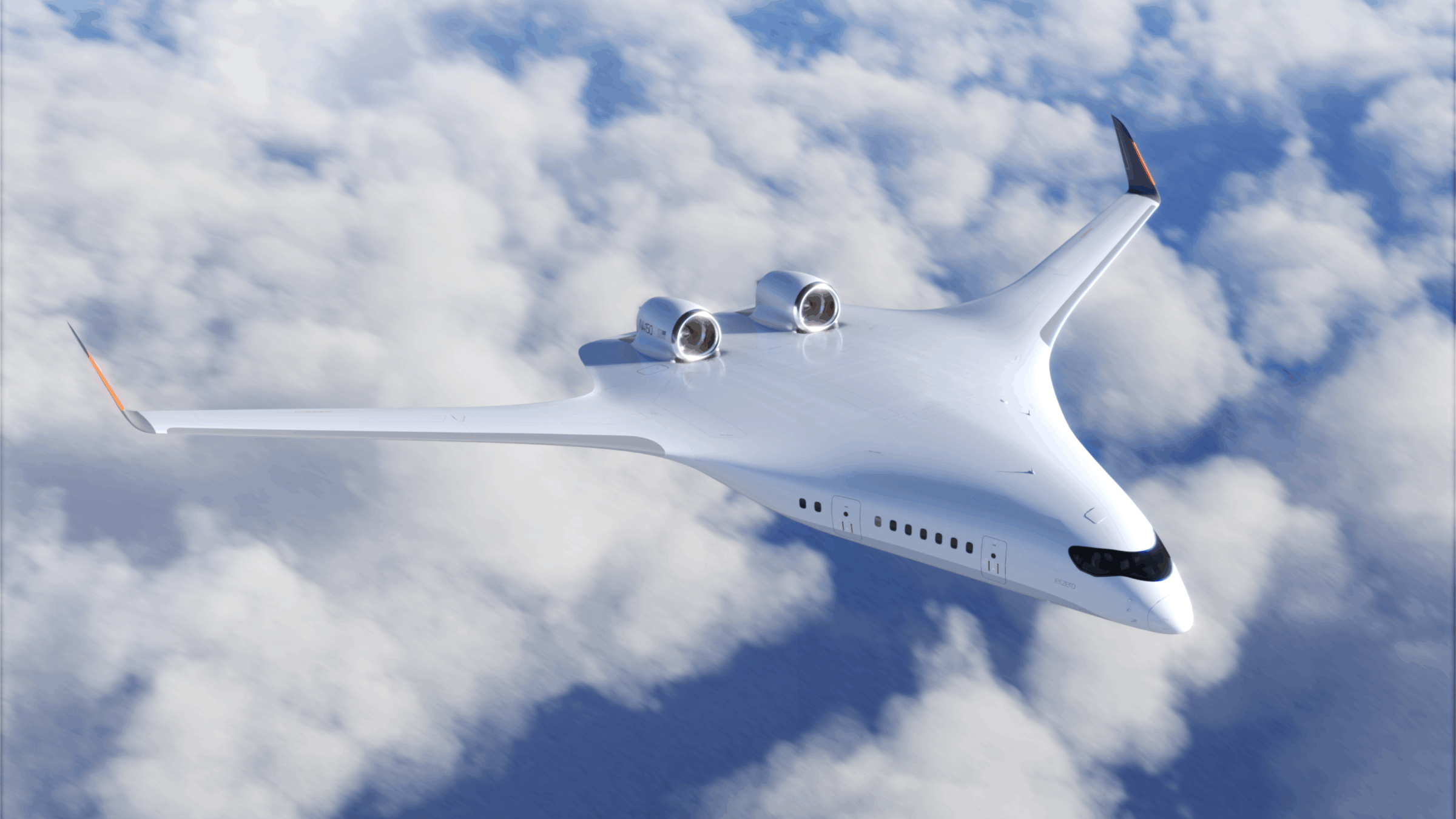
Figure 1. The JetZero Z4 BWB. Source: JetZero.
The difference is how the drag is partitioned between the wetted area caused drag (air friction drag) and drag due to weight (induced drag). The difference between drag and optimal cruise altitudes has consequences for engine choice. Here is how.
Engines for a BWB
To determine which engines are needed for a BWB, we need to understand the fundamentals of airplane engines.
The overall function is that of an air pump. Air is reasonably heavy (1.2kg/m3 at sea level, 0.4kg/m3 at 35,000ft), and by accelerating it backward with a speed faster than the airplane (the difference we call Air-overspeed, the engine people call it Specific Thrust), it generates a forward force on the airplane called engine thrust.
We can write this force as:
Thrust = Air-massflow * Air-overspeed
The engine thrust of an airplane declines during flight, a phenomenon called thrust lapse. It’s caused by the decline in air density with altitude, affecting the Air-massflow part, and by the aircraft’s forward speed, affecting the Air-overspeed part.
The Air-massflow hit from increasing airplane altitude is given by the diagram in Figure 2.
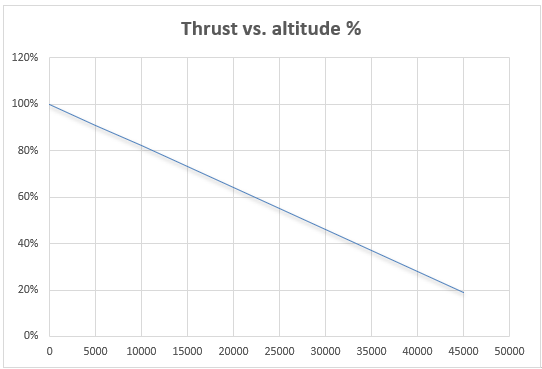
Figure 2. Thrust lapse with altitude. Source: Leeham diagram from Raymer data.
This diagram maintains the same forward speed and shows only the effect of declining air density with altitude. We see that thrust lapse due to increased altitude reduces the thrust to one-fifth at 45,000ft.
The forward speed of the aircraft reduces the Air-overspeed as this is the speed difference between the engine exhaust flow and the aircraft’s speed. The thrust-lapse sensitivity to forward speed increases with increasing bypass ratio (BPR), as you increase BPR to increase the Air-massflow and decrease the Air-overspeed for the same thrust, to gain propulsive efficiency.
The result is that increasing engine BPR increases the thrust lapse due to forward speed (Figure 3).
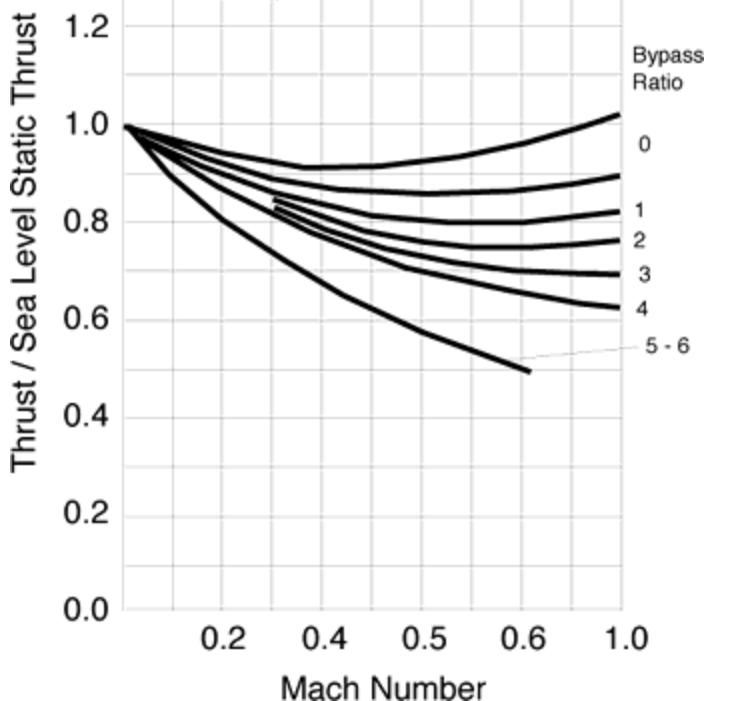
Figure 3. Thrust lapse due to forward speed at different BPRs. Source: Stanford airplane design course.
It’s easy to understand the effect. Let’s compare a Turbofan with a Specific Thrust of 650kts (BPR around 5) to one with 450kts (BPR 10). At rotation at 100kts, the BPR 5 engine has a 550kts Air-overspeed, a 15% decline, whereas the BPR 10 has an Air-overspeed of 350kts, a decline of 22%.
The BWB engine
The development of turbofans for our airliners has gone from BPRs of around 5 in the 1990s to around 10 for the present generation introduced from 2010 to a projected 15 for the next generation. This increases the thrust lapse as speed increases.
The TAW airliners can accommodate this by designing the airframe to cruise efficiently between 30,000 and 40,000 ft. The BWB, which has to reach above 40,000ft, has lost another 18% of thrust due to altitude lapse before it can reach its cruise altitude.
The increased altitude lapse means the thrust lapse dude to forward speed needs to be minimized, or there won’t be enough climb thrust to get to 40,000ft. JetZero therefore chooses BPR 5.5 engines from the Pratt & Whitney PW2040 series for the Z4. This is a 40-year-old engine. If JetZero should need to switch to a modern engine to improve fuel efficiency, the current trend from BPR 10 to BPR 15 is going in the wrong direction for the needs of the BWB.
It needs engines with more thrust at altitudes above 40,000ft, which is the area of the Biz jet engines. These are, however, below half of the thrust needs of the Z4.
In the old days you would just add more of the right type of engine to get sufficient aircraft thrust like using 2ea CF6-80C2 from the 767 to 4ea on the 747-400. The Z4 could thus have 4ea Pearl 10X or 4ea GE Passport engines. I know they are not really designed for 20 000 cycles on wing but as a start it would fit nice.
These are a bit short on thrust. What I can see is that Z4 at least needs two PW2043 at 2*43klbf = 86klbf thrust if not more for the passenger version. The Peal 10X and the Passport stop at 19klbf, i.e., 76klbf for four. But it’s in the correct direction, these are high specific thrust engines.
Yes the present versions are a bit short of thrust if they really need 2 x 43k T-O thrust and what thrust they need at cruising altitude/speed. The B-2 has also 4ea turbofan engines. Now Jet-zero work with PWA but their PW800 has less thrust than RR/GE bizjet engines above. GE has their mounth full but RR Dahlewitz might find the time for a Pearl-Zero version and Middle River Aircraft to make the new nacelles.
I seem to remember that the old NASA program called High Speed Civil Transport (HSCT) environmental study showed that cruising at higher altitudes, where there is less atmospheric mixing, results in more ozone depletion and environmental degradation. We should remember that good work for higher cruise altitude BWBs and new SuperSonics
The stratosphere in that Nasa work was defined as starting at 60,000 ft. Its clear this type of planes will be below that the 45-50 k ft range
Already the heavy iron large business jets can operate to FL510. The primary jets capable of this include the Gulfstream G650/G650ER/G700/G800, Bombardier Global 7500/8000, Dassault Falcon 7X/8X, and the Cessna Citation X+.
The Citation X was interesting because designed for speed at high altitude, wing sweep is 37 deg, second only to the B747. However its smaller than the other jets it uses RR AE3007 7000lb thrust series engines
Driving down engine BPR will make it more difficult for the BWB to satisfy tightening noise requirements.
I’m still trying to figger out where the BWB’s purported efficiency advantages come from..
“look, over there: a squirrel!” 😉
Would it be possible for JetZero to adapt a modern turbofan with a faster-spinning fan? Like taking PW’s GTF and just leaving off the gearbox? I assume JetZero would have trouble, at this point, convincing an OEM to make even the lower investment necessary but I’m just wondering about the theoretical here. Using a modern turbofan core would at least give JetZero better thermal efficiency, even it’s taking a big hit on propulsive efficiency…
I’m very much enjoying this series, btw. Thanks. I suspect that, in the age of high-AR wings, the BWB’s time – if it ever had one – has passed. TAW’s can now easily match/exceed the low-20’s L/D promised by BWB.
Hi Eric,
You are on the money: https://en.wikipedia.org/wiki/Pratt_%26_Whitney_Canada_PW800
So, it’s done. Only that the engine thrust is now below 20 klbf.
I appreciate the detailed explanation of thrust lapse at different altitudes and engine bypass ratios. Thanks.