
Leeham News and Analysis
There's more to real news than a news release.



Spirit Aero problems affected A350 deliveries
By the Leeham News Team

Christian Scherer, the former CEO of Airbus Commercial Aircraft. Credit: Leeham News.
Jan. 13, 2026, © Leeham News: Deliveries for the Airbus A350 fell last year compared with 2024, reflecting supply chain challenges.
Christian Scherer, the former CEO of Airbus Commercial Aircraft, said, “The ‘stagnation’ of A350 deliveries is not a lack of demand. There is a center section of the A350 fuselage that is being built by a company formerly known as Spirit Aerosystems. They ran into trouble. They were the pacing item.”
Airbus acquired Spirit’s Airbus business when the company merged with Boeing in December. “Now that we have regained, let’s say, control of that particular center fuselage piece on section 15 of the A350, you will see the A350 continue its ramp up,” Scherer said during the annual Airbus media briefing of its annual orders and deliveries results.
Dissecting the results reveals:
Wide-bodies lag
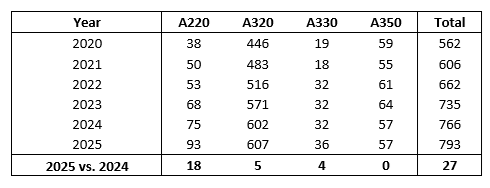
- At 793, the 2025 delivery tally was the third highest after 2019 (863) and 2018 (809)
- Single-aisle deliveries surpassed their pre-COVID-19 peak (700 vs. 690 in 2019)
- Widebody deliveries are still lagging far behind: 93 in 2025 vs the peak of 173 in 2019. 93 is below the Airbus twin-aisle delivery level of 2008.
- Comparing year-on-year deliveries, most of the growth came from the A220.
- Airbus is struggling the most with the A350 production ramp-up:
- A320 family deliveries are relentlessly switching toward the A321neo.
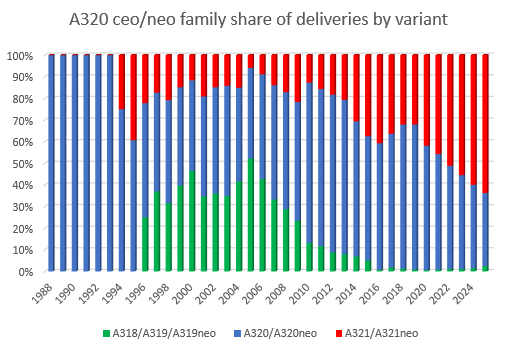
Comparison of single-aisle deliveries by variant in 2025 vs the previous peak in 2019:

A220 and A321 deliveries almost doubled, while A320 deliveries were more than halved (the A319 does not matter).
- Regarding the Airbus comment on the A350 replacing older Dreamliners, it is more relevant for the 787-8 than the 787-9. It is a combination of the relatively poor 787-8 economics and aircraft up-gauging to accommodate traffic growth.
Working with the supply chain
Scherer said Airbus continued to work with the supply chain to resolve continuing bottlenecks and quality issues.
“We managed to further solidify our ramp-up and our industrial system. To achieve this, we made and continue to make substantial investments, modernizing our industrial capabilities by upgrading and expanding our global system.
“For example, all final assembly lines are now A321-capable, all single-aisle assembly lines are A321-capable, and we added two new A320 family assembly lines, one in Asia and one in America, last year in 2025 to support our ramp-up towards rate 75” in 2027, he said.
He said Airbus is streamlining the industrial flow throughout the production process, from detailed parts all the way to the final assembly lines (FALs). “Beyond the FALs, we are upgrading our customer delivery lines to increase capacity. We also opened a number of new lines for pre-final assembly section building and wings, plus a new facility dedicated to the A321XLR rear center tank in Germany, complementing our supply chain’s manufacturing capability.”
Acquiring Spirit’s Airbus work
Scherer said that to secure the A350 and A220 industrial organization and ramp-up, critical work packages from Spirit Aerosystems were acquired.
“It’s strategic. It brings wings, pylons, and key fuselage sections for the A350 in-house and adds 4,000 new skilled employees to our team, whom we welcome with open arms. They are strengthening the overall aerostructures ecosystem. We’re also growing and stabilizing our supply chain, from which we see continuous reductions of missing parts in very meaningful numbers, despite our significant rate increase.”
Airbus now sees a great deal fewer bottlenecks that must be managed, “because we manage them away. Nevertheless, we continue to face engine issues in 2025, with engines, particularly on the single aisles, arriving very late. We see that this trend continues in 2026, and in particular with Pratt & Whitney, with whom we are still in discussions.”
Scherer declined to detail the nature of the discussions.
Great article – learned lots – thank you !
Interesting information. Not a word though on the A350F delays. Nothing about the A220-500 either. What about the Chinese parts for the A220? Unfortunately still no timeline for resolving the GTF engines. I thought that by now the 1100 would be OK. If that’s not the case, how awful are the prospect for resolving the A220 engine problems?
Air Baltic and Breeze must be desperate, having put all their eggs in the A220 basket.
Yes. The A350F was supposed to have EIS in 2025, so now seems to be later 2027?
The first flight is now scheduled for Q2 2026. If that slips again, I’m afraid EIS in 2027 will not happen either. We might see 1H 2028 without a single widebody freighter from either Airbus or Boeing being delivered, unless the old 777 freighter gets an exception.
The number of grounded A220’s are reduced at many airlines like Air Baltic, still work to do. It is a bit worse for the PW1100G where a large number of aircrafts are AOG and many in service have reduced hard times on engines not having full time rotating parts for different rotors. So P&W is squeezed between AOG operators and FAL’s needing engines for “gliders”. RTX in theory could buy all ex. Spirit/IndiGo PW1100G aircrafts and get its engines into shop for Advantage updates, harvest the rest of the aircraft components and ease the pain for its customers.
Thanks for the info. You seem to suggest that there is already an Advantage version for the A220. Is that correct?
Not yet, modifications are rolling into the A220´s PW1500G engines but not a full Advantage package. The PW1100G is only for the A32neo family, PW hope that the PW1100GAdvantage engine with a bit higher thrust and lower fuel burn will be the natural choice for the A321neo´s, a bit like the V2533 became for the A321ceo.
Good info, esp the assimilation of ex. Spirit into Airbus. Looks like engines are still the issue for them, though possibly less so now.
In December, Airbus announced that it would be moving A220 pylon production from Wichita to Toulouse:
https://www.airbus.com/en/newsroom/press-releases/2025-12-airbus-completes-acquisition-of-spirit-aerosystems-sites
It will take a little longer, but I suspect that production of the A350’s section 15 will also be moved outside the US at some stage in the not-too-distant future: there’s too much risk involved in maintaining sole production in Kinston.
I can see it in Kingston, we are moving out, You’ll have a good life!
Airbus will be fleeing Alabama and Canada at the same time for the same reason. Gasp, the whole A220 is made in NA or China (well you go the wings in Ireland).
Or maybe Airbus goes about it per normal and cleans up the Kingston ops.
What is ironic is now we own it the problems are solved. No, that just means you can begin to get it up to snuff. Kind of like buying the A220 program, that dollar buy just turned into billions you have to spend (and in that case on a non conforming control system)
The central section of the A330/340 was entrusted to European manufacturers (mainly German and French) and this is still the case for the A330neo. The decision taken at the launch of the A350, based primarily on production cost considerations , might be a mistake. Considering the very limited success of the A350 with US airlines ( DELTA , UNITED still pending) , the additional costs incurred by the “purchase” of the Kingston plant, and the impact on A350 ramp-up, the benefits are not obvious, not to mention the impact on employment in Europe.
Delta is operating 39 A350-900s and has 20 -1000s on order. Delta is not “pending.”
“…the additional costs incurred by the “purchase” of the Kingston plant…”
There were no costs, as such — Airbus got paid to acquire the portions of Spirit in which it was interested.
===
Apart from that, I agree that Airbus’ interests are not served by having such a major part manufactured in the US — in that regard, just look at the increasing back-and-forth Greenland bickering, including today’s talk of a trade war over the issue.