
Leeham News and Analysis
There's more to real news than a news release.



Strong OEM and maintenance business lift MTU to record earnings in 2025
By Thomas Blackwood
Feb 24, 2026, © Leeham News: MTU Aero Engines saw continued growth across its divisions in 2025 with revenue at an all-time high and continued MRO momentum, according to the company’s full-year figures published on Tuesday.
 Adjusted revenue for the year was up 16% from €7.5 billion in 2024 ($8.84 billion) to €8.7 billion. Adjusted operating profit reached €1.4 billion, up 29% on the previous record of €1.1 billion set last year, and adjusted EBIT margin rose from 14% to 15.5%.
Adjusted net income also reached a new high of €968 million, up 27% year over year from €764 million. The results were in line with market expectations.
MTU said the revenue growth was driven by its commercial OEM division as well as the strong demand for engine maintenance. However there are still doubts over the strength of the supply chain. MTU said that while “improvements are evident … further progress is needed” to streamline the production and procurement of parts.
GTF issues linger
MTU partner Pratt & Whitney’s troubled geared turbofan (GTF) engine program continues to have an impact. The German engine manufacturer said the expected GTF MRO ramp up in Q3 and Q4 had fully materialized, and its GTF Fleet management program was on track, helped by improved turnaround times, a stabilizing supply chain and higher MRO output.
GTF MRO revenue accounted for 41% of total MRO revenue across the business. This is forecast to sit at 40-45% in 2026, supported by Pratt & Whitney’s working assumption that the fallout from the PW1000G recall would stretch to the end of the decade.

Pratt & Whitney GTF Engine Cutaway
That said, MTU managed to more than double its free cash flow in the fiscal year 2025 to €378 million, up from €183 million. This was better than originally anticipated and in line with the guidance from October 2025. “This marks another record level in recent years, even while carrying the burden of the GTF fleet management program, and it proves our progress in improving our cash conversion,” CFO Katja Garcia Vila told analysts on the Tuesday morning earnings call.
MTU has proposed a dividend of €3.60 per share – an increase of €1.40 or 64% over the previous year and a payout ratio of 20%. Garcia Vila said the company intended to return to the target payout ratio of 40%, which had been temporarily suspended due to the costs arising from the GTF fleet management plan, in a sign of recovery from the worst of the GTF woes.
Military revenues flat
Revenue in the military business flatlined in 2025 at €614 million, versus a 2024 figure of €612 million. “Despite a strong fourth quarter, sales in the military business fell short of our expectations. This was primarily due to revenue shifts caused by ongoing supply chain issues,” said Garcia Vila.
On the Future Combat Air System (FCAS), while doubts have been cast over the Franco-German-Spanish project, MTU remains confident that the partner nations will find a “constructive way forward.”
“It is essential for Europe’s long term defense sovereignty to develop their own military products, and MTU is fully committed to do this,” CEO Johannes Bussmann said on the call. “In short, through our programs, partnerships and long standing expertise, MTU contributes meaningfully to Europe’s long term defense readiness.”
Technological progress
Elsewhere, MTU achieved several notable technological milestones over the year, including FAA and EASA certification of its GTF Advantage engine, which is a more-durable, more fuel efficient PW1100G variant with 4-8% more takeoff thrust.
The IAE consortium also publicly reaffirmed its commitment to advancing the GTF architecture as the foundation for the next generation of narrowbody engines, and MTU signed an MoU with Airbus to jointly advance hydrogen fuel cell propulsion.
Bussmann said MTU was growth focused, with plans to expand the company’s footprint internationally and invest in even more technological capabilities through sites in Hanover, Berlin, China, and the new LEAP facility in Fort Worth, Texas.
Bussmann said MTU had “made the most of market opportunities in 2025 and stayed on our successful course despite ongoing challenges.” He added: “The long-term growth prospects for our industry are positive, and we believe we are extremely well positioned to reap the benefits.”
Forecast for 2026
MTU’s order backlog at the end of 2025 stood at €29.5 billion, up 3% year-on-year, with the PW1100G-JM and the V2500 accounting for the largest share. The company has set a target of €9.2-9.7 billion for adjusted revenue in the fiscal year 2026, with the commercial business likely to see the strongest gains.
An adjusted EBIT of €1.35-1.45 billion is anticipated in 2026. MTU has set itself a revenue target of between €13 billion and €14 billion by 2030.
Pratt-Airbus dispute
Last week, Airbus CEO Guillaume Faury issued a warning to engine-maker Pratt & Whitney over problems caused by the powdered metal coating contamination misstep, which is hampering production of both the A320neo and the A220 families.
According to Airbus, the engine-maker has focused more effort on addressing in-service fleet issues, while neglecting to provide the numbers of new engines to the aircraft OEM for deliveries.
“On the A320 family, the continued failure to commit to the number of engines ordered by Airbus is negatively impacting this year’s guidance and the ramp-up trajectory for this year,” Faury said.
Airbus was ready to “enforce contractual rights” with regard to the engines being supplied to the airframe maker, Faury said.
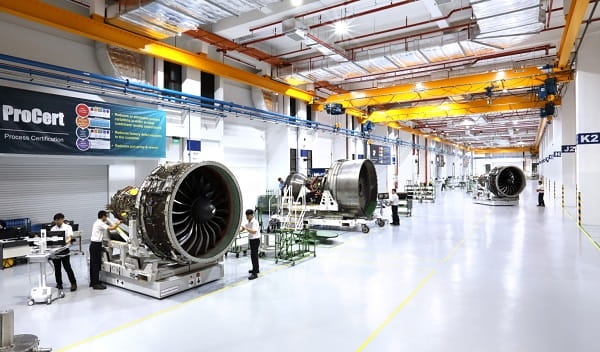
GTF’s at a Pratt & Whitney MRO Facility. Image: RTX
Asked about the dispute, Bussmann said: “The discussions on the deliveries between Pratt & Whitney and Airbus are still ongoing…Obviously we have not come to a conclusion so far, but the two partners are negotiating, and so that’s what I think we will have to wait for.
“I’m pretty sure that they will find a solution. The orders have been placed, and we in the consortium have discussed what we can deliver as a total and now Pratt is discussing with Airbus how we deal with this in the relationship to Airbus and our other customers.”
I wonder how the durability improvements of the GTF ‘Advantage’ will pan out.
MTU volume from GTF upgrades to “close to advantage engine” will be huge until 2030-2035. Then the A320 successor will come and maybe P&W is not invited anymore.
One of those deal with the issue now so there is a possible future, or wreck the ops of the people who order your engines.
well i assume A32x and A22x will be produced till 2040, and P&W / MTU are certainly interested in a higher ramp up of engines for new builds an overhauls.
If the advantage delivers on the promised performance and reliability (if) they are certainly positioned to gain a higher market share just by stretching the legs of 32x and 22x and availability. vs. CFM.
While i am excited about the new narrowbodies, i am pretty sure both 32x and 22x could take another re-engine to a newer GTF version as well.
“MTU signed an MoU with Airbus to jointly advance hydrogen fuel cell propulsion. ”
Interesting to see that AB is still taking hydrogen propulsion seriously, even if the originally-envisioned timeline has slipped.
RR also seems interested:
https://www.rolls-royce.com/media/press-releases/2025/09-12-2025-hydrogen-in-aviation-offers-potential-growth-and-deeper-emissions-reductions-study-shows.aspx
Difference btw an electrostate and a petrostate
From an engine designers standpoint you can do lots of clever stuff using LH2 for its cooling capability and water vapour exhaust. The LH2 cooling is so efficient that you hardly need superalloys/powder metal parts. Also HPC and bearing compartmens can use the cooling. But getting H2 in volumes to airports and they making LH2 can be doomed as the government owned airports and power grids would charge massive prices for both tanking LH2 and defuel aircrafts with LH2 in their tanks. Air Liquid and Linde Gas would be happy selling all the equipment needed and probably have quoted FRA and CDG airports already.
AW: Carbon Analysis: China Continues To Outcompete Europe, U.S.
Assessing efficiency at the largest Chinese, European and U.S. airlines since 2022, we see improvement across the board, but clear Chinese dominance throughout.
PW has put itself in the drivers seat as best they can.
If Airbus customers can insist that PW meet their build and have an enforcement mechanism, PW simply tells its buyers, our hands are tied, Airbus has activatged clause X. We have no choice.
All the Airlines that do not have current line items to be delivered now holler at Airbus (curse more like it)
The Airlines that have near delivered aircraft look at it, we get a couple now and we loose a couple that are working. Short term gain vs a lots of loss, there are more of those for others in the Que and each one of those is an engine we can’t get.
So they holler at Airbus as well. Good way to loose customers. I do not see it happening.
For the future., PW is the only one who will have a GTF program in its pocket and even a new engine would avoid the issues (most of them) and the other guys are offering up their first GTFs that are unproven.
What have the Airlines said? We don’t want any new engines thank you very much.
Let’s imagine P&W stops sending engines to AB, its market share in NB will diminish — not in the best interest of P&W’s long-term survival!
It’s time for me to repost this link to my previous post in view of recent discussion
https://leehamnews.com/2026/02/19/airbus-fy2025-not-happy-with-pratt-whitney/#comment-560124
P&W most likely let the leasing companies decide the mix, they own most of the in service aircrafts and mainly do sale-leaseback once the airline picks up the new aircraft at Airbus. Hopefully Airbus have a short memory of earlier P&W engines they have used JT9D-59A, JT9D-7R4 (D,E, H)’s, PW4158, PW6000, V2500-A1…
https://aviationweek.com/air-transport/aircraft-propulsion/mtu-confident-gtf-dispute-airbus-will-be-settled
> Faury said Airbus will insist on receiving the contractually agreed number of engines.
According to the MTU CEO, the number of aircraft on ground (AOG) as a result of the powder metal issue affecting a part of the PW1100G-powered A320neo family fleet is now fewer than 400. The Aviation Week Fleet Discovery database lists more than 700 geared turbofan (GTF)-powered aircraft as parked or stored, although not all are out of service because of power metal repairs.
Deliveries of Airbus A220 & Embraer E-2
2016 7 / –
2017 17 / –
2018 33 / 4
2019 48 / 14
2020 38 / 11
2021 50 / 21
2022 53 / 19
2023 68 / 39
2024 75 / 47
It’s apparent delivery of the E-2 is much lighter in early years, when the metal powdered coating issue has a much greater impact.
House Narrowly Rejects Air Safety Bill After Pentagon Opposition
> The House struck down aviation safety legislation on Tuesday that would have required planes to carry a type of tracking technology that…
https://www.nytimes.com/2026/02/24/us/house-rotor-act-dc-plane-crash.html
It would be interesting to know how or if warranty is shared on the group engine builders part?
BCA is assembling 737-10 at Renton?
Pedro.
Boeing currently has 1 approved faciliry for all 737s. If they had 1 scheduled to load, there is no suprise its in Renton as all the previous -10s were built there.
Boeing has made (10?) MAX-10 and of course all in Renton.
Near term if they build any more, Renton.
You don’t just crank out a -10 in Everett, you build before so you know the ins and outs.
Boeing is smart that way.
Impressive numbers from MTU, especially considering the continued pressure from the GTF program and supply chain challenges. The strong OEM demand and growth in the MRO segment show how critical maintenance services have become in the aviation industry. It’s also encouraging to see improvements in cash flow despite ongoing operational hurdles. In many industries, combining strong strategy with reliable infrastructure and partners-like KDI Office Technology-can play a key role in sustaining long-term operational efficiency and growth.