
Leeham News and Analysis
There's more to real news than a news release.



Boeing’s 30-year march to its next new airplane
Subscription Required
Open to All Readers
By Scott Hamilton
Background
April 6, 2026, © Leeham News: Depending on what starting point you want to choose, it will be up to 30 years between brand new, clean sheet airplane designs at The Boeing Co.
Boeing announced its 787 program in December 2003, with a formal launch the following spring. The entry-into-service goal for the 787 was May 2008. Boeing planned to design a replacement for the aging 737 platform after the 787 entered service. A new design for replacing the 777 was supposed to come after that.
The 787’s EIS date came and went as design and production problems added up to 3 ½ years of delay.
With cost overruns, deferred production, and deferred tooling costs totaling more than $50bn, plus several billion more dollars written off for research and development and abnormal production costs, the 787 still has more than $14bn in deferred costs to recover.
Delays and cost overruns hurt the 747-8 program. The 2019 21-month grounding of the 737 MAX resulted in billions more in charges. The January 2024 door plug blowout on a new Alaska Airlines 737-9 hurt recovery. Scrutiny by the Federal Aviation Administration (FAA) continues to this day. Production rates for the 737 and 787 are well below those that predate the MAX grounding. Certification of the 737-7, 737-10, and 777X remains a hope, not a reality, so far.
A plethora of losses, charges, and delays in defense and space programs added to the losses. Boeing’s long-term debt in 2018, its last normal year, was over $10bn. Today, it’s over $54bn, with big repayments coming soon.
Boeing’s next new airplane program remains years away.
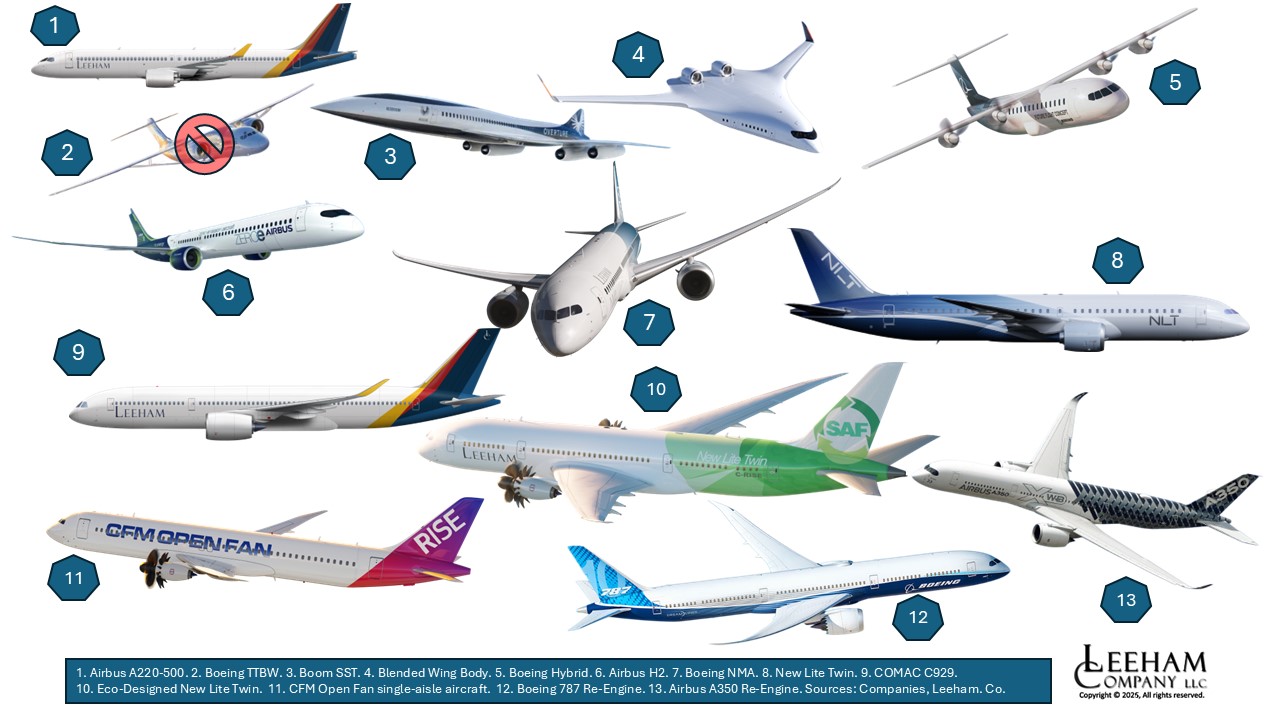
What will Boeing’s next new airplane be? We have a pretty good idea. A new series beginning Thursday explores this question. Credit: Leeham News.
A multi-part series
LNA begins a multi-part series about Boeing’s new airplane program on Thursday. We explain when we expect Boeing to launch not one, but two new airplane programs. LNA reveals what new technology will be applied, what the issues and challenges are, and how Boeing is already, quietly and publicly, implementing processes that will go into its new airplanes.
How we went about this
LNA has spent more than three years gathering information to put this series together. However, the foundations go back to the era of former CEO Jim McNerney (2005-2015). It was during his tenure that Boeing began talking not just about a replacement for the 737 NG, but about a new twin-aisle widebody aircraft about the size of the 767-200ER and 767-300ER, which officials called the Middle of the Market aircraft (MOM). The MOM evolved into the New Midmarket Airplane (NMA), a controversial proposal that split its own executive ranks.
Jim Albaugh, then the CEO of Boeing Commercial Airplanes (BCA), and Mike Bair, the program manager for the 787 and later the 737, wanted the MOM airplane. Ray Conner, then the top salesperson for BCA, wanted a replacement for the 757. Eventually, the MOM won out.
Even then, there was opposition at the highest levels. Greg Smith, EVP and CFO of The Boeing Co., opposed it. So did David Calhoun, the lead director. When McNerney retired, his successor, Dennis Muilenburg, favored the NMA. To implement the anticipated launch of the NMA, he hired Kevin McAllister of GE to replace Conner, who retired in 2017 after replacing Albaugh, who resigned abruptly in 2012. Despite Conner’s advocacy for the 757 replacement, BCA had gone too far down the path toward the NMA. Muilenburg was nearing board approval for the NMA in 2019. This plan was derailed with the March 13, 2019, grounding of the MAX.
There’s more to this background (told principally in my books, Air Wars, The Global Combat Between Airbus and Boeing, and The Rise and Fall of Boeing and the Way Back).
Our research
LNA’s dedicated research for this article series includes ancient history, public statements by McNerney, Muilenburg, Calhoun, Boeing officers and spokespersons, aerospace analyst reports, and our own reporting.
It includes information in the public domain via the Internet. There is a lot of information out there if you know where to look and what to look for. And we did. Additionally, suppliers proved to be another valuable avenue of research. We pretty much hate going to the Paris and Farnborough air shows and conferences, but these venues are gathering spots where suppliers are plentiful.
Boeing’s executives declined requests for interviews about product development, as did BCA’s VP of Production Development and the leaders of the Research and Technology group. But even here, there’s a lot more information in the public domain than Boeing’s own corporate communications people realize.
In December, Boeing’s R&D partner, NASA, provided an update about new wing research recently done at a NASA wind tunnel. The model airplane was clearly a widebody aircraft with a larger turbofan engine—the NMA, not a single-aisle aircraft.
In March alone, the current corporate CFO, Jay Malave, revealed some critical details at a Bank of America event. A week later, Brian Yutko, the VP of Product Development, appeared at the Pacific Northwest AIAA semi-monthly meeting to discuss new technology while studiously avoiding specific airplane programs. His information provided the final pieces of the jigsaw puzzle LNA was putting together to get the picture of the new airplane programs.
Lots of Caveats
Whenever LNA is asked about the progress of Boeing’s long recovery, we always place the caveat on any predictions that unknowns can upset the apple cart for Boeing at any time.
Here, in no particular order, are the caveats that precede our series.
- Global or regional events, such as pandemics and conflicts that have global implications. The Iran War is an example of the latter, in which the full implications have yet to be understood.
- A global recession, such as the one beginning in 2008.
- Trade wars, notably the one with China, began in 2017 under the first Trump Administration. The Biden Administration didn’t ease this trade war, and Trump, in his second term, intensified it.
- Economic sanctions, notably, Biden against China in connection with its support of Russia in the Ukraine war.
- How long the FAA continues its intense scrutiny of Boeing.
- Another “Alaska 1282” event (the door plug blowout) or any other event that raises safety questions over Boeing.
- What happens if Airbus, or even Embraer, forces Boeing’s hand prematurely by launching a new single-aisle airplane program?
- Engine development: new engines must achieve double-digit reductions in fuel consumption compared to today’s engines. They must demonstrate maturity to ensure reliable, durable in-service operations. An entirely new engine is needed for the MOM-category airplane. GE must satisfy the industry that its proposed RISE Open Fan engine isn’t a pipe dream. Pratt & Whitney must regain customers’ confidence that the decade-long debilitating problems with its GTF engine are over. Rolls-Royce must finance the development of not just one but possibly two new engines.
Undoubtedly, we’ve missed some factors that go into the caveats, but readers will get the point.
With that, our series begins on Thursday behind the paywall.
The customers have a big impact. If they go for massive A321neo orders instead of waiting for the 737-10 Boeing has to move. Then comes new technology that is not fully developped or certified like thermoplastic primary structures, single pilot with copilot in computers (or none as per the Boeing-Wisk Aero project) and the RISE engine with maybe 20% reduction in fuel burn. These will have big cost, mass and range impacts on the next narrowbody.
Single pilot? Didn’t the US just sign a new law that bans single pilot operations for those designs?
It is not really single pilot as the co-pilot is on ground or in a computer.
Similar how they replaced the flight engineer.
“With cost overruns, deferred production, and deferred tooling costs totaling more than $50bn, plus several billion more dollars written off for research and development and abnormal production costs, the 787 still has more than $14bn in deferred costs to recover”
Interesting information about $50 billion in costs…back in 2003 it was a “big deal” that Boeing was getting about $3 billion in 787 subsidies
That said, the link below shows how Boeing is “Living off the public trough” with $16 billion in subsidies Washington State with $13 billion…so much for the 787 investment strategy
https://subsidytracker.goodjobsfirst.org/parent/boeing
Thanks for not only bringing this up, but also sharing the link. Im sick and tired of hearing how Airbus is a “government subsidised company” while Boeing supposedly has to do it all on its own.
All these large industrial corporations get subsidies. It’s just how things work. I do hope they get their act in order though. It’s not great for either company to dominate and have more power to dictate terms to the customer (which ultimately us the flying passenger will pay for).
So what did Washington State Taxpayers get for $13 billion? 787 FAL move to South Carolina.
+1
Same as it Ever Was..
“that Boeing was getting about $3 billion in 787 subsidies”
AFAIK:
a significant flow of subsidies happened at “risk sharing” partners.
787 was seen as the “most subsidized” airplane project ever.
Claes makes a valid point. The longer Boeing waits the more the customers move to a company that performs and provides a product they need. But Boeing must wait because their massive debt is a hindrance to launching TWO new programs… seriously 😐
This caveat mentioned: “How long the FAA continues its intense scrutiny of Boeing.”
I’ll counter that they should never let up, same for EASA. Why should they let their guard down?
Look forward to this series. Hoping there is more focus on new engine development since that’s key for both Boeing and Airbus new programs, but my money is on RR.
@Airdoc
I am sure the series will go into greater detail…but Boeing needs two programs as one program does not compete against an A220 / A320 spectrum.
The other piece…Boeing needs to fundamentally be able to make aircraft. Losing mega orders hurts, but Boeing is fundamentally not in a place to deliver large orders the next few years anyways.
> Hoping there is more focus on new engine development since that’s key for both Boeing and Airbus new programs, but my money is on RR.
Seconded re: RR.
RR do look to be sitting pretty w.r.t. options going forward. They’ve already done the hard work on UltraFan.
The Ultrafan they can charge alot as it would change economics on very long range flights due to its fuel efficiency. The narrowbody market is different as they are more price sensitive and cannot tolerate out of competition engine maintenance costs. So RR cannot just scale the Ultrafan but has to work hard on reliability and heavy maintenance cost partly driven by part count and turbine hardware design/repairability, finally allowing independent shops to compete with DER repairs and PMA parts.
As always: where will the funding for new programs at BA come from?
The consensus estimate for 2026 Q1 is for yet another loss. We’ve been hearing “prosperity is just around the corner” continually for almost 7 years at this stage…🙈
+1
Wonder when the 737-7, 737-10, and 777-X will in fact
be certified and EIS.
As I remember all existing MAX will be “recertified” according to the 737-7 or -10 certification. All existing aircraft may need the upgrades according to the 737-7/-10 certification.
A bit of history re Boeing
The most recent split occurred in 1997, when Boeing used a 2-for-1 ratio. Prior to that, Boeing had used 3-for-2 splits more frequently, starting in 1979.
Harry Stonecipher, 2004, former CEO of The Boeing Company, reflecting on the late 1990s
” When I say I changed the culture of Boeing, that was the intent, so it’s run like a business rather than a great engineering firm. It is a great engineering firm, but people invest in a company because they want to make money. ”
Thus the Faster cheaper build era, and significant upward change in obscene CEO and similar salaries/stockoptions.
Trouble with that comment , Stonecipher ( who had trained in Physics, not MBA) was enamoured with short term financial metrics – as people with very strong maths backgrounds do.
Thats not “”business”” its just book keeping.
Look how GE turned out, his training ground , much earlier than Boeings decline under his watch. And even when at GE Aeroengines, the CFM56 succeeded ( originated by Neumann) despite his opposition.
Regardless of what planes Boeing may or may not introduce in distant years to come, there’s one absolute requirement to be met going foward. First, they must clone the A320.
But isn’t the 737 that already, in a sense? Well yes, but not in the way that I think is important. The objective of cloning the A320 is to show to themselves, potential partners and any future customers for aircraft that they can take a new design from beginning to production cleanly, without too many trip-ups. Given their current condition, Boeing needs to get practiced at that, and doing so whilst not fundamentally re-thinking what an A320 is is going to be hard enough.
Even if Airbus in the meantime moves on with a new design, a good 320 clone is at least going to split the market simply through weight of numbers and Airbus not being able to supply all demand on their own; a Boeing clone would sell regadless of comparative performance.
Consider the position of key suppliers such as GE or RR. GE have surely lost a ton of money on the 777-x. RR really didn’t like the the risk-sharing arrangement on 787, and publicly (not even privately) refused to work on an engine for the NMA for pretty much the same reason. Boeing needs such suppliers to be confident of doing business with Boeing, and that will come only from at least one cleanly executed program.
And if one considers RR to be especially key – Ultrafan looks to be very good – I see no way for Boeing to tempt them at present considering RR are sitting pretty with Airbus, and Airbus being a consumately good customer (well, partner – it’s the airlines that are the customer), and with some exceedingly juicy options ready at both their finger-tips (A350neo / A350-2000, A330neoneo, a smaller Ultrafan for an A320neoneo. They would even do an A380neo if Airbus jumped that way). It’s those kinds of options that RR will want and need to secure first and foremost; anything with Boeing will have to be prioritised lower. Airbus too; the mere idea of Ultrafan appearing on a Boeing product will likely give Airbus coniptions, and would I’m sure spur Airbus into pulling the starting gun on neo-neoising their product range.
If one looks throughout history of large industrial endeavours, the success stories for companies that went from nowhere (which is kinda where Boeing is – at least financially) to continued dominance is a story of iteration, not big-bang. It’s also a story of staff and expertise retention, something that Boeing (and US business in general) has been wilfully bad at. An A320 clone by Boeing would be the lowest-risk iterative step that’d have any market credibility at all. If Boeing succeded with that, and then a second step, they’d have shown everyone that they know how to do it again.
The 737MAX is old but not really where it counts Wings and Engines for payload/range, the 737-8 and A320neo lease rates are approx. equal. It is the A321neo that does not have a real competition and if you fill it has the best economics. Customers knows it and orders it in volumes. Airbus just opened 2 new FAL for mainly A321neo. Still the A321neo is an old aluminum aircraft with a pretty old wing design. Boeing cannot deliver all the aircrafts sold and need new FAL’s like in Everett. So both are waiting for 2030 as new narrowbody engines are certified and new technology being ready. If Airbus decides to open 4 new FAL for A321neo or if Embraer joins Comac and make a stretch version of it with composite wings in Brazil to match the A321neo Boeing has to act.
“Even if Airbus in the meantime moves on with a new design”
The real question is what are the new manufacturing processes and materials for the next single aisle? With this drive a brand new manufacturing ecosystem with global risk sharing partners in Middle East and India?
There is lots of work on thermoplastic carbon fibre reinforced structures besides robotic assembly, robotic quality checks and robotic painting. New engines are coming but in 25-35k thrust class only with even more expensive power by the hour programs (I would not be surprised if they match GEnX/T-1000 price per cycle levels)
There are no legitimate Tier 1 aerostructure suppliers left in the US that have the financial strength and engineering talent to design and built thermoplastic commercial aircraft structures.
Boeing can’t afford to fund single aisle rates for composite wings that require autoclaves. So non autoclave process or global risk sharing supplier network is needed
Spirit Aero aka Boeing will need a non autoclave solution for the fuselage/empennage production
You are probably talking about how many of tens of millions to put together a new global manufacturing ecosystem infrastructure.
Let’s hope the bean counters from the 7e7 era are retired so the they don’t make the same financial assumes on FAL
Google AI “The 7E7 (787) was designed to be built in much less time than previous models—targeting three days rather than 13–17 days—by receiving large, pre-equipped, single-piece barrel sections rather than small aluminum sheets.”
@David: Our paywalled series addresses some of the ways Boeing wants to get away from autoclaves.
Hamilton
RTX is getting close to make thermoplastic carbon-fibre out of autoclave primary structures. Airbus has several programs running for this including different plastic welding methods. The main attraction is speed of production and as a by-effect efficient recycling.
DAVID said.
There are no legitimate Tier 1 aerostructure suppliers left in the US that have the financial strength and engineering talent to design and built thermoplastic commercial aircraft structures
Thats terribly harsh since Ive known of BAs OOA R&D for years and know of at least a dozen approved process specs that would allow for the serial producrion of thermoplastic composite parts at large scale. Its just a matter of product design and production tooling to make a new airplane. Thermoplastic composite parts are beimg installled en mass on existing programs. Floor beams were easy as were thousands of small brackets and hangers bwing used todaay. TPC parts changeovers are an ongoing process
trip down memory lane for US aerostructure 747 suppliers in 1960s
Chat GPT
“747 fuselage sections and who built them (1960s)
Section 41 – Nose / cockpit
Built by: Boeing (in-house)
Includes:
Flight deck
Forward pressure bulkhead
Upper deck “hump” integration (iconic 747 feature)
Boeing kept this in-house due to its complexity and critical systems integration
Section 43 – Forward fuselage
Built by: Boeing
Immediately behind the nose
Contains:
Passenger cabin structure
Door cutouts and floor beams
Section 44 – Forward-mid fuselage
Built by: Northrop Corporation
One of the first major outsourced barrels
Large cylindrical structure with passenger windows and frames
Section 45 – Center fuselage (wing box interface area)
Built by: Vought Aircraft Industries
Critical structural zone:
Interfaces with the wing center section
Carries major flight loads
Section 46 – Mid-aft fuselage
Built by: Fairchild Hiller
Includes:
Passenger cabin structure
Systems routing areas
Section 47 – Aft fuselage
Built by: Vought Aircraft Industries
Tapers toward the tail
Includes rear pressure bulkhead area
Section 48 – Tail cone / empennage interface
Built by: Grumman Aerospace
Supports:
Vertical stabilizer attachment
Tail systems”
There’s all of that, and a talented pool of design and production engineers and planners can always get on top of those. I’m very interested to see whether the company can reacquire the corporate maturity to build that talent pool, let them get on top of things, cohere into a good team, and then be willing to trust them, reward them, and retain them. Once they have that team, they can do anything.
Ortberg strikes me as the kind of CEO who understands that, it’s whether the rest of the company and investor ecosystem learns that too whilst he’s still at the helm; time will tell.
Such matters are somewhat “meta”, and it gets more meta as time goes on. It’s more about personal philosophies than accounting, engineering, marketing and sales. Look at Toyota; there’s a lot of books written about “the Toyota Way”, but really it’s simply that they’re very good at having exactly the right mindset bred into the entire staff pyramid from the Chairman all the way down to the floor sweeper in the smallest of suppliers, and stopping that pyramid crumbling via staff loss. Airbus are more like Toyota than ever before. Boeing will always struggle if they don’t follow suit.
Yea, verily.
Toyota and others still revere W E Deming. for quality centered management and process. Boeing not so much. Wuz there when Boeing gave required nods and neat viewfoil window dressing at appropriate times- but never really took seriously. And courses by Juran and others were required attendance by grunts.
But then back to basic ” speaking up may be a career decision”
Remember that Toyota is a high volume, relatively low tech manufaturer while Boeing is a low volume, high tech one, so the Demming stuff doesn’t readily transfer.
Deming’s ideas found highly furtile ground in Japan. Culturally they were well along that way already. They adopted his ideas to the extent that some of them are part of the education system curriculum, starting age 6!
The ideas find favour in Europe too these days. And, one aspect of employment laws common in Europe is that it’s pretty hard to fire people. One of the big pieces of Toyota’s method relies on staff retention, which is a good fit.
@Goforride: er, Boeing is not a low volume manufacturer. They make thousands of units, to a tight schedule, with a high expectation amongst customer for a high quality product. Also, there’s nothing about how Toyota run their business that is unique to large volume production. I’m pretty sure Boeing makes more 737’s per year than Toyota make Centuries.
A key point of Toyota’s method is that – once you’ve got a production line up to tempo and quality, you never, ever let the quality slip (and the tempo will therefore look after itself). But if you really think about Toyota’s approach, the secret of the method is a bit more meta than that. Not only are they good at running a line once it’s running, they treat the matter of setting up a design and production line as a production process in its own right. They are truly superb at setting up production lines. That’s how they decimated the US auto industry – by re-organising production within those US suppliers they took on (to the amazement and profitability of those suppliers).
Boeing needs to be good at that too, but has all but forgotten how.
And when one realises that to be good at producing production, a company has to be very good at expertise retention and skills development, one can understand just how meta Toyota really is.
If Boeing is going to clone anything from Airbus it should be the ability to set up a new FAL anywhere else in the world and not have quality escapes.
Airbus has very few quality escapes “at home”.
New FALs abroad are clones of up to date lines at home.
Boeing has a problem with quality escapes at home.
How do you expect clones to perform?
The 737 will be it for Boeing’s single aisle offering for more than a decade to come (the replacement will be on offer by then but will be in development).
I hate looking at that 1950s nose/windshield but the plane is competitive (look at the backlog!). Because of the bigger and (I think) closer spaced windows I (a window seat flyer) prefer it to the A-320 series.
– new wings
– new engines
– new landing gear
– new tail
– new fuselage structure, windows & door locations
– new cockpit systems.
The newest clean sheet Boeing aircraft is the 777-9. Ask the FAA / EASA..
The 777X is still an Amended Type Certificate….
Mr Hamilton.
It puzzles me to no end that Boeing sold the FAA a cert plan for a Composite winged airplane with wiggling wingtips, using the largest engines ever fitted to a commercial jet BY COMMONALITY saying it was SO CLOSE to the existing 777 that it could be another line on the existing 777 TCDS.
@PNW. I can’t explain it, either. Boeing touted that the 747-8 was an 80% new airplane and the 737 NG was about the same percentage different than the Classic and these both got Amended Type Certificates. Airbus protested the 747-8 and got nowhere.
@PNW
Probably has something to do with this aircraft getting launched ~ 2013. I would hazard to guess that the FAA will be very reluctant to agree to an amended type certificate now for something like this upgrade.
Boeing is spending as much (and more) on the B777X and Max as a new program would have cost. It is arbitrary…but there ought to be something like a 25% design variance threshold for tripping a new type certificate.
Wasn’t the 777X fuselage structure supposed to use a high level of automation during fabrication….. But that didn’t work out. So it’s the existing structure . The ring frames reshaping where the passengers sit was introduced on the 777-300ER and the idea was copied by Airbus for the A350.
it didn’t work out because the fuselage was designed in the early 1990s You need to design the aerostructure to the type of automation you are planning on using
Yes, Airbus had similar experience in Hamburg trying to automate alot of the FAL but had to back down several steps. You need to design for robotic build from the beginning. The car industry has done it since the late 1980’s.
I think the 777 has a circular cross section and A350 not. Not “copied”
Compared fo the 777W the internal structure of the 777X has been changed, as well as windows and door locations. Changing fuselage load pattern significantly.
I think the 2014 FAA decision to allow the 777x to be certified as a 777W derivative already surprized many, from an aeronautical regulatory standpoint, at that time.
Congress Boeing supporters had FAA by the b.lls since the FAA Modernization and Reform Act of 2012. And following yearly budget re-authorizations.
I think China aerospace (COMAC) will “surprize” us in the coming years.
We expect them to slowly but surely master technologies and come up with proven concepts, slowly increasing production rates. But still fully dependent on western aircraft, engines, systems.
They have become a little more ambitious, self confident, like they demostrate in militairy aviation (J50, J-36, J20, J35).
A fully chinese middle of the market aircraft, 200-300 seats medium range, why not? They’ve got the technology, people, market, money, ambitions & might be further than we know, self focussed as we are.
KEESJE
The only people who will be suprised are those ignorant enoughtro continue their dismissal. When McDac started shipping them MD80 kits., it started their countdown to owning the industry. Their version of time and progress to a goal is not measured by financial quarters
why shouldn’t China have its own commercial aircraft program
Chat GPT
“China’s economy (recent estimates)
Nominal GDP: about $17–18 trillion USD
GDP (PPP – purchasing power parity): about $30–35 trillion USD
→ By this measure, China is actually the largest economy in the world
What that means
Nominal GDP reflects value in current dollars (used for global comparisons, trade, finance).
PPP GDP adjusts for cost of living—showing China’s domestic economy is extremely large.
Scale highlights
China contributes roughly 17–18% of global GDP (nominal)
It’s the largest manufacturing economy in the world
China’s economy is massive—second-largest by standard measures, and arguably the largest in real purchasing power, making it one of the most influential forces in global trade, manufacturing, and finance.”
All of that, plus:
-China: ~1.3–1.5 million engineers graduate per year.
-United States: ~130,000–200,000 engineers graduate per year.
-Ratio: China produces over 7 times more engineers annually than the U.S.
– The U.S. relies on recruiting international talent to (try to) maintain technological leadership.
Yes, Boeing has recruited engineers from Europe since the 747 development. Now it might be harder as the US society differs from western Europe more and more.
The ICEed development in the US isn’t really conducive to entice foreigners ( student, qualified, … )
Noteworthy that Germany has a comparable problem:
“Zuwanderung” is a looming topic bringing xenophobic political leverage.
The refugee streams in recent years brought a lot of qualified people into the country … _that are just parked in segregated camps at immense cost. ( Causing dislike in the population )
while in the same time frame lament on “Fachkräftemangel” is pervasive.
With these noncompetitive moves falling back is a preprogrammed outcome. For the US. For Europe.
I see the headline “Boeing’s 30 year march to it’s next new airplane”. Just thinking, does the word “march” provide the most accurate description of its movement toward a new plane?
How about “dance”, or I would even suggest “drunken stagger”? “March” implies a disciplined efficient movement of military precision from point A to point B. Has any motion in recent Boeing displayed the discipline and professionalism of a “march”? The company has “marched” the way the three stooges “marched” in their military themed shorts: bumbling, disjointed, unbalanced, incompetent, taking one step forward followed by three steps back….This is the way Boeing has “marched” across the first quarter of the 21st century.
It’s my newsletter and my headline. It’s what I chose. 🙂
Hamilton
“march into oblivion”
is established semantics, isn’t it?
also see “the way to hell is paved with good intentions”.
March to a new airplane?
I would say Boeing has been on “the march” in recent times, but not toward a new airplane, toward crushing every recurring cost of building an airplane, which means crushing unions, employees, suppliers, etc. It has been a 20 year quest to have the most efficient, lowest cost production of any OEM that ever crashed a plane.
To summarize recent history of Boeing commercial, they spent the last five years struggling to relearn how to build the planes they designed 20-40 years ago, after Calhoun and friends used COVID as a convenient excuse to get rid of everyone who knew the difference between a rivet and a hi-lok.
So will they be successful in this quest to relearn production skills and return quality to manufacturing? Seems likely.
But will they be successful someday in relearning how to design a new plane. It seems very doubtful. I have no doubt that the finance people and the high dollar consultants can build impressive PowerPoint presentations proving that a $30b project can be done for $10b, where most of the engineering will be done in various and sundry third world countries. The Alaska door blowout proved to the doubting bean counters that quality in manufacturing has value, I don’t believe they convinced that quality in engineering has value worth paying for. The day they launch a new plane they will use the cheapest engineering labor they can get. After all, salaries and wages are a known, predictable expense that must be reported quarterly to Wall Street. Future quality failures are by nature unpredictable and unknown, and therefore are not reported to Wall Street in advance. This means the Jack Welch beancounters have in their DNA the compulsion to cut recurring costs without regard to the potential consequences. They have and will continue to save $1m today even though it will cost them $1b tomorrow, simply because the +$1m is reported to Wall Street in advance while the -$1b is not.
A friend of mine is an engineer on the 787 in Everett. He says the prime focus of his management these days is moving his job (and all 787 engineering) to SC. I don’t know the details of this, but I would make a wild estimate once this is done no more than, say, 20% of the relocated slots will be filled by people with 787 experience. What impact will this have on the productivity, efficiency, and quality of the engineering product?
I know that the production line has moved to SC, but remote support is not an option? The real reason for the engineering move is simple: Seattle Engineering = Union, SC Engineering= Non Union. It’s not about the benefit of co-location, it’s about the absolute top priority, “the prime directive”, of the Jack Welchian beancounters: busting unions, squeezing labor, etc.
More evidence that despite the change of CEO the Welchian beancounters remain firmly in control.
https://www.bloomberg.com/news/articles/2011-09-23/boeing-papers-show-south-carolina-787-site-picked-to-gain-edge-over-unions
….bottom line: these Jack Welch beancounters are fanatics about breaking unions and squeezing labor and suppliers. They do not believe in win-win scenarios, they only feel they’ve “won” any negotiation if the other party has obviously, demonstrably “lost”.
These are people who don’t wake up in the morning thinking, what can we do today to take market share from Airbus. They wake up in the morning asking themselves, “what can we take today from employees and suppliers?”
It’s a bleak, depressing zero-sum world these people live in.
A huge question hanging over Boeing Commercial is, are the lunatics still running the asylum? By lunatics I mean, of course, the Neutron Jack beancounters. The answer has to be ‘yes’, as the turnover in management ranks has been insignificant.
The corollary is, why are the lunatics still in charge after two spectacularly fatal crashes and a Hollywood action movie style door blowout? Most likely explanation: the major institutional shareholders are the silent king-makers running the show from the shadows. They likely have been and continue to be strong supporters of the financialist virus that infected the top ranks of the company.
Remember that Calhoun came to Boeing from Blackstone. He was their creature on the inside, (our man in Havana) well positioned to “unlock value” and return it to the shareholders (Blackstone etc). To uneducated observers (the general public, Senator Hawley of Missouri) this unlocking is variously as “looting” or “financial strip-mining”.