
Leeham News and Analysis
There's more to real news than a news release.



Boeing CFO Jay Malave: Priorities are debt, investments, then shareholders
By Karl Sinclair
 Dec. 3, 2025, © Leeham News: Boeing’s chief financial officer outlined the priorities for the use of cash going forward, and it reaffirms what has been obvious but largely unstated: debt reduction is the top priority.
Speaking at the UBS Global Industrials and Transportation Conference, The Boeing Company’s (BA) new Chief Financial Officer (CFO) Jay Malave reiterated the corporation’s prudent position on where Free Cash Flow (FCF) was going to be spent.
“I think that between the balance that we have today, the cash flow that we’re going to be generating, that will give us plenty of optionality to pay down the debt, to invest in the future, and start thinking at the right time about investor returns,” Malave said.

Boeing CFO Jay Malave. Source: Boeing.
This is quite a departure from the position of the previous CFO Greg Smith, who once reported that Boeing was committed to returning 100% of FCF to investors. It is very much in line with the new culture that CEO Kelly Orberg is attempting to instill in the company.
Future Obligations
Boeing has an $8bn debt repayment in 2026 and a further $4bn in 2027.
It will also repay ~$3bn of Spirit Aerosystems (SA) debt, once the deal closes in late 2025. Boeing expects to retain ~1$bn of SA legacy debt, which will fall onto the Boeing balance sheet. There is also the matter of a ~$450m payment to Airbus (AB), which Boeing will pay, for Airbus to take on the parts of Spirit related to Airbus aircraft – most notably, the Belfast wing plant in Ireland.
Future obligations include a $700m payment to the Department of Justice, which relates to the January 2024 door-plug blowout on an Alaska Airlines 737 MAX 8, and will now fall into the new year.
On Nov. 3, Boeing completed the sale of key assets from its Digital Aviation solution segment to private equity firm Thoma Bravo, which included Jeppesen, ForeFlight, AerData, and OzRunways, and netted the company $10.55bn in cash in the process.
Boeing retains the portion related to digital services tied to fleet maintenance, diagnostics, and repair for commercial and defense customers. These operations will remain at Boeing Global Services (BGS) under division CEO Chris Raymond.
BGS produced $3.618bn in earnings in FY2024 and $2.93bn through 3Q2025, a bright spot for the struggling company. It is yet to be determined what financial effects the divestitures will have on that segment.
Boeing, like Airbus, has also committed to retaining a “rainy-day fund.”
“We historically have talked about a $10bn minimum balance. That’s something that, for the time being, I adhere to and agree with. I’ll do my own analysis over a longer period of time to determine whether or not that should be a little bit higher, a little bit lower, but I think $10 billion minimum cash balance is a pretty good benchmark,” Malave elaborated.
He expects that the cash and equivalents balance to be in the neighbourhood of $29bn at year-end, after all the merger and divestiture activity.
Aircraft Certification and Deliveries
Malave expects 737 deliveries to be in the ballpark of 450 airframes for FY 2025.
“When you now fast forward to 2026, we’re going to be increasing our deliveries, but there won’t be hardly any aircraft, if any at all, that will be coming out of inventory. So it’ll be really through the production roll-out system that’ll be the source of the deliveries,” he said.
Certification of the MAX 7 and 10 variants (assuming they arrive at the same time) is now expected to occur in late 2026, with the ~35 aircraft in inventory reaching customers in 2027, once re-work has been completed. 737 MAX deliveries in 2026 rest fully upon aircraft coming off the production line.
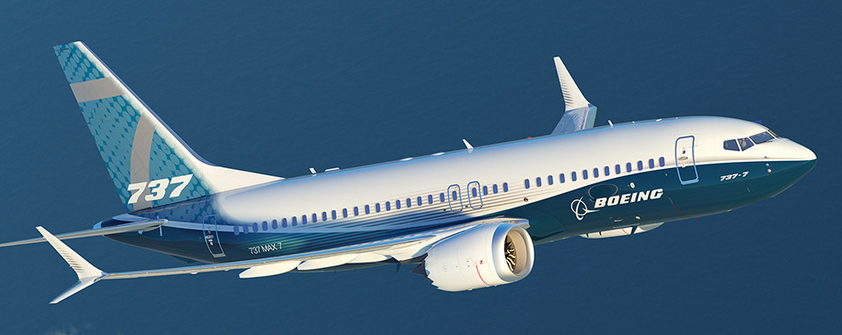
Boeing 737 MAX 7. Source: Boeing.
The much-beleaguered 777X program is now in Phase 3, with partial Type Inspection Authorization (TIA) approval received in November. Avionics, environmental control systems, and auxiliary power units will be tested as part of this approval.
Boeing will require further TIA approvals from the FAA in order to move forward on the flight testing program.
BCA is working on stabilizing production and the supply chain at 42/mo on the 737 MAX program and 8/mo on the 787 program.
Malave expects Capital Expenditures (CapEx) to continue in 2026, directed towards increasing production rates.
“CapEx is growing really on the back of two projects. One is our growth driver in Charleston (SC) on the 787, which is a good thing. That’s going to be an enabler for us to drive up our rates up to around 14 over time per month, as well as the investment that we’re making in St. Louis for the new F47 program…They create some short-term pressure on CapEx and free cash flow,” he explained.
Malave is also cognizant of the costs associated with missing delivery dates.
“We’re sitting on some excess advances. It also puts pressure on the price per aircraft because we’re paying penalties on these aircraft that are delayed. But even with those challenges, it comes back to BCA deliveries. We expect that delivery to grow next year. That will be a large driver of positive cash flow. Embedded in that with increasing deliveries at BCA is the benefit of excess inventory burn-down,” he said.
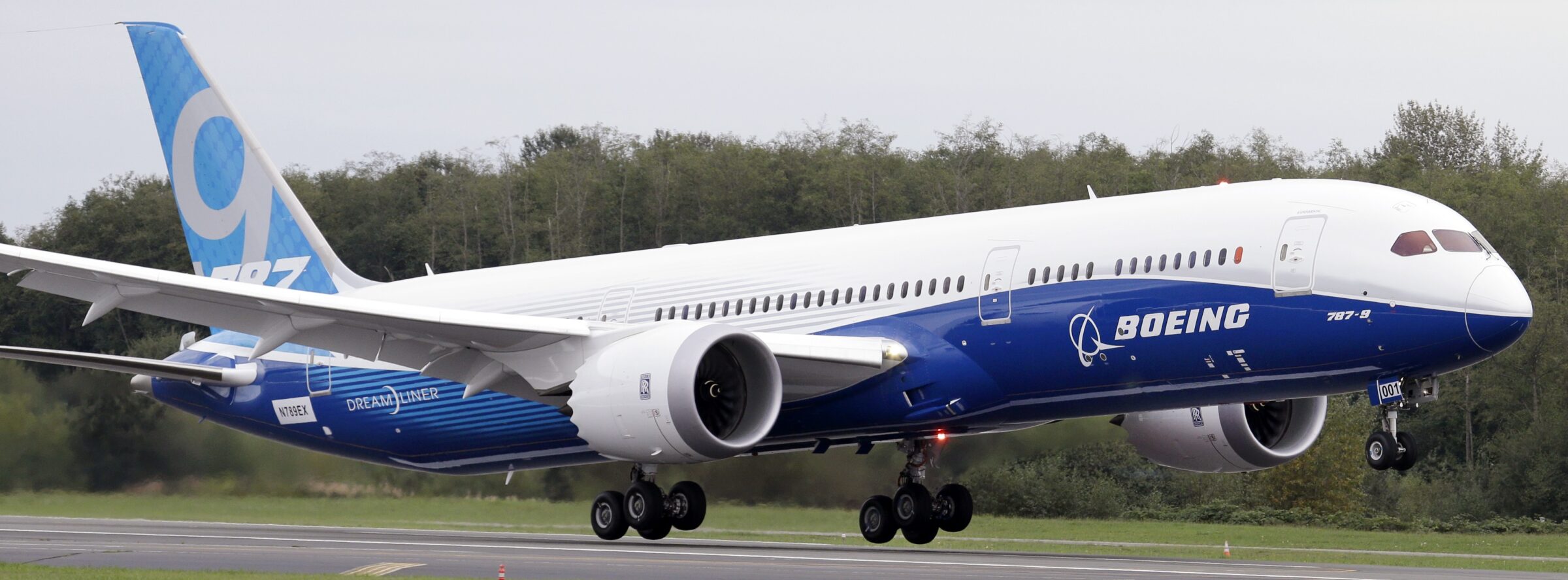
Boeing 787-9 Source: Boeing.
A key point brought up was the intention to hit 14/mo on the 787 program. BCA needs to produce double-digits every month, in order for the program to be profitable for the company.
The last time Boeing was able to deliver those numbers was in 2019 (158 aircraft delivered), when production was split between the unionized Seattle-area FAL and the non-unionized Charleston (SC) FAL.
Today, production is completely reliant on the South Carolina facility, which is undergoing a much-needed expansion to double the footprint and move production beyond the 10/mo mark.
It is estimated that Boeing cannot make positive earnings on the Dreamliner program, producing under double-digits.
2026 and onwards
With the DOJ payment now slipping into 2026, the projected cash-burn rate for FY2025 improves from ~$2.5bn to $2bn.
“I expect free cash flow to grow….[2026] free cash flow to be in the low positive single digits. In spite of that, we know CapEx is growing next year,” Malave said.
This is despite the 777X program incurring a cash-burn of ~$2bn, spread out over the coming years.
Certification and the start of deliveries have now been pushed back to 2027.
It is a safe bet that Boeing will not receive any financial benefit from the MAX 7, MAX 10, and 777X programs in FY2026, despite the inventory build-up. Indeed, those variants will be a cash drain on the company, especially when the costs of certification and re-work are factored in.
However, given the tenor of upper management and the desire to focus on fiscal responsibility and engineering, one could say that the corporation is headed in the right direction.
Despite the non-committal nature of the CFO in regard to returning cash to investors, Boeing stock was up 9% subsequent to his comments. Perhaps a sign that investors approve of the steps the company is taking.
“..Certification of the MAX 7 and 10 variants (assuming they arrive at the same time) is now expected to occur in late 2026, with the ~35 aircraft in inventory reaching customers in 2027, once re-work has been completed..”
Looks like Boeing moved the goalposts again. 😉
Drip, drip, drip…
We should all listen to what BA said and take their words at face value. 🤡
> Adding detail on the certification timelines as he knows it, O’Leary continued, “They’re pretty confident that they’ll certify the MAX 7, even with the current government shutdown, in Q2 next year, and the MAX 10 in Q3, which will be about six months in advance of our first 15 MAX 10 deliveries in the spring of 2027.”
> O’Leary added that Boeing has given Ryanair guarantees in writing that it will deliver its first 15 737 MAX 10s in the spring of 2027.
AW has front page coverage of Boeing:
New Boeing CFO Delights Wall Street With Improving Outlook
> Boeing CFO Jay Malave said that the company expects to report a $2 billion cash burn for all of 2025, better than predicted…
Buried deep is another article not on the front page:
Boeing Sees 737-10 Approval ‘Later’ In 2026
> Boeing envisions FAA certification of its 737-10 “later” in 2026 while the 777-9 remains on its recently adjusted schedule that sees FAA approval in time to start deliveries in 2027, CFO Jay Malave said. “We’ll be building [737-10s] next year,” Malave said
Yep, just like Airbus with software problems out the wazoo (two huge ones in the last few months) and thin ceilings.
A delivery rate to far to put it in European terms, aka the famous failed Arnheim Drop (sp?) and a single road. Worked out really well.
“O’Leary added that Boeing has given Ryanair guarantees in writing that it will deliver its first 15 737 MAX 10s in the spring of 2027” or what?
“Promises are made to be broken.”
“We should all listen to what BA said and take their words at face value. 🤡”
Semantics!
You permutate various outcomes over the B statement ( separate details that could have been understood as joined ) and check if the testcases leave or stay inside the envelope of statement.
:-))
Both from MOL in the same occasion.
No he said the max 10 will be certified later in 2026, he did not say the Max 7.
[Edited] go to read the transcript or listen to the telecast.
My understanding is Airbus’s “rainy-day fund” is in addition to the minimum cash balance* necessary for the company to function properly.
*$10b minimum cash for BA
Does anyone know how much it will cost Boeing to retrofit all existing Maxes in service with the new Engine Anti Ice and updated SMYD with third synthetic sensor?
Rhetorical ?
No, I was genuinely curious.
No one knows. The Anti Ice fix is not finalized. Boeing may have ballpark ideas but no one here is going to know.
I get the curiosity but its not a question anyone can answer. At best you might get an idea out of a quarterly report.
Software costs would be solidly in hand but again, its not the kind of information Boeing releases. Some have opinions but fail terribly in factual and logic.
I recently saw a report on why the MD-11 works so well for freight. It covered it well with some details I had not thought of. No one commenting on the MD-11 knew, just opinions. Shrug.
My guess is BA is going to slow-walk the process — mindful of the cost and labor, etc, involved
Falsifiable prediction: BA will get extensions / waivers ’til the cows come home for retrofitting those items.
We’ll see.
BA never has to fix the wiring of new 767 even though it has made such changes for the K-46A.
PEDRO.
THIS IS ABSOLUTELY INCORRECT.
There is no wiring on the KC46 tthat is carried over from the 767. All wiring on this aircraft n is explosion proof. This requirement is not found on the 767 freighter.
As far as wiring exemptions on the 767. There were a few things deferred and eventually not adopted, but thoose are of little concern as the EASA reviewed and concurred as they always do.
Attempting to smear an aircraft by making false claims about the wiring being corrected on the tanker but not the freighter, when none of the wiring was ever common to the 2 models is another drum you incorrecrly pound on.
That’s NOT* what I said. Please re-read what I posted carefully*. It’s not smear when what I said is factual!
“This requirement is not found on the 767 freighter.”
That’s not an accurate description: BA asked for waiver repeatedly (falsely) claimed the production is winding down.
What i said is based on AW’s reporting, if you have any complaints, talk with them!
> Following the 1996 in-flight explosion of TWA Flight 800, the FAA introduced new rules about flammability reduction in 2008. In 2012, Boeing requested an exemption for the 767 from new wiring separation rules that would prevent ignition sources, because design improvements it introduced fell short of meeting such rules. One of the justification by Boeing: changes to the fuel quantity indication system would require a halt of delivery by three years as production of the 767 model was expected to end shortly. FAA gave the manufacturer three years to have a compliant system while deliveries continued. In 2014, Boeing, without a new design available, asked for and received another time-limited exemption for just the 767-300 and 767-300ER until 2019 when commercial production was expected to cease. But in 2017, with continual demand for the 767-300F, Boeing asked for another exemption up to the end of 2027, well past the revised production end date. It is noted that while Boeing requested extension of the original exemption from 2016 to 2019 based upon the cost of upgrading the design and their low production rate and ending production in 2019, Boeing developed the KC-46 tanker (based on the 767) which fully compliant with the new rulings and is assembled on the same production line as the 767. Since the 2019 exemption went into effect, Boeing has increased production of the freighter to satisfy demand.
@PNEGeek
Thank you for your post. Pedro has been told this dozens of times here, but he always reverts to his false narrative. You saved me from yet another refutation.
I too thank you for weighing in.
We can hope one day he tires of a group of informed people and does the false plowing elsewhere.
Rob and I will continue to disagree with the MCAS facts and what they mean. Too much deference to Boeing as well.
But he is informed and we can have a discussion.
PNWgeek is equally informed and get us amazing information that only working in the industry would you have (I think of myself as informed but I never worked in the industry, kind of a life long commitment affected by/to aviation as its what my father worked in support of and has been and continues to be the center of our wold up here)
Wow no one can dispute what I posted (with factual evidences)? Thanks.
Pedro, your “factual” evidence on this has been disputed and revealed to be an incorrect context, many times here.
The convenience of your memory in not acknowledging this, doesn’t undo that reality.
There are only two possibilities. The first is that by reason of illness or mental defect, you truly are unable to recall previous corrections. If that is the case, you can let us know and all is forgiven.
The second is that your lack of recall is intentional, as it enables you to repeat false arguments without the need to reconcile them with factual corrections.
Given that your recall of the false arguments appears to be perfect, the first possibility is not really credible. So unless you have a specific mental filter that only allows recall of negative claims, we can safely presume it must be the second.
There’s no dispute! There’s one who made allegations without evidence. That’s not a dispute! What i see is those badly informed believe each other or there’s a mental issue spreading among the posters!
Well what I said is extracted from AW. Why don’t you read their report?
> One example is the 767-300F’s compliance with new flammability reduction rules put in place following the 1996 inflight explosion of TWA Flight 800 (AW&ST Nov. 21, 2005, p. 46).
In 2012, Boeing asked the FAA to exempt 767s from new wiring separation rules meant to prevent ignition sources. While design improvements were incorporated, they fell short of the FAA’s newest rules introduced in 2008. Among Boeing’s justifications: The required changes to the fuel quantity indication system would require the company to pause deliveries for three years while production for the model was nearing its end.
The FAA gave Boeing three years to develop a compliant system and said deliveries could continue in the interim. In 2014, with no new design in sight, Boeing asked for a new TLE—this time for just the 767-300 and 767-300ER and only until 2019, when 767 commercial production was expected to cease. **Meanwhile, Boeing designed the tanker variant, which became the KC-46, to be fully compliant**.
The FAA granted Boeing’s request. But in 2017, with the 767-300F still selling, Boeing asked for another exemption—this time pegging Dec. 31, 2027, well past the widebody freighter’s revised production end date. Annual deliveries were forecast at “about” 11 per year, the OEM added, equivalent to a final batch of about 90 aircraft.
One FAA senior aviation safety engineer had seen enough. Mike Dostert, one of the experts tasked with evaluating Boeing’s request, voiced his opposition. When the agency decided to grant the petition anyway, Dostert, as an engineer represented by the National Air Traffic Controllers Association, followed union protocol and documented his point of view.
“Co-routing of high-power wiring and lack of separation in [parts of the fuel system] between the high-power and in-tank circuits has been identified as a noncompliant and an unsafe condition since the TWA 800 accident,” Dostert, now retired from the FAA and a member of the FAS advisory board, wrote in a June 2018 “difference in professional opinion” letter.
He also questioned whether the company ever intended to fix the problem.
“After three years of production of noncompliant airplanes under the provisions of the original exemption, Boeing requested extension of the original exemption from 2016 to 2019 based upon the cost of upgrading the design and their stated low production rate and end of production in 2019,” he wrote. “It should be noted that in that same time frame Boeing developed the 767 tanker airplanes . . . produced on the same production line [that] are fully compliant.”
Dostert said Boeing’s FAA-granted Organization Designation Authorization status requires it to “correct noncompliant design features in newly produced airplanes.” Granting the 2018 exemption “not only reduces the level of fuel tank safety of the newly produced 767-300F airplanes, it rewards Boeing for not producing compliant designs and likely will influence their actions regarding bringing other known noncompliant designs back into a compliant configuration.”
Since the 2019 exemption went into effect, Boeing has upped annual 767-300F production to satisfy demand. It delivered 94 of the freighters in 2019-23—nearly 19 per year. Counting another 27 in the backlog as of Dec. 31, Boeing is on pace to deliver 121 under the 2019 exemption—or about two more years’ worth of production than it anticipated in the rates and time frame detailed in its application.
#######
Quite damning, isn’t it?
You guys should apologize immediately!!
Rome was not built in a day, but we are seeing Boeing laying the right foundations to build it and build it right.
Airbus has swapped into Boeing slot with over reaching rate at all costs which are now coming home to roost.
Nobody wants to talk about Airbus’ quality issues trying to push a supply chain that isn’t ready for the rate they want to go at. Of course not, why would they?
Airbus’ day is coming too
@Opus:
I hope Airbus day does not come. I sincerely do. People lives are impacted and we have seen how horrible that can be.
Clearly Airbus has hit a wall.
What that should tell anyone is that its not easy and if the company is managed for a single purpose of money to the CEO it fails (that is what jacking up the stock prices does, its not share holders, its CEO pay in stock, higher the stock the more lucre they get).
Airbus is an example of hard it is when things get pushed no mater what the management situation is (good or bad)
I do not blame Airbus, they have an enormous backlog and have to try. But its clearly stretched Airbus past the limits of at least decent management, managing for the Company first.
Its why Boeing turning around is so phenomenal. Its not that they have done it overnight but clearly (despite the nay sayers) they are making progress no one but myself (grin) predicted.
I have before and continue to say, Boeing has a good portfolio. Despite management they did wonders on keeping the MAX competitive with the A320. That by itself is a remarkable achievement.
The 737 is in its last iteration, but despite its early structure it has continued to be on par with the A320.
If you can’t give credit to Boeing turning around you are hopeless and biased to the extreme of putting out falsehoods.
Didn’t BA finally admit the progress of certification of the 777-9, MAX 7 and MAX 10 is not according to plan, and incur a $4.5 billion charge? And merely months later, BA is trying to walk back from its earlier estimate of the MAX 10?
Oh yeah, just look at the bright side as BA wants everyone to believe.
Didn’t Rome burn down “overnight”?
> Airbus cut its full-year commercial delivery target by 4% to around 790 jets on Wednesday but maintained its financial goals, sending its shares bouncing higher…
> Airbus shares rose more than 3%, after falling nearly 7% over the past two sessions.
> Airbus said its financial goals for the year were unchanged. It targets adjusted operating income around 7.0 billion euros ($8.2 billion) and free cash flow around 4.5 billion euros.
> Analysts said the decision to hold the financial targets despite lower deliveries suggests that the company had been heading for a beat against forecasts for the full year.
######
YTD stock performances @ about 10:57 EST 😍
AB Frankfurt stock (€) + 23.1%
BA (US$) +15.8%
Spanish union says it warned of quality issues at local Airbus supplier – https://www.reuters.com/sustainability/sustainable-finance-reporting/spanish-union-says-it-warned-quality-issues-local-airbus-supplier-2025-12-04/
Workers complained about quality issues to Airbus and their supplier but nobody listened…..
The great and mighty Airbus. Wow, ignoring workers and quality in the name of profit
A definite “oops” moment Opus..
QC ..nah. we’re good !!
Making unrealistic delivery targets.
Trying to push out planes with little or no QC.
It bit them this time .
> The family of Boeing whistleblower John Barnett, who died in 2024, sued Boeing for wrongful death, alleging the company’s harassment led to his suicide. The lawsuit was filed after he was found dead during a deposition related to his whistleblowing claims about safety issues at Boeing.
> Joshua Dean was a whistleblower who raised concerns about improper manufacturing practices at a Boeing supplier, Spirit AeroSystems, and was fired months before his death.
Selective Deflecting I like to call it..
Glad the Spanish Union had a whistleblower..
Too bad AB was totally oblivious to the situation.
He is at least consistent, you have to give him that. There is no false equivalence that he won’t put forward. 🙂
Whistle-blowers in Europe don’t have to risk their lives! Has any lost their job? Phew.
Evidently,no one pays attention to them either.
What’s their complaint about??
Reuters reports the panel defect were “*consistent with concerns* about quality controls it had expressed to both firms.”
AFAIK the union did not report there’s deficiency about the panels.
We don’t even know what exactly are the complaints from the workers.
The FTC approved the Boeing acquisition of Spirit, with conditions:
— Boeing must divest the previously agreed Spirit divisions to Airbus, with Airbus being paid $440M in compensation for the deal.
— Boeing must divest the Malaysian division of Spirit to Composite Technology Research, a Malaysian company, to maintain competitiveness in the aircraft parts market.
— Boeing must provide transitional assistance to both companies.
— Boeing must continue to honor any defense contracts held by Spirit
— Boeing must protect and firewall confidential competitor information held by Spirit.
The deal is now expected to close before the end of the year.
https://www.seattletimes.com/business/boeing-aerospace/ftc-clears-boeing-takeover-of-supplier-spirit-aerosystems-with-a-few-limits/
Remarkably stupid in my view (FTC)
All that was being done already. Anyone seriously think all the agreement from Spirit to Airbus as well as Boeing involvement have not been done and committed to?
While I fully believe Boeing would do it rights anyway, Boeing acquires all the obligations of Spirit and those include the Airbus divestiture.
Anyone serious [Edited] understands that Boeing does not want to be saddled with Airbus stuff and get rid of it ASAP.
If it needs cash infusion then Airbus can provide that. Boeing just has to maintain as is (which is not great but Airbus signed up for all of it thinking they got a great deal int he A220 (double edged sword there)
Airbus is a grown up company. They need to fix their own part.
As has been pointed out, Boeing all but built the B-2, for Northrup Grumman who had the contract.
Companies do that sort of thing all the time.
Honeywell acquired the firm that was making Johnson Controls main building control processor.
Last I looked they had continued selling it to JC for years, it was a good profit center for them. If JC wanted to have full control they should have built it themselves.
The FTC requirement merely formalizes what was going to be done with Spirit anyway. Nothing to be concerned about, and the story I saw reporting this was uninformed and hyped.
Hamilton
Yes, the FTC complaint containing these concerns about the acquisition, was filed as a formality.
They need to get formal Boeing agreement on the record, with consequences if they don’t comply. The complaint was resolved in less than two days, all the paperwork was prepared in advance and ready to go.
I thought the Orange Angry one had wavered all regulations?
I’ve always believed Boeings executive rewards packages were at the root of its financial problems / debt.
Executive are / were largely (>75%) paid based on stock related bonuses. The stock value was boosted by using free cash flow handing out dividends, stock buy backs and other short term “investments”. Meanwhile over promising, supply chain squeezing and group think took over at Boeing HQ. Everybody loved it, because stock prices were booming and many had joined the party. A deadly circle.
Hopefully Malave and Ortberg are not rewarded the same proven company draining way.
Maybe it helps that Boeing has become a kind of state company with Washington government selling the aircraft, certifying the processes, closing the borders for competition, doing the R&D and being the #1 customers & tax agent.. The US taxpayer might have become a bit more demanding regarding bringing back value to the US
but: ..
https://responsiblestatecraft.org/trump-boeing-intel/
I believe nothing has changed in how they get paid.
What has changed is WHO is there now. Juicing up the stock to get more money is pure greed and that was what was going on.
Clearly Ortberg and co. are working to recover Boeing and pay down debt first.
I will leave it to experts as to share buy back, personally I am against it. Its too easy an out to keep your bucks up and the shareholders voting for you to the determinant of a company.
But just because it is there does not mean you should or do use it for greedy gain.
It should never be used in SB when the company needs to build bucks for a project or pay down debt – at most its a last thing if and only if the company is fully debt free and has project money (RD has to be maintained as well).
Otherwise as we saw, killing the goose to get the golden egg.
Per Scott below I own my part of the guilt.
Comments are closed due to Pedro, Rob and TW.
Hamilton