
Leeham News and Analysis
There's more to real news than a news release.



Boeing, others up SAF plans in Washington State
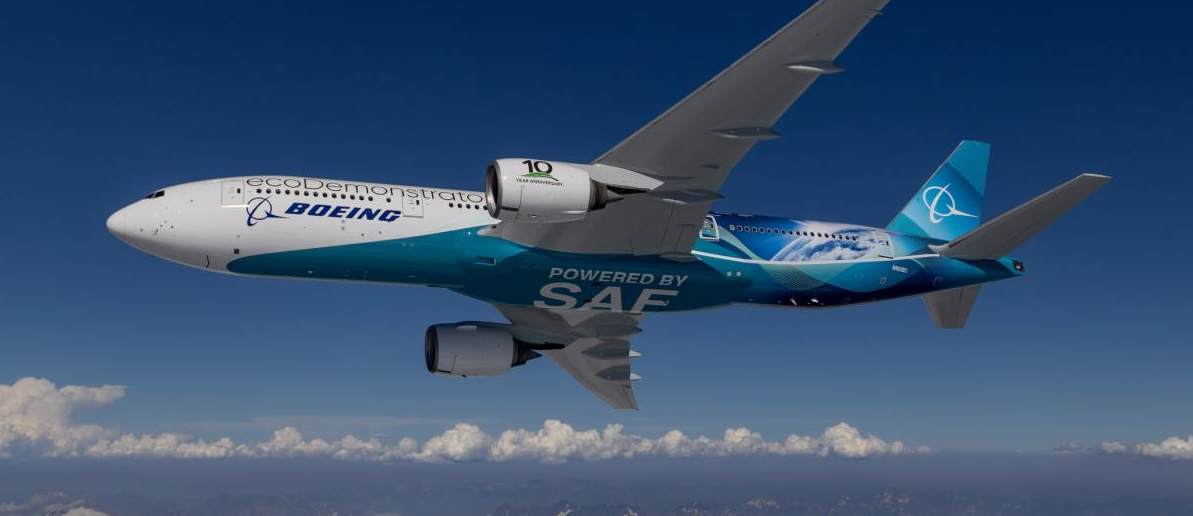
Credit: Boeing.
Announced on Thursday at Boeing Future of Flight, the museum located adjacent to Boeing’s Everett production facility, the Cascadia Sustainable Aviation Accelerator (CSAA) aims to ramp the region’s SAF production capacity to one billion gallons per year by 2035.
CSAA has so far raised $20 million for the initiative; it received $10 million in Washington state appropriations in 2025, which was matched by a $10 million philanthropic donation. According to CSAA, it is the most comprehensive and well-funded SAF initiative in the region.
Boeing is one of the founding partners of the CSAA, alongside Alaska Airlines, Earth Finance, Snohomish County, the Port of Seattle, Microsoft, Washington State University, Amazon, and the Washington Department of Commerce.
The full story may be read on LNA’s media partner AIN.
I have yet to see a viable SAF. Costly and not anywhere near enough to make any difference.
It would help to have the figures of how much Jet Fuel is used in the US and what a billion gallons means.
I am not against it, but to be viable would require a mandate.
It shouldn’t be too hard to come up with a rough estimate of how far a billion gallons would stretch – assume a US gallon of kerosene weighs 8lb and there are 2000lb in a ton: That makes 125 gallons/ton, and therefore 1 billion gallons works out at around 8000tons of fuel – not an insignificant amount, but I doubt if it’ would be enough to keep a even a single commercial airport going. I might have got my numbers wrong, of course, please correct me if I have!
The real, far more important, question, of course, is what the feedstock for producing this fuel will be, there doesn’t seem to be much point doing it if it means diverting land currently used for food production to fuel-yielding crops.
1billion gallons = 1e9 gallons
1 (US) gallon = 3.9l
kerosene .8kg/l
1t(metric ton) = 1000kg
1e9 * 3.9 * .8 / 1000 = 3,120,000t
@ 6.5t/h fuel use for a modern widebody
that would enable 480,000 flying hours.
or 38,000 longer range flights @ 12.5h
The key is growing feedstock in a economic and environamental way. Not that easy as you can get all different problems in the farming. Now corn to ethanol is on top. Some processes can have positive side effects like growing algea in salt water in the desert with high evaporation. However the methods need to develop and improve for each iteration by each producer. There are lots of plastic trash that could be used in the correct plastic to jet process.
Ackhually I’m quite positive about SAF, though admittedly, not in those high(er) cost regions which can’t think out-of-the-box!
Even Singapore
https://www.spglobal.com/energy/en/news-research/latest-news/energy-transition/021924-singapore-mandates-saf-use-for-departing-flights-to-introduce-levy-from-2026
The step from fossil to SAF looks energetically bad.
but:
fossil is “mined” million year accumulated energy with a bit of postprocessing.
while:
SAF ( just like Hydrogen, other storage systems ) is only energy storage.
you have to push in all the energy ( with more or less abyssmal efficiency ) that you want to “take out” in use.
Batteries are a much more efficient storage device in that context
but they currently founder on their energy density and weight properties.
Never thought I’d write this but SAF is an intermediary we will have to use.
Hmm, would be interesting to know how save and controllable that Russian nuclear jet propulsion system is.
Well, from the point of view of energy conversion, yes, I agree with you. CC aka climate change, though undeniable IMO, has become a dirty, heavily politicized term.
For the sake of our (long-term) survival, we have to take action, quite urgently, because we’re already (two or three decades) late. We need to stop grandstanding and work our arse off as if our survival depends on it, because it is!
We need all the solutions available. For regions with abundance (and excess) solar energy, it’s the opportunity people there can exploit to further their economic development. Countries can emerge as new energy export “superpower”. A quarter of century ago, battery electric vehicles are more sci-fi or experimental, today they’re challenging traditional ICEVs in many markets. In many regions, solar + 6hr of battery storage is cheaper than building a new thermal power plant.
The challenge is how fast the cost curve can be lower and who gets there.
Just read today which probably will not be covered in many sites, and many are still reciting outdated info happily:
The Guardian
> Coal power generation fell in China and India for the first time since the 1970s last year, in a “historic” moment that could bring a decline in global emissions, according to analysis.
https://t.co/i3YgXQ6we3
This, if persists, will be a game changer.