
Leeham News and Analysis
There's more to real news than a news release.



Boeing planning to activate North Line with 737-8s/9s in advance of MAX 10 certification
By Scott Hamilton
Jan. 20, 2026, © Leeham News: Boeing is preparing to activate its North Line for 737 production by mid-year, with 737-8s and 737-9s first to be assembled as a prelude to its intended purpose: assembling the long-delayed 737-10.
Boeing has been informally asking the Federal Aviation Administration (FAA) a series of “what if” questions in advance of a formal request to activate the North Line. This is the first time the 737 will be assembled away from its Renton (WA) facility, which has served as its home since the original model program more than 50 years ago.
This is important because the North Line is brand new, it needs FAA certification, and the MAX 10 is new (only a couple have been built at Renton), pending certification. Employees who will be assigned to the North Line will be a mix of Renton transfers, new hires, and Everett incumbents. The latter has never built a 737.
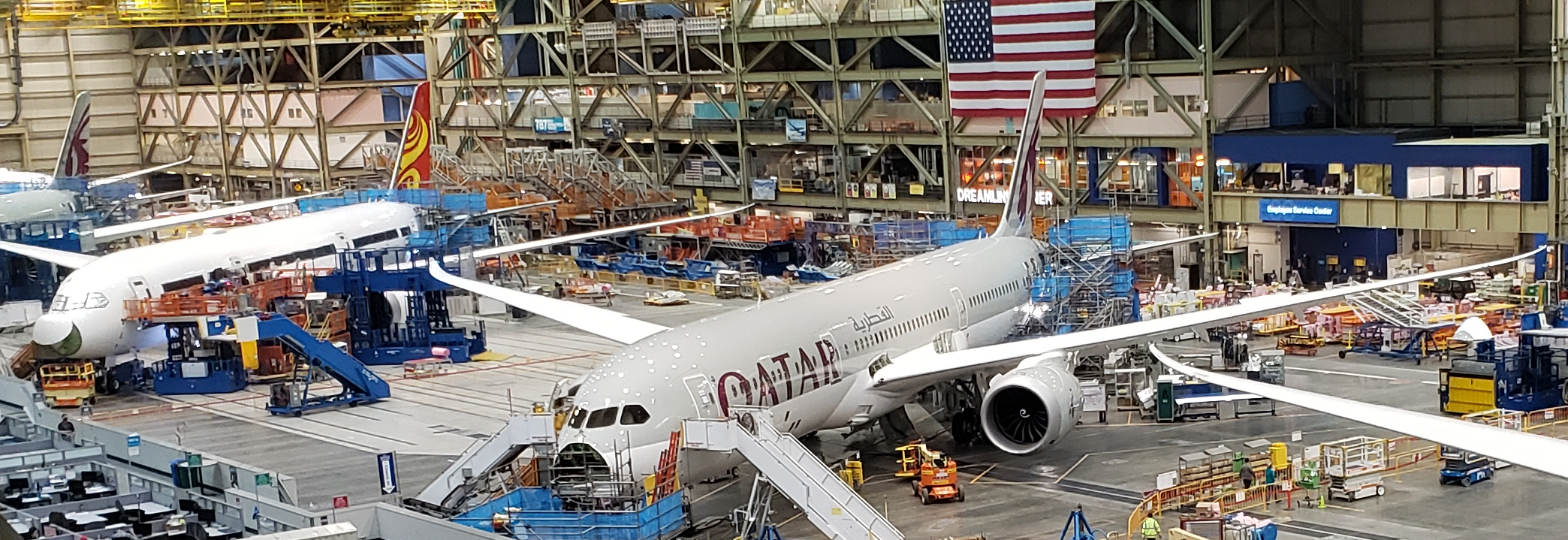
Boeing 787 bay at the Everett factory in 2023. Boeing was engaged in reworking following discovery of a production flaw. Credit: Leeham News.
Gaining FAA approval to build the 737-8/9 on the North Line will smooth production certification and enable employees without 737 production experience to gain some before the MAX 10 is added to the line. While Boeing all along said the North Line is intended for the MAX 10, LNA confirmed that it is capable of assembling the MAX 8, 9, and 10.
Additionally, since the MAX 10 (and the smallest family member, the MAX 7) remain uncertified pending changes that must be made as a result of the overall 737 MAX crisis revelations, Boeing wants to avoid building up an inventory of MAX 10s that would require changes mandated by the FAA.
Related Article
The company wants to begin production as early as May or June. Earlier, Boeing previously said activating the line may not occur until the end of the year, awaiting certification of the 737-10. More recently, CEO Kelly Ortberg identified mid-year as the activation target date. A formal request to the FAA may come as early as March.
Ahead of its year-end 2025 earnings call and in its quiet period, Boeing declined to comment.
Shifting Employees
Officials want to reassign 737 workers from the Renton area to the Everett widebody production plant, where the North Line is located. Under terms of the labor contracts, the IAM 751 follows a seniority list in the assignment of personnel between Renton and Everett. These members assemble the airplanes. The engineers and technicians SPEEA contract does not require pre-approval for moving people around.
LNA is told that Boeing officials want a few more months of smooth operations at a production rate of 42/mo before seeking FAA approval to activate the North Line. The FAA also must approve Boeing’s plans to boost the production rate to 47/mo this year, perhaps in the second quarter. A rate boost to 52/mo by year end requires an up-and-running North Line. If certification of the MAX 10 slips from late 2026 into 2027, the North Line will soon be ready for the rate break to 52/mo with or without the MAX 10.
Production at the Renton plant will be capped at 47/mo, said program GM Katie Ringgold during a recent media tour of the plant. Before the first of several safety crises erupted at Boeing, beginning with the March 10, 2019, crash of an Ethiopian Airlines 737-8 MAX, Boeing produced 52 airplanes a month at the Renton factory. Boeing was preparing to boost the rate to 57/mo; the plant had the capacity to produce 63/mo.
However, given the safety and quality control shortcomings that emerged following that Ethiopian crash, and again after the Jan. 5, 2024, door plug blow-out on a new 737-9 operated by Alaska Airlines, total production of the Renton plant will be capped at 47/mo. This is an average of 15.6 aircraft per month on each of the three lines.
One North Line or Two?
The North Line has been established in the old 787 final assembly bay in Everett. Boeing hasn’t announced what the capacity of this line will be, but LNA reported last June that a Boeing employee predicted that eventually 15 737s would be seen in that bay in 2026. (This timing now appears to be ambitious.) LNA also reported then that production at the Renton factory would likely be capped at 47/mo.
Assuming the North Line will have the same capacity as those in Renton—15.6/mo—this gives Boeing the ability to produce 63 737s a month. Although Boeing now has a backlog of more than 1,300 MAX 10s, the North Line’s ability to produce the MAX 8 and 9 gives Boeing additional flexibility—and room is in the bay to add a second assembly line.
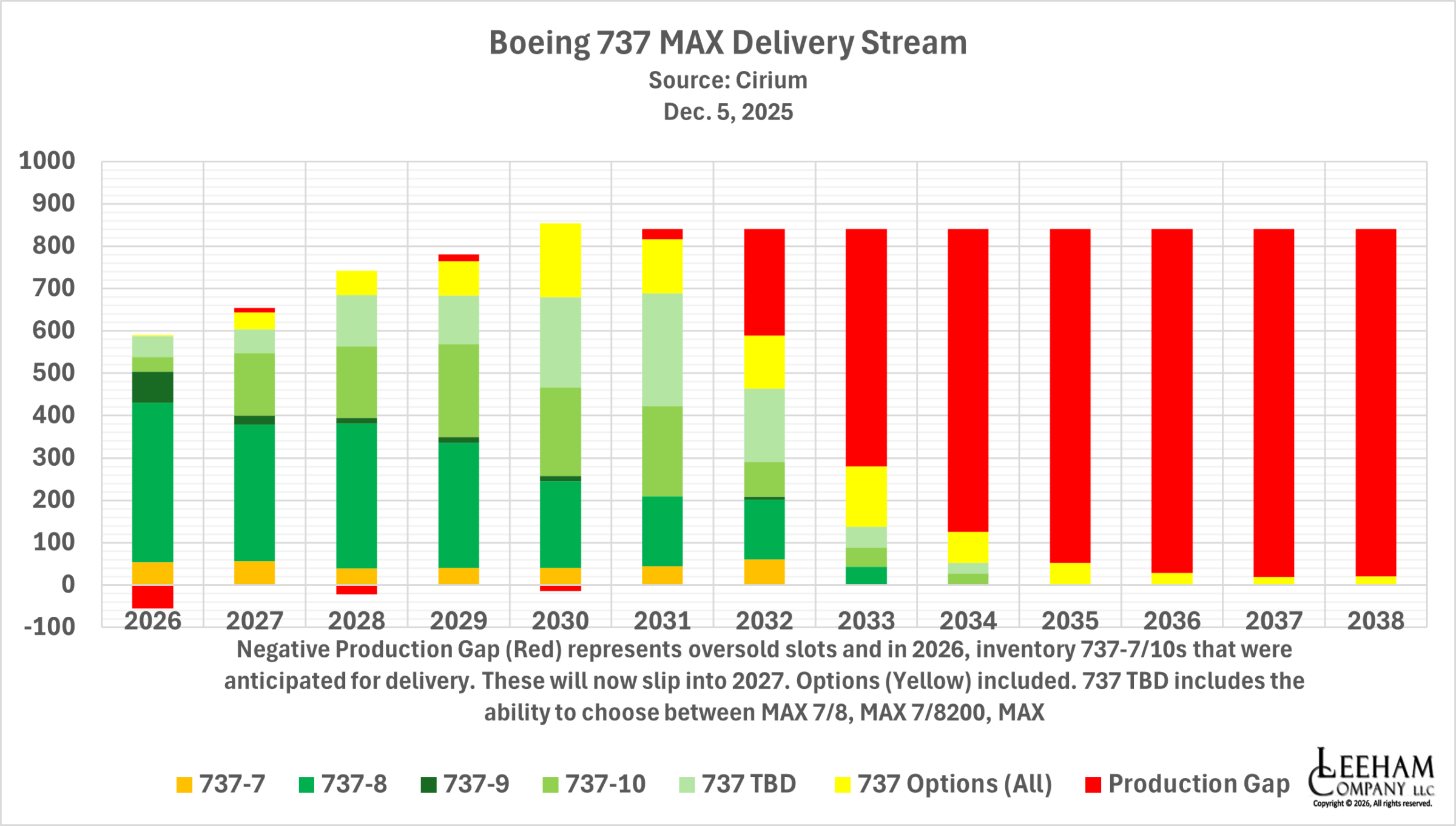
At the end of 2025, Boeing’s 737 delivery stream shows the program is sold out at a rate of 52 next year, in 2028 and beyond at a rate of 57, and potentially in 2029 even at rate 63. Boeing already announced two big orders last month from Aviation Capital Group (50) and Alaska Air Group (105) for 737-8s and 737-10s. Delivery years were not announced. With 2025 orders and options, if all options were exercised, Boeing would need a production rate of about 71/mo in 2030.
If Boeing wants to boost production above 63/mo, a second North Line will be required. The current North Line has been positioned to one side of the old 787 bay. There is room for a second parallel line, according to a former line worker consulted by LNA. Internally, Boeing is looking at this possibility, LNA is told. However, this currently falls into the “what if” thinking, exploring options.
“Employees who will be assigned to the North Line will be a mix of Renton transfers, new hires, and Everett incumbents. The latter has never built a 737.”
===
New hires, and an Everett team that has never built a 737…that’s going to be challenging, to say the least.
It will be interesting to see how quickly production can be stabilized.
That’s why Boeing wants to get a head start.
“This is the first time the 737 will be assembled away from its Renton (WA) facility, which has served as its home since the original model program more than 50 years ago.”
This statement is in error. The first 200-300 737s were built at Boeing’s Thompson site, just south of the old Plant 2 and adjacent to Boeing Field in Seattle. When aviation hit a downturn in the early 1970s, Boeing moved the 737 line to Renton to consolidate its single-aisle production in one place with 707s and 727s.
@George: Yes, the original 737 started at Boeing Field, and yes, it was transferred to Renton. What I was trying to say here is that for 50 years (ie, around 1975), all 737s have been assembled in Renton.
@George:
Good one. I thought Renton was the original and only home.
Fun to get bits of history I was not aware of. I may have read it lo many years ago, but it did not register.
“At the end of 2025, Boeing’s 737 delivery stream shows the program is sold out at a rate of 52 next year, in 2028 and beyond at a rate of 57, and potentially in 2029 even at rate 63.”
hmmm….this will not be achieved because the new 8 wing riveters and lift panel systems (for rate increase) for Renton ordered almost two years ago are not in production and may not ever be delivered! The industry 4.0 technology for this wing line with remote operators is pipe dream!!!!!!!
Thanks for this useful info, DP.
to salvage this Renton wing riveter program…will Boeing send in a “tiger team” into the supplier to get the wing riveters built and tested and then take away the industry 4.0 technology from the contract specifications?
Best case scenario 1 to 2 years late with Boeing help, worst case Boeing Renton lets the supplier fail and then they need to start over with a new supplier which will push out production ramp up at least 3 years
This could have been avoid if Boeing Renton would have chosen the wing riveter supplier based in Seattle instead of a supplier that never built wing riveter system and has no experience in industry 4.0 for automatic fastening system
It seems to me that Boeing is well aware of its resources and what they can or can not do.
I would like to see a link or links to the “issue”.
Trans
if you are referring to my post, not everything in the world is in a link That said, having real world knowledge (tribal knowledge) of building wing riveters and automatic fastening system starting back in the early 1980’s (for over 20 years) I have seen the good, the bad and ugly in production automation of aerostructures for commercial aircraft built around the world
Here is root cause of the problem for current 737 Wing Riveter project
We will dubbed this FAUB 2.0 Syndrome….when facility engineers “dream up” production requirements for equipment to justify their case for ROI on the program, they over spec the performance requirements (in this case not questioning floor to floor rivet rates and putting in technology requirements to reduce manhours (eliminate WRS operators) Then they put out for bid, they find a non experienced supplier to take the job without making a exceptions to the spec and ignore the other suppliers insight about how the job can’t be done.
How did 777 FAUB turn out? ex. (Seattle Times article from 2019 -“Boeing is abandoning robotic production machinery, known as Fuselage Automated Upright Build, or FAUB”)
There are comments below from @Steve which chime with your wing-related analysis 👍
lets go with “don’t complain unless you have a solution”
Note these new 8 WRS will have all electric slug squeeze process which produces a better quality slug installation but will not really increase rivet rate that much. The main issue with 1960 vintage WRS systems (Renton) are slower than the stand alone wing riveting system Why you may ask…the vintage Renton style WRS moves the machine to the stationary wing panel compared stand along Wing Riveter moves the machine and panel at the time to get to the riveting point.
Option #1 Boeing tiger team assists the supplier for the new 8 Renton wing riveter (and panel lift systems) while descoping the industry 4.0 requirements while buying more stand alone wing riveting systems from qualified supplier for true rate increase (if you want to go over 50 rate a month)
Option 2 If Boeing is not inclined to assist the supplier, they still should purchase more stand alone wing riveters for true rate production increase If the supplier fails, Boeing Renton always revert to upgrading their vintage 1960 WRS with new electrical control packages and replace wore mechanical parts (upper and lower heads) like they have done for the past 40 years
In either scenario, they need to add more stand alone wing riveters (go from 50 a month to 70 a month rate) now to avoid a long term production issues
That said, don’t expect any corrective actions from Boeing facility engineers…
DP:
I am going with logic and while I fully agree there are aspects behind the scenes that are not public, in this case it makes zero sense.
Otberg is not stupid. I don’t agree with his contract outcomes, but he also is doing most of the right moves in regar4eds to Boeing recovery.
In this case, Boeing is committing to production targets and outcomes of the new lines.
A huge part of rate increases is managing the supply chain and that is even more true today than before. Its become fragile. Its not the only condiserio0n and planning that needs doing for a RI, but its a showstopper item.
So, I am looking at
1. Commitment to the increases and lines that ignores the lack of wings that will torpedo the whole RI and line building.
2. Wings are a huge ticket item and I have seen nothing on them. Agreed we can have a cover up, our current history is proving that, but its going to be revealed – I don’t see it.
FAUB was and is a disaster at Boeing. Highly successful at Airbus
Go ahead fact check.
For the 737 Max program the wing final assembly at Renton was completely changed from the original method.
summarised as the changes around 10 years back
Key Automation and Production Upgrades:
Spar Assembly Line (SAL) Cells: Boeing replaced ten older Automated Spar Assembly Tools (ASAT) with two, then more, fully automated Spar Assembly Line (SAL) cells designed by Electroimpact. These cells are much smaller, occupy 80% less floor space, and utilize robots to drill and fasten wing spars simultaneously.
Robotic Technology: The new cells feature automated, robotic arms that can change drill heads and fasteners without manual intervention, reducing downtime.
Panel Assembly Line (PAL): The company uses advanced robotic machines (PAL) to assemble wing skin panels, automating the process of connecting stringers to the skins.
Horizontal Assembly Line: The wing assembly process was transitioned to a horizontal build line, making it more ergonomic and efficient.
Automation Increase: These changes have shifted the wing assembly process from roughly 70% automated to over 90% in some areas.
David is of course a professional critic of Boeing but provides no real details on any further automation – which he claims is in abeyance
The existing line has 9 Electroimpact PAL systems (Each PAL robot stands 20 feet tall, weighs roughly 60 tons) to allow for 8 in operation
https://www.electroimpact.com/whitepapers/2015-01-2514.pdf
“The existing line has 9 Electroimpact PAL systems (Each PAL robot stands 20 feet tall, weighs roughly 60 tons) to allow for 8 in operation”
Exactly, time to buy more of them instead of investing over $100 million replacing 1960 vintage style wing riveters with same model type with electric slug process.
You are missing the point, it takes about 18-20 months to get that style WRS ready for production at the customer facility. The chosen supplier selected about 2 years (with no wing riveter experience) and their is no machine or lift panel system on the Renton line
The old style wing final assembly was only retained for the P-8 model as thats based on the 737 NG model.
Who is the manufacturer that’s supplying the newer again equipment – instead of Electroimpact- so we can get some context and background ?
It seems that from what you say its replacing the manual riveting still done in the PALs, where the drilling of holes is automated
Reading between the lines, I’d say this is more evidence that the MAX-10 isn’t coming any time soon. We’ll see.
Certification of the 10 is hoped for in 4Q2026 but we shall see.
How about the -7? Before the -10?
The North Line is not for the MAX 7.
I mean the certification timeline of the -7, ahead or behind the -10?
Nobody knows @Pedro, but the flight testing of the 7 is ahead of the 10, so logically the 7 should be certified first.
Thx. I’m curious about this report from Reuters:
“The FAA approval did not apply to the MAX 7, according to the source.”
https://money.usnews.com/investing/news/articles/2026-01-09/boeings-biggest-737-max-model-moves-to-next-stage-in-certification-but-still-faces-hurdles
Its Ironic that the -7 was used to get the MAX back in the air but could not be built.
Strange world.
So entry into service only 2027 earliest…
Add in a learning curve to make them in meaningful numbers..
its good to see them make use of the spare capacity, the world will need lots of the most capable 737
I was scheduled on a TUI 737-10 to TFS years back, and really looking forward to it – but ended up on vintage A320 Bulgarian Air substitute.
The Max 10 is merely a fuselage extension of the in production Max 9
The fuselages are shipped ( pre stuffed ) from Wichita) and the wings would still be made at Renton.
The assembly line process is just a copy of the process at the 3 lines at Renton.
Everett isnt a new facility for final assembly either – as the 777 and 767 are still made there.
The learning curve is minor also.
DoU said: “The Max 10 is merely a fuselage extension of the in production Max 9..”
No, it’s not. (Details on request.)
There are other differences , minor , but this is about the FAL line process which is fitting the wings and empennage to the fuselage and completing the interior fittings.
Attaching a new variation of the undercarriage isn’t an assembly line issue as the would arrive “fully functioning’ and just be attached to the same mountings. Nor would an upgrade of the cockpit displays be an Everett assembly issue
Hell yeah the MAX 9 is merely a fuselage extension of the in production MAX 8?
How come a door plug blew out a MAX 9 mid flight two years ago?
Is two years already too long to remember anything?
Did anyone catch what a terrible pun this is?
“Reading between the lines, I’d say this is more ”
The problem with reading (ahem) between the lines is the tea leaves may not be telling you what you thought. Each Oracle has their own tool set.
For me, I like what Boeing is doing. It gives a much better transition when the -10 gets going. I have been there on the intense pressure of a timeline. This relaxes it and they build experience.
Reading between the lines (ahem) it indicates to me that Boeing is trending in the right direction decision wise.
I like this idea of utilizing existing space in Everett to increase build capacity for the 737.
However, It’s going to be interesting to see how this all shakes out. The FAA will be crawling all over Everett, as they should, for oversight and auditing.
It’s also going to be interesting to see how trucking wing assemblies from Renton to Everett will pan out and hopefully no major problems.
One very important piece of Everett not discussed in this article is preflight. Airplanes don’t just roll out of the factory then fly away.
When airplanes roll out – any airplane – they move to the field for complete inspection, complete ground functional testing, fueled for the first time and leak checked and engines run for the first time. Also many factory travelers are completed, or should be.
Everett has the preflight facilities. But it takes a special corps or trained mechanics and inspectors and engineers to accomplish this bill of work. Special tooling and other equipment also must be on site. Huge logistical issues. I’m sure Boeing has this all worked out
Once the first flight (called B1) is accomplished the airplane will then proceed to Boeing Field for delivery.
I’m very curious on the cost estimates for Boeing to get this dual city line going. Gotta be enormous!
You have to build the wings, install the systems, and test them before you can send them anywhere. Renton wing structures may be able to keep up, but wings systems installation as it now exists cannot, and will not, no matter how much overtime or abuse of employees takes place.
Its a great point.
Everett has never been at a rate that they are going for as well as their peak rate is years in the past.
Good part is a slow build up and they can work the kinks out.
Its great to see Everett getting used again. Also room for a new aircraft when they do that.
I think Everett will be a boost to 737-10 quality and production tools innovation, especially if a 737-10ER is launched. The 767 and 777 are in many cases more modern and advanced than the 737 hence senior Everett mechanics should find it easy to build. The 737MAX is narrower and simpler than the A321neo hence should be cheaper to produce, letting Everett help define the 737-10ER would make it the volume 737MAX with time until the A321neo successor is in production.
How do the wings get from Renton to Everett? TIA
“It’s also going to be interesting to see how trucking wing assemblies from Renton to Everett will pan out and hopefully no major problems.”
The 777 classic wings still are trucked from their Auburn plant south of Renton, all the way to Everett. The new carbon fibre wings are made at at Everett.
Same trucks could do the much smaller wing no problems.
The fuselages are of course ‘railed’ all the way from Wichita, but pass Everett on the way to Renton
@duke
It’s not the whole wing assembly but pieces such as milled skins and spar assemblies. The 777 wing is assembled in Everett, will be the same for the 777X composite wing.
The 737 wing is complete as new wing and will be shipped as a complete wing. Different scenarios.
The whole 777 classic wing spars and skins trucked from
(Auburn)Frederickson where they were made is far larger than the tiny 737 wing even when its fully assembledIt was a curious arrangement as there was separate rear set of wheels for the wing tip
https://www.youtube.com/watch?v=wsZ6YPsPpj0
Wings will be the problem.
They are always the problem.
The structure is one thing, but systems installation is an absolute train wreck.
Boeing denuded itself of experienced employees, that’s problem #2.
Boeing will rob what experience it can from Renton, increasing the pressure on senior employees to keep those lines at pace. Problem 3.
Established workers who live south of Renton, say Tacoma or Puyallup who have built a life or own homes there will probably Retire or quit rather that attempt a high cost brutal commute. Problem 4.
@Steve
Appreciate this insight and of course you are spot on about these problems.
I hadn’t thought about the employees who will be FORCED to go to Everett and the impact to the line in Renton. And let’s not forget the impact to Auburn and Fredrickson.
Seems Boeing leadership is still the same ole same ole.
Very informative comment 👍
Look at it as a test of current leadership and how they handle it.
Its going to be a slow transition.
It would be a good application for all those electric Helo Taxi’s we have no use for!
Tribal knowledge.
Boeing apparently was never able to put that knowledge into accessible writing.
Is this issue connected to the unionized workforce acting as a distinct and removed entity?
No. The Company never understood or valued tribal knowledge.
That is why they eliminated seniority based promotions in the 2002 IAM contract.
misunderstanding?
you have to feed back tribal knowledge
into the corporate knowledge base.
( you will invariably loose the persons attached to that tribal knowledge. )
different domain:
designing, manufacturing and assembling spacecraft components creates a rich set of notes and write downs of processes applied.
A project running for decades has people moving on but you have to have the means to refresh all that initially tribal knowledge. Very pronounced on the Voyager missions but also on Rosetta and Sofia ( there for other reasons. )
( all told the coverage available is never perfect. shortest interval but worst situation was instrumentation projects for Sofia. )
There is no mechanism to do this and the ones with the capacity were stripped of the ability and incentive to do so. Then they were either bought out, or forced out of careers that became dead ends, where instead of mento6by a lead with 20 years experience, they are directed by a management selected team leader with a year or two in seniority.
“That is why they eliminated seniority based promotions in the 2002 IAM contract.”
Age does not mean you are more capable or have anything to pass on.
5 years has been a common metric for being fully capable of doing a job. I managed it in 3 but I also was thrown to the wolves. Lot of incentive there.
You need the experience, but you need to know more than what is in front of your face as well as the ability to teach it.
Seniority is not the way to get capable people in top positions.
Nimitz was jumped over 20 some admirals and asigned the Pacific theater because FDR and his advisor thought he was the best for the job (and he was).
It was the Senior people who had PH asleep at the wheel on that fateful Sunday.
There were a lot of Senor people who got sidelined either from the get go or when they showed how inept they were.
Lotsa big tech companies have been ‘successful’ by challenging the status quo and fundamentally changing they way they do things. “Break things and move fast” is an example. Boeing thought they could do that by throwing out the old “this is how we’ve always built airplanes” employees and replacing them with smart, young folks full of new ideas and none of the biases of their older, seasoned colleagues. The past 20 years of Boeing history clearly shows that they were wrong. Now they’re starting from scratch. They will eventually figure it out, but it will be a very long time before can make any money at it. Fifteen years or maybe longer. They are lucky that their customers don’t want an Airbus monopoly. That’s what’s keeping them alive.
The smart young folks you refer to may be young, and smart, but half lack any mechanical skills whatsoever.
Understand this:
Boeing doesn’t train. It certifies.
It certifies workers in certain critical tasks, but as far as training therm on their actual work assignment, that depends on the abilities, knowledge and communication of the person who did that work package before them.
If the person doing the training isn’t working to plan drawing ans spec, taking shortcuts, that is what the trainee will learn.
As long as the package is complete on time, management doesn’t care and doesn’t know because most first level managers never worked on the floor. The practice of making new managers from the ranks was largely discarded.
These poor build practices become hard wired into the build timeline. anyone who knows what he is doing comes in to take over that work package and does it correctly is likely to NOT complete the tasks on schedule. The management comes in pressuring the employee until he starts doing the same shoddy but fast work, or get fired.
Once the rate increase takes place, everything is locked in. Time studies can be ordered but there are 2 fatal flaws:
1. The industrial engineer has NO idea whether the job is being done correctly, only how much time it takes.
2. Management will simply ignore the time study, and tell the Industrial engineer to cram the bar-chart timeline like an accordion. They then use massive overtime and pressure tactics and hope they can force it to work.
It gent’s bad. People get burnt out. Accidents increase. Ultimately the line bogs. Keep throwing overtime at it.
The cost of doing business is human, but manifests itself in labor disputes.
Huge difference between a new tech and high tech mature.
Airplane mfg does not work the way cell phones and computers do (low volume high tech)
The line workers are skill but they are not necessarily high tech jobs.
Those are in the places that build things and then send them onto be installed.
Boeing downfall had nothing to do with any high tech and all to do with management greed and the slow liquidation of the company to their benefit.
Steve is again spot on and obviously, like me, has worked within the system.
So true, Boeing, even under Ortberg who promised a different way of doing business but it’s clear he still likes to rearrange the chairs on the titanic with directors and VP’s.
They don’t value tribal knowledge or skill. I feel for the people being forced to Everett.
Will quality suffer?
So the production is going up and qualty also increasing is not a result of improvements?
We are seeing how US defense is being schwacked by a jumped up chocoholic lieutenant .
Managing a company is not the same as working on the line.
I spent my whole career telling people I did not want to manage. I would have made a miserable manager.
Some of the worst employees were spot on critics. But they had no soluti9ons either.
I have no inside knowledge of Ortberg. I do know that as a worker I was not a manager and would not know where to begin to manage a company.
it makes a lot of sense to get the bugs worked out and the staff trained up on well known existing variants.
so much sense that it surprises me that Boeing would even consider it given their track record of making the dumbest possible manufacturing decisions over the last 2 decades.
Seems to me that things are changing.
Will it satisfy everyone? Nope, all the stuff flows downhill so the people on the line are the ones who deal with the end output.
If the company goes down then all the workers loose their jobs.
Navigating all the aspects is not easy. Airbus has seen how even what is considered a well run company has its issues.
My take is that overall Ortberg is doing a good job, I disagree with aspects of what he is doing but the results speak for themselves and they don’t happen accidentally. Things only get worse.
Is Ortberg directly responsibly for all of it? No. But he sets a direction and then will task BCA with coming up with an Everett plan.
He will stop any bad plan (or what his staff sees as a bad plan) – so however they got there, a good plan was created.
That is not an accident.
This sounds like the prelude to another MAX-7/10 certification delay announcement:
“US official says FAA not the roadblock to Boeing MAX 7, 10 certification”
“The head of the Federal Aviation Administration said on Wednesday the agency is not the roadblock to Boeing winning certification of two new variants of the Boeing 737 MAX.”
“FAA Administrator Bryan Bedford told reporters after a speech in Washington the agency has devoted significant resources to helping Boeing get the smaller 737 MAX 7 and larger MAX 10 planes certified “but Boeing still has to do their work … We can only help get them there, but they have got to do the work, and they’re doing the work.” Bedford added “I don’t think FAA is the roadblock on 7 and the -10 certification.””
https://www.ajot.com/news/us-official-says-faa-not-the-roadblock-to-boeing-max-7-10-certification
===
Of course, we already knew that the FAA wasn’t the problem — it was just being used as a scapegoat.
There are misconceptions held by most people here. The first is that Boeing runs an ASSEMBLY LINE. That isnt actually true. An assembly line is set and tooled to build a product with limited variability at a sustained rate into a market where post delivery inventory is absorbed by the consumer/market. That is NOT how this industry works. The manufacturers eschew inventory and adjust production rates to avoid it, the covid 737 buildup and the 787 FJV (fuselage Join Verification) issues are outliers here. The industry actually functions as a Job shop building lot quantity’s of 1 very rapidly. The product variability is such that with very few exceptions, no 2 sequential aircraft off the line are built the same. There are A,B,C and D level components. A level is Model specific structure. All 787s use the same nose/41 section. B level components are series level structure. All 737-8s get this set of parts, different than -9s or -10s. C level components are major model options, D level are minor model options, and then there are customer unique items. When you are running aircraft down the line with such a variable bill of materials with the associated changes to the Bar chart sequencing, training is very difficult. Consequently there is an effort to keep the same people on the same type of work. The planning paper theoretically instructs any assembler by job classification the sequence of assembly, and provides the bill of materials and the drawings with the correct effectivity for the build needed for that line number. The old idea of learning the job and teaching the job to the newer workers is still prevalent BUT standard work packaging is really helping the MFG Planning instructions get to the point where you can actually grab a job you have never done and have what you need. And HERE is where Boeing needs help. The Functional Illiteracy rate of WA State adults is 16%. 28% of WA State adults read at level 2 which means they have the skill to find limited information.56% are competent readers. Understanding this and the requirement to follow technical instructions is one of the big hurdles to quality that Boeing must address. And its a difficult thing to do as personal shaming gets in the way. Consequently, Boeing Planning paper is evolving into picture/graphics to a much higher degree to compensate for sagging reading proficiency. Interestingly enough, South Carolinas Functional Illiteracy rate is 22% and 35% read at level 2. While that 35% number is larger than Wa State, it comes at the expense of competent readers which only number 42%, below the national average of 46% and Wa State at 56 %. This does make the case that the Seattle workforce is better equipped to build Boeings Product than the So Carolinians.
This means a few things to Boeing. They must screen poor readers more effectively or accept that they must really change the planning work instructions down to 5th grade reading. Failure to do so will expose them to more defects caused by the inability to read the the task descriptions in the jobs assigned when the product variability changes them.
So, what does this mean for a new line startup. Everything. IF THEY ARE SMART, they will get solid readers in the new North line workforce. This will add flexibility to the staffing plan as more people will be able to follow the job without having a competent reader/lead man spending a ton of guidance time on them. If you get solid people on the line, the work go’s easier for everybody. Rolling the -8 and -9 down the line as a precursor to the -10 allowing the team to staff up on known processes is smart. Going slow allows the company to find the right people instead of hiring those with pulses and clean drug tests. I Have hope that Boeing can staff up with good technicians by weeding out non performers early in the evaluation period. If that happens, quality should be very good from the outset because poor readers working by rote on variable products are the source of most errors.
you are aware that automotive assembly lines produce cars with similar levels of variation on the same line?
took a tour of the GM plant in the next town when I was a kid. they made 4 different brands of the same platform car, each in 2 door, 4 door and stationwagon variants. some had vinyl roofs, some had fake wood trim down the sides, each brand had slightly different bodywork. some came with vinyl seats, some cloth some leather, some had 4 cylinder engines, some had V-6s, some had manual transmissions, some had automatics. some had A/C some didn’t, some had alloy wheels, some had steelies, not to mention paint color and trim level badging, some had heavy duty suspension, some had air suspension, some had comfort oriented suspension… I could go on and on.
literally the only common component across all the cars on that assembly line was the center section of the floorpan of the unibody.
IIRC according to the tour info, there were well over a million possible feature combinations that could be produced on that line.
this was also one of the early “just in time” inventory factories where rather than having a big warehouse of parts, parts would arrive continuously from suppliers with just enough to get through the next couple days on hand at any time.
how is that not an assembly line? enlighten me.
Agree. Auto assembly also takes place at a much faster pace, hundreds unit each and every day.
Bilbo. Great Observation, but there is no comparison between the level of variability of a car and an LCA. The Automobile assembly lines have all the permutations pre-engineered, and the actual changes are quite limited. Cars have variability only within the company defined selection possibilities that are pre-engineered into THE selection palette. I cannot go to GM, specify my seat vendor with the colors and coverings unique to my airline, I cannot specify what radios, navigation systems, batteries or generators I want. I darn sure cant select who makes my windshield and the associated glass heating system. With Aircraft, virtually anything the customer wants will be engineered into existence. Automobiles are quite simple in that regard. Cars may have a million ish permutations available by the time you look at all the colors and how you select or deselect stuff from the existing palette, but Aircraft have near infinite configurations limited only by what the customers’ needs are. The difference is that each aircraft basic release is a customer unique engineering release event. Unless it is a reorder of a previously ordered configuration, each basic release requires new engineering drawings, the potential for new tooling, a new vendor/supplier mix with different pricing and lead times. Lastly, the vast bulk of automobiles are built for inventory and shipment to dealers to sell, Aircraft are presold in the exact configuration a single specific customer defined for that specific aircraft line number and virtually never produced as an inventory item unless an extraordinary event occurs. Unless you do it for a living, it may not be apparent to you just how complex aircraft really are. I will not even get into the tolerances aircraft are manufactured to and how wide the tolerances are for most auto parts.
The North Line will be the only line capable of assembling the MAX 10, and on that line a maximum of 15 aircraft can be assembled each month.
That would mean that the theoretical maximum production of the MAX 10 will be 180 per year. Hardly a competitor to the A321neo at that rate.
Meg.
Your thoughts that the -10 can only be assembled in Everett is incorrect. It has already gone down the line in Renton. The current -10 fleet was all built there. Boeings statement that the -10 will be built in Everett is a nuanced statement and you didn’t detect that. The -10 is a bit longer and has a slightly larger statement of work than the -8 or -9. This means that you can build them in Renton if you are willing to accept the consequences of a hump in the workload and a change in “chain rate” when they come down the moving line. This means that your presupposition of a 120 a year delivery rate of the -10 isn’t cast in stone. I suspect that we will see a virtually immediate opening of North Line 2 as soon as line 1 is fully staffed just for your production “cap” thinking. It also would be good to start thinking along the thinking of airplanes per MDAY as the actual production rate as most months have different MDAY counts and as a consequence of this, the production count month to month will be different even though the factory flow speed is unchanged. Lastly, the Boeing scheduling system ends at factory rollout. The work package done on the ramp is in the Post production environment and is invisible to the the line rate calculations, so there will be a bit of variability in the delivery rate as it is not directy connected to the production line schedule.
I’m looking forward to seeing 15–20 737-10s leaving the North Line annually by 2027–2028.
This delivery ramp-up is important for Boeing. Hopefully, we’ll see all anticipated MAX upgrades baked into the -10 from the start, not just the taller landing gear.
It might not be an ‘A321neo killer’ in terms of versatility, but for MAX-heavy fleets and 4-5hour leisure hops, it seems a very efficient machine.
Its a Max 9/10 monthly delivery rate.
Its a better plane than the A321 neo, just the XLR is the outlier
“Its a better plane than the A321 neo”
Sure — that’s why BA is being outsold 5-to-1 in that segment…
MAX9 just like the NG900 never achieved
the interest transfer the A321(NEO*) experienced over time.
You think the MAX10 will jump that by magnitudes?
According to safety standards the MAX is decades behind the A320. E.g. acceleration ratings for airframe and seats, powered main cabin doors, no RAT, …
Lending some financial context to the desired rate increases: despite “record” deliveries in Q4, analysts are still expecting BA to run a Q4 loss…and they’re revising their estimates further downward.
That’s despite expected revenue increases at BGS and BDS.
It’s also despite the following:
“The average prediction of analysts places ‘Revenues- Commercial Airplanes’ at $9.50 billion. The estimate points to a change of +99.5% from the year-ago quarter.”
===
“Analysts on Wall Street project that Boeing (BA – Free Report) will announce quarterly loss of -$0.39 per share in its forthcoming report, representing an increase of 93.4% year over year. Revenues are projected to reach $21.74 billion, increasing 42.6% from the same quarter last year.
“The current level reflects a downward revision of 2.9% in the consensus EPS estimate for the quarter over the past 30 days. This demonstrates how the analysts covering the stock have collectively reappraised their initial projections over this period.”
https://www.zacks.com/stock/news/2821053/boeing-ba-q4-earnings-on-the-horizon-analysts-insights-on-key-performance-measures
hmmm…Comac can do variants without any major issues….how’s that 737-7 doing?
article title COMAC C919-600 high-altitude variant spotted ahead of flight tests
here is the link for “Trans” with a picture
https://www.airdatanews.com/comac-c919-600-high-altitude-variant-spotted-ahead-of-flight-tests/
David.
Variants are simple, anybody can design variants. Customer Variability within the variant itself is where the the magic happens. As others have noted. Automobiles have a very wide selection of available pre-engineered options for customers to select from. LCA makers design to the RFQ presented by the purchaser and are not limited to pre engineered choices… Big difference. As far as the Max7, I suspect that with only a few hundred orders, it’s last in priority to cert. That would at least be the logical way forward
“As far as the Max7, I suspect that with only a few hundred orders, it’s last in priority to cert. That would at least be the logical way forward”
Really over 13 years ago from Google AI
“The Boeing 737 MAX 7 was officially launched in May 2013 with Southwest Airlines as the launch customer”
The antiquated 737 cockpit is the killer.
Since the MAX crashes, the FAA and EASA are increasingly asking BA to justify its assumptions regarding crew reaction in emergencies…and BA seems to be having a hard time producing convincing analyses. On many occasions in the past few years, the FAA has publicly chided BA for failing to produce required SSAs. Just last week, the FAA re-iterated that it’s not the cause of the delay in the certification of BA aircraft — that blame lies squarely with BA.
Why do you think BA has decided to undertake a cockpit “modernization” program, to address some of the most egregious shortcomings in the MAX flight deck?
The C919 has a modern cockpit, which puts it in a fundamentally different certification position to the MAX.
Funny how something like 10-15,000 737s have been built and flew just fine.
Someone once said if your computer does what you want and need it to, its not antiquated.
Pneumatic control systems are no longer made, but they sure did the job just fine. You also did not have a single point of processor failure (each receiver control was an entity unto itself). I could make those systems dance.
If something is truly a “Killer” then the statistics would back that up, they do NOT.
The reality is statistics are cold and impersonal things.
If you or your loved one died in a crash, there is no solace to be had.
Co-flating a messed up system aka MCAS with condemning a system as a Killer, that is an emotional event.
Specific program failures are not system failures.
Airbus has had its share, the same as Boeing, they get away with a lot and fix it when they find it.
We have had two dramatic examples of Airbus issues the last year (programs). It has lead to incidents, fortunately it did not lead to crashes and deaths. Statistically they got away with it. Boeing and MCAS did not (the victims did not).
If you want to get real data, then you apply all events in all aircraft by an mfg and a type using the baseline that it could have been lethal.
Airbus has had aircraft go out of control because of what the pilots have done (as has Boeing). That does not mean Airbus system is a killer.
Boeing system has its pluses and minuses as does the FBW and computer control (and there is no single FBW system, each mfg does it their own way, ie the AJHs have never established a certification standard as to how those should work so everyone does it their way)
A FBW system will kill you readily if the program failure is in the wrong area. Just ask Sweden on their first FBW jet (fighter). It was sent to the US to sort out the control statements as the US at the time had the experience in it. We also failed on the F-22 that had a flaw in its programing (fixed after a crash just like Sweden had take place).
Pilots messing up are the most common cause of crashes and that will continue until AI run the aircraft. Then AI program failures will be the biggest issue.
And yea, I had far too much experience in design in failure proof programs. The branching insanity does you in.
All you could do was pick the most common ones. Then if it bit you (no one died) you changed the program to deal with the one you had not thought would be a factor.
That is not computer control, that is a risk assessment and experience in failures. What you do not know is how a system comes together and what the interactions between programs can do (until you test them). You cannot test all the failure paths.
Mechanical controls are actually more straight forward. The Pilot changes his modes on the fly and seamlessly. A computer has to be told what mode its in. It can’t guess because the branch factors overwhelm any input.
Squat switches are a case in point. Try to program all the variables in a gear saying you are on the ground when you have just bumped back into the air. The computer says you have landed when you have not. So try to go around, it won’t let you get the thrust reverses out of slow down until you tell it to (pushing TOGO)
So, how long does the squat switch have to be closed before it says you are landed? And oh, by the way, you need to thrust reverse like mad because the runway is flooded and your landing calcs just went out the window.
And yes there have been Airbus crashes based on how all that interacts. In fact they changed it as a result of one crash and caused another. In that case you could not have both.
If anyone thinks its slam dunk, they are totally wrong. Reality always rears its ugly head.
We’re talking about the safetyof the 737 MAX**.
Thank you for your attention to this matter.
If you want to argue, you should talk with Boeing why it categorizes the 737 into 737, 737 Classics, the NG and the MAX. We don’t set the rules.
@DP:
You are aware that COMAC is in LRP and looks to be there for some time?
You are also aware that China does not use world recognized Certification standards?
You are aware its test flights?
And to be clear, COMAC snaps their fingers and CAAC certifies anything they are told to.
Boeing is making 38 x MAX a month as well as something like 7 x 787s and a couple of 767 Hulls (for the KC-46A)
Nothing like a China certification aproach that screams Regulatory Capture (well it never was free)
How is COMAC doing with its often done attempt to get EASA or FAA approval? For someone that does not need it they sure keep trying to get it.
I am not going to portend that Boeing has not caused itself massive issue, it has.
It is ironic that the -7 was used to certify the -8/9 and is stuck in limbo.
Boeiunbg undid itself with its approach before and the FAA is now doing its job (unliked CAAC whose job is to stamp thinbgs). So yea, Boeing is trying to get -7/-10 certfiied.
Not exacly a huge market for a specilaized high altidute derivative.
Europe, Canada, Brazil, Japan nor the US has even seen submitting from COMAC.
We do know they refused to adhere to the recognized certification process.
So along with the rest you are comparing Zebra to an Apple.
Boeing and COMAC exist in polar opposite systems.
Applauding a system that does the exact opposite of what happens with recognized certification and then knocking the Boeing/FAA relationship is pretty funny.
Its also a logic bust. Holding one system accountable
(rightfully) and then letting another system off Scott free (pun intended) is ludicrous.
You are not the only one but, pretty amazing to do so with a straight face.
I for one like a system where the regulatory agency is not controlled lock, stock and Tomahawk by a government who also owns the same industry they are supposed to be regulating.
I would like to see you justify that approach.
In the meantime Boeing is working up to 50 LCA a month.
https://www.google.com/search?q=comac+easa+approval
Looks sane and positive.
chiding China for nonconformance to “global” FAA metrics
may be a bit over the top.
No its not.
While most do not recall it, I do. COMAC went to bat twice for FAA certification.
For whatever reasons, they would not submit the data that proved they met the criteria.
The first try was the C909 (RJ at the time) and both parties realized the ship had sailed and it was almost impossible to do so.
They then changed to using the C919 as the model to achieve that as it was early enough in the process that it could be done.
The FAA never said what went on, just that they did not meet the specs and they kept going on rather than fix their system.
EASA is no different than the FAA. They use similar if not identical criteria in proof and documentation. That is the reality. Like VHS, its the recognized standard. EASA is not going to create a one off system for China. China has to adhere to EASA.
The standard for recognized certification is not that they are absolutely identical, the mechanism has to result in the same outcome.
You can’t meet the 150% wing overload standard unless you do that test per the procedure. You can invent your own but for it to count, you have to do it the way its been established.
You can use the 787 shim issue as an example. Boeing came up with a method they thought met the requirement. The FAA said no. You can assume Boeing was using a statistical model that ensured catching any issues. The FAA said it did not.
Boeing had to go back and redo the methods a couple of times before the FAA said it met requirements.
Frankly there is nothing wrong with what Boeing proposed for a remedial process, they got to have the problem because their system had failed.
The FAA did its job in that case when they said they were not seeing Boeing process having the required quality control guarantee.
There are more than one way to get QC, but it has to do the job to a level in this case that is 100%.
In the end Boeing did come up with a process that satisfied the FAA. The FAA did not come up with a process that Boeing was spot on.
“COMAC went to bat twice for FAA certification.
For whatever reasons, they would not submit the data that proved they met the criteria. […]”
Oh really? Your source(s), please. Otherwise it’s no better than what one pulled out from thin air.
“You are also aware that China does not use world recognized Certification standards?
You are aware its test flights?”
Trans
Explain what kind of “world recognized Certification standards” let slip a plane that caused two crashes and nearly 400 deaths.
EASA had its pilots test flying in Shanghai, it looks a reasonable progress
‘EASA has “agreed the aircraft is good and safe,”‘
Ahh yes.
So lets talk Tenarife. Two aircraft take off at the same time from opposite ends of the runway. Airport certification does not allow that. It happened.
AF447 also killed a large number of people. What certification process lets pilots crash an aircraft?
In the case of MCAS, Boeing cooked the books by narrowing the failure to an AOA only, not the external factors that cause the majority of AOA SYSTEM failures.
Please note that the test process for the replaced AOA module was not adhered to. That is a failure in a person or an organization that does not follow the process.
In that case the best system in the world fails. Ditto for the Door Blank blowout. Someone fudged the books and pencil whipped the paperwork.
Certification is not a guarantee. It has many possible failure points. Over time with lessons learned, it gets better and better and at this point, its as good as it can get.
The intent of it all is to provide the best possible outcome. A pilot diving his aircraft into the grournd has no certification standards that change that.
There are layers of safety such that certification is only the start. It is not an end all and be all.
So what you are saying is that all Boeing has to do is declare its aircraft are good and safe and wallah, no issues.
Yes that is as absurd as it sounds. The FAA does not declare an Aircraft is Good and Safe no more than does EASA. That is nonsense.
EASA certification process starts at materials, all QC, all engineering that goes into design be it structure, electronics or engines and then there are tests to prove it meets the gross goals (wing to 150%, they do not care what you say, you use THEIR process to PROVE it.
You can believe EASA waves a magic wand and its perfect. You also would be wrong. There are no Unicorns, Fairy Dust nor the Easter Bunnies.
Trans
Why you keep talking irrelevant points? What’s wrong?
Fortunately the Congress disagreed and took action to tighten FAA certification rules, which trapped the -7 & -10. Oops!
You can’t remember any of that??
“You are also aware that China does not use world recognized Certification standards?”
article title “China’s COMAC Jets May Be Headed For Europe As EASA Confirms Test Flights”
here is your link https://simpleflying.com/chinas-comac-jets-may-be-headed-for-europe-as-easa-confirms-test-flights/
“In the meantime Boeing is working up to 50 LCA a month.”
yes that’s the plan…but they will max out at 50 737 a month because they lack wing production capacity to go over that. Its doubtful the new Renton 8 WRS and panel lift system will enter production (aka no rate increase)
Boeing says they can do it.
They would not be saying it if they did not have the data to prove it can be done.
You seem to think the wings are the one and only possible hold up. They are not. Every widget on that aircraft has to be there.
If they can’t do the wings then all the rest is going to fail as well. You need a fuselage, wings, tails, engines and a million parts.
If anything is going to bite you it is a part you do not make and do not know its not ramping up right (and you should know, that is your job)
I in fact know of one mfg that did fail as they did not get a key part to the specs needed (they had the item it did not meet the mandatory specs).
In that case the division involved was lying to management. The people in the division from the top down quite a ways were fired.
So maybe the wing division is lying to BCA. I doubt it but its possible. We could get hit by a meteor today as well. Yep, its happened. Rare but its possible.
The sad part is COMAC totally self certifies and we have a group that beats Boeing over that issue as they used regulatory capture to do some self certification (787 batteries being the most egregious as it was based on nothing). MCAS was more fatal for two aircraft, the 787 could have been fatal for at least two and even more deaths.
You have a 2nd party for Cert so you don’t have self Cert.
You need to go with self cert is fine or its not, you don’t get to have it both ways.
trans
“So maybe the wing division is lying to BCA. I doubt it but its possible”
This is simple case of Boeing facilities “Cutting off the nose to spite the face’ when a supplier falls out of favor with them. I been around this sector for over 40 years and see it several times from Boeing with production equipment sector. Boeing did this time with selecting a supplier that never built wing riveters before on this Renton project I saw it back in 1990s when they had a foreign competitor do an exact copy of domestic supplier’s wing riveter and that one off never met expectations.
“Boeing says they can do it.
They would not be saying it if they did not have the data to prove it can be done.”
Boeing also said they could develop their new aircraft in less time and lower costs. Reality: EIS of the 787 was delayed multiple times for years, costs blew up!
Boeing tried again and forecasted to produce $10 billion FCF by 2025/26. What happened? You think can remember anymore?
Which airframer is famous for “self-cert”?? Lmao. Never forget what caused the two brand new 737 MAX to crash from the sky within a few short months. Never forget.
Edit:
no one* can remember anymore?
For a sane company MAX7 certification should
be low hanging fruit. It is just a shortened MAX8.
( No longer the bespoke subtype as represented by the 737-700 )
MAX10 with that rather special MLG and another fuselage extension …
They have to add in the automatic ice melting heater shut off to the -7… For some reason this is hard for the engineers to do…
When this task is completed and approved by the FAA, for one of models, it will be good for the other.
No, they need to have a material that does not degrade no matter how long the anti ice system has to be on.
Trans
Go back to what was used previously in 737s!! Hahaha
@TW
Well, what material does Airbus use? I thought it had to have an automatic shut off so it would not overheat…
No, the MAX 7 and 10 are the pacing aircraft for the upgrades that have been idenfieid as required. Two were approved (8/9) and then the changed requirements kick in (well they found the engine cowling heater was mucking up the inlet so that was added)
So no, its not a matter of cutting out a few sections. They have to certify to new standards and those standard also have to be retrofitted to the existing models. They have to have a process to do that.
They have made -7 and they have made -10. Its not the build its the proof of requirements and those have not had the Good Housekeeping Sign of approval.
At the end of the day, it doesn’t seem like rocket science, but then maybe it is.
But the -7 & -10 have to be delivered fairly soon, or they risk being perceived as old technology.
No need to mention that the first 737 flew in 1965…
Really? When do airlines have the liberty to specify components like APUs or engines from suppliers other than those selected by the airframers? Can airlines specify their own navigation system for the 737 not provided by Boeing? Can they tell Boeing which supplier to use for the windshield in their 737? So many questions…
Pretty funny, you don’t get to pick your car windows either.
You mix up options with core aspects, deliberately unfortunately. .
Interiors are fully open to customer selection. You can have your own boutique interior, we see how that plays out.
Some of the options are nothing more than added (activated) features, some more so. Each aircraft has its own build ID for a reason. Hint, mechanics need to know when working on them.
A/C is not an option. Power steering is not an option. You can pick any color you want.
Put your money down on a MAX and then you get to see what your options are! Let us know.
I do believe the AOA disagree light is now part of all packages.
Welcome back Pedro.
There are a large number of components that a customer can choose for their airplanes. You would be surprised at the parts that are purchaser selectable. Your first assumption is that Boeing selects the APU. They don’t. They publish an SCD and vendors can sell product conforming to the SCD for installation on the MAX. The Vendor supplies the APU and Boeing installs it.
737 windshields, PPG or GKN, Customer choice, Boeing installs it.
737MAX APU.
Honeywell 131-9A
Honeywell 131-9B
Sundstrand APS2000
There are others including salvage yellow tag parts from parked aircraft and they are all customer choice / BFE
As far as the Nav stuff, the buyer can select from a number of vendors. Rockwell Collins/RTX or whatever they call themselves these days as well as Honeywell puts this kind of stuff together. Thales seems to have stuff too. The purchaser outfits the airplane as they wish.
Have a great day
That’s pretty amazing. Especially, for a company that allows only one engine. I wondered if Airbus gives those same selections…
Remarkable (if accurate):
“Airbus nears deal to sell around 100 A220 jets to AirAsia, sources say”
“If confirmed, a deal including options for about 50 more aircraft on top of the main order could be announced within days as Asia’s largest low-cost carrier pursues a turnaround, the sources said, asking not to be named. ”
https://www.globalbankingandfinance.com/airbus-nears-deal-sell-around-100-a220-jets-airasia-sources/
100 + 50 ?
Indeed.
Interestingly, the order appears to concern a new, high-density variant:
“Discussions have focused on a high-density Airbus A220 variant configured for about 160 seats. AirAsia could become the first buyer of that layout, sources said.
“Airbus has been developing this version with a second pair of overwing emergency exits. The added exits would support the higher seat count within certification rules.
“Airbus aims to certify the 160-seat Airbus A220 variant by 2026, sources said. That timeline aligns with AirAsia’s push to broaden its network across Southeast Asia.”
https://www.analyticsinsight.net/news/airasia-considers-major-airbus-a220-purchase-after-capital-a-restructuring
The financial background:
“Meanwhile, the aircraft talks follow major corporate restructuring at AirAsia’s parent, Capital A. The company completed its PN17 financial restructuring plan on January 23 after the pandemic-era strain.
“In addition, AirAsia X completed its acquisition of AirAsia Berhad and AirAsia Aviation Group Limited from Capital A on January 16. The move consolidated all AirAsia-branded airlines under one platform.
“The reorganized airline group now operates a fleet of about 255 aircraft. It has also set a target of reaching 155 million annual passengers by 2035.”
Is that the same Air Asia that put in orders only to shift them around endlessly while they fiddle and the operation melts down?
They are on the Leeham suspect list for a reason.
https://www.ch-aviation.com/news/160131-airasia-x-to-complete-reorg-by-ye25-a330s-to-exit-by-2031
Time will tell !!
Abalone
This is great. I like the airplane a lot.
Air Asia plane orders are musical chairs- every time the music stops the order has been changed from one type to another and or quantity
Which type are they dropping to make this change.
Its probably the high density version mentioned recently by Airbus- delivery and or vendor finance are the unknowns
Even more “Remarkable”
( If AB ever confirms it…)
The cancelled A339 order Air Asia confirmed nearly 3 months ago.
15 strong; of course still showing as active.
The initial A339s delivered to Air Asia went via lessor Avalon.
In July last year, Avolon ordered 15 A339s — precisely the number that Air Asia cancelled.
Moved from one pocket into another.
And we have confirmation that Avalon is going to lease those A330s to Air Asia?
At this point Air Asia has canceled over 100 A330/A350s, changed the models and types ad nausea.
Or as I like to say, Kick the Plane down the runway (probably a US saying, aka Kicking the Can Down the Ro0ad)
In November 2023:
Jon Ostrower: “Since November 2013, Emirates has announced gross orders (or its intent to order) no less than 455 widebody aircraft.
How many do you think it has taken delivery of?”
Confirmation of what we already knew:
“Airbus CEO warns of new risks after ‘significant’ trade damage”
“PARIS, Jan 25 (Reuters) – The head of Airbus has warned staff that the plane maker must be ready to adapt to unsettling new geopolitical risks after facing “significant” logistical and financial damage from U.S. protectionism and U.S.-China trade tensions last year.
“”The beginning of 2026 is marked by an unprecedented number of crises and by unsettling geopolitical developments. We should proceed in a spirit of solidarity and self-reliance,” CEO Guillaume Faury said in an internal letter seen by Reuters.”
“”The industrial landscape in which we operate is sown with difficulties, exacerbated by the confrontation between the U.S. and China.””
“He said multiple trade pressures had already “caused significant collateral damage, logistically and financially”.”
https://finance.yahoo.com/news/exclusive-airbus-ceo-warns-risks-112809257.html
===
Top of the list will be arranging an alternate (European) supplier for the A350 midsection.
A220 pylon production was moved from Wichita to Toulouse in the final weeks of 2025.
And I think we can assume that the engine for the next AB narrowbody will not be from a US supplier.
Once again, laugh of the day, I just snorted my Tea (no I am not a coffee drinker).
Lets see, A330 engines are not US, A350 engines are not US, last A380 engines were not US.
Darned if all those did not come out before any of this reared its ugly head (well Trump reared his ugly head)
Your Anchor Chain is missing a link, known to techs as a logic bust.
“Top of the list will be arranging an alternate (European) supplier for the A350 midsection.
A220 pylon production was moved from Wichita to Toulouse in the final weeks of 2025.
And I think we can assume that the engine for the next AB narrowbody will not be from a US supplier.”
All good points! It will be interesting to see how all the “recent” Boeing orders from foreign airlines will ever be delivered
Well unless Europe imposes tariff on parts Airbus bring into Europe, the US and China to build aircraft.
Trump will be gone and from the looks of it, sooner than latter.
Airbus owns the factories. Moving some stuff around makes sense, why have a small operation in Kansas?
But a fuselage building operation? That is big bucks. You guys really equating Pylons to fuselage sections?s Wow.
Of course all A220 ops needs to move out of the UK, Brexit don’t you know. Can not trust the Brits. Well and the Wind factory for the rest of Airbus needs to be relocated.
I am sure China would be happy to acquire (ahem, by hook or crook ) all those.
A quick search informs me the customers of Boeing 737 don’t have the ability to specify which windshield suppliers because there’s only one. Whoops!
> For more than a decade, PPG has been the sole producer of original-equipment cockpit windows for Boeing 777, 767, 757 and Next-Generation 737 airplanes.
In 2009, PPG was contracted by Spirit to redesign the windshields for the next-generation 737
https://www.manufacturing.net/home/news/13207753/ppg-contract-to-redesign-737-windshields
In 2016, GKN Aerospace was contracted by Spirit to supply Boeing 737 windows to 2025
PEDRO. 2009 Was a long time ago.
Windshields for the 737 MAX are supplied by PPG Aerospace as Boeing-designed original equipment (OEM), not buyer-furnished equipment (BFE). PPG is the sole source for production and aftermarket parts, including redesigned main windshields for Next-Generation 737s (which include MAX variants post-line number 3400).
GKN parts meet Boeing specs for 737 classics/NG/MAX compatibility but carry PMA approval, not OEM certification. Customer airlines may select GKN for BFE (Buyer Furnished Equipment) installs.
You should spend more time on your half baked answers as we were explicitly discussing BFE windshield selection. Customers can select PPG or GKN and usually so in allignment with their fleet support contracts.
Also, I see nothing about Nav Gear or APUs yet. Try to do better.
Went through a purchase contract between Boeing and an airline in America regarding an order of dozens and dozens of 737 MAX:
Amongst the supplements, there’s an exhibit for BFE Variables. On that exhibit, it lists the buyer furnished equipment variables, as follows:
1. Galley system,
2. Galley inserts,
3. Seats (passenger)
4. Overhead & audio system,
5. In-seat video system,
6. Misc. emergency equipment,
7. Cargo handling systems.
That’s it. No mention of whatever windshield, NAVI etc in your posts.
There’s nothing in the contract that shows it is not a typical one between Boeing and a 737 MAX customer. This allows me to have a sufficient basis to draw my conclusion.
Now it’s time for you to provide your proof. Thanks.
Pedro.
You found a contract document where you believe an airline chose not to execute a windshield change to GKN. Bravo. What you actually have is a list of definition for interior parts group changes, and a supplement at that. The windshield selection still exists and is found, when executed, in a structures group document. You remain silent on APUs and Nav Gear, APUs I believe are handled by Powerplants group and Radios and Nav by Electrical. I have no need to prove anything as I have explained the process, if you disagree, so be it. SO FAR You haven’t addresd the windshield in anything other than a half truth by omitting all reference to the fact that GKN parts are PMA and available for BFE installation. The APU selection was also not included in your list despite the fact that its sizing is selected is based on expected electrical load fleet usage policys and MUST be defined. The entiire BFE/SFE subject is quite complex and as you dig your hole deeper with insufficient responses, remember the complexitys of a purchase also allow for a master BFE/SFE agreement and multiple individual supplements by Program Item Number Group Owners. Each line number is handled seperately by effectivity. Customers are somewhat free to change componemt part numbers up to the LSO freeze date by executing a PRR Change . The absence of any non interior selection reference in the “list” you acquired demonstrates that it is a single group suupplement and using it to make your case is actually laughable. As I said. PLEASE address Nav Gear and APUs in your next response as Im certain you can’t do that either.
As i said in my earlier post: show me your proof.
“That’s it. No mention of whatever windshield, NAVI etc in your posts.”
Did you miss this in my previous post?
Up to now, there’s no proof from you. I wouldn’t respond until you can show me your proof. That’s it, it’s a simple request that you are certainly able to fulfill.
Pedro.
I read your post.
I’ve answered your concerns
You refuse to accept reality.
Good day sir