
Leeham News and Analysis
There's more to real news than a news release.



Bjorn’s Corner: Faster aircraft development. Part 25. The Difference between Continuing and Continuous Airworthiness.

By Bjorn Fehrm
January 39, 2026, ©. Leeham News: We have done a series about ideas on how the long development times for large airliners can be shortened, while at the same time describing all the regulatory work that must be done, regardless of work practices.
It’s now time to sum up what we have looked at in terms of speeding up the development of a Part 25 Air Transport airliner in the 200-seat segment. But before we do that, we will look at what an operator of the aircraft we have delivered will have to do to qualify it for operation with its local regulator.
For an operator to operate our aircraft, Continued Airworthiness, as described in last week’s article, is not enough; the Operator must add what can be called Continuing Airworthiness. These words are close but not the same, and there is a substantial difference in what’s behind them.
Continuing Airworthiness versus Continued Airworthiness
The gist of the content about the differences is taken from this Airbus site. The short of it is that Continuing Airworthiness deals with day-to-day aircraft operations, while the Continued Airworthiness focuses on the entire operational life of an aircraft type. We described the activities under Continued Airworthiness last week. Now we add Continuing Airworthiness.
Continuing Airworthiness Responsibilities
The responsibility for ensuring Continuing Airworthiness falls on the aircraft operator. The operator, whether an airline, a charter company, or a private owner, must ensure compliance at all times with all requirements for scheduled maintenance, airworthiness directives (ADs), and manufacturer recommendations.
The local regulator decides
When an operator (an Air Operator’s Certificate (AOC) holder) takes a new aircraft type into operation, it must seek approval for the operation from the local regulator.
The local regulator will add any local air safety-related requirements to be fulfilled on top of the aircraft’s Type Certificate. These can be additional features for the aircraft de-icing system that will be regularly used in harsh winter climates (e.g., Canada).
The operator must also present a complete maintenance plan. He has the OEM’s Maintenance Planning Document (MPD), Figure 1, to base this on, but while these used to have the structure of 80% ready checklists for the daily, weekly, and local hangar service (B-checks), then C-checks (at a qualified MRO organization), etc., this is no longer the case.
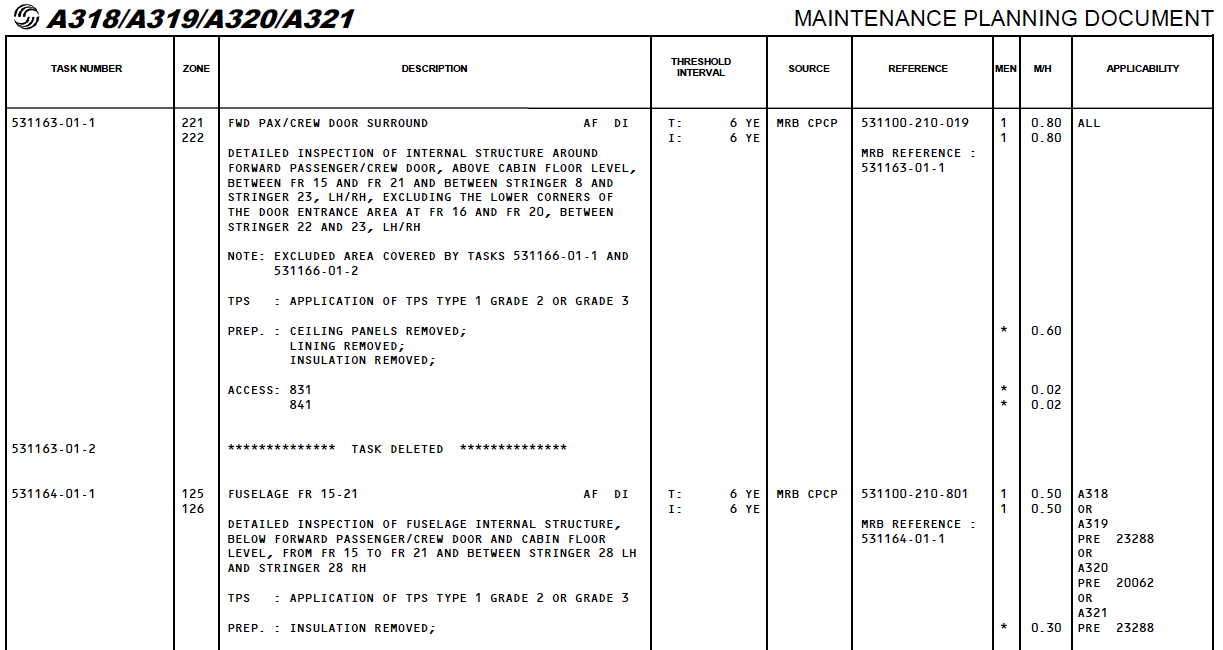
Figure 1. MPD task to inspect the structure around the passenger doors. Source; Airbus. Click to see better.
Now, the Aiframe OEMs use the MSG-3 process to define maintenance requirements for the aircraft, with approximately 1,200 tasks for an aircraft of our type and size. These tasks (inspections, lubrications, replacements…) have a combination of Flight Cycle (FC), Flight Hour (FH), and Calendar time limits. These are no longer clustered in A, B, C, D check cycles as before.
It’s now for the operators’ maintenance department to take the 1,200 tasks and schedule them as best suits the airline. Depending on the operation and facilities at the home base and outstations, it can be beneficial to do tasks early so that they can be done at the home base during the overnight service event. The operator has full freedom to develop the plan, provided the limits are maintained, and the local regulator approves it.
The regulator may impose additional maintenance requirements beyond those prescribed by the MPD. The requirements are described in Certification Maintenance Requirements (CMR), which contain maintenance tasks that must be done to keep the Type Certificate, and different Airworthiness Limitations documents (AL, e.g., tasks to inspect fuel tanks to prevent arcing or fatigue hard limits for structural parts).
The plan for the Continuing Airworthiness, submitted to the local regulator, must also detail how compliance with Airworthiness regulations, Airworthiness Directives (ADs), the arframer’s Service Bulletins (SBs), and modifications shall be implemented. The plan also details component replacements, life-limited parts management, and how records and maintenance logs are maintained.
In short, continuing airworthiness is an ongoing, continuous process with the operator as the responsible entity that ensures an aircraft remains safe, legal, and ready to fly at all times.
To compare with Continued Airworthiness
While continuing airworthiness is focused on an aircraft’s day-to-day airworthiness, continued airworthiness refers to the broader, long-term design integrity and safety of the aircraft type throughout its service life. This concept primarily falls under the responsibility of the aircraft manufacturer and aviation authorities.
An enlightening post on continuing v. continuous service
for the operator. Thanks.
Bjorn, good piece. Just to add a few other attributes please.
It’s true the continued airworthiness is the responsibility of the OEM, to include the engine OEM but it’s the airline operators who drive the content and focus on major issues affecting specific fleets.
An airline continuous maintenance program, specifically known as the Continuous Airworthiness Maintenance Program (CAMP), is a mandatory, structured framework regulated by aviation authorities (e.g., FAA in the US) to ensure aircraft remain safe and compliant through routine,, scheduled, and progressive inspections, including line maintenance and heavy checks (A-D checks). It integrates manufacturer data and operator experience to ensure safety.
Key Elements of a CAMP Program
Regulatory Compliance: CAMP is required for 14 CFR Part 121 (commercial), Part 135 (charter), and Part 91K (fractional) operations to maintain continuous airworthiness.
Maintenance Checks: Structured, interval-based inspections ranging from routine, daily “flight line” checks to heavy, comprehensive, structural D-checks.
Progressive Maintenance: Enables inspections to be spread out over time, reducing downtime by accomplishing tasks at convenient, scheduled intervals.
Reliability Program: Evaluates the effectiveness of the maintenance, using data analysis on component failures and repair rates to adjust task frequencies and monitor the delay and cancellation rates due to maintenance and engineering.
Continuous Analysis and Surveillance System (CASS): Monitors, analyzes, and corrects maintenance, ensuring the program’s ongoing success and safety compliance.
This program is one of the most important as it allows the airline to stay within the good graces of the regulator.
Specialized Programs: Includes ETOPS (Extended-range Twin-engine Operations Performance Standards) maintenance for over-water/remote flights.
Finally one of the most important programs implemented, by regulators, is the SMS. With key risk assessment tools. ASAP and FOQA are important tools for maintaining safety.
Thanks, Airdoc.
Appreciate you chipping in. There are many moving parts around an airliner. Does EASA have an equivalent?
That is the amazing kind of background and detail that is extremely informative into the nuts and bolts that makes things work.
Well Done!
Bjorn,
Yes EASA genesis was developed following the standards set forth from the UK-CAA. All worldwide regulators follow these standards.
The standards were good.
Oddly, my dad was working for the CAA when they transitioned to the FAA.
The problem was that the FAA then went on to violate its standards. Hopefully that is a not to happen again aspect.
I don’t believe China follows those standards as they failed to get certification on two programs.
I think of it as Gold Standard and D and sometimes F implementation by the FAA