
Leeham News and Analysis
There's more to real news than a news release.



Bjorn’s Corner: Blended Wing Body Airliners. Part 2

By Bjorn Fehrm
March 20, 2026, ©. Leeham News: We have started a series of articles on the Blended Wing Body (BWB) as a potentially more efficient design for passenger-carrying airliners than the classical Tube And Wing (TAW) configuration.
In the first article last week, we established that it’s not about getting more lift during the efficiency-deciding cruise phase; it’s about reducing the drag that must be countered by engine thrust.
The drag in cruise is essentially decided by the air friction drag against the aircraft’s outer skin, called the wetted surface of the aircraft, and the induced drag, which is decided on how wide the aircraft is where there is lift generated. The reason is the high pressure below the wing will push air towards the wingtips to circulate to the low pressure above the aircraft, causing the global circulation around the wingtips of an aircraft.
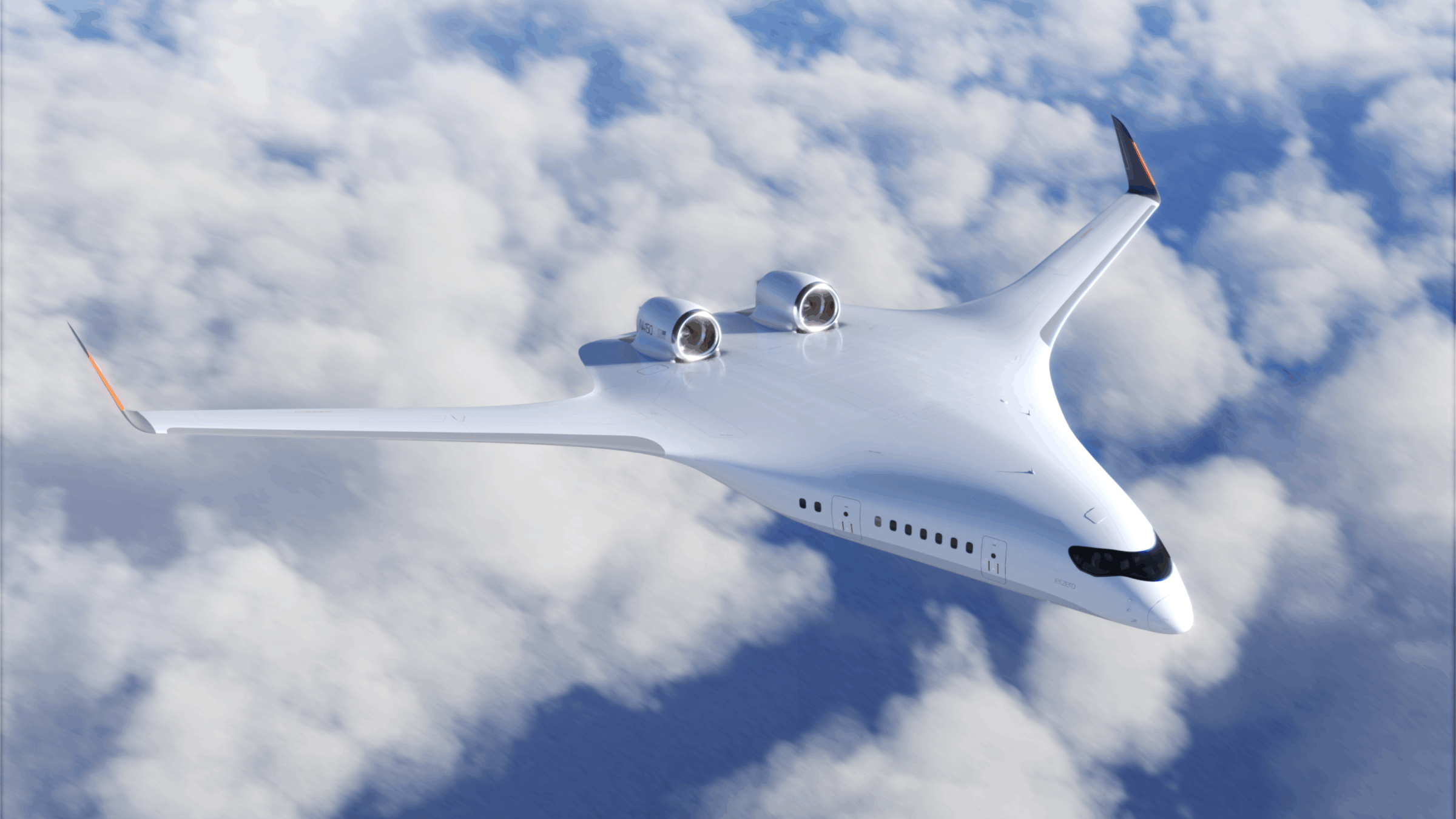
Figure 1. The JetZero Z4 Blended Wing Body 250 passenger concept. Source: JetZero.
The drag of a Blended Wing Body airliner compared to a Tube and Wing design
We will now look at the drag of a Blended Wing Body compared to the classical Tube and Wing aircraft. Let’s do the analysis for JetZero’s Z4 in Figure 1, a 250-seat aircraft and a smaller variant designed in 2019 by the same core team then called DZYGN Technologies Inc., with JetZero’s CTO and founder, Mark Page, as a member.
The smaller aircraft is a BWB presented in a DZYGN report as the Ascent1000 (Figure 2).
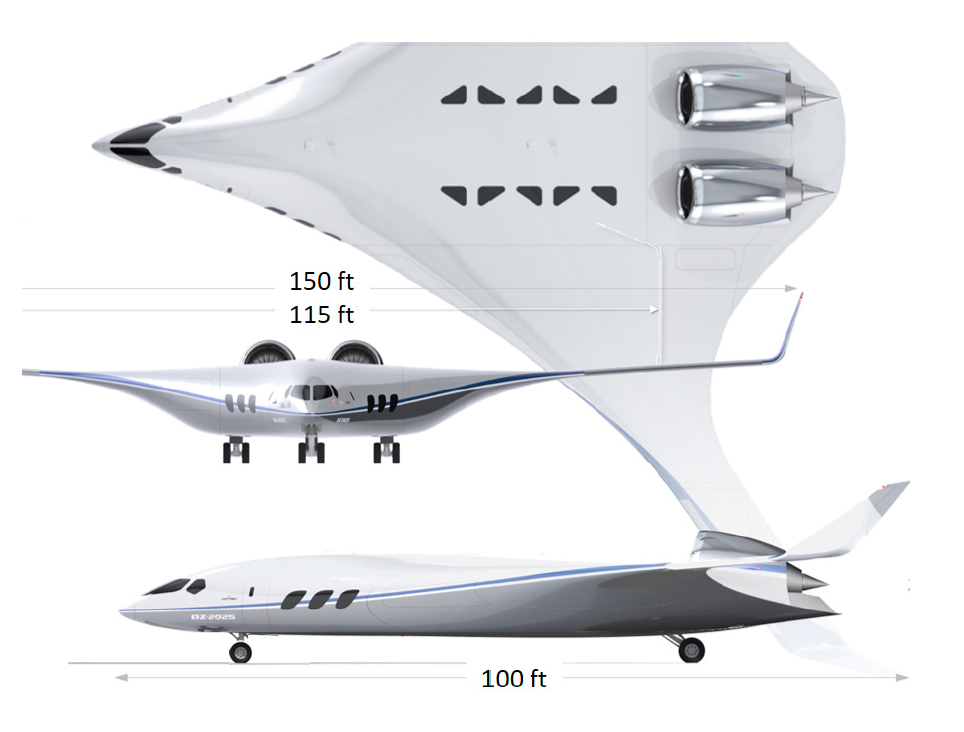
Figure 2. The DZYGN Ascent1000 165 seater BWB. Source: DZYGN Technologies Inc.
It has a passenger capacity of 165 seats, the same as the MAX 8 when using the US Domestic cabin comfort standard. We get a bit more data from that paper than what is officially known about the JetZero Z4 in Figure 1.
Air Friction Drag
The air-friction drag is proportional to the wetted area when we assume turbulent flow for the aircraft (which is the normal state; laminar-flow assumptions are for optimists).
The Ascent1000 actually has a 12% larger wetted area than the MAX 8 in Figure 3, which is surprising. We will discuss why in the following Corners. It has to do with the problematic takeoff and landing characteristics of a BWB.
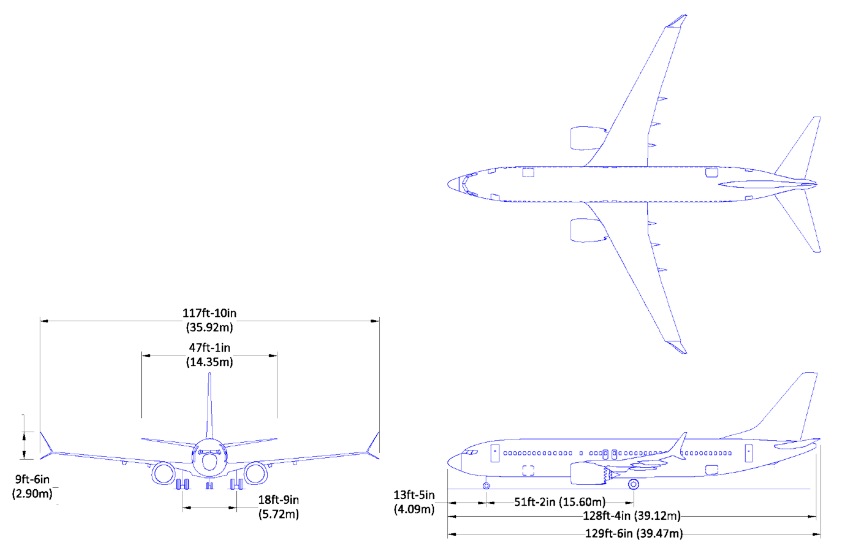
Figure 3. The 737 MAX 8 in 3D views. Source: Boeing.
After designing the Ascent1000, the JetZero team increased the cabin size of the JetZero Z4 to 250 US Domestic seats, matching the capacity of the Boeing 767-300. The Z4 then has a wetted area that is 16% smaller than the 225-seat 767-200, Figure 4, and 24% smaller than that of the 265-seat 767-300.

Figure 4. The JetZero Z4 superimposed on a Boeing 767-200. Source: JetZero and Leeham Co.
Induced drag
Induced drag is determined by the total wing span, which resists the global circulation around the aircraft. This includes any wingtip devices. Not because these affect the wingtip vortices, as many writers assume. The extension of a wingtip into a winglet simply adds a tripway for air to circulate around before it reaches the lower-pressure area above the wing.
Structures that are vertical, like winglets, are a bit less effective at affecting this circulation compared with raked wingtips, such as those on the Boeing 787, or low-profile winglets, such as the A350 Sharklets.
The Z4 has an effective wingspan of 57.6 m when we count the winglets/vertical tailplanes, versus the 767’s effective wingspan of 50.6m with winglets. So the induced drag will be lower for the Z4, given that these would have similar cruise weights. Neither of these airliners fit in the common 36m gates; they have to use Widebody gates.
For an airliner that shall fit in the 36m gates of the A320 series or the 737 NG/MAX, a BWB like the ASCENT1000 at 150ft/46m would not fit. It’s why it has folding wingtips that limit the gate width to 115ft (35m, the light gray vertical line).
We are now comparing a future BWB airliner with an existing MAX 8. The future BWB would use folding wingtips to take the 150-ft wingspan down to the gate width of 36m. So would a future Tube-And-Wing (TAW) replacement for the MAX 8, using a 150ft wingspan with folding wingtips, so given the cruise weight would stay the same, we would not see any induced drag advantage of a BWB versus a TAW single-asile replacement.
The fact that we must measure induced drag at the same weight to get comparable drag is because, as we can call the drag due to wetted area the drag due to aircraft size, the induced drag can be called the aircraft drag due to weight. Of the two, the size stays constant during the mission, whereas the weight varies as the aircraft burns off fuel, and thus the induced drag varies as well.
Conclusion
It seems there is a scaling problem with BWBs. The many projects that have studied BWBs since 1990 have all focused on large examples with seating at or above the Boeing 747 levels. When Page designed the Ascent1000 with the same passenger capacity as the MAX 8, the BWB shows no drag advantage if we equipped both with folding wingtips.
The next project, the Z4, was therefore increased in size so that the comparison would be with the rather old and inefficient 767, which is known for its low-aspect-ratio wing. We will explore this scaling problem more as we dig deeper into BWBs.
The engine position aft on top of the fuselage can help by sucking in slow boundary layer air and accelerate it. One issue is new demands on anti-ice as the engines will suck in what stays on the top of the fuselage. T-O pitch moment due to a short distance between tail and c.g. is another. Most US airports have long runways allowing them to T-O like a B-52 still it is a limitation. Doing engine inspections above the fuselage is a thing if the past (DC-10/MD-11 and Lockheed Tristar mid engines). Any engine uncontained failures have a bigger chance to hit the fuselage or its buddy engine. So lots of engineering work to make it commercially competitive
Sounds like there’s no real advantage to the BWB as currently envisioned, and a lot of added complexity.
Much appropriated. I am very interested in BWB. Pretty simply, we have such marginal ability to increase a T&W aerodynamically , very interested in alternatives.
I think the following qui9te out of the article would be cleared up by different phrasing. No issue in getting the intent, but its somewhat awkward.
” It’s why it has folding wingtips that limit the gate width to 115ft (35m, the light gray vertical line).”
More accurate, Gate width is what drive the need for folding wings in this pax size aircraft.
note: I am also very interested in TTBW for the same reason. How viable it is, I clearly do not know. One issue is the strut and public perception/acceptance of that. Nothing wrong with struts but its not a common aspect even in short haul aircraft. Most people do not fly Twin Otters or Skyvans!
The bigger span the higher % of the wing area is experience laminar flow with less drag. The T-O pitch moment can be an issue but you have space for a flap into the fan exit stream to increase pitch moment just for rotation.
I think one plan was to extend the nose gear on takeoff so you got the angle. Supposedly you could do it without the nose gear extending, but of course you had to have the runway to do that.
they then dropped it (why do something complex when you can’t count on it!)
A great example that engineering is all about plus and minuses and you need to blend and adjust to deal with that.
In this case it is also, oh, it has to be cost effective to build.
One nice thing about a TAW design (at least with wing mounted engines) is that the payload is distributed either side of the centre of mass more or less symetrically. No need for ballast weights when flying empty.
Looking at the picture, the centre of mass of the flying wing seems a very long way aft – is the above true of BWB aircraft? Does fuel need to be pumped around to maintain trim? It would seem to need a lot of elevator authority to rotate it at take-off.
Something that I don’t understand is the comment in the article, “the induced drag will be lower for the Z4, given that these would have similar cruise weights.”
The passenger cabin is so far from ideal from the point of view of resisting pressurisation loads – about 7 lb/sq in, so needing to be reckoned with – that I’m not sure a pressurised BWB would be of similar weight (assuming the two types are flying at the same altitude). There are going to have to be a series of large spars across the belly and top of the passenger cabin to keep it in shape, and the two are going to have to be joined by cross-members to relieve bending loads. Or am I wrong?
The Z4 has more span, 55m instead of 50m + the effects of winglets. You are on the money regarding structural challenges.