
Leeham News and Analysis
There's more to real news than a news release.



MTU Aero Engines posts Q1 gains, sees continued strength despite geopolitical pressures
By Thomas Blackwood
April 30, 2026, © Leeham News: Operating profit and revenues at Germany’s MTU Aero Engines were up in the first quarter of 2026 amid a strengthening position across both the military and commercial divisions.
 Adjusted revenue was up 7% from €2.1 billion to €2.2 billion, while adjusted operating profit reached €320 million, 6% higher than in the first quarter of 2025 (€300 million).
The adjusted EBIT margin held steady at 14.2%, compared with 14.3% in the prior-year period, and adjusted net income grew by 3% from €221 million to €229 million.
The company confirmed its guidance for the full year and said that despite the uncertainty with the Iran conflict the board was “confident” it would reach the targets set, of full year adjusted revenue of between €9.2 billion and €9.7 billion, and adjusted EBIT of between €1.35 billion and €1.45 billion.
Geopolitical tension fails to dampen MTU’s spirits
Speaking to investors, Johannes Bussmann, CEO of MTU Aero Engines, said geopolitical tension had driven a sharp increase in jet fuel prices and raised the potential for supply chain constraints putting pressure on airlines.
However he said that despite several airlines having announced moderate capacity reductions, the impact was “expected to be absorbed mainly by the older, less fuel efficient fleets, while demand for modern and fuel efficient aircraft and engine remains largely unaffected against that backdrop.”
With the Middle East crisis looming large over the aerospace industry, MTU said its military business had performed particularly well, with demand up.
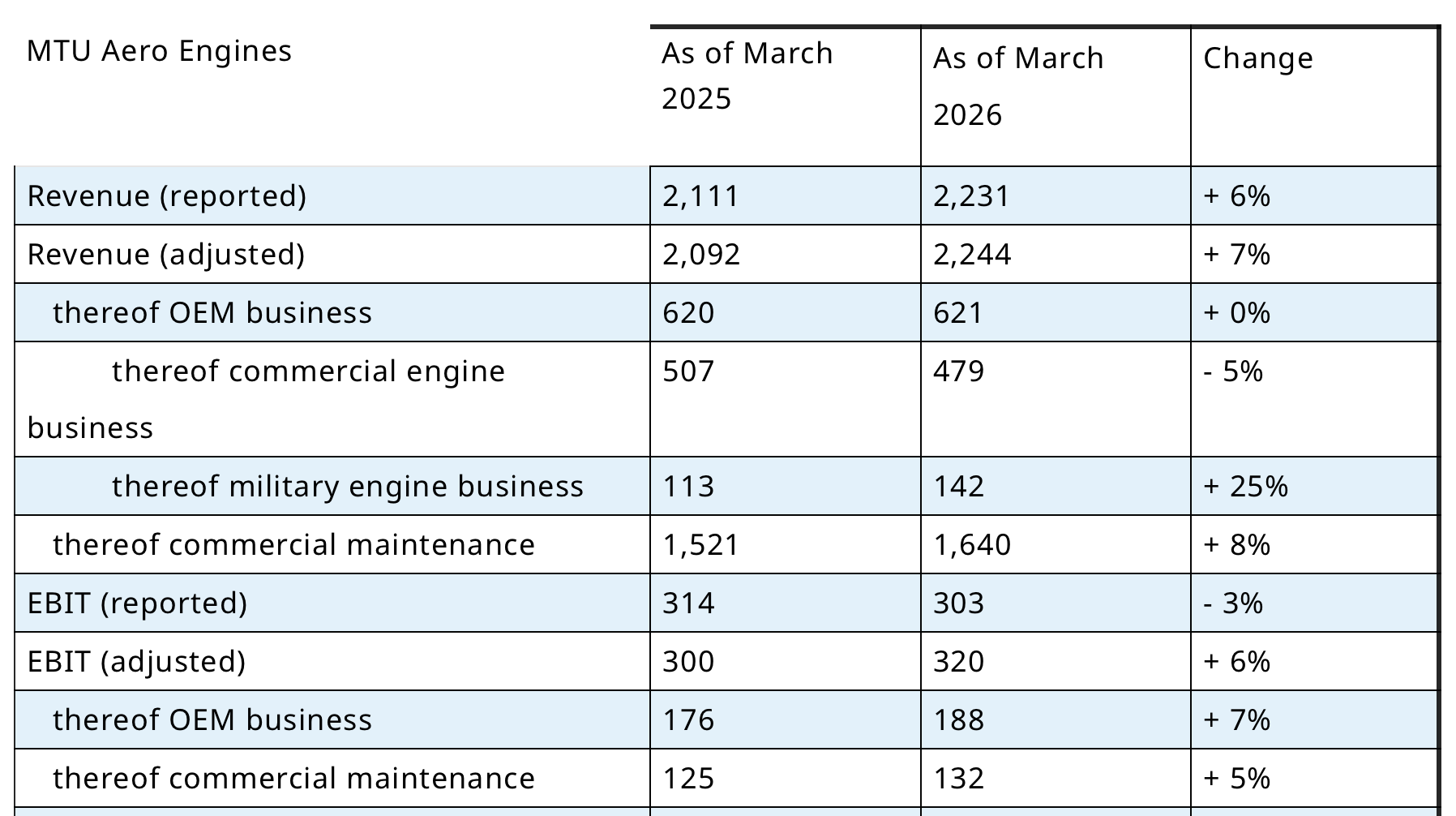
MTU Aero Engines’ key data the first quarter of 2026. Credit: MTU Aero Engines
Adjusted revenue climbed 25% from €113 million to €142 million in the division, beating the market consensus, with the EJ200 engine for the Eurofighter and the TP400-D6 for the A400M military transporter among the primary drivers.
This offset a 5% year-on-year decline in revenue for the commercial engine business to €479 million, down from €507 million. This was down on where the analysts average had settled for the commercial OE segment.
However, organic revenue growth for the commercial engine business remained stable on a US dollar basis.
Sold out for three years
Munich-based MTU’s confidence is underpinned by a strong group order book of €31.6 billion at the end of March, 7% higher than the prior-year value. That equates to MTU technically being sold out for three years.
Engines from the Pratt & Whitney GTF engine family, especially the PW1100G-JM, and the V2500 made up the highest proportion of the order backlog.
The GTF fleet management plan remains on track, and MRO outputs increased by 23% in the first quarter.
Turnaround times are benefiting from an improved supply chain and airlines have reported back to MTU that the long-running issues that have left large parts of their fleets grounded are easing.
For airlines, that wait has been arduous. The GTF has been in service for more than 10 years now and has accumulated over 50 million flight hours, and with an order book of 8,000 engines.
“The GTF management plan is well on track, operationally and financially, and AOGs [aircraft-on-ground] are trending down,” Bussman said during Thursday’s earning call.
A resilient portfolio mix
Bussmann also struck a confident tone when discussing the company’s current position, pointing to a balanced portfolio and continued strength in maintenance, repair and overhaul.
“We are well protected by our resilient portfolio mix and our strong MRO positioning,” he said.
“Airframe order books are basically sold out through the end of the decade. For the aftermarket spare parts and MRO, demand for shop visits remains strong, and there are no signs of weakness in our shops. We have not received a single cancellation or meaningful deferral.”
MTU’s free cash flow also increased by 18% from €150 million to €177 million in the first quarter.
Capturing the UAV market
Having acquired drone engine startup AeroDesignWorks this month, MTU now has a foothold in the burgeoning drone propulsion market – and the firm’s CEO stated clearly to investors that he is seeking to establish MTU as a core European supplier for UAV propulsion systems.
“Unmanned aerial systems are becoming a key capability in modern defense and propulsion is a critical enabler of their performance, reliability and mission effectiveness,” said Bussman, noting that MTU had “seized an opportunity to enter into another area of a rapidly evolving UAV market.”
He added: “The demand for military drones is clearly visible.
“The global market for military drones is expected to grow by around 12.5% per year for the next five years, and what has been missing so far is European made propulsion systems that meet military requirements in terms of quality, reliability and especially industrial scalability.
“This is where we, as MTU, come into play.”