
Leeham News and Analysis
There's more to real news than a news release.



UPS MD-11F crash, theft of trade secrets lawsuit impacts on cargo market
By Scott Hamilton
Nov. 11, 2025, © Leeham News: The Nov. 7 UPS MD-11F crash and a new trade theft secret lawsuit are likely to impact the air freighter new sales and conversion markets.
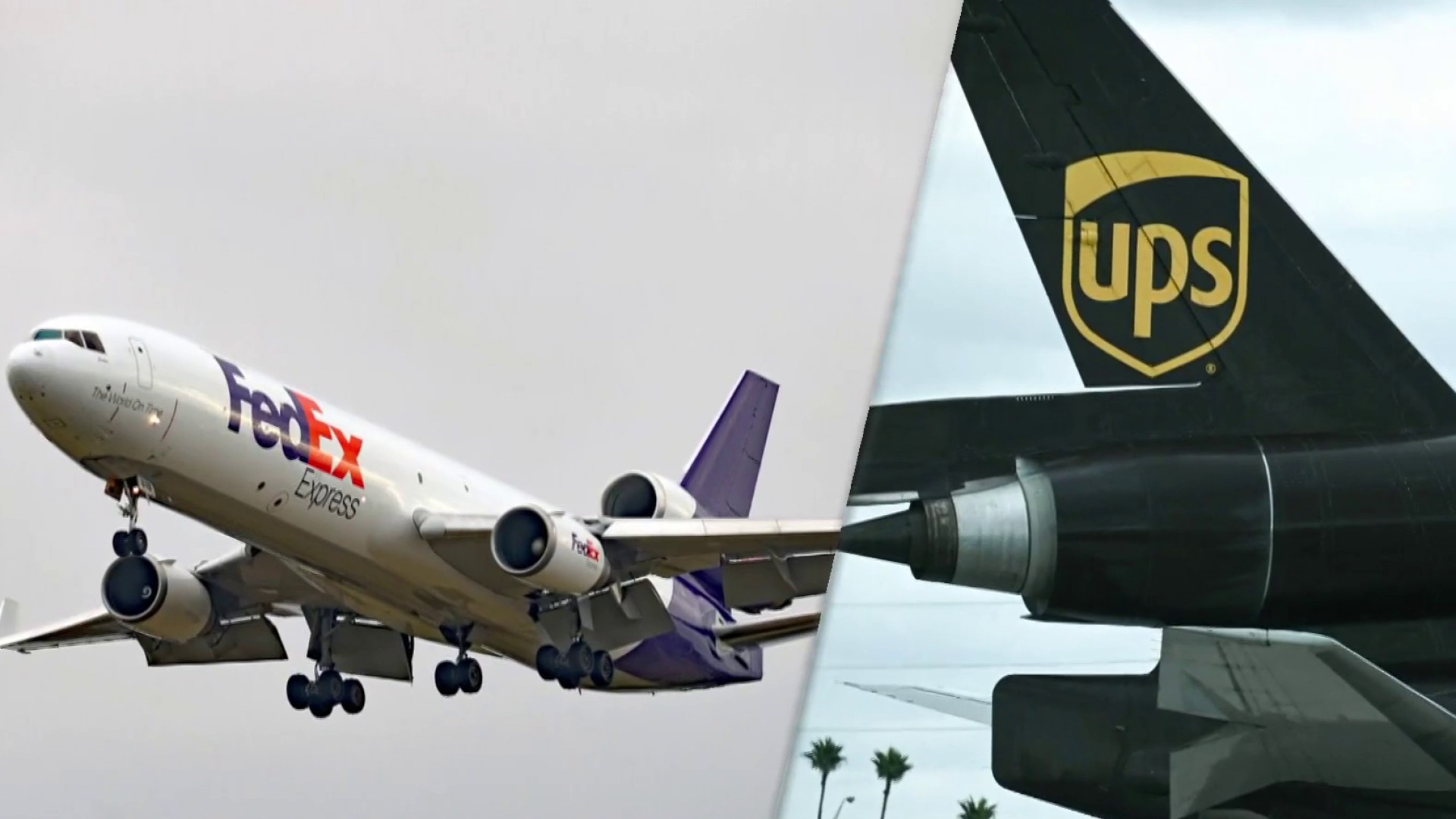
Boeing MD-11Fs of FedEx and UPS were grounded following the Nov. 7 crash of a UPS MD-11. Credit: NBC News.
Boeing recommended grounding MD-11Fs pending inspections of the engines and pylons, a move mandated within a day by the Federal Aviation Administration. The cause of the crash is unknown. The No. 1 engine separated from the widebody cargo airliner on takeoff from the Louisville (KY) airport. The airplane had passed the V1 commitment speed when a fire broke out, and the engine and pylon separated from the airplane.
The cause of the fire and the sequence of separation remain under investigation. More than a dozen people were killed, including the three pilots on the plane and the rest on the ground, when the plane crashed into an industrial park.
A theft of trade secrets lawsuit was filed on Oct. 20 in the US Federal District Court in Oregon by P2F company Precision Aircraft Solutions LLC against Mammoth Freighters, also a P2F conversion company. Precision converted Boeing 757s from passenger to freighter configuration and now converts Airbus A321ceos. Mammoth converts Boeing 777-200LRs and 777-300ERs.
One of the principals of Precision, William Wagner, left Precision and years later co-founded Mammoth. About 20 employees from Precision went to work for Mammoth and, for a time, Precision and Mammoth cooperated on the latter’s process to achieve a Supplemental Type Certificate (STC) for its conversions, according to the complaint filed in federal court. Precision alleges that its former employees signed Non-Disclosure Agreements that restricted the use of its trade secrets for the benefit of Mammoth.
The unrelated UPS crash and the lawsuit may have ramifications for the respective segments of the air cargo market.
UPS crash ramifications
UPS and its chief rival FedEx are the largest operators of MD-11Fs. The former has 27 aircraft and FedEx has 25. Tiny Western Global Airlines has two. All were grounded by the Boeing recommendation and the FAA emergency Airworthiness Directive. These may be returned to service following inspection and fixes, if any are needed.
UPS planned to retire its MD-11 fleet within the next two years.
Airbus has made presentations to FedEx and UPS for several years for its new A350F, so far without success. Its competition is Boeing’s 777-8, which is the same size as the 777-300ER passenger airplane (and the converted 777-300ER undertaken by Mammoth and two rival companies). The A350F is based on the -300ER-sized A350-1000, but it is slightly shorter.
Analysis by LNA’s Aircraft Performance and Cost Model (APCM) concludes that the A350F is generally the better aircraft for volumetric payload and the 777-8F is generally the better performer for heavy payloads. UPS and FedEx are volumetric operators.
The A350F uses the Rolls-Royce Trent XWB-97 engine, which has had durability issues in harsh Middle East and severe salt-air environments. Rolls claims to have resolved many of these problems. The 777-8F will use the newer GE Aerospace GE9X, which has yet to enter service due to the long delays to certify the 777-9. LNA’s APCM concluded that the GE9X is more fuel efficient than the older, smaller-diameter Trent XWB-97.
The A350F is supposed to enter service in 2027. LNA is told that initial customers have been informed by Airbus that EIS may slip to 2028. The 777-8F is supposed to enter service in 2030, but a new certification delay casts doubt over this.
Earlier Airbus production slots
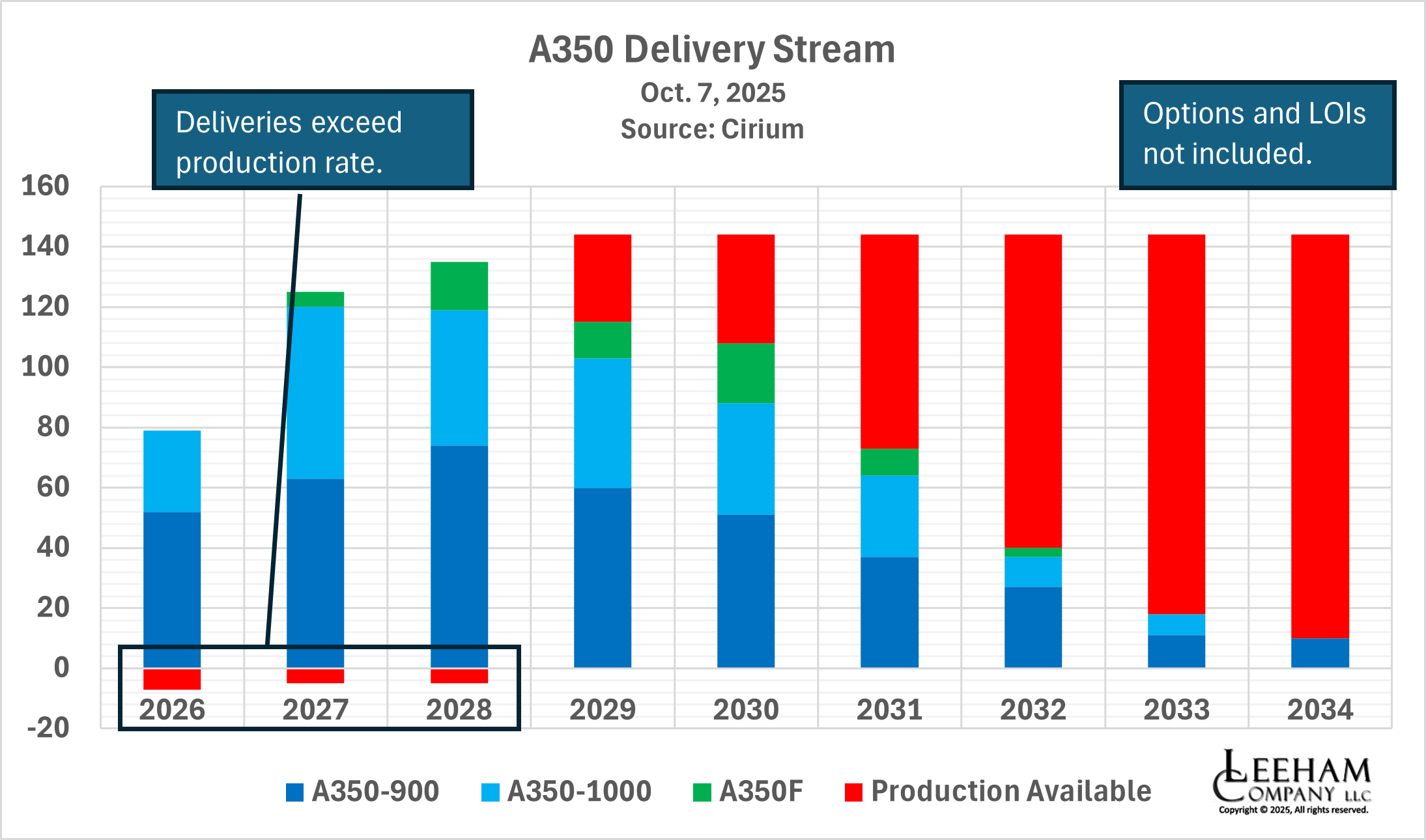
Regardless, Airbus has earlier delivery slots than Boeing, provided its sales department doesn’t fill the slots with A350 passenger models. Notably, for the first time, Airbus has more freighter sales (74) than Boeing (59) for competing aircraft. Wins from either UPS or FedEx will be a major blow to Boeing, which has dominated both fleets forever.
Trade secret theft lawsuit
The trade secret theft lawsuit filed by Precision against Mammoth comes shortly before Mammoth expects to win a Supplemental Type Certificate for the 777-200LRF conversion. Conversion of the first 777-300ER is underway.
Precision’s lawsuit includes details of its allegations. It may be downloaded here: Precision v Mammoth 10-20-25. As of the end of business on Nov. 10, Mammoth hadn’t filed its response.
The allegations could have the effect of delaying new orders for Mammoth. This is what happened when Mammoth filed theft of trade secret lawsuits against the parties of a rival company, Kansas Modification Center (KMC). KMC was developing a forward-cargo door conversion of the 777-300ER and initially had discussions with Wagner, who eventually co-founded Mammoth.
KMC was not sued. The defendants were its marketing entity, Sequoia Aircraft Conversions, LLC, and its founders, David Dotzenroth and Charles Wiley Dotzenroth, Andy Mansell of the financial advisory firm Split Rock, and NIAR, the aerospace research arm of the University of Kansas at Wichita, the engineering firm for KMC. Mammoth sued because it alleged these entities benefited from conversations and presentations from Wagner.
Once these lawsuits were filed, KMC’s efforts to take orders dried up, although there was also market doubt about funding for the project. Eventually, Mammoth dropped all lawsuits before trial, with no compensation from any party.
While the KMC project was a start-up, Precision has been in business since 2001. It claims the improper taking of trade secrets and loss of some 20 engineers has harmed it financially and its standing in the industry. It asks for a jury trial.
Competitive landscape
IAI Bedek of Israel is a competitor to Mammoth and KMC. The STC for its 777-300ER P2F conversion was recently issued, years later than expected. The COVID-19 pandemic, changes to the certification process by the FAA following the Boeing 737 MAX crisis, and difficulties in obtaining Boeing licenses for its intellectual property led to the delays. IAI’s first conversions have just been delivered to operator Kalitta Airlines. The aircraft are owned by the lessor AerCap. KMC has yet to win more than a handful of orders.
Feedstock to the three companies relies upon the retirement by passenger airlines of the 777-300ER. This feedstock has virtually dried up due to certification delays of the 777-9, which is required before the 777-8F will be certified, and due to delays in the Boeing 787 and Airbus A350 programs. Airlines that planned to retire the 777-300ER (and in some cases, the 777-200LR and A330-300) have had to retain the older airplanes in order to maintain capacity. IAI, KMC, and Mammoth have each been affected.
Before the MD-11 crash, FedEx had expressed an intention to delay retirement of its MD-11 fleet from 2028 to 2032…at which stage the average MD-11 fleet age at the company would be 38 y/o.
The A350F may be a better fit for parcel carriers like FedEx and UPS, but Donnie won’t like it at all if two prominent US companies decide to order non-Boeing. So, they’ll probably order 777-8Fs and somehow muddle along for another decade until delivery.
Meanwhile: how’s the ghost-like 787F plan coming along? Is it any nearer to becoming a reality?
Given that the crashed MD-11 only had just over 10,000 cycles on the airframe with proper maintenance they should be able to operate them safely for another decade at least. Keep in mind the Airforce’s KC-135 fleet was built in the 1950’s and the last one came off the assembly line in 1965 and they are still flying safely. It’s the airframe cycles that really count with proper maintenance and service as a given.
What about parts availability for MD-11s?
And don’t forget public — and political — perception:
“Aging plane crashes into buildings and kills 4 times as many people on the ground as on the frame”…
…is not a good look.
The comparison to the KC-135 fleet is not very apt, as tankers clock *very* low flight hours compared to commercial freighters — of the order of 435 hours per year for a KC-135.
Flight hours and cycles on freighters are a fraction of passenger service so yes the KC-135 example is appropriate as a relative comparison. If you want to get into public and political perceptions about aircraft I cannot help you there. Ours is a technical business and aircraft are not designed, built, operated and maintained on perceptions. Right now there’s a lot of people in Asia that feel that a crash was caused by the aircraft itself rather than the operators of the aircraft. Fortunately our industry is driven by objective facts and not feelings and perceptions.
“Fortunately our industry is driven by objective facts and not feelings and perceptions.”
The Concorde story would suggest otherwise: for British Airways, the huge popularity before the crash never returned after RTS.
The glamorous image had become irrepairably tainted.
There were also frequent flyers who actively went out of their way to avoid airlines using “mad dog” MD-80/90s: no particular incidents — just unreliable, antiquated wrecks compared to what other carriers were offering.
But there are also counterexamples.
We’ll just have to wait and see.
p.s. Not at all clear yet that those people in Asia are wrong: we’ll just have to wait until the accident investigation report appears.
Keep in mind that the KC-135 of the USAF spend plenty of time on the ground throughout their lives:
> In 2006, the KC-135E fleet was flying an annual average of 350 hours per aircraft and the KC-135R fleet was flying an annual average of 710 hours per aircraft
[Not quite comparable with UPS or FedEx. ]
The USAF also made an effort to “modernize” a large number of the KC-135 with new engines.
** Nevertheless both UPS and FedEx plan to retire their MD-11F. Many older generation of aircraft are retired as supply of parts dry up! Not because the aircraft reach their number of cycles or hours of flying!
Can anyone here explain why the USAF retired their KC-10s?
Also I discover this:
> The USAF projected that [KC-135] E and R models have lifetime flying hour limits of 36,000 and 39,000 hours, respectively
Doesn’t seem to align with what poster here tried to say.
The KC-10 were mostly used as freighters and were not sitting idle on the tarmac as the KC-135 with close to no real cargo capability. The aircraft was so good for cargo transportation that it was sometimes banned from refuelling missions. The fleet had 2.3 million flying hours in 2020. That’s about 40,000 hours per aircraft. Maybe a life time expansion program was cancelled due to KC-46 somehow entering service.
Due to the experience with kC-10 the USAF was focused on the C part for KC-X but then Boeing never would have got the contract.
The KC-10 was retired because the original mission was obsolete. It was intended to fly NATO refueling mission nonstop from CONUS, presuming that the Soviets would deny airfield access in Europe. Today, most NATO members have their own tankers.
Additionally it had the highest cost per flight hour in the fleet, and was overkill for most refueling missions, where only a fraction of its capacity was needed. It’s cheaper to fly the KC-135, and a lot cheaper to fly the KC-46.
@Pedro
> The KC-10 was retired because the original mission was obsolete. It was intended to fly NATO refueling mission nonstop from CONUS, presuming that the Soviets would deny airfield access in Europe. Today, most NATO members have their own tankers.
It was about to top off C-17s to get them across the Atlantic. C-17 has barely a range of 3.000 nm with a fuel load of 135 cbm or 108 t. A KC-135 can load 90 t of fuel while a KC-10 can carry 165 t. These types of missions still exist today.
> Additionally it had the highest cost per flight hour in the fleet, and was overkill for most refueling missions, where only a fraction of its capacity was needed. It’s cheaper to fly the KC-135, and a lot cheaper to fly the KC-46.
KC-10 and C-17 have nearly identical costs per flying hour on first sight. After a closer look you need a tanker to get a C-17 to destination while the KC-10 won’t need a tanker. About 2/3 of the KC-10 fleet were reserved for cargo operations only during Iraq war. The costs per hour are about 5 % more expensive for KC-10 compared to KC-135.
The costs for a KC-46 are lower? Never mention capital costs. That’s why some airlines still fly their own A340s. In case you get your 777-9 then you can retire the A340/KC-10.
The point about “overkill for most refueling missions” is mute in case for the missions where excessive range is required. USAF used KC-10 to refuel F-111 sized aircraft. How big is the F-47?
Will The USAF use a less capable tanker over the Pacific in case something happens there?
Sorry, a KC-46 doesn’t has the legs a KC-10 had or an A330MRTT has – Airbus already has the order for A330neoMRTT. DC-10-30 had a range of 5,000 nm while the A330-800 has over 8,100 nm. That aircraft could offer fuel over Japan and fly back to Honolulu.
Rob
How much does it cost to fly the kc-10? Is it significantly higher than the KC-135 (adjusted for higher fuel offload)? Show me your numbers.
On the contrary, it’s reported:
> It costs roughly the same to fly the KC-10 and the KC-135
kc-10:
From the tanker war times I seem to remember
that the kc-10 can tanker vast amounts of fuel
and burns another slightly lesser vast amount of fuel to getn on station, linger and back.
i.e. a fuel guzzler.
Incredulous statements from Pedro and Halblaub. Not really worthy of rebuttal, as the facts are well documented in the public domain.
Uwe is correct that the KC-10 was more expensive to fly.
The usual tactics: put up a bold face when one can’t provide any data to substantiate their statement. Because truth hurts their narrative. Plain and simple. OTOH as mentioned above, it’s reported: “It costs roughly the same to fly the KC-10 and the KC-135.”
Lol!! I give you credit Pedro, you stick to your lies no matter what. That makes you a premier influencer.
Rob
Typical behavior:
“When the law is against you, pound on the facts.
When the facts are against you, pound on the law.
When both are against you, pound on the table.”
Fact:
The KC-10 carries almost twice as much fuel as the KC-135 Stratotanker
Fact:
It didn’t cost twice as much to operate the KC-10 as the KC-135!
Fact:
In one mission, it took fourteen KC-135s to replace six KC-10s.
“Given that the crashed MD-11 only had just over 10,000 cycles”
Curious where did you get this information? It looks unrealistically low for a 34 year old airframe!!
PS: Between Dec. 31, 2021, and Dec. 31, 2024, UPS retired 13 total MD-11 planes.
Last I heard there will be no 787F, after Boeing floated those
early trial balloons for one. Samey same..
@Vincent: 2030 for a 787F
Excellent clarification — thank you.
So, around the same time as the (currently hoped-for) EIS of the 777-8F.
Will LNA soon be doing another article on the 787F?
@Abolone RE: 787F article: Not planned any time soon.
Hamilton
Thanks for the correction.
Scott,
Are you sure about that? I think you mean 2030 for the 777F. There are no miracles imaginable that would produce a 787F five years from now. There may not be any that will produce a 777F…
Internally a 787F by 2030 is the target. Boeing has most of the engineering already done.
That said, since when did Boeing last meet its target?
@Vincent
The first B787F might very well be a P2F conversion. A handful of conversion firms are exploring this. I would hesitate to bank on a 2030 EIS for new frames from Boeing given their recent track record.
Boeing will likely have at least three years of production gap on freighters after dominating the business for so long.
Interesting about the 787 P2Fs being considered.
Feedstock may be an issue — it’s already an issue for 777s and A330s.
Agreed as regards the (inevitable) delay to the 2030 date for the 787F.
***
On the subject of production gaps, BA delivery figures for Oct came out today.
53 frames in total, of which 39 MAX. Two of those MAXs were from the parking lot (6 and 6.2 years old, for China Southern and Air China), leaving 37 from the line.
So, the assertion right at the start of the Q3 earnings release — that MAX production had stabilized at 38 p/m during the quarter — still isn’t manifesting itself in deliveries.
Note that “stabilized” is a stronger term than the “reached” term used in May.
We’ll see what November brings.
Airbus delivered 78 frames in October, of which 64 A320/321s and 4 A220s.
Interestingly, it sent 4 A350s to Emirates in the month.
Someone can’t tell the difference between delivered and produced.
@ TW
We’ve been hearing the “produced but not delivered” excuse for months now — gets a little stale in a world in which customers are itching to collect their delayed orders.
Clearly you don’t want to get it.
I know you won’t respond, but tell me this:
You roll a MAX out the door Oct 31 at 11:30 PM.
Its not been through the delivery cycle (you know all that pesky stuff like check out, financing, inspections by owner)
Its the same aspect of Car production. The one metric is production, the other is sold (or in this case delivered) – aircraft and cars to be clear are not identical, I know people know that, but have to dot the I and cross the T (not in the Naval sense)
Pretty simple. It takes a week or two for all the delivery details to be worked out.
Delivery numbers will lag sales until your line is stabilized. Then deliveries will mostly reflect that but not perfectly. Boeing is headed to rate 42. The information is that it will take 5-6 months to both stabilize and confirm process has not deteriorated. Obviously (well to most) is that they won’t jump to 42 next month.
The good news to those of us who want Boeing as a company to succeed is that they proved to the FAA they can do 38 and no quality loss (probably continues to improve) and rate 42 is a go.
Why? Production is fixed. Any number of things can delay a delivery.
How long has Airbus claimed they will build (not deliver) 75 a month. Last look its about 60 (A320 series)
If there is a problem in the supply chain, that will impact build which is why they work so hard at it (all mfgs by the way).
You seem to think you are fooling people but its grossly obvious that you have a vendetta against Boeing and the US. Facts get run over deliberately in trying to carry that out.
@ TW
No “vendetta” at all.
But interested in the continuing mismatch between wat BA “says” and what it “shows”…in all sorts of areas.
Ask Tim Clark, for example.
If a frame is produced just before the end of month M, then it should show up in the deliveries for month M+1…right?
Not seeing that at all…every month since May.
Airbus isn’t continually claiming that it has “stabilized” production at a particular rate.
The operative word is “stabilized”.
No problem if BA says that it’s “working toward” something…but it’s going further than that.
It should be careful that investors don’t construe this to be misinformation — BA is already embroiled in enough shareholder litigation as it is.
Abalone – The Boeing earnings release says “737 stabilized production at 38 per month”.
You keep thinking this only means MAXs. You admit they delivered 37 from the line in October. They also delivered a P8 to Australia. There’s your 38. As an aside, there were 40 first flights for 737s last month.
> ..Interestingly, it sent 4 A350s to Emirates in the month [October 2025].
Heh, I see what you did there. 😉
ABALONE
There are holes in your calculations. There are only 20.75 MDAYS in a standard month. A 38 rate includes the P8 line as it takes up 1 Gemcor wing build up position. The real number is 1.831 aircraft a day off the line. Critique that for accuracy.
ABALONE ET ALL.
When Boeing says 37 a month, they really mean 1.831 aircraft per MDAY. They say 37 because its easier to visualize, but it lacks accuracy due to each month having a different number of days and the irrational distribution of holidays.
For October, 38 were delivered. This is 1.652 aircraft per calendar Mqday BUT 1.831 per standard month. So they are stabilized at 38
You can do the math
@ Russell
You’re technically correct as regards the 737 P-8.
The Q3 earnings report indeed says “737”…not “737 MAX”.
But FAA documents specify a 38 p/m cap for the “737 MAX”.
ABALONE WROTE.
So, the assertion right at the start of the Q3 earnings release — that MAX production had stabilized at 38 p/m during the quarter — still isn’t manifesting itself in deliveries.
Note that “stabilized” is a stronger term than the “reached” term used in May.
We’ll see what November brings.
Abalone and all you others out there that fail to understand manufacturing systems, heres a quick scheduling overview.
Boeing schedules (and production) are broken up into 3 phases. PreProduction, Production and PostProduction. These three phases are layered according to control code shutoff. A control code is an internal workstation where a work sequence is accomplished. Early control codes feed later control codes as raw materials are processed into detail parts, detail parts into sub-assemblies or end items, sub-assemblies into major components, and major components are joined into a deliverable.
Pre-production are actions taken prior to control code load. The cutoff date is called LSO freeze. These actions include production planning, tool design and fabrication, ordering of purchase parts to support the load date among other things.
Production is a layered event in which the control codes having scheduled work for a specific line number are activated and Industrial Engineering Bar charts showing the exact sequencing of each assembly task with the name of the assigned mechanic are printed using a precedence network to ensure the work is sequenced efficiently within the time allotted for the control codes closure. The Master schedule connects all control code closure date/times to ensure that all scheduled assembly tasks for IN POSITION WORK is accomplished concluding with Factory Rollout. The production schedule is complete at this point.
Postproduction work is done on the ramp in a line stall. The aircraft goes thru a number of functional checks who’s number and timing are quite variable depending on how the aircraft is equipped, how many new customer intro items are in the vehicle. The aircraft is fueled, leak checked again, has engine runups and trimming. Additionally, the aircraft needs to be test flown, finish rigged and in-flight functional checks made. These flights are called B1, B2 etc. They are Boeing flights flown by Boeing flight test pilots according to the flight test card package developed for this specific airplane in pre-production. Any squawks found must be addressed and reflown as necessary. Most airplanes schedule a B1 and B2 flight before moving on to Customer flights. The customer flights crew is specified by the customer who may use Boeing Pilots or their own. The customer checks the aircraft in flight using the flight test cards developed by Customer Engineering during preproduction. Additionally, any scheduled out of position work identified in preproduction is accomplished. These are usually customer specific items that cannot be sourced prior to the in sequence need date causing an LSO freeze conflict. THEN the Callendar dated BFE items such as slide packs, life vests, fire extinguishers, first aid kits and a myriad of other things are installed. Postproduction activities happen after factory rollout and do not count towards line rate calculations
So, what does this mean to a casual observer???
A casual observer looking to determine if the line rate is at 38 has no publicly available data to show this. Line rate calculations measure performance to PRODUCTION tasks.
The only thing available to casual observers is a monthly production number of 38. Inside the factory scheduling software this comes out to this.
38 a month x 12 months = 456 airplanes a year
In Boeing we work and schedule by MDAYS. MDAYS are Monday thru Friday, non holidays. This means given the current contract with 12 holidays (I think) there will be 248 production days a year. To get 456 planes built in 248 days you need to build 1.838 airplanes per MDAY.
Now is where the casual observer attempting to use a Calendar month to evaluate line rate gets lost even further. Each month has a different number of days AND holidays are distributed weighted to the later months. This year there are 23 MDAYS in Oct, while November has 18 and December has 17. The casual observer’s attempt to force distribute 38 aircraft into the line on these months is not possible and his expectations must align with the production schedule.
November is scheduled for 33.08 and December is scheduled for 31.24, BOTH of these are MDAY equivalents for 38 a month due to the MDAY count.
Some months will load in excess of 38. November will load 42,274 aircraft, which is a monthly equivalent of 38.
THESE are invisible to outside observers and attempting to follow things because nobody reports factory line rate from the first control code load. Boeing HAS reported the rollout of the first line rate 38 airplane, subsequent to that they have reported stability at line rate 38 which means that 1.838 airplanes per MDAY are being continually loaded. Attempts to extrapolate actual line rates from delivery data are clouded by month-to-month MDAY count differences along with the variability of the postproduction work packages for each vehicle along with customers delivery scheduling concerns.
In short. Relying on reported deliveries per month is a poor substitute for actual factory rollout data, which is available to some on a subscription basis.
Phew, you can give Tolstoy a run for his money! And I thought I was loquacious!
Great info, worth an article all by itself.
@PNWgeek, thank you for the detailed explanation. It is indeed not trivial or simple to calculate production rates. I’m content with what Boeing announces. All the analysts seem to be as well.
Trans
What’s the delta in month-to-month variation of delivery and production? Care to explain why, in your opinion, is it a major factor as we consider the monthly delivery number?
@PNW
Any explanation why the delivery number goes thru the roof near the financial year end? Somehow, deadlines and executive bonuses work in mysterious ways!
Russell
In Boeing’s Q3 2025 earnings release, under segment result of “Commercial Airplanes”, the company reports:
“The 737 program stabilized production at 38 per month in the quarter and jointly agreed with the Federal Aviation Administration in October to increase to 42 per month. The 787 program continued stabilizing production at seven per month and progressed on previously-announced investments to expand South Carolina operations. During the quarter, the company updated its assessment of the 777-9 certification timeline…”
https://investors.boeing.com/investors/news/press-release-details/2025/Boeing-Reports-Third-Quarter-Results/default.aspx
I’m quite sure the earnings release was reviewed by internal and external professionals including lawyers and public accountants to ensure its accuracy, it shouldn’t be mistaken as anything other than commercial aircraft production. Amirite?
PEDRO WROTE.
Trans
What’s the delta in month-to-month variation of delivery and production? Care to explain why, in your opinion, is it a major factor as we consider the monthly delivery number?
@PNW
Any explanation why the delivery number goes thru the roof near the financial year end? Somehow, deadlines and executive bonuses work in mysterious way
Good Questions PEDRO…..
Lemme take a shot at both
1st . Delivery Variability Delta. Delivery is controlled by the customer and not Boeing. In the current environment we have significant delivery delays caused by a number of supplier situations. Engines, Seats, Interior parts are still not on track. This hits smaller customers harder than Leasing companies. There are aircraft waiting for a lot of this stuff and how the contract is structured for the specific aircraft matters. In some cases, when the engines aren’t available, rental powerplants are affixed to the airplane on the line and the airplanes fly to storage. they don’t deliver until they are B1 flown by the production engine. That could be a while. There are a number of aircraft in varying but explainable situations where they cannot deliver. This is some of the hysteresis in the line and the part of the reason the delivery number of aircraft out of POST-PRODUCTION is variable. Boeing does not measure performance of Post-Production as it is not scheduled on bar charts or supplied by the Boeing MRP process. Boeing reports PRODUCTION, that is measured when it leaves the assembly line and goes to a Post-Production Line Stall.
2) Boeing flushes the facility of anything they can get delivered at the end of the year to pump the books. This annual event happens due to the total number of MDAYS in December being far lower than the yearly average. This means that the production line is stopped a lot for the holidays. 2 things make this work so mechanics can focus on the aircraft in line stalls to get them off the field. Remember, 1) the production lines stop on Non MDAYS so no schedule is lost and 2) the mechanics that are idle can platoon onto line stalls and kick em over the fence. This is all an overtime process, not interfering with normal production which is officially halted for factory shutdown. I see you talk about bonuses and deadlines working in mysterious ways, but it is more closely related to how the MDAY calendar gives you a significant production pause by having so many non-scheduled workdays in the end of the month freeing the overtime assets to really clear the decks. It would be the same Catch-Up story if the quarter didn’t end in December because it is an artifact of the December Mday peculiarities around Christmas shutdown. Your linkage of bonuses and deadlines doesn’t resonate with me since I understand the system at a different depth than streetside observers.. Great Questions by the way
@PNW
It appears you tried to blame there’re many Boeing aircraft that can’t be delivered because there’s a wide spread shortage of engines and customer furnished equipment which is contrary from what top BA executives said as recently as in October and the picture they tried to paint! Just curious, how many gliders BA has at the end of October?
My understanding is it takes awhile for the aircraft to go through various flight tests by BA and customers, not unusual to take like weeks. So I’m a bit doubtful that aircraft finished by mechanics because there’re no manufacturing days near the end of the year can be delivered by the year end!!
PS I’ve been watching flight tests of aircraft to be delivered for awhile.
PEDRO.
I gave you examples of Post Production Variability. I thought you were looking at that when I saw your response. IF you are asking why the difference in deliveries month to month is so different, I have that. I covered it in my long post on how the Boeing Production system schedules things. So lets try again in a way you might see better.
First, You are using a monthly Callendar. That makes it difficult to track things.
Boeing at rate 38 will build 456 1ircraft a year.
Boeings assembly line is scheduled to run 248 days a year. 248 MDAYS, this is 1.83 airplanes per mday
248 MDAYS divided by 12 months is 20.66 days a month average for the “Standard month” of 20.66 MDAYS
This is the number Boeing gives the press. It calcs out to 38
I’m going to take the 2025 MDAY calendar dates to work from. since I can’t find the 2026 yet.
Month/ MDAYS/ airplanes
JAN 21 38.43
FEB 19 34.77
MAR 21 34.83
APR 22 40.26
MAY 22 40.26
JUNE 21 34.83
JULY 22 40.26
AUG 21 34.83
SEPT 21 34.83
OCT 23 42.09
NOV 18 32.94
DEC 17 31.11
These are the actual monthly production numbers on the stated notional rate 38.
It becomes quite obvious that when viewed by the Callendar Month, it looks like there’s a lot of difference in production when there isn’t. Your perception of big differences in monthly reported delivery’s is difficult to reconcile until you look at the actual schedule.
The assembly line steadily producing at a 1.83 airplane per MDAY will send a variable number of aircraft into Post Production BY DESIGN. Theres a story here, and it is told by the master schedule which does not recognize a calendar month in its methodology. In Boeing, the MDAY calendar gives every production day an increasing number. you start at mday 1, count to 1000 and reset it. This calendar eliminates differences in how different entity’s look at dates, because each day gets a specific numeric value, and that makes scheduling really easy when somebody tells you are 37 mdays out. It’s really solid.
That should get you a lot closer to why you, using a monthly calendar, has so many questions. Have a look. the mday is in small black numbers
https://www.speea.org/Member_Tools/Spirit_Payday_calendar.pdf
Wouldn’t Boeing 787 P2F conversions be quite problematic, given its composite fuselage (amongst other things)?
We’ll see how it goes.
For new build 787 freighters, Boeing would design a new fuselage section that contains the cargo door.
For conversions, the section with the door would need reinforcement to carry the loads around the door. It’s no different than aluminum in principle, but more involved, time consuming, and expensive with composites.
There have been studies done on the stringers, which indicate changing the shape would stiffen the structure sufficiently to support the door, in new builds.
For conversions, there would have to be either doubling or enclosing of the flat space between stringers
It’s not a question of whether it can be done, but rather that it hasn’t been done before, so there’s a learning curve involved. Several conversion companies have proposals underway.
When Boeing designed the 787, it “protected” the ability to make a freighter out of it.
Thanks Scott. It seems like several conversion companies also have plans but no one has pulled the launch trigger yet. Many economic factors involved. But it seems inevitable, eventually.
@ Mr. Hamilton
Why in Christ’s name would BA “protect” the 787 in such a manner?
Is that not monumentally short-sighted?
@Abalone: I don’t understand your comment.
In Boeing language, “protect” means design the area where a cargo door may be installed so that systems, wires, etc., avoid the anticipated size of the main deck cargo door for either a P2F conversation or a new-build freighter at a later date.
You comment appears to conclude the opposite.
Hamilton
Kind of funny, last I heard Airbus was working on an A350F.
Granted its a different structure but it is composites.
Might be tougher with all the panels and cross intersections of stinkers and ribs.
Seems like Bryce does not understand what protected means.
@ Mr. Hamilton
Thank you.
I misconstrued your use of “protect” to mean incorporation of a deliberate impediment to P2F conversions, e.g. by routing utilities in such a manner as to prevent placement of a cargo door.
As always, when someones mind is auto vendetta, they interpret all aspects though that lens.
As has been seen in the past, its, “I Got Caught” and schooled by the head Honcho (Scott). caveat: I have gone off the Range and been chastised and suspended for doing so. Like others in a pursuit of fact and truths I have gone Goldwater.
Think of him as the cattle boss of Leeham. Maybe not Rowdy Yates but the other guy.
[Edited as a violation of Reader Comment rules.] Airbus is still struggling with their widebody line up. The 787 series out delivered entire airbus widebody now and probably for the future.
Definitely an interesting aspect. I am looking at 3500 x 787 builds.
Its going to take Airbus a while to turn around the Spirit acquisitions. Probably the management (current) is not going to approved a hammer, why would they? Less money the spend the less Boeing has to pay.
Like the A220, Airbus is going to have to spend billions to fix the Spirit A350 stuff.
Oh no! No word about how much the weaker major airframer is about to dump on the cluster fire cousin that it split up in 2008. Little wonder an order of magnitude bigger than whatever AB is going to spend!
“Its going to take Airbus a while to turn around the Spirit acquisitions.”
More pressing:
What will Boeing have to invest and improve to fix up their side of Spirit? ( keep in mind that Spirits issues are Boeing driven! )
Airbus has a job set up but they have the tools for fixing:
money, know how, competence.
It will be interesting to see if a ND can go on forever.
I had seen some non compete documents, that was limited to two or three years.
At least to some degree people are still free to change jobs, that part is absurd.
Tough if someone snags your workers.
“trade secrets”
are we talking about valuable internal information
or just PR bubbles.
( long time ago the place I worked for at the time had a legal spat with another entity from the same domain.
Every time a legal letter hilarity ensued: what dumb removed from reality stuff can those lawyers write!
well, one day we got to read what our lawyers had written. …
Well matched by all means. 😉
I’m betting PR bubbles.
NDAs generally have a defined duration, survival period and scope. Usually, they’re much narrower and less constrictive than people think.
Its the legal version of throwing Spaghetti at the Wall and hoping some will stick.
Good news for Boeing
https://www.barrons.com/articles/boeing-stock-777x-faa-c2ab7a86?gaa_at=eafs&gaa_n=AWEtsqdWZq3DDlc1Ul38h-R-MT_V35qoZrYR7s2SqROYbFsfvZgTsIwX5YkV&gaa_ts=691398e1&gaa_sig=qnZ-fY_N3Gte3zpDWJb_53W0hlovBEbJs87EaTkThpLNDOLoExEURo-SA_maxRWRKOvL4noWJvpOeRIq8SW_Ow%3D%3D
Av Week has a good write up on the history and status.
It should be noted that this phase is the biggest test phase, so major progress can be made and they have a buffed up test group of 777X to do so.
Maybe the FAA borrowed people from EASA?
Not even positive spins are of much help when faced with reality.
“Boeing shares have been weak since the third-quarter earnings report, when the size of the 777x charge was disclosed. Coming into Tuesday trading, shares were down about 13% since the quarterly update…”
Down almost 20% in the last three months. 🤭
What was the final size of that latest Boeing 777-X charge? Something like $5,000,000,000 ?
Yeah.
More than a year after gaining TIA, now it enters the “biggest” phase, how much longer will it take to gain certification? Another year or more? The more it’s sold, the higher compensation goes.
A Turkish Airforce C-130 has crashed in Georgia, with 20 on board…
https://www.bbc.com/news/articles/c2dryrz8823o
“Sakaeronavigatsia air traffic control service said the aircraft disappeared from radar soon after entering the country’s airspace. It sent no distress signal prior to the crash, it added.”
The disturbing video in this link shows the aftermath of mid-air disintegration, with front and rear fuselage detached from the wings:
https://www.telegraph.co.uk/world-news/2025/11/11/turkish-military-cargo-plane-crashes-20-people-onboard/
57 y/o frame…delivered in 1968.
If you are going to run old aircraft (like the US does) then you have to maintain them.
A significant chunk of the KC-135R fleets is AOG while they go through and do frame and skin corrosion and crack maint.
Tragically the 20 who died had no role in those decisions.
front and rear of the fuselage where separated.
the center fuselage and wing tumbled down. leasurely.
I have some doubts this will be explained as an MX problem.
https://x.com/Osint613/status/1988233074966954205
( could also be an AI fake 🙂
Valid and likely true.
Propeller separation as it did happen to a C-130 not long ago in the US. May the crew Rest in Peace.
from South China Morning Post
“As C919 output falters, China’s Comac scrambles for Western engines amid global bottleneck”
“State-owned planemaker deploys teams to CFM – a joint venture between GE and Safran that makes the C919’s Leap-1C engine – as suppliers race to meet demand”
Here’s the link, per Mr. Hamilton’s recent request:
https://www.scmp.com/economy/global-economy/article/3332368/c919-output-falters-chinas-comac-scrambles-western-engines-amid-global-bottleneck
“Jason Zheng, an analyst with Airwefly, a Shanghai-based aviation news portal and consultancy, said: “The unstable engine supply from the West remains Comac’s biggest vulnerability, likely resulting in its setback in increasing C919 output.””
“While Chinese engineers work on domestic alternatives, the American-Franco high-bypass turbofan engine remains critical to powering the C919 as Comac tries to scale its production and chip away at a global monopoly held by Boeing and Airbus.”
***
The incentive to get the domestic CJ-1000A into service couldn’t be higher.
Meanwhile, the Russian PD-8 engine (for the Russified SJ-100) is weeks away from cert, after just 6 years in development.
Yep, blame CFM for the issue, not your side, pretty funny but long standing practice.
What happened to all the engines you claimed they stockpiled?
A Strategic Analysis of China’s ACAE CJ-1000A
https://airinsight.com/a-strategic-analysis-of-chinas-acae-cj-1000a/
Google AI
“Timeline: Initial plans for service entry were around 2020, but delays have pushed back the anticipated certification and service entry, with some estimates suggesting entry into service by 2030”
I’ve seen 2030 in western outlets, and I’ve seen 2025-2026 in Chinese outlets.
Take your pick.
Regarding stockpiles of LEAP-1Cs:
“COMAC has stockpiled CFM engines, reportedly enough to meet its production targets through 2025, as a way to mitigate recent U.S. export restrictions. However, this stockpile offers only short-term protection, and COMAC faces continued challenges in securing a long-term, reliable supply of engines”
For example:
“…The CJ-1000A is expected to fully replace the LEAP-1C by 2027.”
https://www.bjreview.com/Opinion/Pacific_Dialogue/202506/t20250609_800404203.html
***
Also, the first C919-600 (for high-altitude airports) is already being assembled, with expected EIS in 2027. It’s engine is asserted to be more powerful than that of the LEAP-1C. You can interpret that as you like.
As I recall said stockpile was 1000 engines.
And COMEC has built 6 or 8 C919 this year? Hmmm
Bottom line, COMAC is running into the reality that to build a quality aircraft is not only not easy but ramp up is a really hard thing.
You can’t iterate unless you build at high rates. Even then its not iterate.
I saw Iterate back when South Korea took over the VCR industry (don’t ask me how I know) . You could not keep SAMS up to date as every 3 months they had a new or hugely changed main board. Repair guy did not stand a chance.
Why? The VCRs were failure prone (which is why I saw them). Bottom line, we don’t do VCRs, send it to Hitachi or whoever made it (well their US rep on West Coast)
That cost time and money! Yep, you bought cheap and you got cheap. Buy another one, even if I could fix this it would take time (said correct SAMS) and its going to cost you the same.
Trans
How is VCR relevant in this discussion?
“For example:
“…The CJ-1000A is expected to fully replace the LEAP-1C by 2027.”
https://www.bjreview.com/Opinion/Pacific_Dialogue/202506/t20250609_800404203.html
***
Also, the first C919-600 (for high-altitude airports) is already being assembled, with expected EIS in 2027. It’s engine is asserted to be more powerful than that of the LEAP-1C. You can interpret that as you like.”
This is like a non cartoon version of the funny papers.
So, they can’t build what they said they would. So, all those desperate Chineese Airlines (not) are in horror (phew, we don’t have to use too many of those dogs we can buy an Airbus or Boeing (well the government can)
So we hare off into the wild blue yonder with a NICHE model powered by engines that are going to have issues and not as good as even a GTF.
The core problem is total failure to accept facts.
C919 is a prestige program not a commercial one.
929 the same
@DP:
My question is while Covid was rampant (thank you China) why they did not stockpile parts? Not just engines but all the Western system that go into the C919. Companies would have been delighted at selling product they got paid for, keeping people working.
Its clear heads are going to roll and they are trying to push the blame on the Evil running dog capitalists!
so what’s Boeing excuse for the 777x upgrade…launch 2013…maybe EIS 2027…14 years?
Google AI
“Boeing started building commercial aircraft in the 1920s with the Boeing 40A”
Who said Boeing needed an excuse.
You seem to easily forget I have said Boeing has had bad management going back to Mcnnearny . Reality it was Stonecipher but I was busy not starving at that time and not paying attention.
Rather than deflect how about staying on task of what was commented on?
@ TW
Wow…someone is really in overdrive today 🙈
COMAC stockpiled, but stockpiles are finite.
Source..
😉
He has one of two.
Propaganda or spins out of air.
Someone has no cloths
A question for Mr. Hamilton – Re: “IAI Bedek of Israel is a competitor to Mammoth and KMC. The STC for its 737-300ER P2F conversion was recently issued, years later than expected. ”
Is 737-300ER a typo that should have been 777-300ER?
777-300ER, of course. Thx. Fixed.
For the Turkish C-130 crash, turns out there was a nearly identical US Marine accident in 2017, with the aircraft separating into 3 sections in mid-air.
The cause was a propellor blade out event. It sliced the fuselage forward of the wing, and the impact sent a shockwave through the aircraft that damaged the structure and other engines.
Another blade out then ocurred on the opposite side, which liberated the forward fuselage. The resultant opening exposed to the airstream, then liberated the tail section.
The cause was deficient propellor overhaul procedures at a central depot that supported all the armed services. Corrosion went unaddressed, leading to crack inception and fatigue growth.
In this case, the crack grew radially into the propellor interior, and was not visible. Further the inspection methods could not measure internal growth beyond a few tenths of an inch. The crack had grown to nearly a half inch.
The problem was exacerbated by the services having different repair and inspection standards, within the same depot. There were combinations that could miss corrosion. That was standardized after this incident, as was auditing of the overhaul process.
https://s3.amazonaws.com/static.militarytimes.com/assets/public-release-command-investigation-report-yanky-72-redacted.pdf
Great sumation
It seems A330 P2F conversions are growing with providers becoming available at Elbe, Ghangzou, Israel and Alabama.
Twenty years ago A330 deliveries went to 8-10/ month, in the coming decade a lot of airframes should become available, with a total nearly 1500 CEO’s delivered.
According to the 11-12-25 FreightWaves article at the link after the excerpts below, FedEx anticipates that MD-11 inspections will start in a few days and be completed relatively quickly.
“FedEx Corp. expects minimal shipping disruption from grounding its MD-11 freighter fleet because mandated inspections can be completed relatively quickly and the carrier has already deployed alternative aircraft to compensate for the lost capacity, Chief Financial Officer John Dietrich said Tuesday.”
“FedEx (NYSE: FDX) mechanics, working closely with Boeing and the FAA, will begin inspecting 25 aircraft in the operating fleet within the next few days. The express delivery and logistics giant owns 34 MD-11s, but six are inactive and three are maintained as spares, Dietrich said.
“It’s important to note that once the aircraft is inspected and released those aircraft will start to get back into the fleet on a one-off, tail-by-tail basis. It’s not like we’re waiting for the whole fleet to be inspected before concluding whether they can safely go back into service,” Dietrich said during a presentation at the Baird Global Industrial Conference in Chicago that was livestreamed. ”
https://www.freightwaves.com/news/fedex-plugs-transport-hole-caused-by-md-11-groundings
Thanks for posting this. It’s clear that they can’t talk about the issue until the NTSB does, or gives their permission.
It’s nice to see that everyone follows the investigation party rules here, no leaks.
Boeing got slapped pretty hard in the MAX door blowout.
NTSB can remove a party from an investigation if they do that, in this case it was a severe warning and they quit.
Granted its a much more intelligent man at the helm now.
Has FAA released details of what to inspect? How can FedEx start inspections?
Boeing has begun developing the inspection procedure on a grounded aircraft in Seattle. They have removed the engines and the pylons. The NTSB has control of the public disclosure, not FAA and not Boeing.
Which agency grounded the aircraft? Not the NTSB, mind you. And it isn’t NTSB’s job to approve when it’s appropriate to let the MD-11 fly again. 🤣
Pedro, you don’t understand the roles of the agencies because you don’t want to understand. This has all been explained to you before. So it’s quite obvious what you’re doing, as well as the reasons for your presence and intent here.
The FAA has to approve the inspection in order for the MD-11 to fly again, not the NTSB. Period.
PEDRO WROTE
November 14, 2025
Has FAA released details of what to inspect? How can FedEx start inspections?
Pedro
PEDRO ALSO WROTE A REPLY TO ME
November 10, 2025
The FAA doesn’t devise solution or inspection method, so ultimately it’s not up to the FAA’s “expectation”.
HEY PEDRO
PICK ONE.
Requesting the FAAs inspection details of what to inspect while at the same time insisting it isnt their job to devise solutions or inspection methods looks nonsensical to a casual observer.
Which of your 2 statements was wrong, as one has to be.
Lol. How about another alternative?
There’s not contradiction: manufacturer(s) devises solution in order to unground the aircraft, it has to be approved by the FAA and the FAA will release the details to the public so the airlines can follow through before the aircraft flies again.
Pedro’s responses on this reflect his lack of understanding of the process, and he has doubled down on that in response to correction.
So he just has to believe what he chooses to believe. I don’t take his posts as serious discussion.
Great Tory Bruno podcast interview with Butch Wilmore. He emphasized the precision of the Atlas/Centaur launch and in the handling of Starliner.
He noted he had over 1,000 hours of manual control simulation, so he was well prepared.
Also there was a communication issue where Butch thought Starliner came back to single-fault redundancy, after the thrusters misfired and were mapped out, when in fact it had returned to double-fault redundancy.
He also emphasized that everyone was completely calm, they had worked through hundreds of problems in simulation. No drama as reported by Eric Berger or the majority of media.
So nice to penetrate the hype and get to the truth.
https://www.youtube.com/watch?v=WIHwayID2BQ
One swallow doesn’t make a summer 😉
Looks like Mr. Wilmore is somewhat fickle:
““I don’t know that we can come back to Earth at that point,” Wilmore told Ars‘ Eric Berger. “I don’t know if we can. And matter of fact, I’m thinking we probably can’t.””
““We’re already past the point where we were supposed to leave, and now we’re zero-fault tolerant and I’m manual control,” Wilmore recalled. “And, oh my, the control is sluggish. Compared to the first day, it is not the same spacecraft. Am I able to maintain control? I am. But it is not the same.”
““There was a lot of unsaid communication, like, ‘Hey, this is a very precarious situation we’re in,’” Williams added. “I think both of us overwhelmingly felt like it would be really nice to dock to that space station that’s right in front of us.””
https://futurism.com/boeing-starliner-disaster-worse-astronauts
***
Fox News thinks Mr. T is doing a great job…but I think I’ll go with the “majority of media” in that case, also 😉
Abalone, all the evidence points to Eric Berger’s article being mostly hype. He’s well known for it in the industry. That shocks exactly no one.
As noted before, it’s easy to make dramatic allegations without the need for evidence. It requires little to no effort, and as we have discussed many times, it tries to dodge the burden of proof (and the corresponding workload), by thrusting it upon others. You are somewhat of a specialist in that yourself. Therefore not surprising you would defend the hype over the clear facts.
But as I’m sure Scott and Bjorn will attest, the real work in journalism is in getting the story and the facts right, presenting them in a context that fosters understanding of the truth in the audience. That takes effort, I’m sure they spend many hours preparing articles that we consume in a few minutes.
Bjorn’s series on aircraft certification is a gold mine of information. He’s saved us many hours of research, assuming that we would even have access to the wealth of knowledge and materials that he has. Not to mention his experience.
The result of that is, you can count on one hand the number of factual corrections either Scott or Bjorn has required. That doesn’t happen by accident. As opposed to Eric and yourself, where there is a veritable flood of corrections, for almost every post.
Eric Berger composes dramatic tweets, then writes articles to support them, usually quoting anonymous sources. I have real time access to some of the groups for which he makes claims, they are often incredulous at his statements.
Whatever that is, it’s not journalism. I guess the modern term is “influencer”, which is the category I place you in as well.
“Abalone, all the evidence points to Eric Berger’s article being mostly hype.”
Will you be posting any of that “evidence” for others to assess?
I somehow doubt it…
If Mr. Berger misquoted Mr. Wilmore, then one would expect legal action against Mr. Berger…no?
I’m hearing lots of words, but not very much substance.
I just posted the video interview of Butch’s actual words and perceptions. Unedited and unbiased, without selecting quotes for dramatic effect.
The true context of Berger’s interview, which he conveniently omitted, was explained later by Suni. Berger asked them about the hypothetical, what if the thrusters didn’t come back online, what would you do, what is running through your mind?
Butch’s answers make sense in that context, he is not being “fickle”. He’s thinking through what will happen to Starliner if it lacks control on a given axis.
He’s an astronaut, he’s trained to think through contingencies as they arise. It’s actually quite impressive that he reasoned out how to maneuver Starliner in the absence of full degrees of freedom. That’s the value of training and preparation.
Note that Berger chose to present that as the actual situation, rather than the hypothetical that it was. As Suni, Butch, Boeing, and NASA have all clarified, there was never a time when their safety or the outcome was in question.
That choice is what disqualifies Berger as a journalist, and qualifies him as an influencer like yourself.
Boeing anticipated that thrusters might momentarily overheat, as it happened on both the previous flights. However the flight software resets them in automatic mode, so it’s difficult to fully assess the impact. By having Butch exercise them in manual mode without reset, they could establish the full flight envelope with degraded thrusters.
And that is what they did. They let Starliner degrade to zero redundancy, then they reset the thrusters and resumed the docking.
All of this is documented in the live broadcast, which remains on YouTube for anyone to view. I know the broadcast commentator and he has explained in enormous detail, exactly what happened. There is no question or doubt as to the facts.
@Rob:
While I hate to agree with Bryce, even someone posting in ignorance accidental gets something right once in a while. Granted its for the wrong reasons from my view.
MAX blank blowout would be an example. In many ways it was sensationalized. But we also do not know how close the blank came to wrecking the left stab.
The issue was not that Starliner shifted back to redundancy, no one could tell you if there was other cascade failures waiting to bite them.
So, things went nutty on the first launch because they never ran the full mission and when they shifted to space mode (my term) they found software bugs.
Then the thrusters failed to check out. There were attempts to fix on the pad (and my take was knee jerk cover up try).
Then it failed again.
You simply do not know what failure is waiting in the wings (on the Shuttle literally) until it happens.
I don’t get the auto defense of Boeing. It undermines credibility and gives others an excuse the other way.
Please read my response to Bryce. There was no moment when Boeing didn’t understand what was happening or have the solution in hand.
They chose to explore the degradation of the thrusters to learn about how Starliner would handle for that circumstance. They could only do that in manual mode, with an astronaut pilot on board.
They couldn’t do it safely in automatic mode, with no one on board to take over in an emergency. That’s the benefit of crewed test flight.
@Rob:
Having a solution in hand vs what actually happens are two different things.
Its what you don’t know (or sometimes change the narrative so it looks good aka O rings)
I have zero faith in Boeing and the capsule. Boeing fully justified my belief.
Writing War and Peace does not change that.
@TW
To each his own. NASA has confidence in Starliner as do the astronauts. I trust their judgement, as well as the detailed engineering explanations I’ve received from them, which I shared here. But you are free to believe as you wish.
Who’s Bryce?
“NASA has confidence in Starliner as do the astronauts.”
The greatest disinformation! Look, at the end of the day, NASA didn’t have confidence in BA or the Starliner to let the astronauts to ride it back to earth and had to take an unplanned extension of stayover from one week to nine months. Oops!
Pedro, this is just a continuation of the misinformation that Bryce started. You don’t have the first clue about this event, yet you make definitive statements as if you do.
Which puts you in the same category of influencer, posting falsehoods in the interest of your agenda.
As NASA clearly explained, the reason they sent Starliner back in automatic mode, was they ran out of time before the docking port was needed for another vehicle. There are only two such ports on ISS.
They had not completed tests at White Sands to characterize the unseating behavior of the thruster valve O-rings. There was a small probability that an unseating event could occur. In the actual return, there was no such event, which was expected.
This didn’t diminish confidence in Starliner. Its just a function of the safety rules, if a question is not answered, human missions don’t proceed.
More misinformation trying to explain away BA’s failure. No, the emperor wears clothes only smart people can see. Oops.
“There was a small probability that an unseating event could occur.”
So NASA was right not to trust BA’s Starliner. It doesn’t want more eggs on its face!
Why BA failed to detect such failure on the ground? They did a rush job?
The Starliner hasn’t flown again, that tells you how much confidence NASA and BA have on this project.
Pedro, your responses are just doubling down on your incorrect beliefs. You offer nothing in the way of factual reasoning or argument as I have consistently provided.
Which confirms my original assessment that you have no clue about any of this, and are just parroting what you have read elsewhere, or at least the negative parts that reinforce your beliefs.
Therefore you are unserious and clearly in pursuit of an agenda. In which case there is no need to continue here.
——> “When the law is against you, pound on the facts.
When the facts are against you, pound on the law.
*When both are against you, pound on the table*.”
It’s based on my observations of the reality, therefore there are factual, unlike those who peddle only their narratives.
“There was no moment when Boeing didn’t understand what was happening or have the solution in hand.”
Read this again. Not a single word is true or based on facts. No wonder that person got put on the throne not once, but twice!
MNG (Türkiye) has firmed-up an MOU (from the Paris Airshow) for 2 A350Fs:
https://www.aircargonews.net/airlines/mngs-a350f-order-is-confirmed/1080898.article
UAC (Russia) has released real-world data for the Russified MC-21, which is currently undergoing certification.
Range is 3830 km, for 175 passengers in a 2-class configuration, with an MTOW of 85 tons.
A very far cry from the A320/B737…but sufficient to cover 80% of current domestic routes in Russia, such as the 4-hour flight from Moscow to Novosibirsk. The Tu-214 (currently being updated) will be required for longer non-stop narrowbody flights.
Interestingly, this range would enable Iran Air to serve the whole of Iran, and also cover a large regional network including India, the Arabian Peninsula, Türkiye, the Horn of Africa, Southern Russia and most of the Stans.
It would similarly enable North Korea to service essentially the whole of east Asia, excluding Indonesia.
https://english.pravda.ru/news/russia/164811-mc21-range/
Yea, curious as to why you don’t believe the Boeing press releases? Same self service aspect – Ostowere has made a career of the real story
So you get excited by an engine dating back to 1983 – Clearly they are lying as the listed range is exactly the range it had with the GTF.
You going to tell me a brand new ground up modern GTF won’t beat a old in the tooth PD14 which has no GTF and much worse bypass ration. Pull the other one.
note its gained pax numbers, a tad of range which is impossible.
Also worth noting the S100 has the same engine (with a different name) that is going to sink it completely.
The JT8 737 has better range!
As for North Korea, phew, the Dubai of Asia for sure. Too funny
@TW
Not sure it really matters tbh.
The MC21 is only going to sell to countries that literally have no other choice. The sales brochure is for internal consumption only. Maybe Iran can buy C919…but Russia is only serving its own needs with this aircraft. This is what you do when sanctions bracket out all other options.
We can have a spirited debate about the C919…but it is not a sanctioned aircraft.
Also countries with other choices…but who wish to remove/reduce dependency on US supply chains.
India has plenty of choices, but has nevertheless chosen the Russified SJ-100 (and the Su-57). Part of that is to develop its own aviation manufacturing base…but part is also probably due to hostile US trade behavior toward India. India is projected to take 200-300 SJ-100s…so that’s a loss of 300 potential orders for western OEMs.
When the JCPOA was signed, Iran ordered 200 western aircraft. Those orders will now be going to Russia and/or China.
It all adds up.
As regards the C919 — it was a partially-sanctioned aircraft during the summer, due to US export restrictions. We can thus assume that the Chinese are “Sinofying” it a.s.a.p. That will mean more lost business for western OEMs.
@Casey:
In a way you are right but we have someone who portends its a viable LCA. So if it comes up, its worth discussion if not hing else for how not to do things.
So, putting it in context, the former Soviet Union spans 5600 miles (and upwards of 4000 North to South)
Russian aircraft are better off carrying fuel as the refuel situation and quality is iffy at best.
So to contend a short range aircraft works fine in Russia is absurd. Claims of matching SFC is also absurd. That aint a new engine. Its been cobbled together from an old engine.
Its worth discussion in my opinion as its also a very modern build (or was until Russian substitutes messed it up weight wise and they never built good stuff)
Russia will want to sell it to others. So while it won’t fly a lot of places, its not limited to in Russia either. No different than the C919 in that regard.
Past experiences proved relying solely on Boeing’s unreliable projections are causes for limitless headaches. Ask TC!
China learns and iterates very quickly — will its civil aviation industry follow a similar path?
“Strong Evidence That China’s Next Carrier Will Be Nuclear Emerges In Shipyard Photo”
“Recent imagery indicates that China is progressing with work on a new aircraft carrier, its fourth, which is expected by many sources to introduce nuclear propulsion. A new detail that is now visible of the makings of the ship’s hull structure would appear to directly support this”
https://www.twz.com/sea/strong-evidence-that-chinas-next-carrier-will-be-nuclear-emerges-in-shipyard-photo
The country’s third carrier has just entered service.
***
Also:
“China Claims World-First Thorium Reactor Breakthrough”
“Chinese scientists successfully converted thorium-232 into uranium-233 within an experimental thorium molten salt reactor, validating the technical feasibility of the thorium fuel cycle.
“This breakthrough puts China at the forefront of next-generation nuclear research, as the thorium molten salt reactor offers inherent safety features, water-free cooling, and less waste than traditional uranium reactors.
“China has massive domestic thorium reserves, which, if fully exploited, are estimated to be enough to fuel the country for tens of thousands of years, providing a safe and reliable energy solution.”
https://oilprice.com/Energy/Energy-General/China-Claims-World-First-Thorium-Reactor-Breakthrough.html
Curious what this has to do with Aviation?
Does China build military spec Navy vessels or commercial class?
I am gathering you do not know what the definition of iterate is.
While the first is arguable (Carrier) its Navy in general has been a line of upgrades base on previous.
A one off reactor if it exists is totally like not, let alone the note about the massive domestic reserves making it (if you did not need the clarity) a propaganda puff piece.
Anyone remember the super torpedo that could be fired in China and hit a ship on the US West coast?
Now a Submarine can make that trip (Nuke) but a torpedo? Even a nuke powered torpedo (only in theory, it boggles the mind to think of how huge a nuke torpedo would be let alone the complexity and single a single Fishing Boat?)
Dang, its like reading a Tabloid in the Grocery store, there it is, right in front of you.
“While the first is arguable (Carrier) its Navy in general has been a line of upgrades base on previous.”
I’m quite certain that the Ford class carrier has sufficient differences from the earlier Nimitz class that caused it an insufferable amount of delays: a new propulsion system and new type of catapult and elevators, etc.
A new type of reactor can certainly be iterated, that’s how there’s progress in nuclear power generation.
COMING TO ABALONES RESCUE……
TransWorld
November 12, 2025
Curious what this has to do with Aviation?
Thorium REACTORs ARE AIRPLANE STORIES. The development story of the THORIUM REACTOR starts with Hyman Rickover of the US Navy singlehandedly driving the US domestic nuclear industry by inserting his subordinates into the Nuclear Regulatory Commission AND Westinghouse to develop high pressure water cooled nuclear reactors. The USAF, not willing to be cut out of the future of nuclear power and lose future defense funding to the navy, came up with the concept of a high duration nuclear reactor powered bomber that could fly for weeks at a time to make it more survivable in a first strike event. They selected the THORIUM REACTOR as their vehicle of choice since it is air cooled and if the aircraft was shot down or crashed, the reactor would self safe as it cooled off leaving the contaminants easily cleanable. THORIUM is a universally available contaminants that needs to be separated from rare earth deposits. In the THORIUM documentary, there is a reference to 1 mine in Utah being able to supply the world’s THORIUM needs for 1 year. The airforce canceled the program and went with the B52 chrome dome missions instead……. This left all the USAF reference materials in a library in Tennesee in an archive…… Fast forward decades and a Chinese group of researchers came over, copied it all, took it home and stole a march on the world…….. We gave it to them for the cost of copies……..
The punch line is this…….. It’s happened befpre
Ben Rich from Lockeed was developing low radar visabikity shapes and heard rumors of Russian work on the subject. They sent people, all above board, to look through Russian library’s to see what might be had, found a research book on energy beam deflection. They grabbed copies of it and used that to solidify Stealth. The book was completely dismissed by the Russians, and we stole a march on the world with it.
I’ve been a proponent of THORIUM REACTORS for many years.
https://www.amazon.com/gp/video/detail/B086P6GSNC/ref=atv_dp_share_cu_r
@ PNW
Let’s not incur Mr. Hamilton’s anger by dwelling on Thorium molten salt reactors…though they’ll probably be the salvation of humanity as regards sustainable energy generation.
It should be obvious to anyone with a technical background that the relevance of my post above to aviation was to demonstrate China’s lightning-fast ability to innovate in very challenging technical areas.
On that basis, we should expect regular positive surprises from China in civil aviation — we’re certainly already getting those in military aviation.
Apart from that: if any form of electric aviation is ever to take off, we’re going to need *much* more electricity. TMS reactors are the best way to produce that.
p.s. The Chinese didn’t steal this decades-old concept from the US — they just had the foresight, balls and technical acumen to put it into an operational, large reactor.
ABALONE
Agreed on LFTRs.
What’s your read on my production system description and how the schedule works.
Have a great day
Your description of how line rates pan out in practice seems feasible/reasonable…though I’m not sure that Mr. Ortberg attaches weight to such nuances, and don’t know if he had those in mind when making his pronouncements on line rates. Mr. West certainly didn’t seem to attach much importance to nuance when issuing financial “guidance” 🙈
My postings were more about weeding out inccurate investor information: the constant flow of (deliberately?) inaccurate information vis-à-vis cashflow projections, certification status, EIS, expected earnings, etc. is tiring, and it continues to cause exasperation and anger among investors, customers and analysts.
Who brought up the Reactor subject?
What the US failed to realize is finally done in the East. Proof that the centre of economic and scientific developments are moving towards Asia.
Everyone: Knock of the personal attacks, innuendo and off-topic stuff. I’ll close comments otherwise.
Hamilton
Who consistently does that?
Lo many years ago as a 1st grader, we had a school break in (the kid who did it was a psycho though we just thought of him as creepy)
Ok, we had no proof. But kids in a small community know. Teacher asked who did it and we had one on one sessions and told her. 100%. We had seen other actions from him that made it an MO.
Ok, where is your proof. Good grief, you asked and then want proof, no one saw him.
So, for recess we all marched around the flagpole in punishment for what he did. Now we get to the heart of it.
Teacher fully admisted we were all going to get punished for one persons actions, he knew it of course, he should confess why? We should be punished why?
In this case you can clearly see who went off topic where.
Rather than blame the group, please deal with the one that did it. We not only have no control of him, he has proven to be a font of baseless postings (most false).
You know I am no saint, I try to keep it aviation related. I admit when I am wrong like I recently was.
I will fully admit I counter it when it goes off the rail and I should not, but I did not take it off the rail. Happy to shut up if the offending poster is dealt with.
They have not been.
I don’t get what you want us to do? The solution is in your hands not ours.
Here is a good take on the UPS accident. Especially about thoughtless Internet commentary.
https://www.youtube.com/watch?v=ZYZkZTdur1Q
Always a good idea to go to sites like “The Mover and Gonky Show” for expert opinion 😉
I disagree, Mover and Gonky are disappointing. Its all maybe and no solid info. They don’t even remember procedures for the aircraft they fly (or did).
If you want good info Juan Brown is probably the best. Mentour pilot does some very good material as well. Very facts based.
Went over somebody’s head, apparently.
😉
When an aircraft accident occurs, it is crucial not to draw premature conclusions and to allow the official investigation to proceed without interference from rumours or emotions.
For the aircraft operator, transparency and full cooperation with investigators are essential—not only to support the search for the truth, but also to protect the company’s reputation.
Since such investigations often take six to nine months, public attention tends to fade over time as new events dominate the news cycle. Remaining calm and consistently emphasizing the importance of waiting for the official findings helps reduce speculation and allows public and stakeholder focus to shift naturally.
In the meantime, the operator can provide financial assistance to affected families to cover immediate expenses, ensuring this process is handled sensitively. In return documents to be signed can be prepared by the legal department to neutralize fall out later on..
NTSB (and the other major independent investigation agencies) have developed a good methodology for controlling the media presentation of the accident narrative. They have people on-site and in front of the media almost immediately.
NTSB also only releases confirmed information, and they push back on speculation and unconfirmed or agenda-based narratives. That’s pretty effective for editorialized media content.
However the Internet is the Wild West, there is really no editorial standard, except that which influencers and commenters impose on themselves. Not really a good solution for that.
Question of “reach”.
Before the internet only the press had this kind of reach.
( and wrote about as much unqualified mumbo jumbo as those with lesser reach.) :-)))
another difference is “before” there was not much talking back (possible, caaptured audience).
today you can push your counter screed without much ado and good reach too.
Completely agree.
The difference I cited is that if the NTSB says in a briefing that something isn’t true, then media with editorial control cannot really publish the falsehood.
But Internet pundits have no such restrictions, they often continue to post the falsehood after it’s been denied and disavowed by the authoritative source. That is a relatively recent thing in our culture.
Denying / disavowing a thing doesn’t equate to that thing being a falsehood.
Thank goodness there are media that prick through smokescreens.
Many, many dirty secrets have been revealed by investigative journalists who refused to be sidetracked by some form of peddled “consensus”.
It just depends on your standard of truth, whether it’s associated with objective facts or subjective beliefs.
In most cases, the liars know they are lying. In extreme cases like Steve Bannon, or the buyers at Enron, the liars are proud of lying because they think deceiving others makes them smarter than everyone else.
You can reference “Smartest Guys in the z Room”, or “Flooding the Zone” as examples.
There is one constant to keep in mind.
If the NTSB is made aware of an issue (be it their people or one of the participating parties that bring it forth or find it) then they will do some kind of immediate action.
They almost certainly have data for what happened. The action in this case was easily moved to UPS and FedEx as the only people operating MD-11.
Air India had a different aspect to it, wide spread use of 787, so the Indian authorities released enough info to make clear fuel cutoff switch action was deliberate.
Frankly the details of why and who moved the switches is irrelevant.
There currently is no way to screen a pilot for having gone off the rails (nor anyone else).
It does put a caveat to the notion that a 2nd person in the cockpit could prevent it. We now have two cases where that is not true (different reasons involved but also true).
So, two people in the cockpit is not a given but its not negated, it may keep other incidents from happening.
Some day there may be a way to screen out someone who plans that, but nothing currently does.
I was full on board with the Switch Inspections. Not because I had any belief what so ever they moved on their own, its they could and the odd twixt on gates, it was a good cross check.
Unlike MH377, we have all the details immediately needed. MH377 has been sleuthed out in the gross part enough to satisfy what happened and recovery would only (maybe) answer the details that frankly are not important.
Wonder who are the sources of Jon/TAC etc. Lol.
Often info is leaked for strategic purposes to frame the narrative. Who is going to benefit from such leaks? 🙄
“Boeing to Pay Over $28 Million in First 737 MAX Lawsuit Verdict Following Fatal Crashes”
“A Chicago federal jury has ordered Boeing to pay more than $28 million to the family of Shikha Garg, a United Nations consultant who died in the 2019 Ethiopian Airlines 737 MAX crash.
“The verdict, announced Wednesday, marks the first lawsuit verdict following two deadly crashes involving Boeing’s 737 MAX jets, which together killed 346 people.”
“Under a court-approved deal, Garg’s family will receive a total of $35.85 million, which includes interest and an additional payment to her husband, Soumya Bhattacharya. Boeing agreed not to appeal the decision.”
“Jurors were not asked to decide whether Boeing was responsible for the crash — the company has already accepted liability.
“Instead, they determined the amount of compensation owed to Garg’s family for her suffering and their emotional loss.
“The payout includes $10 million for Garg’s pain and suffering before the crash, AP News reported.”
https://www.vcpost.com/articles/130002/20251113/boeing-pay-over-28-million-first-737-max-lawsuit-verdict-following-fatal-crashes.htm
https://apnews.com/article/boeing-crash-lawsuit-737-max-ac57501738dc21590325e95e3301b6fe
Worth repeating:
“Jurors were not asked to decide whether Boeing was responsible for the crash — the company has already accepted liability.”
***
Several more trials on this matter have yet to run their course.
That’s an expensive slap in the face for BA…as well as very inconvenient PR.
In a statement, a Boeing spokeswoman said the company is deeply sorry to all who lost loved ones on the two flights.
“While we have resolved the vast majority of these claims through settlements, families are also entitled to pursue their claims through damages trials in court and we respect their right to do so,” she said.
There are less than a dozen outstanding cases remaining. Five more were settled in November.
Also to clarify, Boeing accepted full liability for the Ethiopian accident as part of the agreement to merge the cases against Boeing and Ethiopian Airlines, and move them to the US court system. Under that agreement, Boeing will not prescribe any liability to Ethiopian for their contributions to the accident, in return for Ethiopian sharing in the cost of the settlements.
The reason for this agreement was that Boeing and Ethiopian share a common insurer, who did not want to have concurrent trials that would try to apportion fault between them. Also conducting the trials under US law greatly expands monetary compensation over what would be possible in Ethiopia. So this agreement has benefited the accident families.
By contrast in Indonesia, the Lion Air payout was limited by law to $100,000 per victim. By settling with Boeing in the US courts, the compensation could be orders of magnitude greater.
Ortberg may indeed be sorry, but sorry does not cover the loss. Frankly its as lame as you can get.
Muilenberg tried to get the violin section working as his background was farming and that made it ok some how.
There is nothing that said Boeing could not compensate Indonesian victims survivor on an equal basis as Ethiopia .
What I can tell you, there is no compensation that replaces a loved one. What does make a huge difference is having the money to go forward and move on in life. That loss is with you forever, but their presence is gone and that may be severe emotional consequences as well as earning power.
My family was lucky. There was enough insurance to start a new life (former life depending on my fathers employment, like military survivors, ones that link is gone so are you – no place for you – that house is for an active working member).
If you are in a remote area like we were, displaced, there is no future there. You still have to make a living and few if any chances when living in a bush community and the prime wage earner with all the wage skills is gone.
Just to clarify, Boeing did compensate the Lion Air families on the same basis as the Ethiopian families.
The difference I noted was from the airline. Lion Air paid almost nothing, as the laws in Indonesia protect them. If Boeing had not agreed to merge the case and bring it to the US, the same would have happened in Ethiopia.
AW
Podcast: Will The Comac C929 Be The Next New Widebody?
https://aviationweek.com/podcasts/check-6/podcast-will-comac-c929-be-next-new-widebody
@Pritchard
Depends on your definition of new widebody I guess. New centerline widebodies are probably the last priority of either Boeing or Airbus. The B787 is due for a refresh…but that might be somewhat limited in scope…same with A350. An ultrafan might make sense.
The podcast didn’t really address the A321XLR impact for long haul routes Need to remember for point to point, its easier fill a point to point A321XLR than hub and spoke 777x much less than 777x stretch
Google AI
“The A321XLR is a long-range narrow-body aircraft from Airbus with a range of up to 4,700 nautical miles (8,700 km), allowing for transatlantic flights between cities that were previously only accessible by wide-body jets. Key features include its ability to operate non-stop on new long-haul routes”
Google AI
Key points about the A321XLR backlog and deliveries
“Backlog size: The firm backlog is over 460 orders”
“Order drivers: The strong demand is driven by the aircraft’s extended range, which is opening new long-haul routes for airlines.”
seems the podcast was mislabeled
It should be titled “Podcast: Will The Boeing 777X stretch Be The Next Widebody Upgrade”
It seemed to be a mini advertisement for the Boeing 777x
“It seemed to be a mini advertisement for the Boeing 777x”
A hell of a lot of that going on on Simple Flying, also.
hmm 777x marketing campaign!
Some info (https://simpleflying.com/airbus-a321xlr-how-much-it-costs/)
“Airbus claims the XLR offers a 30% lower fuel consumption per seat compared with previous-generation aircraft and that its cost per flight is 45% lower than those of a modern widebody aircraft.”
Google AI
“The final price of an Airbus A321XLR today depends on the source, with list prices for 2025 projected at approximately $144.5 million, while market prices are estimated to be around $71 million to $80 million”
Some info https://simpleflying.com/how-much-boeing-777x-cost/
“The list price of the Boeing 777-8 is approximately $410 million, while the larger 777-9 costs approximately $442 million”
So take 777x $442m x 50% discount is around $220m per aircraft I know we are mixing apples and oranges for aircraft types (single versus widebody and different routes)…but you can buy three A321XLR (with lower cost per seat mile) for the price of one 777x and have more point to point routes and be less concerned about filling seats in slow times
3 4 1
but you need 3 times the (cockpit) crew resources.
cabin should be only slightly elevated.
Uwe
Are you consider the lower cost per seat mile for A321XLR?
Google AI
“Airlines’ cost per seat mile includes operational expenses like fuel, labor (wages and benefits for flight and ground crews), maintenance, and aircraft ownership costs (depreciation, rent, and amortization).”
Riddle me this, why hasn’t any US airlines purchased the 777x?
It lacks flexibility.
No US Airline bought the 747-400 Pax (nor the -8 Pax)
Delta is closest with the A350-1000.
Trans
LMAO
> Northwest Airlines was the launch customer for the Boeing 747-400, placing an initial order for ten aircraft in 1985.
> United Airlines had an order for the Boeing 747-400, receiving its first in June 1989 and operating a fleet of 44 aircraft.
https://www.airfleets.net/flottecie/United%20Airlines-history-b747.htm
https://www.airfleets.net/flottecie/Delta%20Air%20Lines-stored-b747.htm
@David
“Riddle me this, why hasn’t any US airlines purchased the 777x?”
Because there is no escape from the “small units, fly often” evolutionary cul de sac in the US market setup.
US airlines show the shape of the bottle they grew into.
Please restrain or just stop using “Google AI”. You’ll kill the sources the AI is feeding from. Guess what the publisher of this website would think in case you just use the content without visiting the site.
MHalblaub
So you are the research cite monitor?
This isn’t a peer reviewed discussion board. Point out which information is not accurate? We are not free research consultants on this discussion board and the information should be treated as such for other uses (aka harvesting our IP for other uses)
@David Pritchard
It’s not about accuracy. It’s about to honour the site that was providing the data in first place. Most private websites make their living through adds. They don’t get paid in case you just use the AI summary and skip over the source of the information Google extracted for free.
MHalblaub
“It’s not about accuracy” Really?
from Google AI
“AI for research automates tasks like literature reviews, paper summarization, and data analysis, helping researchers improve efficiency and productivity.”
from ChatGPT
Question “will AI change how aviation media and research operate”
Conclusion
“Overall, AI has the potential to dramatically transform aviation media and research by automating processes, improving data analysis, and enabling more personalized experiences for users. As AI technologies evolve, they will likely become even more embedded in both the practical and creative sides of the aviation industry, bringing new opportunities for innovation while posing new challenges that must be managed carefully”
It’s not about the use of AI in general. It’s the way Google sucks up information for free. AI won’t generate information out of thin air – oh it does, it’s called hallucination. If Google kills the source the AI won’t get useful informations or analysis.
I use AI for data analysis but the data belongs to our company.
It’s not about the use of AI in general. It’s the way Google sucks up information for free. AI won’t generate information out of thin air – oh it does, it’s called hallucination. If Google kills the source the AI won’t get useful informations or analysis.
I use AI for data analysis but the data belongs to our company.
@DP
I have positive expectations as regards the C929.
“New” doesn’t necessarily have to mean technically innovative — it can also mean from a new supplier.
I think that Chinese carriers, and a lot of China-aligned countries, would place a sizable number of orders — particularly if accompanied by attractive financing. In that last regard, remember than interest rates on yuan loans are *much* lower than those on dollar loans.
Abalone
All valid points But the AW group like many other western aviation experts do not look at the total picture They just go back to their “Not Invented Here” (NIH) syndrome.
Or they read Bjorns Corner and know how complex an undertaking building an aircraft is.
Western world has the best suppliers, not because they are the West, we have been at building aircraft for 100+ years.
We have yet to see the Chinese master production let alone support.
“Western world has the best suppliers, not because they are the West, we have been at building aircraft for 100+ years.”
Oh yeah! Supply chain continued to experience massive disruptions. BA fails to certify a couple of derivatives aircraft after years of trying… a company that has been in aviation business for over a century. 🙈
Acompany that has been in business for 100+ years could never fail? I can’t find many of the original components of Dow Jones Industrial Index, where are they now? 🙄
Tree falls after it’s rotten.
Everybody
I FINALLY got around to explaining the Boeing Production System scheduling process and exactly why causal observers lacking data have trouble understanding it
It’s under ABALONEs post on scheduling…. take a minute or two….
Thanks
I have done a quick go over and will return.
Catching up with the world and then picking the in depth items to follow up.
“European NATO countries scrap plan to buy Boeing E-7 Wedgetail AWACS”
“The Netherlands and a number of European NATO partners are scrapping plans to buy six Boeing E-7 Wedgetail aircraft to replace the alliance’s fleet of aging Boeing E-3A airborne warning and control systems, the Dutch Ministry of Defence said.”
“The main European alternative to the E-7 is Saab’s GlobalEye, with the company’s CEO Micael Johansson in October saying the company was seeing “huge interest” for the plane, including from NATO, Germany and Denmark, as well as other countries. The system is built around a Saab radar and sensors mounted on a Bombardier long-range business jet.
“Dassault Aviation has proposed a modified version of its Falcon 10X for the AWACS role, though that system’s prospects took a hit when France said in June it would buy Saab’s GlobalEye.”
https://www.defensenews.com/global/europe/2025/11/13/european-nato-countries-scrap-plan-to-buy-boeing-e-7-wedgetail-awacs/
ABALONE
The wedgetail rethink probaly has more to do with the results of the IAF BVR slaughter put on them by the Pakastani AF using a Global eye to feed datastreams to forward deployed non radiating shooters. It was a brilliant exchange. When it rains Rafales and Migs people notice……
Oh yeah…. I detailed the Boeing scheduling system. Go back and read it, I suspect you could find it quite usefull
I consider this to be a more likely explanation:
“…The withdrawal by the U.S. in addition shows the importance of investing as much as possible in the European industry.”
European countries are prioritizing European kit, which reduces exposure to questionable supply partners, and concurrently strengthens and expands the European defense industry.
It’s why AB is developing an A321 MPA for France…among many other examples.
This is prudent risk management and self-investment…not “anti-US” as a particular commenter here likes to (dramatically) assert.
Abalone.
I am a results kind of guy and when the Pakastani AF rained IAF aircraft in a BVR slaughter using the Global Eye, it proves that the airplane available and in service gets it done. That makes it worth a very hard look
I wrote 2 other things for you to check.
1) a piece on the thorium reactor
2) a dissection of the Boeing Production scheduling and assembly line operations.
Lemme know what youbthink
I do not see the link that if the Global Eye turbo prop worked (and it did) an E-7 would work better (better longer range radar, higher altitude, faster if you need to run)
US E-7 was done by the stupidest person on the planet. An amoebae has more bairn power than Hegseth. He is also an alcoholic.
I understand this is off topic
In the Indian hearing today on the flight AI-171 petitions, the Supreme Court and the government agreed that the purpose of the AAIB investigation is to establish cause and make recommendations, not to assign blame.
The government also said they had not assigned blame in the preliminary report, and further had issued a statement afterwards that they have not blamed the crew. And that they are conducting the investigation according to ICAO standards, and that the courts should not interfere with that process.
The Indian pilots union and the Safety Matters organization told the court that AAIB is not following ICAO standards, that they are compromised by having DGCA members, and that the investigation should be converted to a public court of inquiry, managed by a court appointed officer.
The court responded that it didn’t wish to prejudge, and scheduled another hearing in two weeks to hear a report on the investigation by AAIB.
https://www.hindustantimes.com/india-news/centre-tells-v-no-blame-being-fixed-in-air-india-crash-probe-inquiry-to-find-cause-not-fault-101763023775620.html
Seems strange not an immediate ruling. No one was blamed but ludicrous to think that one of the crew did not do it as the actions on the fuel switches was deliberate.
Getting into an Oxymoron, you can not publish what little they did and not have the crew as the central factor.
The final report is going to clarify which crew member did it. Silly semantics.
Does not matter which person shut down the engines, the Captain is always responsible. The main question is how many pilots with severe mental illness is out there flying and how can medical review/tests find them. One can start by investigate how many retired pilots have mental problems mainly from sleep deprivation and alcohol during their career.
CLAES
In America, if a pilot seeks mental health care, it is almost always career ending due to the FAAs risk averse position on the subject. Legislation is now being passed to help pilots in this regard.
https://casten.house.gov/media/press-releases/castens-bipartisan-pilot-mental-health-bill-passes-house
Claese:
That is a corruption of a Captain being responsible.
In this case irony of your statement is a high percentage probability that the Captain did it.
Does that make him double responsible (if he did)?
“Boeing defense workers approve new contract, ending more than 3-month strike”
“Boeing’s latest contract offer includes a $6,000 ratification bonus, as well as a 24% general wage increase the manufacturer previously pitched.”
https://www.cnbc.com/2025/11/13/boeing-defense-workers-strike.html
Good to have that resolved. The St. Louis facilities are going to be busy in coming years.
Yea, I am looking forward to another 400 F-15EX and the T-7A and its derivatives.
I do wish Boeing had done a good offer in the first place. Calculus seems to be we can get away with it as it will not impact us (the usual we will wait until t hey miss a few paychecks and then start offering the same package, if refused then nudge it up but don’t go for a real solution)
… have been at building aircraft for 100+ years??
F-15EX and Its Electronic Warfare Suite Both Face Supply Chain Issues
> The F-15EX “may not meet” Air Force cybersecurity requirements because the aircraft was originally designed for Qatar, which did not have such a requirement
> The watchdog agency noted that Boeing “experienced quality deficiencies” on early F-15EX fuselages “which required time-consuming rework.”
> The program office told GAO that “due to legacy maintenance issues and poor contractor performance” there will be a new delivery schedule…
Looks like Tim Clark has dropped his reticence toward the XWB-97 engine:
“Big Bus Deal: Emirates Looks To Order At Least 30 A350-1000s”
“Dubai-based Emirates is in advanced talks to place an order for at least 30 Airbus A350-1000. This order, if it proceeds, could see a massive shift in the carrier’s long-haul fleet strategy, given the airline has previously been highly critical of the aircraft’s engines manufactured by Rolls-Royce. The order could be finalized at the Dubai Airshow 2025, which is scheduled for between November 17-21.”
https://simpleflying.com/big-bus-deal-emirates-looks-to-order-at-least-30-a350-1000s/
https://www.bloomberg.com/news/articles/2025-11-13/emirates-in-talks-to-order-airbus-jets-after-criticizing-engines
Emirates now has 13 A350-900s in service, so has plenty of data on customer feedback, fuel efficiency, operational availability, etc.
9 more frames are currently on the line in Toulouse.
***
Also looks like Etihad may be in a buying mood:
“Etihad Airways In Talks With Airbus Over Potential A350 & A330neo Order”
https://simpleflying.com/etihad-airways-talks-airbus-potential-a350-a330neo-order/
Etihad has 9 A350-1000s in service.
Good news from RR. See my post below.
The announcemnt at the end of October has now been converted into a firm order:
“Air China Cargo becomes new Airbus A350F freighter customer”
“Beijing, China, 14 November 2025 – Air China Cargo Co., Ltd. has signed a purchase agreement for six Airbus A350F becoming the first customer to order the all-new A350F in the Chinese mainland. ”
https://www.airbus.com/en/newsroom/press-releases/2025-11-air-china-cargo-becomes-new-airbus-a350f-freighter-customer
So, the A350F order count is now up to 80.
> A recent agreement between Airbus and China Southern Airlines for inflight connectivity systems points to a likely order for 10 new A350s.
> Shenzhen Airlines has issued a tender via China’s Government Procurement Network for more A320neos while Loong Air has signed a new lease.
Seems like it’s more Boeing need China, not China needs Boeing
Big airlines want to maintain dual source policies. Emirates is no exception. But they needs efficient seats at some point. They have forgiven Boeing on the 777X for 5-6 years now.
Patience has its limitations…and doesn’t hold up well when one gets the impression that one is being “screwed over”…🙈
No one is being screwed over. Could we please limit the commentary to the factual?
Note the qualifier “impression”.
You evidently haven’t read Mr. Clark’s most recent interview on the subject.
Since you’re not in a position to know whether or not 777X customers are being screwed over, please limit your commentary to the factual. You’re presenting opinion as fact.
***
“Clark explained he had no clue of the delays, even following a recent meeting with Boeing in both New York and Seattle:
“I was with them recently, in New York, and before that in Seattle. There was never any hint that they would make an official pronouncement that 2027 was to be the delivery year.”
***
Synonyms:
screw (one) over
“To con, swindle, cheat, or unfairly deprive one; to put one at a disadvantage or in a difficult position, especially in an unfair or selfish manner.”
Abalone/Bryce, to be abundantly factual and clear, the term “screw over” has originated with you, and you alone.
No industry participant or edited media outlet has said that, because it would be a falsehood.
Further one of your tactics here is to imply that your views are industry views, when they clearly are not.
As I alluded to earlier, an influencer such as yourself will post falsehoods that others won’t, because there is no consequence to you for doing so. It’s a matter of self-actualized personal character to impose the requirement for truth on oneself.
Therefore it’s the least that I and others here can do, to call out the falsehoods, when they occur. Ideally they would not occur at all. Most commenters here manage quite well to avoid them, on their own recognizance.
Well that takes the term screwed over to entirely different patch (level is not a word to use when its a negative)
But yea, I go with Rob though in reality the condemnation should be (not allowed) in multiples of not allowed verbiage.
I don’t see Bryce as an influencer, more disruption for disruption sake.
Is anyone here convinced that AB is going to achieve its 820-frame delivery target for 2025?
The OEM had still to deliver 243 frames on Oct. 31, but has thus far only managed to deliver 20 of those frames in November…a figure which should be closer to 60 to maintain an even tempo.
I suspect that Mr. Faury will have to temper expectations one of these days…
interesting way to sell your commercial aircraft to emerging regions Maybe a model for Africa in the future?
Comac buys into Lao Airlines
“The Laos government has sold 49% of flag-carrier Lao Airlines to Chinese aircraft manufacturer COMAC.
This partnership aims to reform state-owned enterprises, improve efficiency, and address financial losses.”
btw….here is the link
https://www.aviationbusinessnews.com/low-cost/
Embraer has done that
Not sure how one State Enterprise reforms another let alone efficiency.
And then there is the debt incurred and being turned into a Indentures State.
Of per here and a famous US Song, “I Owe My Soul to the Company Store”.
Looks like all the all the posturing about the Turkish max order posted, will more than likely leave the doubters disappointed .
Definitely looks like a formal announcement upcoming in Dubai.
Along with all Bryce’s postings, a possible split order from Flydubai as well..
https://aerospaceglobalnews.com/news/dubai-airshow-order-rumours-airlines-aircraft-2025/
A slew of previous order commitments also
look to be finalized at the high profile event.
Yes likely so. I created an overview of LOI’s, orders and commitments the Trump Government generated since April 2025, using tariffs to take Asian and Middle East countries hostage. Including active links, many from the White House. Around 800 aircraft involved. Trump is very proud about these accomplishments.
https://07185918574543712684.googlegroups.com/attach/1d15d9a9c8e27/Trump%202025%20Boeing%20International%20Orders%20Tarriffs%20Politcal%20Pressure.pdf?part=0.1&view=1&vt=ANaJVrHRxjEV7VvlFmZ_RzMxSNvLyBYw_gXJNz3f1Q7-cyEMt_rkKkQOmPPnVB2LEDKQPsH3ldyS76ARn7W0LXjLGUouRhYGsVluFa3wRvA_U3csBL213eQ
Bloomberg
How the Rest of the World Is Moving on From Trump’s ‘America First’
> While nations make deals with Trump in the short term, they’re preparing to move on for the long term.
Lesson 101: how to kill the goose that lays the golden eggs.
At the request of the Indian government, the Supreme Court has granted an extension of time for AAIB to prepare a response to the AI171 accident petitions.
The next hearing is now scheduled for January 28th 2026. The response is due in 4 weeks.
Surprising information from AW, it’s the engine’s fault, not the A321XLR’s (naysayers are going to be disappointed):
> In fact, the situation is worse for Middle Eastern airlines than for most others because the latest generation engines are even less durable in the hot and harsh environment of the Middle East than they are in more benign circumstances.
Wizz Air was one of the first to pull its Airbus A320neo aircraft off the Abu Dhabi base, even before closing it. And it reduced its A321XLR order from 55 to just 11 aircraft because it is pulling many longer-haul routes that would have exposed the engines to harsh environments again.
> “I had to change an engine 48 hr. after delivery of a brand-new aircraft,” Ali said.
> Willie Walsh, director general of the International Air Transport Association (IATA), clearly does not feel sorry for any supply chain representatives. The high profit margins of companies such as GE Aerospace indicate to him that “there is something very seriously wrong here” and that “excess profits on the back of supply chain problems” are being generated.
> Emirates Airline President Tim Clark is planning to expand his active Airbus A380 fleet from 95-96 aircraft today to around 110 by the end of 2026
> Emirates is seeking supplemental type certification to manufacture its own aircraft cabin and some airframe parts to tackle supply chain issues.
That seems to be an interesting signal from Emirates.
Maybe a re-engining of the A380 is not so farfetched.
Lufti is warming up their stored A380 too.
( a bit of MEME follower remorse? )
> Airbus sees potentially sufficient demand for its new A330neo-based military refueling aircraft to warrant a doubling of output.
> The company has won the lion’s share of tanker competitions against Boeing
> The company also continues to work on developing enhancements to the tanker, including automating refueling functions. After certifying a daytime automated refueling system with the boom known as A3R, Airbus has been working with the Republic of Singapore Air Force (RSAF) to bring nighttime automated refueling to the fleet. The RSAF’s tankers now are approved to automatically refuel Boeing F-15s and other MRTTs
[How difficult is it for the KC-46A to follow with automated refueling? So many questions, so few answers.]
Ahem, the core problem is total failure to accept facts.
The Airbus A330neo tanker will probably be fully operational before that other outfit’s KC-46A is.
Just to clarify, Boeing has been testing automated refueling for some time, but it requires the RVS 2.0, which is hung up in supply chain hell.
And the statement that Airbus has won the majority of contracts is misleading, there are only a fraction of MRTT as KC-46 in service.
Also as has been explained here numerous times, the KC-46 is optimized for USAF CONOPS, which require large numbers and varieties of missions.
USAF flies more missions in a week than most other nations do in a month, or even multiple months. There really is no comparison. The MRTT would be a poor and expensive match to those missions, while it’s well suited for the lower mission cadence of smaller nations.
The USAF could order an A321XLR tanker for USAF CONOPS. The point about KC wasn’t so much the K, it was about C until Boeing lost. For CONOPS a 767 sized freighter might be OK but for further away not so much (topic: MD-11F).
According to the final results of the competition KC-45 wasn’t more fuel hungry than KC-46 except for the 7 touch&go maneuvers on every flight. A smaller aircraft needs less fuel for such training maneuvers you do in simulators nowadays. For cargo the MRTT is a far superior choice. Guess why Delta ordered A330 instead of 767? When was the last order for a 767 from a passenger airline?
So a bigger jet suits smaller countries better? So the US has smaller tanks than other nations? The USAF had to bow down before Boeing. That’s all. The KC-46 is an inferior aircraft in every category except for fuel consumption during touch&go maneuvers. Never mind the vastnesses of the Pacific. Only smaller nations have to deal with it. Smaller nations also use simulators to train touch&go maneuvers.
This just isn’t true, but it’s the same argument that has raged for 15 years. Some people just don’t learn or let go. But no need to rehash it again now.
USAF had a big US tanker in the KC-10, they got rid of it, for the same reasons they don’t want the MRTT. That’s all you really need to know.
As USAF has also explained, there is no tanker that has the unrefueled range to deliver enough fuel in the Pacific theater, from CONUS. So if they have to refuel anyway, they can make the KC-46 work. It’s not ideal but there is no ideal solution, at present.
It’s still cheaper to do that with the KC-46, because of the savings accrued with it over more typical missions.
USAF is looking at NGAS concepts that could have the direct Pacific theater capability, but it’s too early to say if it’s feasible.
These are the realities of the program, whether or not people choose to accept them. They aren’t altered by denial or dissent.
There isn’t much the USAF can do nowadays. The military industrial complex is more about how much one can scheme from the public. The USAF deemed older F-35 from LM have to be replaced, aren’t worthy to upgrade. So another win for LM since if one sells junk, one got rewarded repeatedly. That’s the current mentality.
Another junk post, doesn’t address the issue or provide any factual evidence or reasoning.
You’re on a roll today Pedro, must be working overtime on a Sunday.
Which one do you dispute? Spell it out!
Otherwise, “old man yells at cloud” meme.
“[How difficult is it for the KC-46A to follow with automated refueling? So many questions, so few answers.]”
Has Boeing come to grips with a working vision system yet?
fun fact:
Felix Kracht worked on an aircraft towing and tankering project during WWII. completed. due to circumstances not used.
How difficult is it to ask those suppliers which worked on automated refueling successfully for help?
I heard there’s supposedly a fast follower advantage! 😅
The RVS 2.O has flown, completed testing, and been approved for production.
One outstanding issue is that one of the suppliers cannot deliver the hardware at volume.
The other is that the panoramic cameras sourced by the USAF, don’t have civilian transport certification, which the KC-46 is required by USAF to have.
grounding seems to have been extended to (some?) DC-10 frames !?
see:
https://www.flightglobal.com/safety/us-faa-broadens-md-11-grounding-order-to-remaining-dc-10-fleets/165313.article
more sources:
https://www.google.com/search?q=faa+md11+dc10
Also confirmed that the potential defect is in the pylon itself.
Good thing USAF retired the KC-10 last year.😌
https://drs.faa.gov/browse/excelExternalWindow/DRSDOCID152287776020251115032932.0001
from Flight Global
“The number of 777X in Boeing’s backlog slipped by 33 jets in recent months after the company shifted those orders into an accounting bucket reserved for deals it suspects will not result in actual sales.
Boeing confirms the change to FlightGlobal after having disclosed revised backlog figures in its third-quarter financial report. The company made the shift in October but applied the change to its September figures.
Removing those 33 orders left 473 777X in Boeing’s backlog at end-September – a figure unchanged through end-October.”
Of note, Boeing picked up 84 orders during 2025, while moving 33 orders into the 606 accounting category. So the 777X order book is still growing.
Cough, cough, more compensation to the customers are coming.
> Rolls-Royce is on track to clear key durability upgrades to the Trent XWB-97 engine on the Airbus A350-1000 as it nears the end of the latest phase of dust-ingestion tests.
> “Phase three is a bigger degree of change,” Curnock says. Launched in 2023, the four-year effort is targeted at certification in 2027 and entry-into-service in 2028. The initiative is intended to improve time-on-wing for current operators in the region while simultaneously bolstering future sales campaigns for the A350-1000 in the Gulf.
===========
A400M Industrial Deals With UAE Partners Ready For Signing—Airbus
> Wow, impressive rehearsal from @fursanalemarat7 who are now flying the CATIC/Hongdu L-15 advanced jet trainer, replacing their MB-339s…an eye and ear-catching display…volume up and listen to the mega howl!
https://x.com/Rotorfocus/status/1989667696431304776
Reuters:
Large defense companies have “conned” the U.S. military into buying expensive equipment…
😅
Oh boy! No wonder the US is spending like a drunken sailor… with capabilities falling behind.
same Reuters article
“Previously, the Army has said that a Lockheed-owned Sikorsky Black Hawk helicopter screen control knob that costs $47,000 as part of a full assembly could be manufactured independently for just $15.”
Just saying
Google AI
“Yes, Lockheed Martin is listed as a donor to help fund the construction of President Trump’s proposed ballroom”
Notably the issue here is that Lockheed procures and replaces the full assembly. They don’t purchase or inventory just the knob, or myriad other small parts.
That issue is not exclusive to the military, I face the same problem with my car. And with appliances as well. Sometimes you have to purchase a full assembly instead of the broken part.
The thing that is not discussed in the report, is why that is. It has to do with the cost of maintaining a system of spare parts that might never be required during service life.
We just repaired our furnace, the high pressure gas burner pressure switch failed. But it’s manufactured as part of a sensor assembly that combines pressure and flow sensors into a single part. So the assembly cost $200. You cannot purchase just the pressure switch alone.
It’s frustrating but that’s the reality now. If the Army wants individual part availability, Lockheed can do that but they will also charge more for providing that service.
There’s probably an intermediate solution, where the Army could identify small parts with frequent wear and replacement, and ask Lockheed to maintain inventory.
The final element of this is mil-spec, the part has to be certifiable so you can’t just purchase commercial products off the shelf. Neither Lockheed nor the Army can do so.
As an addendum to this, I purchased a $300 microwave oven from Frigidaire. Just outside the warranty period, the internal power supply for the control panel failed.
I tried to order the part but Frigidaire told me the microwave is a rebranded Chinese model, that has no parts support. If it fails under the 1 year warranty, they will replace it. Outside of warranty, there is no product support.
Fortunately I had the skills to repair it myself. But that kind of thing is now common. Nothing in the product materials warns the buyer that it’s unsupported. Buyer beware.
Nor can you presume that a US manufacturer will be selling US products. The marketplace is full of substandard foreign goods.
What makes you think the goods would be better if they were US maid? The company orders goods made to a certain standard. It dose not matter if they are made in China or any other place on earth.
That’s not been my experience. There is no standard for durability that can be applied.
When I went online to research my Frigidaire microwave oven, there were dozens of complaints for early failures, many of them not long out of warranty, like mine. They should last longer than 1 to 2 years.
In contrast, we have an over the stove built-in microwave oven made in the US, that came with the house and is 30 years old. It gets daily use.
Similarly the countertop microwave I replaced with the Frigidaire, I bought in graduate school so was nearly 40 years old. The magnetron finally failed.
There is a difference in how well they stand up over time. My mistake was buying that microwave in the store, because it was on sale. I try to research everything myself now, before buying.
“that came with the house and is 30 years old.”
time of manufacture. place of manufacture is more or less irrelevant.
tighter manufacturing tolerances.
items with 1 year warranty may fail after 1.2++years
back when variability was high you had to produce for 7+yeras +-4years
today you produce for 1.4 years +-2month ( a bit overstated … 🙂
Suppliers tailor their retail strategy to maximize profits. Americans buy cheap. That’s what they got: cheap products!
Reality check: Boeing has a composite plant in China that supplies for all of Boeing’s commercial aircraft models! There are even two major expansions in recent years.
As reported by the NYTimes, Apple once were made in the US, the company almost went bankrupt!
“After Apple announced a large new campus in Austin, Tex. — creating as many as 15,000 jobs, none of them expected to be manufacturing — it’s worth looking at the company’s flirtation with advanced manufacturing in Silicon Valley in the 1980s. Apple’s co-founder, Steve Jobs, had an abiding fascination with the tradition of Henry Ford and the original mass manufacturing of automobiles in Detroit, as well as the high-quality domestic manufacturing capabilities of Japanese companies like Sony. But his efforts to replicate either in California were examples of his rare failures.”
I’ve bought two microwaves, not one failed (one lasted over twenty years)! 😄
Every iPhone is made outside the US, are they failure prone? Don’t kid yourself! Detroit lost against Japanese cars because they were unreliable, low-quality gas guzzlers.
Possibly you all have missed the point. The microwave I bought was not manufactured by Frigidaire, it was a rebranded Chinese model.
Frigidaire also has US manufactured products, and products they manufacturer overseas in their own factories. All of those have product support.
This unit didn’t because it was never a Frigidaire product, it just had the Frigidaire name stamped on it.
Call me skeptical that there’s consumer grade microwave made in America, or by American brands in *their own factory* anywhere in the world! Hahaha truly eye-opening…
GE Appliances is now owned by a Chinese company. Wink wink.
> GE Appliances’ microwaves are primarily *assembled* in facilities in the United States, specifically in Louisville, Kentucky, and Selmer, Tennessee. However, the exact country of origin can vary by model, and some microwaves or *components may be manufactured globally*.
Junk posts again, Pedro. There are several appliance manufacturers in the US.
You keep spouting misinformation based on ignorance of the facts. I now routinely distrust anything you post. No credibility remaining.
How many consumer grade microwave are made in America? Have you checked? Where do the major components come from? 😅
Are there any TV made/assembled in America?
Who has lost touch with reality?
Pedro, your assertion, your burden. Which you reliably avoid, which destroys your credibility. Its long gone, at this point
My guess is most commenters fashion their own judgement.
tv-sets: none really made in US:
https://www.usalovelist.com/televisions-made-in-usa/
microwaves is less clear cut:
https://www.slashgear.com/1923664/microwave-brands-made-america/
and funny: GE appliances is owned by Haier the Chineese manufacture that also built my heat pump water heater 🙂
Uwe
Reality is we live in a global village. Most of those are just brands, which are controlled by multinational conglomerates, with products slapped together among other brands under the same roof — products of different brands sharing the same assembly line. The major component of a microwave is the magnetron, which is mainly a volume business (for microwave in your kitchen, not military applications) and produced outside the US. So ultimately I believe it depends more on how demanding the brand is (varies depending on price, for any given brand) than the country of origin.
Don’t forget Boeing “overcharged” the UASF 8,000% for soap dispensers. May be that’s the only way BA will recover every penny it lost on its low-bid fixed-price contract.
We all know where the Boeing aircraft is assembled with its plug blew out!
contracts*
Yeah, the mil-spec soap dispenser! It costs a measly 8,000% more because Boeing found out there’s no competition since it “can’t be bought off the shelf”.
> Since 2011, the U.S. government has awarded Boeing more than $30 billion in contracts to purchase needed spare parts for the C-17 and be reimbursed by the Air Force.
=========
As reported back in 2023:
How the Pentagon falls victim to price gouging by military contractors
https://www.cbsnews.com/news/pentagon-budget-price-gouging-military-contractors-60-minutes-2023-05-21/
> “The landscape has totally changed,” Assad said. “In the ’80s, there was intense competition amongst a number of companies. And so the government had choices. They had leverage. We have limited leverage now.”
The problem was compounded in the early 2000s when the Pentagon, in another cost-saving move, cut 130,000 employees whose jobs were to negotiate and oversee defense contracts.
“They were convinced that they could rely on the companies to do what was in the best interests of the war fighters and the taxpayers,” Assad said.
The Pentagon granted companies unprecedented leeway to monitor themselves. Instead of saving money, Assad said the price of almost everything began to rise.
In the competitive environment before the companies consolidated, a shoulder-fired stinger missile cost $25,000 in 1991. With Raytheon, Assad’s former employer, now the sole supplier, it costs more than $400,000 to replace each missile sent to Ukraine. Even accounting for inflation and some improvements, that’s a seven-fold increase.
“For many of these weapons that are being sent over to Ukraine right now, there’s only one supplier. And the companies know it,” Assad said.
Army negotiators also caught Raytheon making what they called “unacceptable profits” from the Patriot missile defense system by dramatically exaggerating the cost and hours it took to build the radar and ground equipment.
> In 2015, Assad ordered a review and army negotiators discovered Lockheed Martin and its subcontractor, Boeing, were grossly overcharging the Pentagon and U.S. allies by hundreds of millions of dollars for the Patriot’s PAC-3 missiles.
> Bogdan pointed to another Lockheed Martin contract with problems. In 2012, he was tapped to take the reins of the troubled F-35 Joint Strike Fighter program; it was seven years behind schedule and $90 billion over the original estimate. Bogdan said the biggest costs are yet to come for support and maintenance, which could end up costing taxpayers $1.3 trillion.
> When a part breaks, the Department of Defense can’t fix or replace it itself. That’s likely to come from a subcontractor, like TransDigm, a fast-growing company led by Nick Howley. He has made a fortune taking over companies that make spare parts for the military.
Last year, Howley was called before Congress a second time over accusations of price gouging. Assad’s review team found the government will pay TransDigm $119 million for parts that should cost $28 million.
If Frigidaire wants to build a device, that can last for years, they are able to do so. No matter where it is manufactured. The problem is the companies want to shell you junk that fails so you can buy some more. Sadly.
I responded above.
South Korea Black Eagles Grounded from Dubai Airshow 2025 After Japan Refueling Withdrawal
> In a dramatic twist of international diplomacy clashing with high-flying aviation dreams, South Korea’s elite Black Eagles aerobatic team has been grounded from the prestigious Dubai Airshow 2025, all thanks to Japan’s abrupt withdrawal of critical refueling support.
Media’s attention would increase 100 folds if this is about Chyna.
Statement from Boeing on 777X certification at Dubai Airshow.
“With Boeing continuing to steadily work through FAA type inspection authorization (TIA) test phases, head of airline marketing for the 777X Justin Hale has a “high confidence” the airplane will enter service by 2027, with certification forthcoming as soon as 2026, he told reporters during a briefing on the eve of the Dubai Airshow on Sunday.
Admittedly, Hale attributes some delays to issues “out of [Boeing’s] hands,” including the time taken for the airframer to perform its due diligence in meeting stringent regulatory conditions. However, following receipt of new FAA permissions earlier this month, the test fleet is shortly about to enter the third of five major phases of the certification process. With the requisite test aircraft reconfiguration complete, Boeing expects to be flying up to six days a week to progress through what CEO Kelly Ortberg described as a “mountain of work.”
I’m confused. What’s more important? Why BA sent WH001 to Dubai when it also needs the same aircraft for Phase 3 flight tests?
> Flight tests for Phase 3 will immediately involve the first 777-9 development aircraft, WH001, currently on display at Dubai.
This is why it’s necessary to have a phased approach for flight tests:
> “The airplane has some updates to do to be in configuration for that particular set of testing,” she added. Most of the updates are concerned with uploads of close to final software for the aircraft’s fly-by-wire flight control system.
Fool me once… who the hell is being fooled twice?
AW reported in Feb 2025
> Boeing Says 777-9 On Track For 2026 First Deliveries
Boeing’s 777-9 certification program remains on track to wrap up by early 2026, CEO Kelly Ortberg said, emphasizing the company is engaging the FAA’s new leadership to help ensure its current timeline will not change. “We’re planning to get the certification done towards the end of this year, early… [Just one year away, has always been… 🤡 🤡 🤡 ]
############
As recently as June 2025
AW: Pope expressed satisfaction with how the 777X test and certification program was progressing
> “We’ve flown that airplane over 4,000 flight hours. All four airplanes are flying now in the test program. We are aiming to *complete most of the certification work by the end of the year*. So, there’s no change to the program; we have risk around that, and we have opportunities, but I think we are progressing now to where the scope, the statement of work, is getting more and more known,” Pope said.
“*This summer* is really important to us as *we work through the final flight tests*. We have a lot of work on the aerodynamics; we have been doing work on brakes and engine performance; we have resolved the thrust link issue,” she said. “So, we will continue to execute the flight-test program and validate the safety and performance and reliability of that airplane. It’s performing really well. And then we will work with the FAA and take their lead to get that certified. But we are seeing a lot of progress.”
On Boeing’s relationship with FAA, which continues its oversight of BCA’s production processes, Pope said the agency had been “very firm but fair”
In Oct 2025
> Boeing has confirmed that it will *need at least all of 2026* to complete the 777-9’s FAA type certification program
For how many times cry wolf it takes for you to stop believing it?
@ Pedro:
Who is the biggest customer for the 777X? What region of the world is the biggest customer for the 777X? The flight hours to and from Seattle are unlikely to be “just” cruising hours.
@Scott
Notably:
GE is about to send its flying testbedwith a GE9X engine to the Gulf
That aircraft can spend weeks there replicating customers’ pace operation, which is not going to be performed by BA’s WH001!
They’re only doing that NOW? Yeebus.
In the cooler months… what a coincidence!
pace of* operation
TC may prefer a big fat cheque instead of some flyover demonstrations.
Funny to hear someone speak for Boeing and TC.
And as he is not in the room (rooms) , phew.
Common sense prevails, don’t you agree?
Agreed Scott, the two goals are not mutually exclusive. They make perfect sense from a rational and logical perspective.
There still is significant resistance within the comments here, to factual reality.
Well the intent is to berate Boeing no matter what.
Even if no tests done, a week loss on the program is not a problem. Giving one of your biggest customers a look is priceless.
TIA was delayed while the FAA caught up. They have added a bird to the tests. They may be able to catch up.
Regardless its only an excuse to knock Boeing.
Boeing’s decision to make and nothign to criticize. No tech violations or issues.
And to top it off the hoot about Cooler time of year
Boeing had nothing to do with when they hold the show!
What TC wants? A certified 777-9 that Emirates can fly to make $$$, not a test aircraft performing promotional duty for a few days for the manufacturer.
PS: No one at Boeing thought of /cared about giving the “biggest customer” a heads up of one-year’s delay of the 777-9 . 😂 Save your narrative, it makes little sense and won’t work for those with clear eyes.
It’s a drain of limited resources, the jet left on November 11, after days of practices.
flight global
Everett 737 Max line remains on hold even as Boeing eyes future rate rises
“Boeing has no immediate plans to activate its propsed 737 Max production line in Everett, Washington for at least another 12 months despite eyeing further output rises on the narrowbody.”
“But Stephanie Pope, chief executive of Boeing Commercial Airplanes, says the airframer does not “need the north line for [rate] 47”.”
“Instead, she says, “you should think of the fourth line as more of a rate-52 venue”.”
They made rate 50+ with the current lines.
I suspect they will be running test hulls through the Everett line and ready to deliver their rate at 12 months.
I believe that Everett line is the -10 producible.
The Everett line won’t be needed to reach rate 47? 🤣 Does it make sense to have a separate line at Everett at the end of the day?
@PNW
I think it’s best we can have some numbers to look at in order to focus our minds. I went back to 2017 & 2018, the last years
of normal production at Boeing. Deliveries in recent years mixed current period production with inventory from prior periods.
2018 commercial aircraft delivery
Q1/ Q2/ Q3/ Q4
737 132 / 137 / 138 / 173
I don’t think the variations between quarters, especially the significant jump in Q4, can be explained by the number of manufacturing days.
Pedro:
Keep in mind most of what you post I ignore so its a waste to address it to me.
Relax, not addressed to you.
Have a good laugh from time to time.
@TW: Dial it back.
Hamilton
‘Boeing ordered to pay more than $28 million to 737 MAX crash victim’s family’:
“The verdict awarded to the family of Shikha Garg is the >>first in the dozens of lawsuits<< filed after two plane crashes in Ethiopia and Indonesia that killed a combined 346 people.."
https://www.nbcnews.com/world/africa/boeing-ordered-pay-28-million-737-max-crash-victims-family-rcna243623
Comments are closed. You may thank Rob, Abalone, Pedro and TransWorld.
Hamilton