
Leeham News and Analysis
There's more to real news than a news release.
There's more to real news than a news release.



NTSB issues preliminary report of UPS crash with dramatic moment engine leaves airplane
Nov. 20, 2025, (c) Leeham News: The National Transportation Safety Board (NTSB) released its preliminary report of the UPS Boeing MD-11F accident of Nov. 4 in Louisville (KY). Included are photos of the dramatic moment the No. 1 engine separated from the airplane, which had just lifted off on take-off.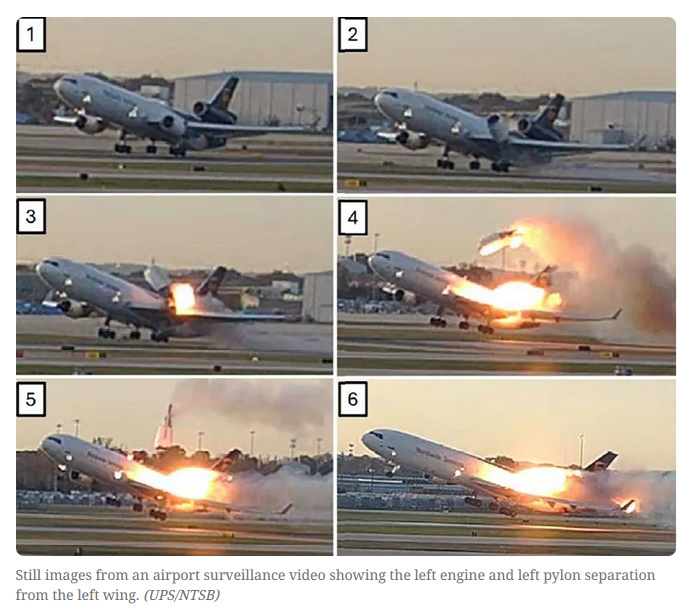 The report may be downloaded here: Prelimiary Report DCA26MA024 UPS MD11
Wow, those are incredible photos. Such an unfortunate accident.
Hardware or MRO failure.
The 45 secs must have been harrowing for the crew.
Given the Boeing advisory to ground, slight probability they felt hardware failed. But not more than slight.
Interesting- 92922 hours and 21043 cycles showas the average cycle time of 4.4 hours per cycle. I’m sure the normal passenger flight cycle time is longer. A shorter cycle time IMHO means more full thrust takeoffs per flight hour. It would ” seem ” that some sort of slack in the forward and aft lugs ( fig 9 ) resulted in basic fatigue failure of the aft lug. I’m sure a detailed analysis will pin down the sequence and probable reason.
Interesting that so far only LEFT wing failures have been documented for that basic model.
Even more interesting as half of this aircraft’s life was as a passenger jet.
There’s nothing much left to discuss,an absolutely devastating failure at the worst possible time
Fleet diversification seems a better idea than ever if an aircraft type can be grounded this late into its life.One of the ULCA is going to come unstuck like this one day
People should really read the report instead of jumping in with opinions.
NTSB has found indications of fatigue crack on the rear pylon mounting bolt. Not wear out per increasing clearance, fatigue.
Look at the pictures. The engine lets go at the rear only, then flips up and over the wing.
The system is designed to break off evenly under X force.
Its not intended to allow for a singe pin to let go.
What has lead to that fatigue and why not found previous is going to take time, but its clear why they grounded it.
747s have had 3 incidents I know of, it was a know corrosion issue that was not addressed.
One crashed in the Netherlands, one in China (not positive on crash) and the one in Anchorage broke off clean enough that they had a wing intact and were able to limp back and land.
Will the MD-11 fly again?
After the wing engine bolts have been inspected for fatigue cracks. Yes
Look again- the ‘bolt/pin’ ‘ did not fail, the clevis(s) failed- one in apparent fatigue and one in overload. And the bolt has a shallow slot apparently for lubrication. Not know if the slot was supposed to be in a certain clocked position relative to thrust load on the clevis.
> Look again- the ‘bolt/pin’ ‘ did not fail, the clevis(s) failed- one in apparent fatigue and one in overload. <
Sure looks that way, as seen in the NTSB photos.
Agree I misstated it.
Fatigue at 3 points and snapped on the 4th.
I was baffled by the engine flight patch after departure as after the crash it was found on the right side of the runway.
Spinning masses do stragane things when free to fly.
Reported fan blade parts found external but those could have blown out or ripped out.
They stood no chance, may they all rest in peace.
Even with two engines massive wing damage and huge ball of fire going.
AP:
> [John] Cox said those air carriers “are going to have to make some hard decisions” because they were already planning to retire the planes in the next few years. “If you have to pull the engines off and do some sort of visual inspection or replacement, that’s going to run into a significant cost,” he said.
An inspection so far is all thats required . Not replacement.
Fatigue isnt uncommon on an airline structure , just means checks are more frequent.
The other wing engine pylon “may” have been just fine.
Any idea how much it costs for an inspection? IIRC it takes more than 200 man hours of work *just* to remove engine and pylon *together* for a DC-10.
Furthermore, there were instances that MRO inspections have failed to catch metal fatigue like the United’s 777-200.
The MD-11s are on their last legs, even before all these added costs of inspection and replacement of parts.
> Inspections and potential repairs for MD–11 cargo jets under a no-fly ban following this month’s fatal crash of a UPS freighter could take much longer than some originally expected, leaving FedEx, UPS and Western Global Airlines with a shortage of widebody capacity during the peak shipping season.
Western Global Airlines on Friday informed many many employees, including pilots, that they have been furloughed indefinitely, effective on Nov. 22, because of the longer time horizon for completing safety checks mandated by the FAA…
> Western Global, headquartered in Estero, Florida, and based out of Southwest Florida International Airport in Fort Myers, is the most impacted of the three carriers. UPS and FedEx had 26 and 25 active MD-11s at the time of the accident, respectively. The MD-11 represents about 9% of their mainline fleet, but a much larger share of Western Global’s fleet. Western Global has about six active MD-11s and three Boeing 747-400 freighter aircraft, according to aircraft databases.
> “During the past two weeks, WGA has been in constant communication with Boeing, who originally anticipated that by Nov. 14 they would have an approved noninvasive inspection protocol to return the aircraft to service. Because of this, we were hopeful that the MD-11 grounding would be short-lived. However, Boeing has now advised that *more and highly invasive inspections, as well as repairs and parts replacements, would be required*, resulting in an extended grounding of the MD-11 fleet for an undeterminable period of time,” Romnios wrote.
https://www.yahoo.com/news/articles/md-11-freighters-face-extended-205712010.html
It might, but they haven’t answered the primary question on why the jet couldn’t climb. It didn’t JUST crash because the left engine separated. It was certified to be able to fly and climb with one failed engine. The NTSB has provided no explanation on why this aircraft could not climb out of ground effect on the other two remaining engines. The certification standards for transport category aircraft is an engine fire, failure, severe damage and separation event on one engine doesn’t preclude an aircraft from being able to climb to an acceleration altitude, clean up and come back in for an emergency landing on the other remaining engines. This aircraft never flew out of ground effect because it lost thrust in more than one engine. Whether that was a fuel line that was cut to the tail or FOD damage from engine one through engine two, it needs to be determined why this aircraft did not have the thrust to continue it’s climb. I’d add, if a left engine detachment is always going to lead to the engine departing in an arcing pattern over the fuselage spraying shrapnel into the tail engine, it may no longer be a “Safe” aircraft design. Especially when we have twin engine aircraft that don’t have to rely on a third tail mounted engine that’s in the direct path of debris from the wing mounted engines.
IMU, AFAICS:
the rear Engine chocked on smoke and fire from the separated engine. aided by prevalent airflow.
in the pic set you can see a burst of flames at the rear. compressor stall?
1 engine remaining. FIN
Hmm, was it ever assumed that a catastrophic engine loss ( as happend ) here did fit the “two remaining, no issue” cert idea?
As the MD-11 fleet is going away (or gone) and DC-10 is all but gone (if not gone) I don’t see any value in fully understanding the dynamics of the engine loss (obviously there will be more detail to come)
What is needed is simply why did the Pylon rear attachment crack?
Its binary. Either the pylon was not maintained how it should have been (failure on MRO) or the maintenance specs are wildly out for how often it should be inspected and possibly maint (greasing of the bearings)
Can they be returned to service to finish out their time in safety or is the pylon trigger aspects so compromised as to make it a no go?
Pylons are not new, attachments are not new, inspections and maint is not new. All too many crashes from a failed pylon system have resulted. They know better.
I am reminded of Alaska Airlines loss off SFO and the wrong grease and maint on the tail stab jack screw. Two maint failures.
Have I got this right?
The crash started with the rear pylon connection failing?
Nothing on the engine?
no (fan)blade out or disk failure?
Should this have been survivable for the airframe?
As near as I can sift out, yes.
You can see from the pictures its way aft.
No as I noted above, its not designed for what happened.
Its supposed to be a severe jolt (air turbaulance ) or an unbalanced engine and they should break off at or close to the same time.
In this case, the rear let go and with the takeoff attitude and thrust on very high, it rotated around the front pin. Front pin clearly did not have enough force on it to break.
The 747 over Anchorage (takeoff) was incredibly lucky to survive. While they were in early climb over Anchorage, they were relatively level (they hit maybe 2000 feet by the time they get over my part of town).
My wife saw the engine detach. It landed about a quarter mile from our house. Amazingly it fell into an empty spot though that was next to an apartment.
The repair was quite the saga. FedEx would not let them use their hangar as it was going to be tied up for weeks. So they did the work under tarps on the open ramp. Enough for it to fly to the states for complete fix and engine install.
In their case Boeing had bulletin out on checking and replacing the pins. They were ignored in the 3 incident though once it happened in the US the NTSB told the FAA to make it mandatory and immediate inspection and any corrosion replace before flying.
Open ( and referencing your 747 case ) :
Should this have been survivable for the airframe?
“only” 1 of 3 gone
According to the report the left engine “traversed above the fuselage”. Therefore debris could have hit the center engine. Smoke or fire could have entered the center engine causing this engine also to loose thrust.
Ok, one word answer, NO.
fire like that and you either get it on the ground or you are gone.
The Number 2 engine well have been compressor stalling or injesting parts of 1.
Even with two engines its not survivable with a fire.
Not true, at a safe altitude they would close the spar fuel valve and the fire would extinguish.
I wont argue becuase its unknowable. The system will in fact sheer off and cut fuel if it does it in the designed manner. This was not it.
Bottom line is it did not happen in level flight so you don’t know, I don’t know, the experts don’t know.
A lot like cutting two fuel switches on the 787. You don’t test or train for that, its a waste. The engines stop. If at altitude you have options, on takeoff you have none.
Factors:
While no where near identical, the Qantas QF32 A380 suffered an incredible amount of damages when the engine disintegrate
While its survival was/is testimony of Airbus incredible build and robust backup systems, it also did damage that the models said could not hyappen (aka back to origins of jet engines and turbine blades disintegration).
In short they did not know. Not for a lack of trying, that is what uncontained (aka Certification) blade design is all about. QF32 went far beyond that. One fragment in one more wrong place could have doomed them.
In this case the engine rotated around the wing then ripped out of the wing in a rear tearing motion, flipped up over the aircraft and landed on the opposite side.
The flames never stopped.
The distance the engine traveled had to do with the energy of thrust and then the gyroscopic precession. Lower speed and it acts different.
So, you are postulating a nice outcome when in fact no one knows.
It could take out the tail if it did not go over the top.
Like blowing out a door plug blank South of Portland, no one knew what it would do in a different phase of flight, altitude etc.
Nothing was working as intended and no one knows what would happen and its a waste to entertain it as the victims died becuase it happened where/when it did.
@Lou:
A bit of follow up, Spar Fuel valve is not relevant.
If the tank is ripped open which obviously it is the case, then its mute.
Obvious becuase of the size of the fire. Massive. That is not dripping fuel remnants (I know you understand that part)
One doesn’t have to go all the way back to 2010 to find uncontained engine failure:
In 2018, Southwest 1380 – the engine cowl was broken, and cowl fragments damaged the fuselage, shattering a cabin window and causing explosive depressurization of the aircraft. Other fragments caused damage to the wing. One passenger was partially ejected from the aircraft and died, while eight other passengers sustained minor injuries. The aircraft was substantially damaged and written off as a result of the accident.
This accident was very similar to an accident suffered 20 months earlier by Southwest Airlines Flight 3472 flying the same aircraft type with the same engine type. After that earlier accident, the engine manufacturer, CFM, issued a service directive calling for ultrasonic inspections of the turbine fan blades with certain serial numbers, service cycles, or service time.
Or more recently, UA 328 experienced a fan blade separation due to metal fatigue causing an engine fire and extensive damage to the nacelle. Despite being classified as a contained failure, large parts of the engine’s cowling, inlet and thrust reverser detached, creating a debris field over 1 mile (1.6 km) long across residential areas of Broomfield, Colorado.
Yes. Just like AA191 was survivable.
yes, but: either debris rom engine 1 or just the fire/smoke caused engine 2 (the tail engine) to go into compressor stall meaning the plane only had 1 fully functioning engine, and therefore not enough thrust to climb out.
Juan Browne has a new video up re: this crash and the
preliminary report:
https://www.youtube.com/watch?v=UpUkwzVUs5Y
No mention if there was a fan blade fracture event leading to increased engine mount loads. Most likely not. A SB requiring disassembly, clean, NDT and install a fresh bearing would be expected together with reduced inspection intervals of the pylon lugs.
Hoover at Pilot Debrief on this crash and NTSB preliminary report:https://www.youtube.com/watch?v=BoaWsgLfhsg
38+ year Airline Capt. here, ….. The engine was developing full rated T.O. thrust (or planned de-rate based on their performance data for the runway, weight, temperature, etc) at the moment of pylon failure and that thrust continuing for even just a second or so would naturally propel the engine up because the “moment arm” or put simply the leverage angle, of an under wing engine creates a nose up moment as thrust is applied. Obviously the exact sequence of metallurgical failure can’t be predicted but any momentary resistance would cause the centerline of thrust to skew and send it left or right as it shot upwards and separated. That’s why it ended up on the right side of the runway. For a few moments like a rocket with no fins to guide its flight.
I know you know that already, but what I really wanted to comment on is that a 3 engine Jet “should” be able to fly safely away from the ground with 1 engine failed, on fire, or even separated. The fire ball is dramatic but that in itself isn’t really a factor. Had the crew been able to get the aircraft climbing, 400 ft is the usual minimum “stable” climbing altitude before taking action to suppress the fire. They would’ve at some point methodically working as a crew identified the failed engine by the engine instruments, and shut off the fuel supply running out to the engine at the wing root spar. The fire would run out of fuel and extinguish, and the would run more checklists to secure the engine, and prepare for a return to the airport. My point is something else happened that degraded the ability of the aircraft to fly, beyond the engine fire/separation. Don’t be immediately fooled by the fire ball…… the jet SHOULD have flown away from the ground just fine on the remaining 2 engines…… they are all certified to do that at max gross weight. There was likely NOT massive damage to the left wing, they are literally designed to break away before they could cause structural damage. If you recall A A flt 191 in 1979, DC-10 left engine did the same thing on T.O. …… they climbed away just fine, but unfortunately the early design of the DC-10 had ALL of the hydraulics systems routing in the leading edge of the wing with no redundancy built in, and when they pylon broke loose it ripped out some lines that supplied the leading edge slats and they quickly retracted which caused the left wing to lose lift…… the left wing now needed to be flying at a higher airspeed to generate the same amount of lift as with the slats out, but the crew could not know in that short time span what was actually happening and they were flying at the speed they were trained to fly at for an engine failure. The left wing was stalling and hence the aircraft began an uncommanded left bank that the pilots could not counter in time …… 400 ft or something……. Point is this UPS jet, something else other than the fire/seperation happened that prevented the aircraft from climbing. The prevailing thoughts are that the #2 or center engine on the tail, experienced a “compressor stall” condition concurrent with or immediately after #1’s failure, and it’s thrust was degraded significantly enough to make it such they suddenly found themselves with only 1 engine developing full power. The jet will NOT fly on 1 engine loaded as they were. Out of runway, and no where to put it down they simply had no choice but to try and claw their way into the air……
God bless everyone affected and involved.
Thanks for this informative comment.
I am not religious so I will put it in my terms, its a tragedy that the survivors will deal with for the rest of their lives. The dead may the Rest in Peace.
I reread your post. NTSB will detail what wing damage there was.
A lot of aircraft have had engine fires and they never got them stopped.
The fire continued on until they crashed.
Its not a given that if engine 2 was not impacted (some compressor stalling obvious) if they could have kept it in the air.
While a good write-up, its speculative. Juan feels gyroscopic forces were involved, I won’t say he is right or wrong, he has a valid point that may be spot on.
The engine lost all thrust when the fuel line severed. Its not a rocket.
Again what you are postulating is normal emergencies. This is totally abnormal.
Having seen it in person, I can tell you the wing tank is right behind the slats. I saw one punctured on time by a loose bracket.
The fireball size tells you a vast amount of fuel was involved.
As this was not designed for, nothing worked per design that did work. A fire you shut off fuel, pull the bottles and most likely snuff it.
Nothing says that fire was going out. Fires in flight are not survivable. Your only recourse is to put it on the ground. That in fact is what pilots are told to so since the Swiss flight, ditch it now if you can’t land now.
With fuel tanks ripped open, the source of energy (fuel) ignited, its going to stay ignited until the fuel is gone.
Unknown yet is how much physical damage was done to the wing and if it was compromised regardless of the fire.
The best pilots in the world can be dealt a no win hand, its what kills Mountain Climbers, back country skiers or people in a Tornado (etc).
Some things no matter how good you are will overcome all your skills.
“The engine lost all thrust when the fuel line severed. Its not a rocket.”
Not really. There’s momentum and you can see how the engine went over the wing.
It is rarely worth a comment to your posts, for other readers to consider.
Trying to map an event like this is futile. The investigators will be able to make some informed ideas as they get the full input.
The engine does not have “momentum”. The air-frame with the engine at ached does.
At what point thrust was lost is unknown. As this was a non design separate, there is no modeling for it. It all depends on where the fuel line is, is the fuel line solid or flexible and when did the fuel line rip free?
As soon as the fuel line breaks the engine stops producing thrust. The fan is spinning down, but its not thrusting.
My guess (and only that) is the engine did not break the fuel feed until it was over the top of the wing.
At that point a combination of the air over the air-frame pushing it back and the spinning and how it tore off determined the rectory.
A rocket is self feeding, and engine is not.
I need to remind that as soon as fuel is cut, the engine drags, it has no momentum. The air drag is in play.
That is why an aircraft would yaw to the left if an attached engine quits. Drag.
The 787 has a software function to counter it. Otherwise if you watch Viedo of planes taking off and loosing an engine, it yaws the the side the engine is on. Drag, momentum is cancelled.
Who’s incoherent but bellicose here?
You first said:
> “The engine lost all thrust when the fuel line severed. Its not a rocket.”
You now said:
> “At what point thrust was lost is unknown.”
Fact:
The engines were producing at about the maximum thrust.
Pedro and Trans……..
The airplane was at V1 + something.. 150 mph ish. Dont forget that at a certain point, the aero loads on the front engine will attempt to push the engine backwards over the wing . The engine only needed to get a big enough impulse to get “over center” and the free stream airflow takes it from there. Momentum as Pedro says may be the wrong specific word, but there are sdditional forces not listed at work…….
the set of pictures in the NTSB doc showing engine separation is rather informative.
Note that the background “is moving to the right” 🙂
even without fuel the engine will provide fast deceasing residual thrust by energy transfer from the rotating spools.
Then “everything” has momentum. engine, airframe, …
linked until things change when the engine separates from the airframe.
it might be useful to revisit school physics for the occasion.
placed the 6 images according to background.
https://photos.app.goo.gl/G4z4VoV4q6gDtKfD8
1 2 3 are closely spaced.
5 and 6 seem to not overlap?
@PNWgeek:
I think you are saying what I put down in a different way.
As for Momentum, in a pure sense any mass at speed has potential inertia (mass x speed).
But, that does not mean it has and inertial force that is actual doing anything, as other factors have their say.
As noted, thrust while the fuel is still flowing is a factor.
Rotation around the front joint is a factor.
180 mph is a massive factor.
So no, it was not inertia that kept the engine moving, it was still developing thrust and rotated around that front attachment point.
Ok, the other aspect that Juan Brown pointed out is gyroscopic forces that are a form of inertia.
In this case we are going from a forward inertia to a vector to the side (or resistance to).
So, as its rotating on the front joint, its got a sideways force tearing at the front joint as does the engine tear the joint from the thrust in a forward and upward direction.
All those forces are acting at the same time as well as the relative air motion (drag).
So no, it was not momentum of the mass of the engine going forward (that was canceled) , it was far more complex and the relevant aspect is it went over the top of the wing, ripped it to shreds and up and over the fuselage spewing a fire ball that to some degree (high or low) affected engine 2.
No I did not normally read what Pedro wrote because its not worth reading. I don’t mind stating that (vs the hate to tell you).
In this case, he made a factual statement that was misleading as I believe he does not understand what happened nor tech issues period.
It should be noted, the massive fireball continues AFTER the engine disappears over the top of the MD-11 and is gone from view off to the right.
Massive damage to the wing, lifting capability, engine 2 impacted etc. Some or all those factors.
It never was recoverable.
What you can’t say is what would have happened in cruise (very likely it won’t hyappen in cruise) – less thrust, less fan speed, different trajectory.
I would hazard its a high probability it still takes down they aircraft.
You might find the following of interest-FWIW
https://www.youtube.com/watch?v=jUmYJoWPpX0
My summary – the long known MD-10/11 pylon fubar design strikes again…
Oh. Glad to have that all sorted out by an expert.
I am not an expert. I can piece basic concepts together.
‘Boeing MD-11 plane that crashed had ‘fatigue cracks,’ NTSB says’: https://www.seattletimes.com/business/boeing-aerospace/boeing-md-11-plane-that-crashed-had-fatigue-stress-ntsb-says/
“..On the MD-11, the left and right engines are attached to the underside of pylons, which are then attached to the underside of each wing.
That pylon attachment consists of several pieces of hardware, including a forward mount bulkhead, a thrust link assembly and an aft mount bulkhead. Each of those pieces has its own set of hardware, including spherical bearings and fittings bolted together with lugs.
In its investigation, the NTSB found fractures on the left pylon aft mount lugs and the spherical bearing. In examining those fractures, it found evidence of “fatigue cracks” and “overstress failures” on the aft mount lug.
It did not find evidence of preexisting fractures or deformations on the structure.
The NTSB is continuing to examine several pieces of hardware, including the left and right pylon aft mount, the fractured lugs and two engine fan blade fragments that were recovered from the scene of the crash..”
And the point of repeating the info in the report?
Bloomberg: MD-11 Grounding After Crash May Linger on ‘Invasive’ Checks
> The FAA hasn’t provided inspection procedures yet, a UPS spokesperson said. The regulator said in a statement that Boeing will develop the procedures and any necessary corrective actions, which the *FAA must then approve*.
“Very unusual”?
After UPS plane crash in Louisville, MD-11 grounding was ‘very unusual,’ expert says
https://www.pressreader.com/usa/the-courier-journal-louisville-/20251119/281496462566214
Reuters: MD-11 Fleet Grounding After UPS Crash Unlikely to End Before 2026, Source Says
https://www.usnews.com/news/top-news/articles/2025-11-26/md-11-fleet-grounding-after-ups-crash-unlikely-to-end-before-2026-source-says
so, does this mean Boeing is going to get that 767 emissions waiver they’ve been seeking or are they going to go forward with a 787 package freight version?
or are they just going to cede the market to the A330F-NEO and A350F?
Boeing is not making money from its 767 freighter business?
@bilbo: Boeing will eventually do a 787F
@bilbo:
I think you are working with dated info.
Boeing is discontinuing the 767 in 2027 (stuff on the line can still be completed)
No reason Boeing cannot put engineering onto the 787F. They are in proving phase of the MAX7/10 and 777X.
At one time other sources said 787 was not intended to be an F. Leeham has corrected that it was a view all along.
Maybe a holdup would be a 787 backlog that they want to make money on.
Have to see. Airbus does not need an A350F right now nor an updated A330-900F but they are doing A350 and I suspect the A330 as well (basically the A330-300 not the 200 from prior)
The F market is getting odd, at one time the 767/777-200 was the heart of the market, now is more A330-300 minimum and A350/777X-F.
I believe all the 767F new builds are for UPS and FedEx and that is not the main F market that uses a lot of conversions as well as some new bought.
777F was a -200 variant.
I am puzzled on the MD-11F being a used bird still but the people running the numbers like it (or did).
F market is very diverse.
⬇️
Boeing: The MAX 7 will be certified in Q2 2026
Fox news: UPS warns of ‘months-long’ disruptions after grounding entire jet fleet after deadly Kentucky crash