
Leeham News and Analysis
There's more to real news than a news release.



Book excerpt: Legacy Boeing’s last hurrah
Dec. 1, 2025, (c) Leeham News: In October, Boeing announced another delay in certification of the 777X and a delay from 2026 to 2027 of entry-into-service of the -9 model. Tim Clark, the president of Emirates Airline, is vocal about his dismay over the continuing delays. Emirates has more 777Xs on order than any other customer. The first airplane was due in early 2020. Had it been on time, Clark says Emirates would have had 110 in service by now.
During the Dubai Air Show, he told the financial news network CNBC that he believes Boeing can restore its glory. He doesn’t know or predict when. But legacy Boeing’s last hurrah was the development of what is now called by some to be the “Classic” 777.
Scott Hamilton’s new book, The Rise and Fall of Boeing and The Way Back, details not only how Boeing lost its glory and how it’s recovering. It tells the story of legacy Boeing’s last hurrah: development of the 777 Classic.
Here is an excerpt.
Legacy Boeing’s Last Hurrah
“Working Together.”
—The 777 Family
In 1985, Airbus, Boeing, and McDonnell Douglas (MDC) were planning for the next round of twin-aisle jets. Boeing toyed with the idea of building a larger 767. One concept included a partial double deck, but it was a very odd design. Instead of a 747-like hump at the front of the airplane, the upper deck began at about the wing and went aft. MDC considered a stretch of its DC-10 with initial working titles of Super 50, Super 60, etc. Airbus, still in the development phase on the A320, was already planning twin-aisle, two- and four-engine aircraft under the code names TA-6 and TA-7. These would become the A330 and A340.
Boeing’s humpback 767 design was short-lived. It soon gave way to a wider twin-aisle, larger-capacity airplane that eventually became known as the 777. United Airlines was one of the leading contributors to Boeing’s customer input process. The initial design became known as the 777-200. There were a shorter-range “A” model and a long-range “B” model. Both seated about 301 passengers in a mixed-seating configuration. The A model’s range was 5,240 nautical miles (nm); the B model, which later was named the ER (for Extended Range), had a range of 7,065 nm. The planes’ dimensions were identical.
The Classic’s folding wingtips
One proposed feature for the 777 was the inclusion of folding wing tips to allow the plane to use some of the ramp and gate space of smaller widebody aircraft. Boeing eventually dropped the idea for weight-related and other reasons. But the idea would resurface decades later and become a key component for the next-generation 777.
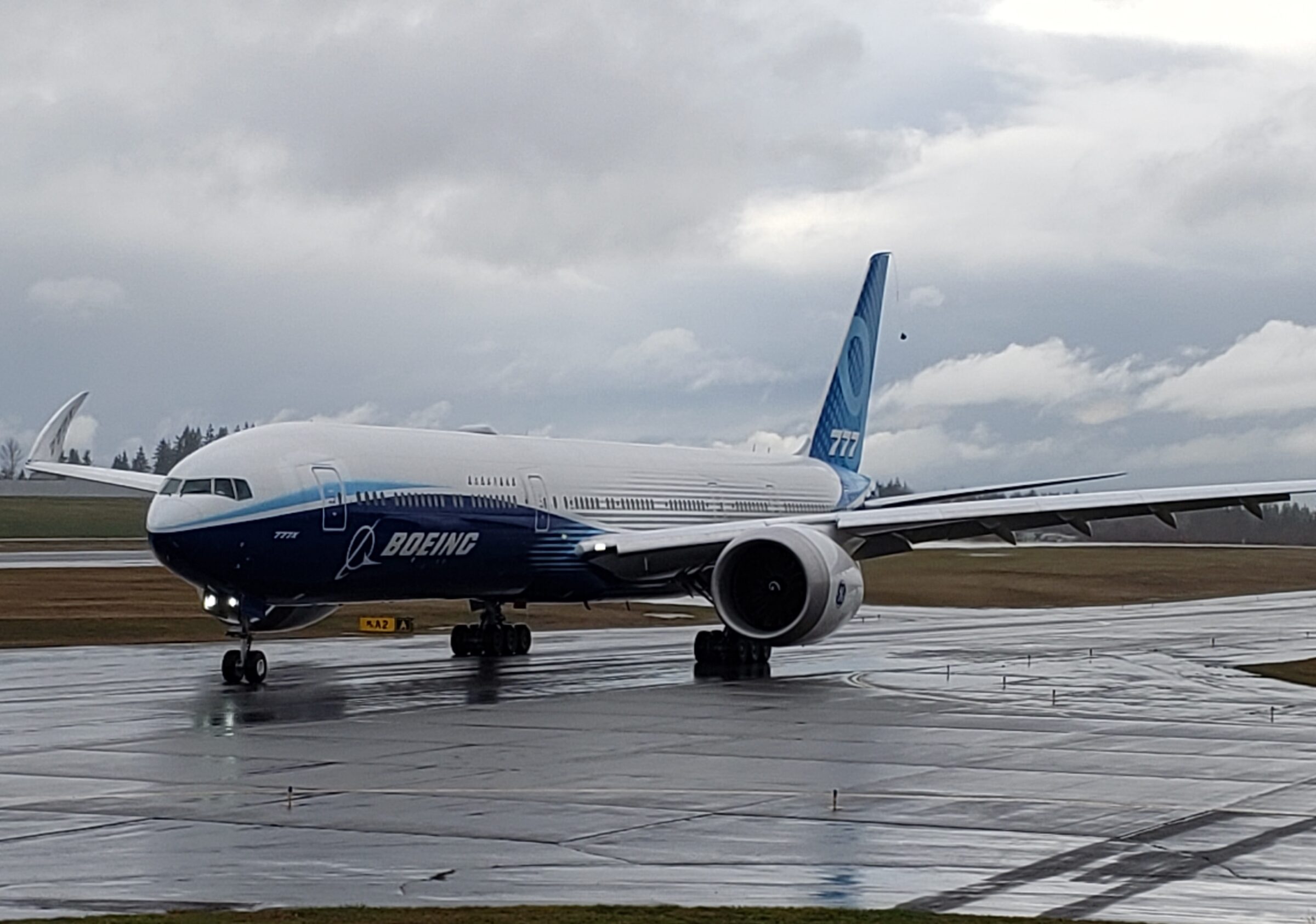
Today’s notable feature of the Boeing 777-X is its folding wingtip, designed to allow the wider wingspan to fit into today’s airport gates. The idea was first conceived for the 777 Classic in the 1990s but discarded then. Credit: Leeham News.
Boeing was going to be last on the market with the 777. The MDC MD-11 and Airbus’s four-engine A340 would precede the 777. The three-engine MD-11 was essentially a stretched DC-10 with new engines, a glass cockpit, and split winglets. Even with such features, however, when the airplane went into service with American Airlines, it was a big disappointment. American ordered MD-11s and planned a major overseas expansion from its prime hub at Dallas–Fort Worth Regional Airport (DFW). DFW, situated in north Texas in the southern-middle of the United States, presented range challenges for American’s ambitions across the Pacific. When the airline received route authority from DFW to fly to Tokyo, for example, American’s long-range DC-10-30s couldn’t make the hop non-stop. The airline acquired two ex–TWA 747SPs for the route. As a shrink, the plane wasn’t as efficient as the standard 747, but it could make the 6,500-mile trip non-stop.
The MD-11 was supposed to be able to make the trip from DFW to Hong Kong, but it burned more fuel than expected, and its actual range was less than its designed range. DFW–Hong Kong was out, and the economics on other long-haul routes within its reduced range strained airlines’ ability to make these runs profitably. MDC worked diligently to make up for the shortfalls but, in the end, engineers couldn’t recover 100 percent of the deficiencies. With MDC already on the decline, the shortcomings of the MD-11 didn’t help sales. Eventually, only 200 MD-11s were sold.
Over at Airbus, super-salesman John Leahy did everything he could to jump on the MD-11’s shortcomings. The third engine sitting on top of the MD-11’s fuselage at the base of the tail was, he sniffed, just a big aerodynamic drag. Leahy’s rhetoric was seen for what it was. But his company’s A340 had its own problems, which were not insignificant: the plane was designed around the SuperFan engine that Rolls-Royce (RR) and Pratt & Whitney (P&W) ultimately killed, destroying the planned economics of the aircraft. Airbus executives met with P&W executives and pressured them unsuccessfully to reverse the decision. So, Airbus’s next stop was CFM International, the 50-50 joint venture between GE and what was then known as Snecma (now Safran Aircraft Engines), a French company. The CFM 56 powered the re-engined MDC DC-8 Super 60 series (rebranded the -70) and the Boeing 737-300/-400/-500, later called the 737 Classic. It had been a monumental mistake by P&W to cede the 737 market from the original 737-100/200/200A models to the re-engining of the -300/-400/-500 series models. The Classic series put CFM on the map. Like an amoeba, CFM’s dominance in the small jetliner market spread across the world. Airbus initially chose the CFM 56 to power the A320. International Aero Engines (IAE) later joined this market with its V2500 engine, but CFM products ruled.
Airbus’s engineless A340
When Airbus went to CFM, hat in hand, to power the A340 Glider, CFM exacted its pound of flesh. Airbus had no choice but to take it. The result was an airplane that was overweight to the power provided and slow compared with other trans-ocean airliners. Leahy, well after he retired in 2018, put it in his typically direct way: The A340 was prone to bird strikes from the rear. With four engines, maintenance costs were naturally higher. Fuel economy wasn’t as good as some of its competitors, either.
Airbus tried mightily to overcome the A340’s operational and economic disadvantages. In those days, ETOP aircraft, and the Extended-Range Twin-Engine Operations Performance Standards (ETOPS) that applied to them, which were developed and implemented by the International Civil Aviation Organization (ICAO), were both still fairly new. Qualifying for ETOPS certification was complicated, and some of the less-sophisticated airlines found that doing so strained resources. A four-engine airplane didn’t require the same level of training, support, and sophistication as other models did, so the A340 fit nicely into airlines’ systems. The A340, being lighter than the 747 and with less restrictive engine-out performance than a twin-engine widebody airplane, also could serve challenging airports more easily. For example, South African Airways found the A340 a better fit for its hot environment than the early 777s. The A340 could operate out of the French/Dutch island of St. Maartin in the Caribbean, with its short runway and mountains near one end of the runway, more easily than the 747.
Airbus produced the A340 in four versions—the original -200, with its underpowered CFM engines; the -300, with an upgraded engine; the -500 ultra-long-haul model; and a stretched -600 version, the last two featuring RR engines. Nevertheless, Airbus sold only 377 A340 models, a poor showing but still better than the MD-11.
Out-of-the-park winner
Boeing’s 777, with its subsequent versions, proved an out-of-the-park winner. Only eighty-eight of the base model -200s were sold, with United Airlines being a principal customer. The longer-range -200ER saw 422 sales. The ultra-long-range -200LR, the same plane dimensionally as the -200 and the -200ER, added sixty-one sales. Boeing stretched the airplane into two versions of the -300: the base model and the extended-range -300ER. These typical models seated around 365 passengers in a mixed-class configuration. The base -300 traded a little range (about 100 nautical miles) for capacity. The -300ER recovered the original ranges and added about 300 nautical miles more. It proved the most popular model, with sales of 837 aircraft.
Even then, Boeing wasn’t through. It took the -200LR and made a freighter out of it. As of 2025, the freighter was still in production, with a total of 321 orders. The 777LRF is to remain in production until 2027, when new noise and emissions regulations will render the model obsolete. The 777 became one of Boeing’s best-selling jetliners of all time. Production peaked at a rate of 8.6 a month, a record for a widebody airplane up until then. The 777 and 737 carried Boeing’s Commercial Airplanes division (BCA) through future industrial snafus with the 787 and the delays of the poor-selling 747-8.
Unmatched safety
The program manager for the 777 was Phil Condit. A lifetime Boeing employee and an engineer, Condit and former Boeing CEO Alan Mulally are credited with ushering in a major transformation in the way Boeing designed airplanes. The 777 was Boeing’s first computer-designed aircraft. Its entry into service (EIS) was in 1995. The 777’s development budget of $6 billion ballooned to nearly $12 billion (about $25.95 billion in 2025 dollars). But the airplane’s reliability and performance over the following decades was unmatched. So was its safety. The first 777 hull loss didn’t happen until 2008, fourteen years after the plane’s introduction, when a British Airways 777-200ER lost power in both engines on a short final approach to London’s Heathrow Airport. Through marvelous piloting, the plane crash-landed short of the runway. There were no fatalities and only forty-seven injuries, most of them minor. The power failure was traced to a freak icing condition that blocked fuel to both of the plane’s RR engines. The 777 itself came away with a rather enhanced reputation for its strength.
The second hull loss happened to a 777-200ER when a cockpit fire broke out while the plane was parked. There were no injuries, and the fire damage was such that the airplane was written off. A third hull loss occurred when an Asiana Airlines 777-300ER crashed on landing at the San Francisco airport. Pilot error was blamed. Although the plane split in two upon the crash landing and spun around before coming to rest, only three of the 310 people on board died. They were the first fatalities of a 777 accident.[1]
777 success due to culture
How did legacy Boeing succeed so spectacularly with the 777 Classic? The reason is ironic, considering the future criticism that would come Boeing’s way on the very same topic: culture.
“I believe that it was primarily the culture that we built essentially for the program,” Condit recalled in 2023 in an interview for this book. “I had an advantage. I was coming from being executive VP so I could pick my team for the Triple Seven. I had the experience with the 757 program. We learned a lot on the 757 program. For example, what I discovered on the 57 program was that while we had a really good core team when we started, the developmental team, when the program got authorized, engineers started coming on the program at 200 to 300 a week. The culture very quickly shifted to what I call a traditional culture, because the core team was the minority all of a sudden. Everybody, in my words, set up camp the way they had always set up camp.
“On the 777 reset, when people come on to the program, everybody goes through what we call boot camp. Everybody got introduced to the program and got introduced to the culture. We actually took the whole initial team offsite on a Saturday and spent a whole Saturday crafting an eleven-word mission statement for the program very, very carefully. Every word in that mission statement had a really important meaning.”
This was in 1990. Condit remembered that the theme then was people working together to produce the preferred new airplane family. “The first word in there was ‘people’. The whole program had a very strong focus on people, how important they were in the program, how critical they were to the program. ‘Working together’ became the buzz phrase, if you will, for the program.” Boeing had a tradition of putting a pilot’s name under a plane’s flight deck window on the left side, and a co-pilot’s name on the right side of the airplane. At the time, “Working Together” was printed under the left side of each cockpit window.
“It was people working together,” Condit recalled. “Working together to produce. We had a great, long debate. Not surprisingly, the engineers said it ought to be ‘design.’ The factory guys said it ought to be ‘built.’ The support people said, ‘Well, how do we get it there?’ The word[s] we settled on w[ere] ‘to produce.’ It included design, build, all of the pieces together. Next, ‘the preferred.’ We had another debate. We were looking at one, at the word[s] ‘quality,’ ‘performance,’ ‘customer satisfaction.’ ”[2]
Working together
As with other Boeing 7-Series airplanes, with the exception of the 757, the 777 was going to be a new airplane family. “That was very intentional,” Condit said. “We looked at a lot of derivatives that had potential for that program. [The 777] really changed the world. The whole program was designed with the intent that there would be a family of airplanes. We talked about that mission statement with everybody who came on the program, what it meant, why were we doing it. We said, for example, that ‘working together’ wasn’t just internal, it was external. It meant that working together, we would work together with suppliers. We were going to work together with airlines. We actually had airlines on the team.”
Condit’s description of “working together” at all levels, internally and externally, is a marked contrast to how things evolved at Boeing over the next thirty-plus years, when confrontations with labor, suppliers, and even customers became the rule rather than the exception.
The 777 program was launched in October 1990. The original 777 entered service in June 1995. The highly successful 777-300ER, in 2004. The 777 “Classic” was the last airplane designed and developed by Boeing before its 1997 merger with MDC. In many respects, the 777-300ER was probably the best airplane Boeing ever designed. Through 2024, more than 1,700 of all sub-types had been delivered. As a widebody airplane, the 777-300ER paled in comparison to the 737. The company’s 787 model had higher gross sales. But unlike the troubled 737 and 787 programs, the 777 Classic proved to be a superb program.
It was legacy Boeing’s last hurrah.
Footnotes
[1] Two more 777 hull losses occurred, resulting in fatalities to all on board the planes: Malaysian Airlines flight 370, which mysteriously disappeared in the ocean near Australia on a flight from Indonesia to China, and another Malaysian 777, which was shot down in a mistaken combat action by Russia during fighting in Ukraine. There have been a couple more hull losses, but no passengers died in these other accidents.
[2] In 2024, when Kelly Ortberg was named by Boeing’s board of directors to succeed departing CEO David Calhoun, Ortberg began using the phrase “working together” when meeting with employees.
********************
 The Rise and Fall of Boeing and the Way Back is available here. Rise and Fall continues the story told in Air Wars, The Global Combat Between Airbus and Boeing, published in 2021, also by Scott Hamilton. This tells the story of 35 years of competition between Airbus and Boeing, and the role played by super -salesman John Leahy of Airbus. Air Wars is available here.
I ordered the book the moment it was released a couple of months ago, and I throughly enjoyed the volume. It helps explain the extremely complex web that leads to Boeing’s troubles, and in so doing clarifies the link back to GE’s philosophy of leadership (“make money for shareholders”.)
I was less impressed with the repetitive summaries. Some are necessary because of the intertwined relationships between Boeing leaders, but others felt a bit exaggerated. In any case, the value of this book (to me as a historian) is its immediacy, one of the strengths of investigative journalism, with some materials unlikely ever to appear in archives. Personally, I found the previous volume on Airbus more polished (though more sympathetic,) but this one (on Boeing) truly helps get through gazillion media reports on the many screwups that occurred.
In closing, a little irony: Historians almost always mess up predicting the future. I wish (for personal reasons) but I am unsure that this piece’s suggestions and projections prove prescient. Having tried my game at projecting the future, I am just uncertain of its conclusions.
Why am I unsure? Corporate culture between king and underdog. Boeing’s reactions were almost always to blame the customer (737 Max, as documented in Mr. Hamilton’s work and elsewhere.) Aérospatiale (a.k.a SNIAS, pre-Airbus) almost always as well. Airbus? It’s very different. Read Bernard Ziegler’s “Les Cowboys d’Airbus” (sadly untranslated into English): the willingness to kowtow. Nothing surprising, but it stuck for many years Most recently the solar flare issue affecting the A320 software demonstrates remnants of this practice. The Airbus communiqués are notoriously short and thus frustrating (two paragraphs–seriously???), but they are apologetic, underdog-style. Cute, cheap detail? Yes, but in our brave new world of social media, it matters.
All that rumbled, thank you for publishing this. I gifted it to a good friend in Toulouse (not of Airbus, but close.)
A very interesting excerpt from the book, which I look forward to reading in full.
I am curious as to your obviously reading and commenting on the very good information presented by Leeham and then the lack of that in the postings?
Vincent is a lot less inventive in his postings than select others.
Did not read it but I can say it was directed to Vincent not you.
Usually I can ignore this poster who doesn’t follow the rules here most of the time. There should be an auto ignore for those who lack credibility and it should be reflected on their posts. Why is he the antagonist for no reason?
RE Boeing 1990 and computer designed aircraft. Prior designs used ‘ wooden’ mockups to determine placement and routing of hydraulics and wiring type things. With very few exceptions, 777 used mainly Catia systems for CAD (computer aided design ) and what was then labeled as ‘ fly thru ‘ checks instead of mockups.
That being said, a lot of that evolvement was the direct and indirect result of Boeing work on the B2 program in the 9101 bldg and Thompson site in Seattle.
Boeing pretty much designed and built the major parts of the B2 wing and body using composites and titanium. A lot of B2 design and manufacturing people wound up on 777 program (including yours truly). In many cases, to avoid issues of Govt versus private ‘ development’/”research” certain design and test and manufacturing methods had to be done /redone on 777 even though the ‘ results ‘/’methods of computer design’ were already known to work.
Thank you for that background. I had read references to how much Boeing contributed to the B2 but had no citation.
Its also a very key historical aspect I have not seen listed as people generally think Boeing went composite via the 787 on a wing and a prayer. No way, there had to be a back story for why they felt it was the way to go and how to work with the material.
Did Boeing have a background program before the B2 (in composites?)
Yes- sort of 😉 – a good partial reference can be found online
COMPOSITES IN THE BOEING 767 ( published 2013 )
Robert H. HAMMER
Engineering Manager, Structures Design, 767 Division, Boeing Commercial Airplane Company, Seattle, Washington 98124
which in the partial abstract says
“ABSTRACT
The new 767 medium range wide body transport will be the first Boeing commercial aircraft to commit advanced composite materials to initial production. Composite materials, mainly fiberglass in an epoxy matrix, have been used in Boeing military and commercial aircraft in ever increasing amounts for the last twenty plus years,……”
SO 2013 MINUS 20 years gets only to 1993 re major carbon fiber composites- but note the ‘ ever increasing . . .”
so before 1980’s- the major ‘ composites ‘ were ” fiberclass ” secondary structure
Experimentation in the 1970s: Boeing first experimented with fiberglass as a composite material in its early models, specifically in the Boeing 707, which used only 2% fiberglass in its structure.
First Use in 737: In the 1970s, particularly for the Boeing 737, Boeing evaluated and utilized carbon fiber reinforced plastic (CFRP) for certain components.
This included the spoilers on two dozen 737s and the horizontal tails on five additional 737 aircraft, which were operational by 1982.
However development of manufacturing process of CFRP ‘ straight ‘ stringers ‘ took place in the mid 70’s to my best knowledge and memory.
Thank you, great history, so much like that is forgotten.
Kind of a side note, but I had a friend who was a Radio Operator on a B-17 in WWII.
We got into a discussion of the B-17 vs the B-24. He had no overall take, but purely from a crew point of view, the B-17s when they went down tended to do so so in a slow spiral and the crew could get out vs the B-24 that tended to wild gyrations.
So much we can only get the overall perspective and not what it meant day in day out to the people at the pointy end of the spear.
and before I forget Boeing did participate in the composite re-wing of the A6 – called A6E
in the mid 80’s in a separate bay from the B2 program but using a lot of the same layup and manufacturing type and inspection equipment.
The A-6F Intruder in fact was to have been an advanced version of the A-6E, initially known as the A-6E Upgrade. A contract was issued in July 1984, and it was anticipated that the A-6F would be the principal medium attack aircraft in the Fleet in the 1990s. The A-6E Upgrade was to have been virtually a new design, using most of the components of the A-6E but with new radar, a digital avionics suite, improved engines, the epoxy /composite Boeing wing, and additional weapons stations.
The A-6F, the A-12 and the End of the Intruder Community
Boeing Seattle also was involved in DARPA’s HALE program building the Condor in the late 1980s that had a 200 ft span carbon composite wing. Also, Boeing Philly did the Model 360 composite fuselage and the V-22 fuselage about the same time (V-22 composites is an interesting story on getting ahead of the regulator, in this case NAVAIR structures). I believe the Philly folks also have tended to show up in commercial airplane programs at least peripheral roles, such that there tended to be technical interchange between the two teams.
Condor was an interesting program. It was indeed a 200 ft carbon fiber wing, but very different construction from the B-2 and later 787 – two fairly thin layers of graphite sheet sandwiching a honeycomb core. Two were built. The first literally had its wing break during ground handling at Moses Lake, WA, flooding the tarmac with AvGas. To say disaster was averted that night is an understatement. During its first flight, the main landing gear, consisting of an aluminum skid that was supposed to drop through a thin sheet of mylar, failed to deploy (takeoff occurred from a wheeled dolly and pair of wing outriggers, all of which were left behind on the runway once airborne). It was bird hunting season in Moses Lake, and the program manager was ready get in the back of a pickup truck with his shotgun and ride down the runway as the airplane flew low overhead, allowing him to blow away the recalcitrant mylar. Saner heads prevailed, in the form of the president of Boeing Military Airplanes, who directed him to keep his shotgun in its case. The plane landed safely, with minimal damage to the bottom of the fuselage but a couple chewed up propellers. Too crazy to be made up.
WSJ -Airbus Hit by Fuselage Quality Issue Affecting Hundreds of A320 Jets
“Airbus hasn’t publicly disclosed the number of planes that may be affected, but told customers late last week as many as 628 jets could have defective panels installed”
“The issue at hand is the thickness of five specific panels that sit on top of the cockpit and either side of the jet’s right and left front doors. The defects were introduced during the stretching and milling process used to manufacture the panels, leaving some with patches that either exceed or fall short of thickness requirements, according to the presentation.
“Of those, 168 are in-service, while another 245 are in final assembly and being readied for delivery, Airbus engineers noted in the presentation. A further 215 are moving through earlier stages of production.
The affected parts were produced by Spain’s Sofitec Aerospace, which didn’t immediately respond to a request for comment. Sofitec isn’t the sole supplier of the components for the A320 family.”
website Sofitec Aerospace https://sofitec.es/en/capabilities-experience/
I guess this is hard to see from outside the company, but …. the culture on the 777 program was astonishingly good at problem-solving.
Work was divided among over 100 integrated teams that brought key stakeholders together from engineering, manufacturing, suppliers, sometimes airline customers, maintenance, support groups like legal and supply chain management, and I saw FAA technical specialists in some of the coordination meetings.
The 777 program didn’t need “speak up” messaging, since everyone was already speaking, inquiring, suggesting, and tracking each other’s progress as a matter of course.
No surprise, then, that a strong leadership message on the 777 program was identifying problems “upstream,” when they are easier and cheaper to resolve.
Not to put too fine a point on it, this very strong 777 problem-solving culture was the exact 180-degree opposite of the 787 program culture which had very poor lateral communication, ill-defined authority to make changes, and decision-making paralysis … until foreseeable problems grew to crisis proportions.
One financial analyst explained the 787 culture to me this way.
“Why do you need 40 people in a coordination meeting? In my business, when I hear the word “coordination,” the next word in my mind is “cost.” Managing “coordination costs” is a great strength of markets [outsourcing and cost-cutting].”
As it happened, this guy was very smart, worked much harder than I did, and was very patient and forthcoming with me. He just needed to spend less time in business school and more time understanding how to build things.
MCAS on the 737 MAX is a master class study in dysfunctional coordination between critical stakeholders. I was already aware of a shocking number of moments when MCAS could have been rescued during design and testing, if people had been coordinating properly with other groups. On pages 168-69, Scott describes a particularly glaring new example – new to me at least – of a communications failure relating to MCAS. That example should be understood in terms of the very poor problem-solving culture on the 787.
In the excerpt from the book in this Leeham post, Phil Condit speaks proudly of the lessons learned on the 757, which he put to good use in designing the 777 program culture. Good on ya, Phil.
How ironic, then, that when Condit was CEO and responsible for strategy(!), he threw all of those lessons in the crapper when setting the problem-solving culture on the 787.
I like the book, by the way, although it stresses me out, as you might see from this comment I’m posting.
I very much appreciate the perspective.
From a non inside view, what I saw were management failures on all fronts that lead to the program meltdown.
Its not that there were not tech problems, but looking at just the battery, it was how that was organized culminating in the key test was driving a nail into it and saying it was all good.
@Stan S
Well stated you are correct on everything. Don’t forget who was the program leader on the 777 and the reason for the success. Boeing also introduced the first Chief Mechanic, Jack Hessburg on the 777.
Condit sold us out to Mickey D!
“Not to put too fine a point on it, this very strong 777 problem-solving culture was the exact 180-degree opposite of the 787 program culture which had very poor lateral communication, ”
The (initial) 777 doubled its planned budget but was ready ~~on time.
The 787 apparently quadrupled the budget and nearly doubled the time to EIS.
When die Boeing’s management start to hate is design and workforce?
“When die Boeing’s management start to hate is design and workforce?”
When the MCD buyout brought in Harry Stonecipher.
Harry Stonecipher, 2004, former CEO of The Boeing Company, reflecting on the late 1990s
” When I say I changed the culture of Boeing, that was the intent, so it’s run like a business rather than a great engineering firm. It is a great engineering firm, but people invest in a company because they want to make money. ”
And FWIW I also knew [fairly well] Stan Sorscher during his SPEEA days and I agree with his comments.
Great and insightful commentary.
And both Phil and Jack were fishing off the company pier
Wasn’t Phil Condit a great admirer of McDonnell Douglas, especially its stock & financial performance –minimal R&D, great FCF, etc?
sort of- but mainly he was VERY impressed by Jack Welch and at shareholder meet in 2001-2001 (in huntsville alabama he answered a question about Jack in glowing terms ( I wuz there )
And stonecipher and way too many other’ BA management’ types believing in Neutron Jack were then and are still in BA mis management.
Even Jack after virtually destroying GE later admitted that his emphasis on stock price and cutting the bottom 10 percent was sort of stupid. But have no fear- mcKinsey types then and now still believe in Jack
@Uwe. Your question has 2 parts.
First part; When … . Scott poses the question of timing in the book. He sees the shift from engineering focus to shareholder focus coming BEFORE the merger.
It is my clear impression that Boeing wanted to pursue shareholder value at least as early as the fall of 1996, and was certainly on that path by the summer of 1997. Boeing recognized Stonecipher and McDonnell Douglas as the paradigm for shareholder value. Condit fell into Stonecipher’s arms by design.
Second part: .”.. hate its design workforce.” My feeling is that Boeing didn’t hate its past, so much as loving its future in the bosom of the financial community.
“It is my clear impression that Boeing wanted to pursue shareholder value at least as early as the fall of 1996, …”
From the Seattle Times (Apr 28, 1996):
[…]
Looking ahead 20 years, Condit has already told Boeing managers his goals are based on four fundamentals: customer satisfaction, integrity, SHAREHOLDER VALUE and people working together.
To achieve these goals, Boeing will have to develop and refine what Condit calls the “core competencies” of detailed customer knowledge, LARGE-SCALE SYSTEMS INTEGRATION and lean, efficient design and production.
[…]
When profits rise from increasing sales, Condit will have to decide how to handle them.
[…]
Condit said the company is considering INCREASING ITS STOCK DIVIDEND, which has been at 25 cents a share since 1989. Other possibilities include BUYING BACK STOCK or ACQUIRING ANOTHER COMPANY.
[…] “He wants shareholders to know he owns Boeing stock, too, and
wants to level the value so share buyers don’t have to worry about missing a cycle when they want to invest.”
Condit said Boeing would have to balance demands for spending on new technology, including proposed new derivative models such as a larger 747, with SHAREHOLDER VALUE.
[…]
( https://archive.seattletimes.com/archive/19960428/2326262/phil-condit-taking-boeings-controls—-new-chief-faces-the-challenge-of-continuing-work-in-progress )
When Boeing decided to launch the 787 in late 2003, the 777 program was looking more like a failure than a success. The program had cost more than double what was initially estimated, while orders were languishing. When the 777 was launched in 1990, expectations had been for sales of around 1,500 aircraft over 15 years. By the end of 2003 (13 years after its launch), Boeing had received orders for only 629 777s and delivered 463, leaving it with a backlog of just 166 aircraft.
While sales were lower than expected, the 777’s development costs had been much higher than estimated. According to BusinessWeek, the 777 “had a development budget of $5 billion to $7 billion for initial design, production tooling, and flight-testing. By 1995, it had quietly overrun this budget by nearly 100%, according to two former high-ranking Boeing managers.”
Considering that in 1995 the -200ER and -300 variants were still under development and that the second-generation (-300er/-200lr) would not be launched until 2000, the overall costs of the 777 program were likely higher than the usually reported estimates of $12–14 billion.
The 777 program was effectively saved by its second generation (-300er/-200lr, launched 10 years after the first), but orders for these aircraft would only begin to come consistently since the second half of 2004.
In 2003, when the 787 was launched, the 777 was likely not yet profitable and there was no certainty that it ever would become so, so the constraints placed by Boeing management on the 787 budget were unrealistic in their size but not as unmotivated as one tends to think now. The extra costs of the 777 (combined with initially lower-than-expected revenues), in addition to having a negative impact on the 787 budget, were probably also one of the reasons why Boeing waited 13 years before launching a new program after the 777. John Newhouse wrote in “Boeing versus Airbus”:
“Boeing estimated the development costs for the 777 at $4 billion, although the real number was probably close to $14 billion. It then read, or misread, what seemed to be the handwriting on the wall: the cost of developing new products—at least in Boeing’s case—argued for a withdrawal from the company’s core business, competing in the market with state-of-the-art aircraft. It would be an extended recess, lasting until the decision was made late in 2003 to build the 787”.
What I’m getting from this is that every Boeing program since the 777 in 1995 has been been mismanaged and though outright failure is too strong a description, nothing since has been happy or properly profitable. With the next new aeroplane due in the middle of the next decade at the earliest, all of those who saw firsthand how it should’ve been done will be retired by then. Fair?
So I’m a potential investor; if I absolutely insist on a first tier airframe manufacturer, why pick Boeing knowing that experience is short and a vast cultural change is required but yet to be delivered, and by a management team that is probably not yet in place? Why not Embraer or Airbus?
You know what they say about Troy; each time it burnt down they rebuilt it. Until they didn’t. An M-D style management might be just as incapable of preventing an M-D style outcome as M-D we’re.
partially agree- BUT ( while holding nose ) keep in mind that for ” large” commercial passenger aircraft – there is and has been for years – Boeing .
And IMHO – by whatever method – ODDS are that Boeing commercial will survive. Boeing ” Military ” will be busy for years- as will Northup-Grumman. Boeing Space is near a dead end for any large space program.
Boeing will always be around for US and Airbus will always be around for ‘ Europe’…
Just my .00001 cents worth..
Mr Lee.
Quite respectfully I might add.
As an investor, wouldnt one bypass tier one aerospace companies in general? BAs volatility over the last 10 years swinging between 100 to over 400 gave everybody immense opportunitys, but the risk and unpredictability of it made me a nervous wreck….. It seems that over time, index positions were a more predictable way to produce gains without the extreme risks BA carried with them….
Today’s major indexes are dominated by a small group of companies with massive market capitalization (wink wink, you know what I mean… )
Take this!
Confirmed: Boeing has been delivering/selling aircraft at “cash-negative territory” for almost two years.
Stonk up like 8% even though there’s nothing new (except one bad reporting by Reuters. See below):
Boeing CFO talked up his company: higher 787 and 737, positive cash flow next year. [Does that mean Boeing is still stuck in negative FCF in Q4?]
Reuters (12:07 PM EST)
> He expects Boeing’s 737-10 narrow-body jet to be certified later this year, adding he was confident the planemaker would deliver on its annual $10 billion free cash flow target.
When will someone at BA start to declare: “Mission Accomplished!” with stock buybacks and dividends to follow?
PEDRO.
Agreed that the stock bears very limited relationship to reality.
The news is that the Apache program filled the line out to 2032
with foreign orders.
https://www.aeronewsjournal.com/2025/11/poland-buys-96-ah-64e-apache.html
> Analysts still project about $2.46 billion in free cash flow for next year, though those forecasts have been cut sharply since mid-July as delays on the 777X mounted. The jet, now more than seven years behind schedule and pushed to 2027, triggered a $4.9 billion accounting charge in October after slower-than-expected progress in flight testing. Malave said the delay could bring roughly $2 billion of pressure to next year’s cash generation…
> Boeing faces $8 billion in debt payments next year and intends to quickly repay another $3 billion tied to Spirit AeroSystems
Surprise, surprise!
AB stock at Frankfurt +19.66% (€)
BA +19.5% ($)
#########
No wonder the stonk jumped!
FG: Boeing CFO makes clear new aircraft development is ‘a ways out’
#########
FG: Safran tasks new UK centre with electric and composite research for future single-aisle
Oops! Forgot to add, I was referring to YTD stonk performances.
> Safran wants to be “fully prepared” for a next-generation narrowbody, and maintain its strong position with Airbus.
The next generation of engines will be electrified.
Thank you, Mr.Hamilton
AW: Air Premia Weighs Airbus Widebodies, Ponders Change In Strategy
> South Korean carrier Air Premia is considering adding Airbus widebodies to mitigate delays in its Boeing 787 deliveries and is also evaluating a shift toward narrowbodies as it studies transitioning to a hub-and-spoke network model.
Airbus A320 panels inspection:
> Airbus has reportedly concluded the defect does not require emergency repair for the in-service fleet, and has already addressed it on in-production aircraft.
> Because the affected panels were produced without serial numbers, Airbus said the checks must be carried out across the entire batch of potentially impacted aircraft.
> Airbus told customers that a “significant proportion” of the panels are expected to conform to standards and will be accepted without further action.
(Business Today)
The 777 beating the A340 seems to have become an American classic. The 4engines4longhaul usually pops up and the glorious entrance of the 777 with Leahy biting his tongue is re-celebrated.
The story of A340 little sister, A330 showing up, high-kicking the 767 and 772 shortly after, forcing Boeing to design the same size 787 in a hurry is a less popular story..
Keesje
I was at Douglas on the MD-11, and the 2 engine airplanes and ETOPS killed it. The A340 was a good airplane, it just had too high a rotables cost and SFC. It was also a victim of ETOPS. The 330 is quite good, and underestimated by many. The 330 NEO is still quite respectable.
AW: Emirates Deploys First A350-900ULR On Adelaide Route
> Emirates says its configuration of the A350-900ULR, which features a modified fuel system that increases the aircraft’s fuel carrying capacity without the need for additional fuel tanks, can fly non-stop for up to 15 hours.
######
AW: Latin America’s first order of A220
> The airline has ordered 15 A220-300s with options for five additional aircraft.
[There’re still slots available for the 737-10 delivery in 2027?]
######
Macron visits China
> Macron was accompanied by a delegation of more than 80 people, including nearly 40 chief executives from sectors ranging from energy to aviation
> Macron eyes energy cooperation, Airbus deals and ‘pandas’ on China visit.
######
AW: Airbus Continues Propulsion Work To Enable Zero-Emission Airliners
AW: Daily Memo: Rational Exuberance Advised On Boeing 737 Rate Increases
######
> Delta says government shutdown will cost airline $200 million in lost profits
Thats amazing,.An A350 ultra long range aircraft capable of flying those legs with no additional fuel tanks..
Definitely news worthy….in “2018”…. Not so much now !!!
Emirates A350 ULR can still carry about 300 passengers.
Myth buster!
PEDRO.
It doesnt matter that the airplane carries 300 people. Its all in the performance charts. At extreme ranges, all airplanes are gas or people machines. To get the range without adding tanks, a bad term but I get it. Airbus went out one more rib bay in the wing tanks for the added tankage. They didnt seem to add to the mtow so the extra tankage is only of value on very long routes with few users. Good on the customers for getting the capability added, but adding fay seal to a rib bay and poking in a few limber holes isnt an earth shattering event.
My post is to remind another poster what he posted was wrong! An A350-900 ULR can certainly carry more than say 160 passengers and still reaches good range!
Didn’t AB increase the MTOW to 280 tons?
> Airbus has increased the maximum takeoff weight (MTOW) of the A350-900 to 280 tons (280,000 kg) as a standard option. This higher MTOW was originally introduced for the specific A350-900 Ultra Long Range (ULR) variant…