
Leeham News and Analysis
There's more to real news than a news release.



Safran hails ‘outstanding’ 2025; prepares for Airbus ramp-up
By Tom Batchelor. Feb. 13, 2026, © Leeham News:
Safran enjoyed an “outstanding” 2025 with a record number of LEAP engine deliveries, a thriving aftermarket and significant growth across its defense activities, CEO Olivier Andriès said on Friday as he announced the French aerospace group’s full year results.

Describing its “all-time high financial performance,” Andriès noted that Safran had delivered more than 1,800 LEAP engines, up 28% versus 2024, and 49% higher year-on-year in Q4 – and said the aviation, defense and space group was preparing to meet Airbus’ targeted production capability of 75 A320 Family aircraft per month in 2027.
For the full-year period ended December 31, 2025, revenue stood at €31.33 billion ($37.14 billion), with a recurring operating income of €5.2 billion and free cash flow of €3.92 billion.
This compares with revenue of €27.32 billion (up by 14.7%), recurring operating income of €4.12 billion (a 26.2% year-on-year increase) and free cash flow of €3.12 billion in 2024. Safran’s operating margin stood at 16.6% of revenue, up from 15.1% in 2024.
Revenues up across the board
Broken down by division, Propulsion revenue was up by 17.6%, with aftermarket revenue up by 21% and OE sales up by 12.1%.
Equipment & Defense revenue was up by 11.4%, with aftermarket services increasing by 12.2%, notably helped by landing gear for the A350, A320, A330 and 787, nacelles for the A320neo and A380), and evacuation slide systems. OE sales also grew by 11%.
Aircraft Interiors saw a 14.2% revenue growth, aftermarket activities in this segment increased by 13.5%, and OE sales grew by 14.7%.
Safran is proposing a dividend per share of €3.35 for the fiscal year 2025, paid in 2026, representing a 40% payout ratio on adjusted net income.
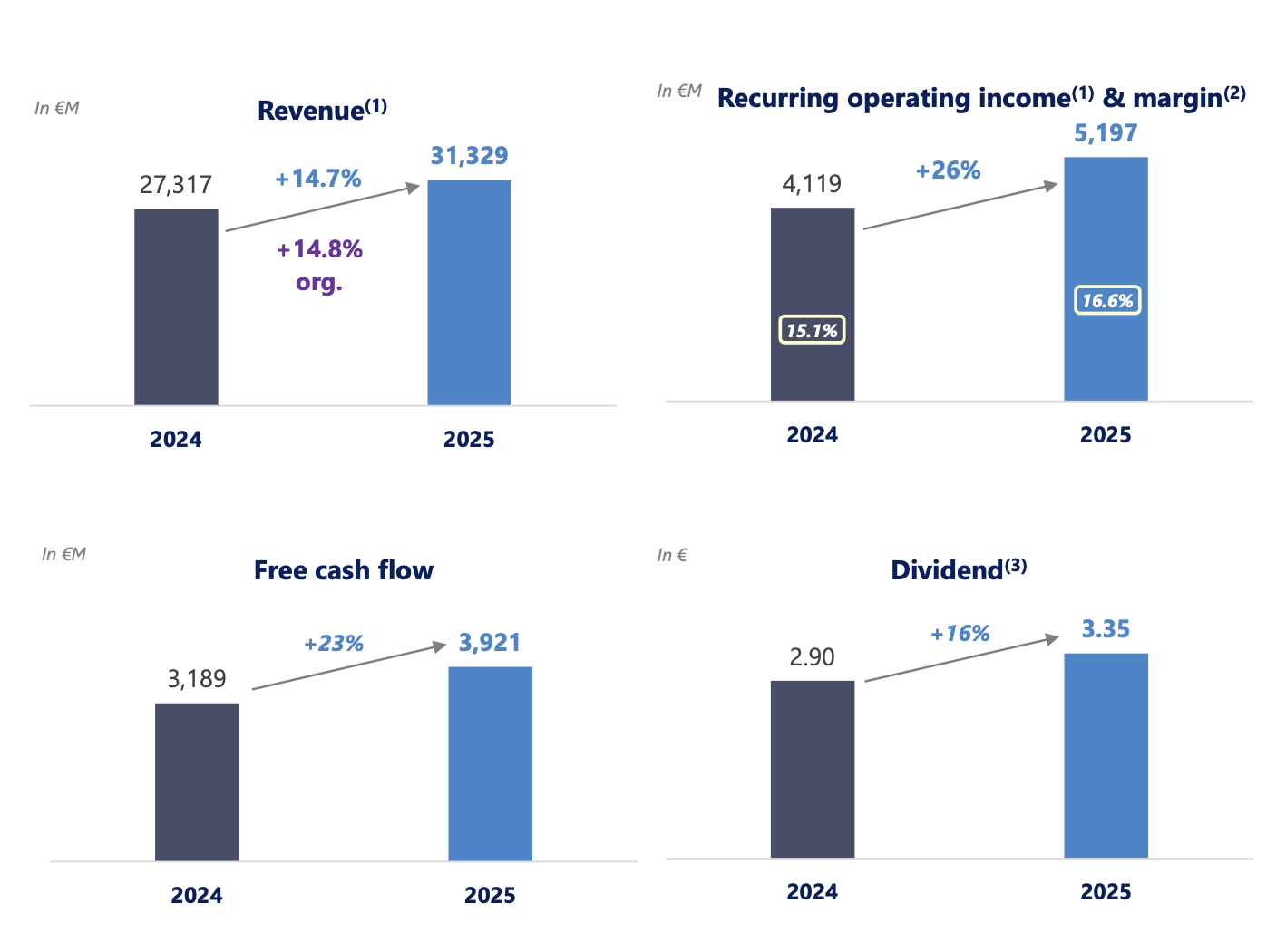
Safran’s revenue, income, free cash flow and dividend for 2025. Credit: Safran
Improvements in LEAP production
The strong figures were underpinned by improvements in the supply chain, and efforts to improve resiliency within the troubled LEAP production line.
More than 1,450 of the high-pressure turbine hardware durability kits for the CFM LEAP-1A engines that power Airbus A320neo family aircraft have now been produced. This upgrade can more than double time on wing in harsh environments, and Andriès said this was bringing shop visit intervals in line with the CFM56.
Around half of the LEAP 1-A fleet is also now equipped with the reverse bleed system which reduces on wing fuel nozzle maintenance.
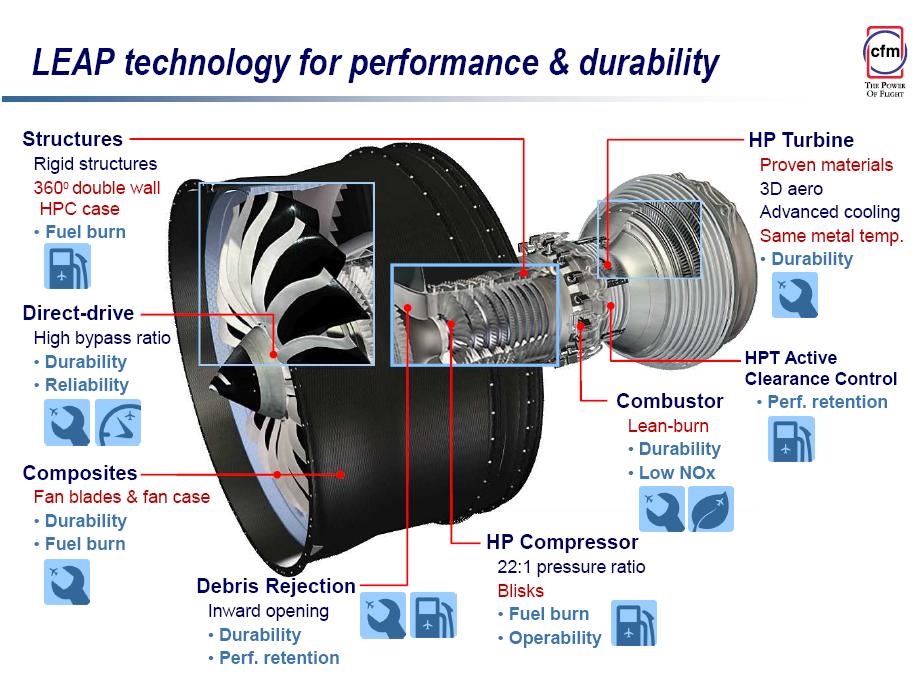
For the LEAP-1B, both the reverse bleed system and the HPT blade upgrades are expected to be certified in the first half of 2026, delivering the same durability improvements to 737 MAX operators.
This week, Ryanair and CFM announced a long-term material services agreement to support Ryanair’s entire fleet of about 2,000 CFM56 and LEAP engines powering its Boeing 737 aircraft.
Safran, one of CFM’s two parent companies, will help cover the provision of spare parts and parts repair from CFM for the two new engine MRO shops that Ryanair plans to establish in Europe from 2029.
CFM will also support Ryanair with a services agreement for both CFM56 and LEAP engines, until the Ryanair MRO facilities are fully operational.
For the CFM56, Andriès highlighted a strengthening afterservice market driven by high MRO demand and resulting low retirement levels, with around 2,300-2,400 shop visits per year from 2025 to 2028, more than 750 additional shop visits over the period than previously forecast.
This chimes with Bernstein’s analysis, that retirements were around 1% of the total fleet in 2025, “significantly below industry normal, due to the shortage of new planes.”
Safran said shop visits were expected to start declining from 2029, however Bernstein said this was “difficult to believe” given the strength of demand. “That is
the key driver behind our bullish stance on Safran,” they said in a January 22 analysis.
Strengthening defense portfolio
Growing momentum within Safran’s defense activities is also sustaining this rosy picture for the Paris-based corporation.
Safran has accelerated production of the M88 powering the Dassault Aviation Rafale fighter jet, recently announced a new MRO shop dedicated to the M88 engine in India, and has secured a new Rafale export contract with the Indian Navy.
Safran Aircraft Engines also announced a project to expand its Le Creusot facility, which specializes in machining complex rotating parts. The Le Creusot site currently exclusively produces low-pressure turbine disks for the LEAP and CFM56 engines, but the expansion will add production lines for complex rotating parts for the M88 as well as the GE90 engines, which power the Boeing 777 .
In defense electronics, the order intake reached a record level, with 1.6 book to bill ratio. “Momentum remains extraordinarily strong in defense,” Andriès told investors on Friday’s earnings call.
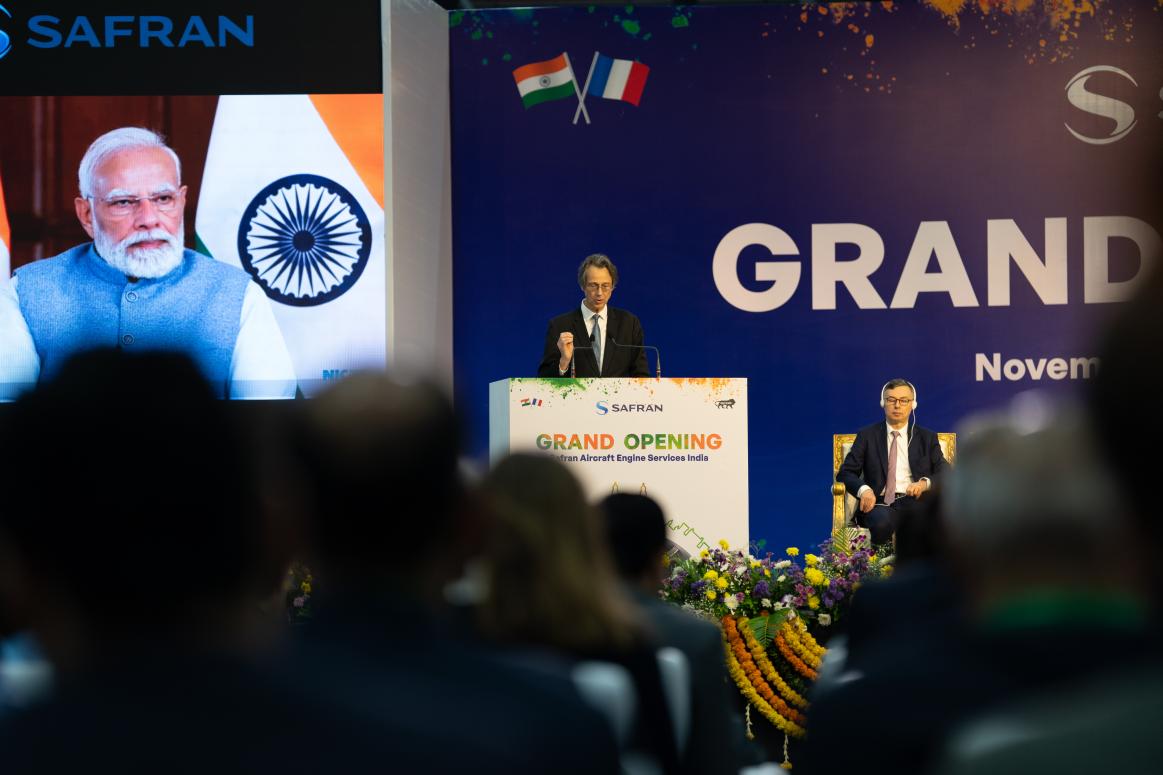
At a ceremony in Hyderabad, attended by Narendra Modi and Olivier Andriès, Safran inaugurated its largest MRO center dedicated to the CFM International LEAP engine. Credit: Safran
On the portfolio management side, Andriès said the integration of Collins actuation activities was “progressing well”, while Safran is also moving ahead with the divestment of two non core activities. The sale of Safran Passenger Innovations, Safran’s in-flight entertainment and connectivity solutions division, was completed last month.
The deal for Safran to sell its 50% stake in EZAir, a 50/50 joint venture that manufactures Embraer’s interiors in Chihuahua, Mexico, along with associated aftermarket activities, to partner Embraer, is expected to close by the middle of the year.
More growth to come in 2026
For 2026, Safran expects revenue to increase by the low to mid-teens percentage points, while recurring operating income is forecast to reach €6.1 to €6.2 billion with free cash flow projected to sit between €4.4 and €4.6 billion. LEAP deliveries are expected to increase by around 15% over the year.
The French corporate surtax on large companies’ profits, which is set to be maintained in 2026, is expected to knock €470 million off its free cash flow (the figure reached €377 million in 2025).
The positive results have pushed medium term forecasts higher, with Safran forecasting that recurring operating income in 2028 should now land somewhere between €7 and €7.5 billion, up from the €6 to €6.5 billion listed at the capital markets day in 2024.
Meeting the Airbus rate 75
Safran is betting on further growth in line with Airbus’ ambition for the A320neo family delivery rate of 75/mo by 2027.
The group has taken the decision to invest to be ready for Rate 75. “We acknowledge that the demand has been there for some time so it is worth investing,” Andriès told investors. The target production rate was a catalyst for the new assembly line in Morocco, and Andriès teased future investments to help meet that 75 figure.
“We are just getting prepared, we have to be realistic it does not happen over night but we getting prepared and we are investing,” he said.
Sounds good from SAFRAN. Wonder if AB will hit those
number by 2027.
Great job 😎
The stock was up 8.29% at close of business in Paris, so the market was evidently impressed.
India has just approved the aquisition of a further 114 Rafales, and Dassault is accordingly upping the Rafale build rate, aiming for 3-4 per month by 2028-2029. That will further increase Safran’s M88 revenue stream.
The Rafale backlog has now climbed to over 330.
Ok;
So fighter Jets are back in the discussion, or violation of the Rules clearly stated by Scott..
The article above devotes a paragraph to fighter jets — I’ll even quote it for you, since you apparently missed it:
“Safran has accelerated production of the M88 powering the Dassault Aviation Rafale fighter jet, recently announced a new MRO shop dedicated to the M88 engine in India, and has secured a new Rafale export contract with the Indian Navy.”
Quote all you want. Unless its linked a point on CFM and LEAP, its just another violation (my opinion, Scott has the say here not me).
Your MO is to skirt the rules if not over the line then when called, I am Sorry. You are not. [Edited]
Note the topic:
“Safran hails ‘outstanding’ 2025; …….)
Safran is Safran and not a synonym for CFM
Wow literally the first line of the article: 👇👇
Not CFM, not LEAP!
> Safran enjoyed an “outstanding” 2025 with a …
I disagree. Safran exists due to CFM.
GE not as much but they too are CFM
PW does not exist sustainably sans the alliance with MTU and the Japanese grop
RR stands alone with a limited market. Profits and numbers are in the single aisle market.
@TW: CFM was formed between GE and Snecma, which is Safran’s predecessor. Today’s Safran includes interiors and other things.
For those interested in all the products that Safran makes, here’s an informative link — with 58 pages!
https://www.safran-group.com/products-services
Commercial engines, fighter engines, helicopter engines, nacelles, thrust reversers, landing gears, cabin fittings, missiles, fuel systems, flight recorders, brakes, antennae…you name it.
@Scott:
Yes I knew that.
I also knew that they did some other engines.
I have not dealved into them but at a guess the CFM link up is the core of their foundation and profitability.
Call it the Dog with a couple of tails.
Otherwise sans CFM they would have been folded into someone else in my opinion of course.
The Euros do seem to get wound up when its fair to knock the US firms.
I have dealt with some very good European kit, SAFT would be one. The other is a compressed air specialist who makes a fantastic Mass Core air dryer.
In both cases no one in the world let alone US comes close. Both are gold standards in the true sense of that term.
Here’s more info on Safran’s M88 engine production plans in India:
“HAL and Safran Set to Localize M88 Engine Assembly for India’s Expanded Rafale Fleet”
“Reports indicate that Safran Aircraft Engines is preparing to establish a local assembly line for the M88 turbofan engine in India, with Hindustan Aeronautics Limited (HAL) acting as the primary industrial partner.”
“This partnership builds on decades of successful collaboration. Safran has been a long-term engine partner for HAL’s helicopter programmes, powering platforms such as the Chetak, Cheetal, and the Light Combat Helicopter (LCH).
“A standout success of this relationship is the co-development of the ‘Shakti’ engine, which is manufactured in large numbers at HAL’s Engine Division in Bengaluru.
“Furthermore, the two entities operate a joint venture in Bengaluru dedicated to producing precision aero-engine pipes, a critical link in the global aerospace supply chain.”
“In 2025, HAL and Safran signed a contract enabling the Indian manufacturer to produce components for the LEAP commercial engine family.
“This deal integrates Indian manufacturing into the global supply chain for civil aviation, leveraging the high-precision skills required for military applications.
“Safran’s physical footprint in India has also expanded significantly. The company has established a network of production sites across Hyderabad, Bengaluru, and Goa.
“Notably, in late 2025, Prime Minister Narendra Modi inaugurated Safran’s largest maintenance, repair, and overhaul (MRO) facility for LEAP engines in Hyderabad.
“This facility serves as a precursor to the comprehensive aero-engine ecosystem the company aims to build in India, covering everything from manufacturing to servicing and technical development.”
https://defence.in/threads/hal-and-safran-set-to-localize-m88-engine-assembly-for-indias-expanded-rafale-fleet.16898/
And then there’s this interesting story:
“A clean-sheet engine for AMCA: Safran agrees unprecedented tech transfer to India”
“India will gain full ownership of the engine’s core intellectual property under the deal, giving its AMCA programme access to hot-section and turbine technologies that foreign suppliers have never shared before.”
“Safran chief executive Olivier Andries has described the agreement as one that goes well beyond assembly or licensed manufacture. Speaking to The Economic Times, he said the company had agreed to a “complete transfer of technologies” for the fighter engine, including the critical hot section.
““We, along with the DRDO, are basically going to develop a new engine together in India,” he said, calling it a unique proposal in the market.”
“The engine partnership is expected to run for over a decade and cost around ₹610 billion ($7 billion), placing it among the largest aerospace development programmes India has undertaken. The plan includes multiple prototypes for flight testing by the end of the decade and certification in the early 2030s.”
“The economic scale is matched by its industrial ambition. Under the agreement, Indian engineers will work directly on turbine design, single-crystal blades, thermal management and composite materials, skills considered essential for future propulsion programmes.”
https://aerospaceglobalnews.com/news/safran-india-fighter-jet-engine-amca/
Looks like Safran is VERY happy and comfortable with its Indian ventures.
Another sharp contrast with the comments made elsewhere on LNA regarding BA’s alleged dissatisfaction with Indian engineering.
Starp a couple of those puppies on an MC-21 and yo9u got one hot jet.
Certainly could dogfight an A-10! Note to self, DO NOT get in front of the A-10 gun, big nasty 30 mm at ooodlese per minute output.
You just overpower the PDF weight problem. Granted its probably only 200 miles combat reading. Still better than an ME-162 (3?)
Very positive sign of SAFRAN’S growth plan for the engine supply program, in contrast to P&W total evasive plans to satisfy the airline market, whose aircrafts have and are still being grounded for lack of compromised service contracts. P & W seems to be more inclined to serve their MIC fat contracts being adjudicated to contractors related to the War sector.
Sure confirmed by Vietjet going tor more of them!
I am sure if they went with the REO it would work out much better.
I think approximately 650 to 700 aircraft are currently grounded worldwide due to the ongoing Pratt & Whitney Geared Turbofan (GTF) engine crisis.
This represents roughly one-third (33-35%) of the global GTF-powered fleet. The situation is driven by a manufacturing defect involving “contaminated powdered metal” used in high-pressure turbine and compressor disks, which can lead to micro-cracks and premature engine failure.
This presents a commercial opportunity for CFM on the NEO’s as well as on the recovering 737 MAX production line.
CFM faces its issues, Southwest is shaking in the boot.
> A potential engine shortage due to CFM LEAP-1B engine durability concerns may ground Southwest fleet in the coming months
Southwest has the biggest exposure
> As a durability problem has emerged with the Leap-1B turbofan’s high-pressure turbine disk, CFM International partner Safran will rely on spare engine leasing to help solve the looming engine availability issue, Safran CEO Olivier Andriès said Feb. 13.
https://aviationweek.com/air-transport/aircraft-propulsion/safran-counts-engine-lessor-ses-ease-leap-disk-durability-issue
The earlier life limit remains, so the same life limits as when they were new. Hopefully will new parts with extended life limits be certified and produced in volumes. This is pretty normal in the industry historically. The LEAP production volume is above normal peacetime production causing the scale of the problem.
Something, something happened?
> In the Leap-1B HPT stage 1 disk case, findings from routine shop visits prompted CFM’s decision to develop an improved version rather than seek a life extension.
It’s more about the lack of preparedness (or the rather late realization there’s no life extension coming) by CFM, MRO shops and airline customers for this coming “tsunami”
More likely detailed Finite Element Analysis with temperature data from operations together with manufacturing cost reduction (and a good price increase on the coming new “Long Play” T1 disk.)
The Moroccan assembly line referenced in the article is for A320 landing gear:
“Safran to open landing gear plant in Morocco”
“RABAT: Safran Landing Systems, a subsidiary of French aerospace group Safran, signed a deal with Morocco on Friday to set up a landing gear factory near Casablanca worth 280 million euros ($332 mln) to supply the Airbus A320, Safran Chair Ross McIness said.
The new plant will help Safran support the production pace of the Airbus A320 family and prepare the next generation of short and medium-haul aircraft, McIness said at the deal’s signing ceremony chaired by Morocco’s King Mohammed VI at the Royal Palce in Casablanca. ”
https://www.arabnews.com/node/2632947/middle-east
===
“The investment also reflects a broader trend among European aerospace manufacturers seeking to diversify their industrial footprint and build supply chain resilience closer to home. Morocco’s geographic proximity to Europe, its established industrial platforms and its existing pool of approximately 25,000 aerospace workers make it a natural candidate for nearshoring strategies in the sector. The facility is also expected to attract new suppliers into the Moroccan aerospace ecosystem, potentially deepening the country’s integration into Safran’s global procurement network.”
https://www.ecofinagency.com/news/1402-52903-morocco-safran-announces-305-million-investment-to-build-one-of-the-worlds-largest-landing-gear-plants
Best move now Safran ever made to link up with GE.
Combined the two companies have matured one legendary product and working hard on another.
Worst probably was the Silvercrest engine. I don’t follow Safran a lot unless its linked to CFM, but that is the one that stood out.
Reminds me a lot of the IH diesels debacle. They ran on emissions credits for years and insisted they did not need EGR. Then came the day of reckoning and that approach failed totally (they now build one engine and Cummins rescued them for emissions gear and engines.
Silvercrest was the same. It was not that the approach was novel, trying to use it was, and they were told it had not and would not work. Huge egg on the face and lost serious business in the Rich Jet Market.
Yes, never really understood the silver crest problems.
A company that had a linage in successive commercial and military engines over the years, couldn’t get a business jet engine to work satisfactorily.
I think it has far more to do with human dynamics that past success.
In depth I was a diesel engine guy so followed the industry closely. My end was mostly backup, simpler the better, you just want em to start and run and could care less about economy.
IH took a direction and the engine division management then put on blinders. They cooked the book so to speak. They had a line of very successful engines in their background.
There is a flip point when you pick a path and then refuse all further input. From what I was reading it was identical with Safran.
PW knew the GTF worked, it was a question of could you get it lite enough and reliable enough for a larger application.
What bit PW was not the GTF, it was the execution on other parts and a supplier bust.
Safran/IH seems to be a situation where your engine department goes rogue and lies about results and management trusts them due to their track record.
The key to going rogue is wrapped up in a bright shiny feature that gives you something special (if it works) and the special thing does not work.
I know with IH was was simplifying engine emissions and no EGR. Oddly, some engines in some applications (steady speed likie a generator/water pump) they can do that now. Years down the road and huge amounts of research. At that time and date no, you needed Urea injection, Soot filters and EGR.
Safran had something to do with the rotor that gave them in theory SFC, big improved power to weight or some such that others had tried and found it did not work.
You don’t go all in unless data is backing you up but engineers can fool themselves as well.
It was a new design with a big centrifugal hp compressor. My understanding is that it worked per spec at steady state conditions but got problems in the transients where flow regulation thru massive bleed valves were missing. They should have made a stationary engine out of it and fitted it with the missing high capacity bleed system as cost were sunk into it (Like the Stal-Laval GT35 stationary engine from the cancelled fighter engine)
@claes:
Thank you, I can follow jet engines but I sure can’t rattle off the features and any shortcomings. It makes sense as centrifuge has long been dropped though it sure made for some good early engines.
Interesting idea on the ground version. GE did it with the LM series and RR did it with the RB211 (I forget what they call theirs). Both have been an answer to steam in military applications where power density and size were factors. Combine them with diesel engines and you can get a hot rod with great range.
US is biased to all or nothing in jet or diesel alone, Europeans have gone the combo route which makes sense.
I believe the jets are used for some power application though I think its more towards an emergency backup. A number of built to spec jet engines for mainstay power.
Nice thing about the Aircraft derived ones is the easy to rebuild aspect.
I worked on one of the Backup type, Cat at the time from a bought out operation. It was not well liked as it was iffy on a fast fire up. Took several start attempts at times which is not what you want for that application.
Once it got up and going it was solid. Kind of hard to beat a Cummins V-12 1710 (Allison in gasoline version) for starting and running in 20 seconds.
Both the P&W JT8D, RR Trent and most GE aircraft engines are available as “aeroderivative” powerplants. RR MT30 (Marine Trent 30 MW) sells well. GE do it from the first CF6 as a navalized and modified LM2500 (Land&Marine 25000 hp) on to the LM5000, LM6000 and some others.
Outside the CFM framework, Safran has had two failures in the civil sector with the Silvercrest and the Ardiden 3TP. The success of the M88rex (Rafale F5) will be a good indicator of its ability to be a global engine designer. GE is now unambiguously the leader in CFM with the HP section, with the exception of the GE90 HPC, which is still in production.
do you perchance have a hint what issues are coming up on the Ardiden 3 turbo prop engine?
Ardiden 3TP, which has not yet been selected for any platform, is derived from the Ardiden 1 and 3 helicopter engines. Its architecture is therefore based on a combination of axial and centrifugal stages in both the compressor and turbine. GE’s competing engine is a more recent design based on axial stages in both the compressor and turbine. The OPR is likely higher. The thrust margin appears to be greater here, and the development cost was considered lower by Airbus (Germany) at the time of the Eurodrone selection. However, initial certification was delayed. The first civil platform is now certified on the Denali. The datasheet for the uncertified Ardiden 3TP is obviously not available, making comparison difficult, but this remains a failure for Safran vis-à-vis GE outside the CFM framework. SAFRAN is now studying a light hybrid electrical version of Ardiden.
> Speaking at the recent Singapore airshow, Rick Deurloo, president of Pratt & Whitney Commercial Engines, says the number of A320neo AOGs is now reduced by around 20% compared to its peak of more than 700
CFM LEAP engines
> “Engines are the biggest issue for us, particularly CFM Leap engines,” Greenway said Feb. 4. “Last year, we were fortunate not to have aircraft grounded due to engines, but that is no longer the case. We currently have aircraft on the ground that are not generating revenue.”
We’re now into the second week without an open forum.
Are we to assume that Mr. Hamilton has abandoned the concept?
If so: understandable, though regrettable.
@Abalone: The truth is I was traveling and forgot to post specifically-dated Open Forums. Thanks for the reminder. I’ll resume this on Monday.
Hamilton
I figured he was busy, not all about us here.
Reuters:
> US FTC finalizes consent order in Boeing acquisition of Spirit AeroSystems
Why so late, wasn’t the transaction completed in December 2025?
https://ca.finance.yahoo.com/news/us-ftc-finalizes-consent-order-220154118.html
Apparently, there was a mandatory public commenting period after the provisional approval in December, and that period has now expired…
Bloomberg
Qatar Airways’ New CEO Prioritizes Better Relations With Airbus
> About a month into his tenure as Qatar Airways Group’s chief executive, Hamad Al-Khater made certain his first overseas trip took him to the French headquarters of planemaker Airbus
https://x.com/business/status/2023990060471713891
#########
https://www.linkedin.com/posts/qatar-airways_qatar-airways-group-chief-executive-officer-activity-7421089003946491904-wd3g
#########
> Al-Khater indicated the narrowbodies [A321LR] will feature new business and economy cabin configurations and suggested the aircraft could be a game changer for the airline’s network flexibility.
At long last .. Vietnam Airlines finalized the 2 year MoU for 50 737 Max 8’s.
Sorry Donnie, gotta give it to your predecessor ex pres.Biden on that one
Hey, you still got Air Astana to firm up their Dreamliner order for up to 15 787-9’s.
Start-up carrier Sun PhuQuoc Airways firms up a deal for up to
40 787-9 Dreamliners.
Vietjet signs for 6 more max 8’s on lease deal.
More Geo political drama fun.
Well done !!
Well, let’s take a look at the track records of both Boeing and Vietjet:
United became one of the launch customers of 737-10 by announcing an order of 100 the day after Boeing’s launch in June 2017. **United expected to begin taking delivery of the 737 MAX 10 in late 2020.** But United still has received none, not a single one despite the order has been on Boeing’s backlog for almost a decade. OTOH, United didn’t order the A321neo until June 2021and has received a total of 62 since 2023. What a contrast!
Southwest became the launch customer of the 737-7 in 2013.** More than a decade later, Southwest still hasn’t received any.
> “We ordered MAX 7s expecting 2021 delivery,” stated Southwest CEO Bob Jordan. “It’s now 2026 and we STILL don’t have them. We’ve had to extend leases on aging 737-700s at huge cost because Boeing can’t deliver.”
> Boeing has told the carrier to expect certification “in the next month, or two or three,” Chief Operating Officer Mike Van de Ven said. “In my mind, I’ve got it sometime in the first quarter [of 2021].”
Qatar Airways’s CEO had received words from Boeing CEO that the airline would receive its 777-9 starting from early 2026! (OTOH Qatar got its A350 earlier than scheduled, according to the CEO.) I guess checks of substantial amounts were dispatched to compensate. No wonder BA has to make another substantial provision for the 777X last year.
Vietjet placed its order of 737 MAX in July 2018 and didn’t take delivery of its first aircraft until a few months ago.
I see a pattern that orders has been staying on Boeing’s backlog for much longer than expected as the airframer has difficulties to meet its own promises. Many have to accept that Boeing’s order book has little connection with its deliveries in near future.
“Quality escape,” but this one wasn’t caught in time by the airframer, unlike its main competitor!
FAA to mandate 767F cargo track fitting inspections following ‘suspect material’ discovery
> Boeing sought to address the concern by issuing an Alert Requirements Bulletin in October 2025. That document calls on operators to complete x-ray fluorescent spectrometer inspections of the fittings, to identify the material from which they were produced. The bulletin instructs airlines to replace non-compliant fittings.
https://www.flightglobal.com/airframers/faa-proposes-767-300f-cargo-fitting-inspections-amid-material-concerns/166345.article
FG: Bombardier bedeviled by ‘brutal’ engine supply issue but Martel sees progress as deliveries rise
> Presenting the company’s full-year performance on 12 February, chief executive Eric Martel said the engine supply issue had resulted in one of its assembly lines stopping “for days or even weeks”.
CFM Uncontained engine failure:
> WILD!
Mid-flight engine explosion forces Arik Air Boeing 737 to make emergency landing…
https://x.com/Osint613/status/2023070785238360511
> “… left hand engine suffered an un-contained failure, causing debris damage to the left wing, fuselage, tail fin and left stabilizer…”
https://www.planespotters.net/airframe/boeing-737-700-5n-mjf-arik-air/rzwnvz
Gulf News: How Boeing 737 pilots, cabin crew saved 80 passengers in mid-air engine horror
> Similar incidents
Southwest Airlines incidents (CFM56 engine series, similar to many 737s)
Multiple cases involved fan blade failures leading to uncontained debris. In 2018, Southwest Flight 1380 experienced a left-engine explosion shortly after takeoff from New York; debris punctured the fuselage, causing one fatality (from depressurisation), but the pilots landed safely in Philadelphia. A prior 2016 Southwest event saw a similar fan blade separation; the aircraft returned safely to Florida with no injuries. These prompted FAA inspections of CFM56 engines.
Aerolíneas Argentinas CFM56-7B failures (Boeing 737-800s, 2025)
In October 2025, repeated engine failures on 737-800s led the airline to ground eight aircraft. One flight (AR1526) from Buenos Aires experienced an in-flight failure shortly after takeoff; the crew diverted safely to Ministro Pistarini Airport. This marked the fourth similar event in a year, highlighting recurring issues with the CFM56 engines before reaching service limits.
https://gulfnews.com/business/aviation/how-boeing-737-pilots-cabin-crew-saved-80-passengers-in-mid-air-engine-horror-1.500444480
> Aerolíneas Argentinas grounds some 737s after pair of engine failures
The second incident, occurred on October 15th, was similar to the first, held on October 9th, as both happened seconds after takeoff, involving two different Boeing 737-800s from the same airline and two left CFM engines. Furthermore, the aircraft concerned have similar characteristics and engine components.
> As a result, Aerolíneas Argentinas decided to ground several Boeing 737-800s from its fleet, all of which have CFM engines with similar characteristics to those involved in the two incidents.
> As well as confirming which planes are grounded, Aerolíneas Argentinas stated in the same press release that it “fully complies with the checks specified by its manufacturers. Despite this, and the company’s institutional strength in terms of its commitment to safety, this is the fourth incident recorded in the last year involving the same type of engine. These are engines manufactured by CFM (GE Aerospace and Safran Aircraft Engines), with a specific type of component that caused these failures.”
“CFM recommends an inspection after 17,200 cycles (landings and takeoffs). None of the engines that experienced failures were close to reaching that threshold, so a technical opinion was requested before returning these aircraft to service. At the same time, technical opinions were also requested from other airlines in the region that operate aircraft with this engine type and have experienced similar events.”
https://www.flightradar24.com/blog/aviation-news/airline-news/aerolineas-argentinas-grounds-some-737s-after-pair-of-engine-failures/