
Leeham News and Analysis
There's more to real news than a news release.



Rolls-Royce boosts mid-term targets, CEO dismisses UltraFan loan speculation
By Thomas Blackwood
Feb 26, 2026, © Leeham News: Rolls-Royce posted strong 2025 full year results on Thursday, with profits up and upgraded mid-term targets, as the UK-based manufacturer restated the case for its re-entry into the narrowbody engine market.
 Speaking to analysts, CEO Tufan Erginbilgic said Rolls-Royce was seeking partners for the £3 billion ($4 billion) Ultrafan 30 engine development project, which will allow the company to establish itself within the large and growing narrowbody market.
Responding to media reports that he was seeking a UK government loan of up to £200 million initially to help support the development and testing of a demonstrator, Erginbilgic suggested Rolls-Royce was looking for grant funding through initiatives such as the Aerospace Technology Institute (ATI) rather than any lending facility. The ATI programme co-funds civil aerospace research and technology development in the UK.
“Let me be very clear, we are not asking for any loan from anybody, not to mention government,” he said. “It is not actually uncommon that governments support R&D, and our competitors get two-three times what we do. They are not actually loans… so we are talking about that kind of support. We don’t need any loan, but we are in a competitive world.”
The UltraFan 30 program
The UltraFan 30 program is still at an early stage and details are scant on exactly when and how it will enter the market, aside from a 2028 date for testing, but Erginbilgic said the UltraFan technology at Rolls-Royce’s disposal put it in a strong position for the next generation of narrow body aircraft.
“The narrow body market is large and would offer meaningful synergies with our wide body and business aviation activities. We are building a narrow body size demonstrator with up to 30,000 pounds of thrust, which will be ground tested by 2028,” he said.

A demonstrator from the UltraFan program (not the 30) in the new RR test stand. Photo: Rolls-Royce
“We expect the UltraFan to deliver a significant improvement in fuel burn versus today’s narrow body engines, as well as meeting the time on wing expectations for customers in this market. We have already invested significantly into UltraFan, and will continue to do so as we look to re-enter the narrow body market in partnership.”
The starting position for Rolls-Royce is that a partnership on the project would be beneficial, and the company is talking to engine makers and other entities. Airbus and Boeing are said to be supportive of the project. But the engineering capability is there to go it alone, and Rolls-Royce continues to work on a demonstrator, with or without a partner.
“Given the developments we made with UltraFan – we already spent more than £1 billion on UltraFan – and the new technologies we are incorporating, and continue to incorporate in UltraFan, that positions us really well for [the] narrowbody [market],” Erginbilgic said. “We prefer [a] partnership, we are talking to multiple parties. More importantly, they want to talk to us and two airframers…Airbus and Boeing, they are actually keen that we participate in narrowbody.”
Profits surge after bumper 2025
On the financial side for full-year 2025, Rolls-Royce posted underlying operating profit of £3.5bn in 2025, up from £2.5bn in 2024, with an operating margin of 17.3%, versus 13.8% in 2024.
Free cash flow reached £3.3bn, up from £2.4bn in 2024, and net cash stood at £1.9bn at the end of 2025 compared with £475m by the end of 2024.
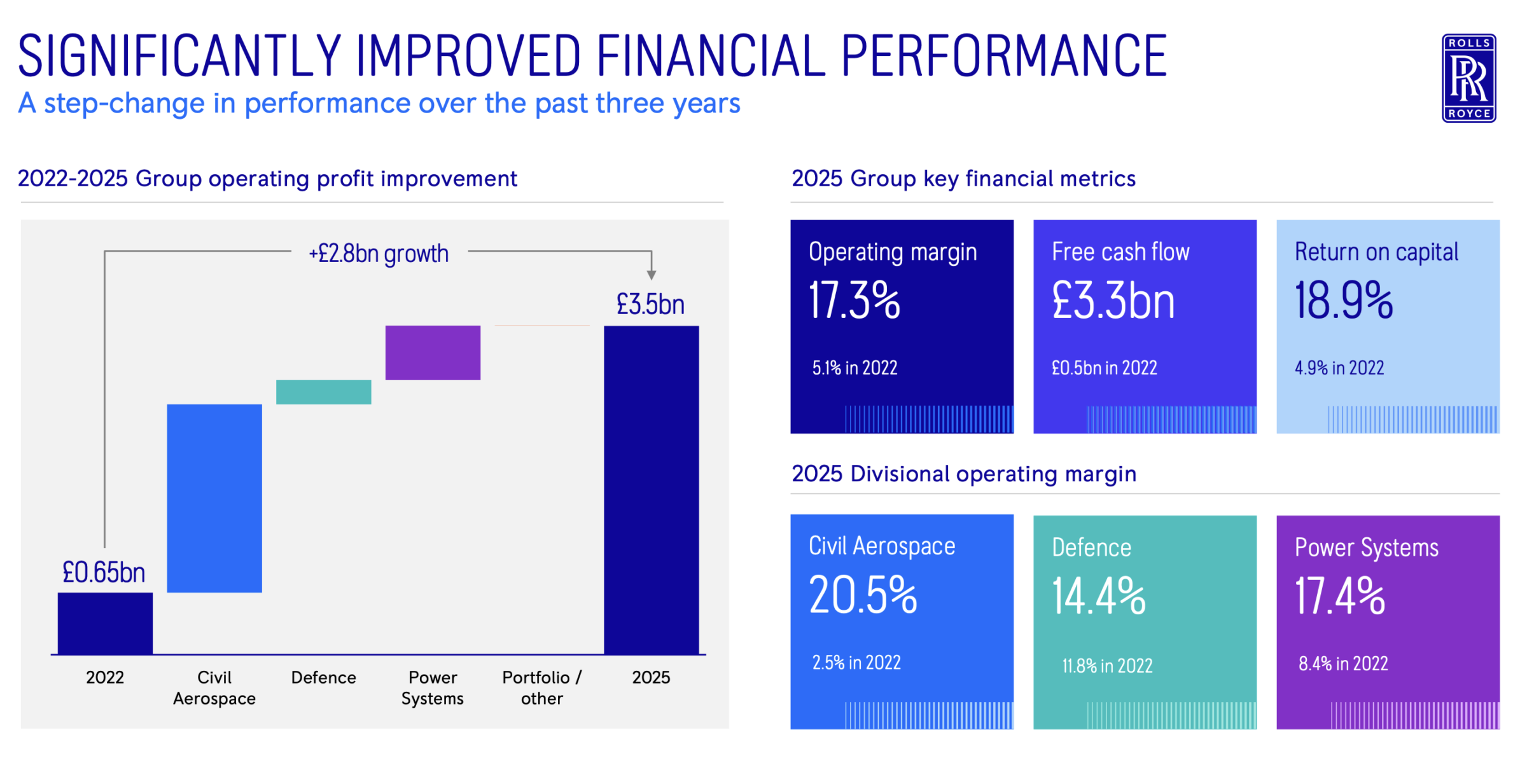
Rolls-Royce 2022-2025 financial performance. Photo: Rolls-Royce
The civil aerospace division delivered an underlying operating margin of 20.5%, versus 16.6% in 2024, helped in part by stronger large engine aftermarket performance and higher spare engine profitability.
On the defense side, Rolls-Royce reported an underlying operating margin of 14.4%, flat from 2024 (14.2%), due to the absence of a one-off benefit in submarines last year.
Rolls-Royce has benefited from increasing defense budgets worldwide. Testing of the AE 1107 and F130 engines, which will power the MV-75 (Future Long-Range Assault Aircraft) and B-52 aircraft, is progressing to plan, the company said,
Power Systems achieved an operating margin of 17.4%, up from 13.1%.
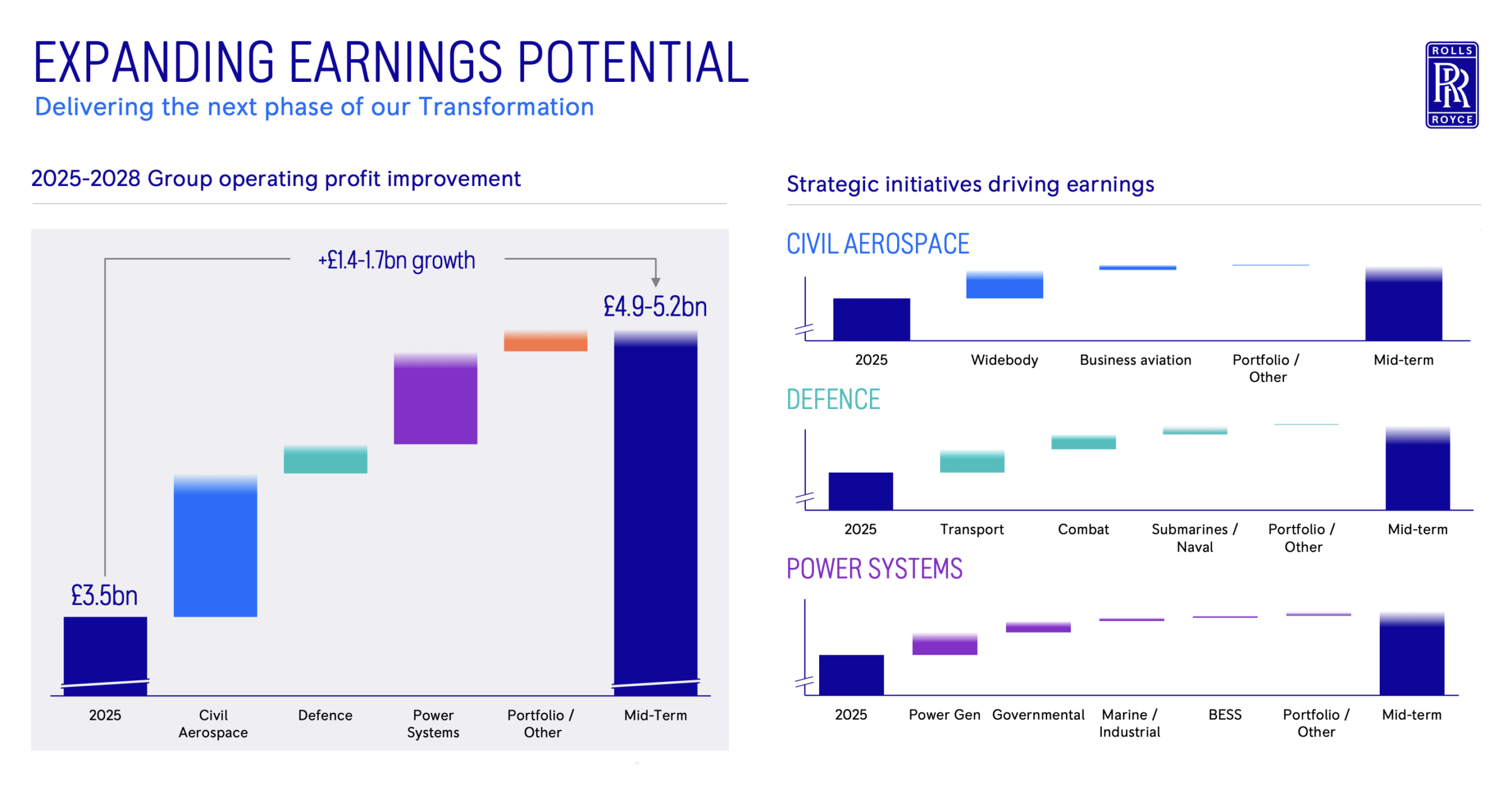
Rolls-Royce earnings potential in the mid-term. Photo: Rolls-Royce
As a result of its strong balance sheet, the engine-maker announced a £7-9 billion multi-year share buyback to 2028, following a £1bn share buyback in 2025.
Rolls-Royce likes to compare its financial position now with that of 2022, to highlight the transformation of the business under its new CEO Tufan Erginbilgiç, who joined the company at the start of 2023.
In that time, the operating margin has risen from 5.1% to 17.3% (2022 vs. 2025), free cash flow from £500 million to £3.3 billion and a return on capital from 4.9% to 18.9%.
Erginbilgic said: “I’m proud of what we achieved over the past three years, and we are not done yet. Our transformation has delivered a step change in performance across the group, this has been achieved despite a challenging external environment, including supply chain and tariffs.”
Future growth
Rolls-Royce expects underlying operating profit of £4-4.2 billion in 2026, with free cash flow of £3.6-3.8 billion. This includes a £150-200 million cash impact related to the supply chain, similar to that of 2025. The company said parts availability was improving but was still constrained.
Rolls-Royce has upgraded its 2028 mid-term group targets, increasing underlying operating profit to £4.9–5.2 billion (from £3.6–3.9 billion), underlying operating margin to 18–20% (from 15–17%), free cash flow to £5–5.3 billion (from £4.2–4.5 billion), and return on capital to 23–26% (from 18–21%).
The guidance includes the continued supply chain headwinds, which Rolls-Royce said would be gone by the midterm.
While Rolls-Royce has its sights set on a future position within the narrowbody market, it also continues to increase its share of widebody deliveries.
Over the last three years, the company has captured more than 50% of wide body deliveries, driving up its share of the installed fleet from 34% to 38%. Erginbilgic said this was expected to grow by 6-7% per year in the installed fleet to the midterm.
Improving time on wing and MRO capability
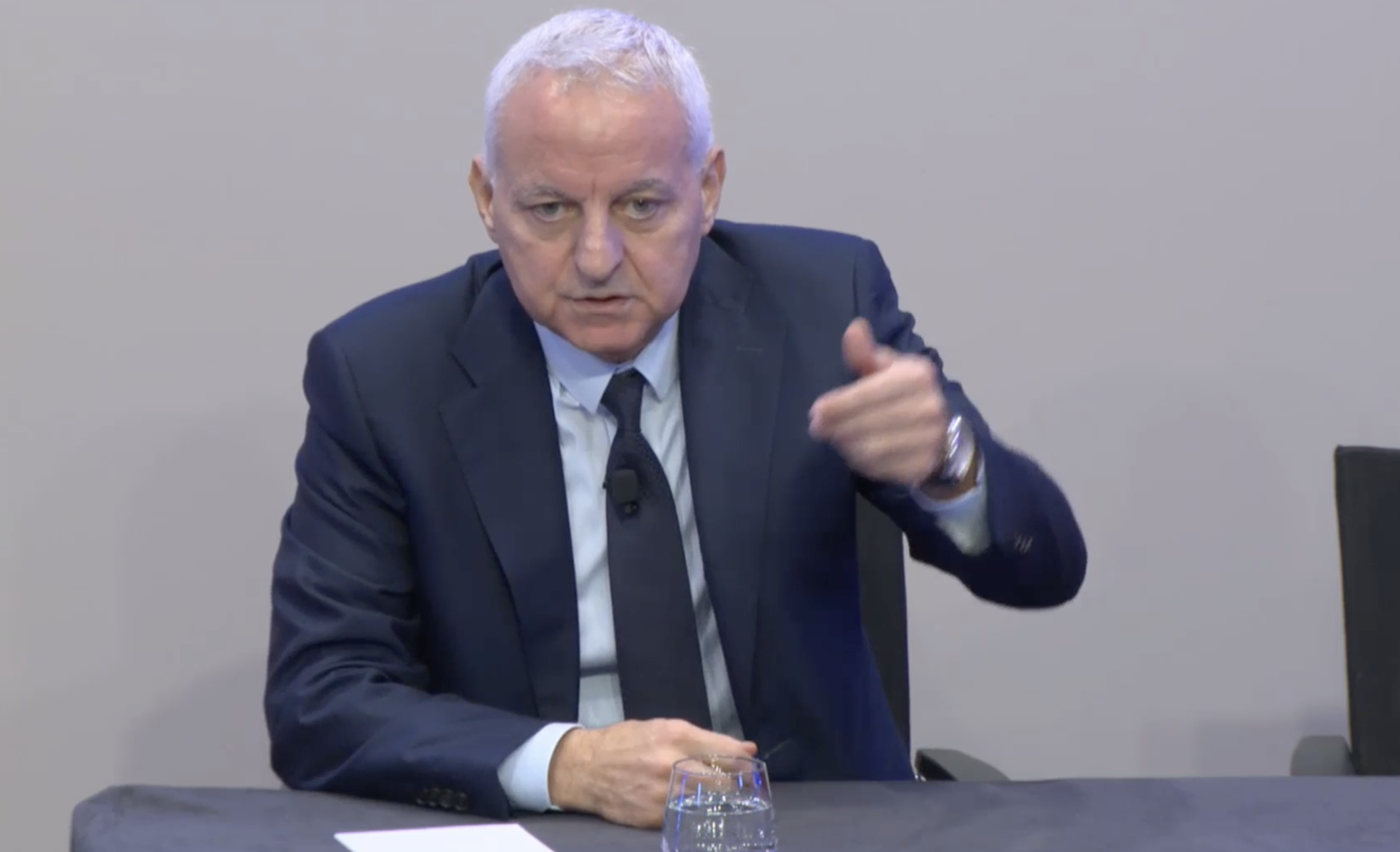
Tufan Erginbilgic, Rolls-Royce CEO. Photo: Screengrab/Rolls-Royce
There have also been significant time-on-wing improvements supporting this strengthened market position.
Rolls-Royce is targeting a more than 100% increase in durability across in production engines with more than half of this improvement target already delivered. This increase, compared to a previous target of more than 80%, reflects critical part life extensions for the Trent XWB-84 (Airbus A350-900).
Other key time-on-wing milestones include the certification of the first phase of improvements for the Trent 1000 XE (Boeing 787) in June, the second phase of HPT blade improvements for both Trent 1000 (Boeing 787) and Trent 7000 (Airbus A330neo) which were certified in December, and planned improvements for XWB-97 (Airbus A350-1000), which remain on track to be completed by the end of 2027.
Rolls-Royce has also been expanding MRO capacity and has seen increased shop visits – up more than a 50% since 2022.
The MRO network capacity will grow by a further 20% by the midterm to support future fleet growth. LTSA shop visits rose 10% last year.
The use of AI continues to reshape the operation. Last year, Rolls-Royce launched an AI platform, AiRR, which has capabilities in generative and agentic AI.
Erginbilgic said this was being used across engineering, MRO and the supply chain, helping to improve intelligent engine monitoring and planning, reducing turnaround times and shop visit costs.
It’d be good if RR can break back into the NB market.
I think we can be 100% sure that that’s on the cards 👍
And I also think it very likely that AB’s next NB will have an RR engine (choice).
Agreed on both counts.
RR more or less forces customers onto their power by the hour programs, so if RR can increase time on wing more than the increase in its maintenace bill both benefits, customers need fewer enginge changes and spare engines and RR increase profitability if they can keep the PBH rates. Getting above GE90 number of cycles (+4000) before engine change with competetive fuel consumption will improve its T1000 sales that are lagging.
Engine removal and change isnt the standard method now. Various components and sections have variable limits . Many can changed with the engine still on the wing
I know hydraulic pumps and generator can be changed but it sounds like blades and hot section.
I would like to see the procedures for something like that.
It seems a stretch to me but they do some amazing advances all the time.
While not aircraft at all, I am seeing water and sewer pipe replacement being done via some kind of injection of plastic or ? into the old lines and creates a new pipe (albeit a bit smaller). . Flow wise its probably the same as its smoother now. No more digging up streets and backyards at huge expenses when the pipe itself is the small one.
I’ve accomplished much work with RR in my career.
I wouldn’t term it as “RR forces customers”onto Total Care (their PBH). But their sales team makes it a great selling tool for decreasing the risk on the operator, GE and P&W do the same. The guarantee’s alone are worth the cost benefit to join a PBH program.
The GE90 is on the 777, so really can’t compare the T1000 with this engine.
The dispatch reliability for the GENx is 99.98%! dispatch rate and a time-on-wing (TOW) performance that is three to four times higher than its competition, particularly for the Boeing 787. (This engine is also used on the 747-8I/F.
But RR Trent 1000 is right there, boasts a 99.9% dispatch reliability rate, according to manufacturer data. Despite well-documented durability issues with intermediate pressure compressor blades that led to fleet disruptions starting in 2016, the engine has maintained a high reliability rate in service since its 2011 entry.
The updated Trent 1000 TEN (introduced in 2017) aimed to address some of the earlier durability issues. They’ve turned the corner but still more work required. RR handled this T1000 issue quite well IMO.
I agree with Vince, be great to see RR take on a NB development engine.
RR engineering was a bit sloppy on MHI oversight hence the IPC problems, the IPT blade internal coating miss was RR own as well as the T1 blade life. The 3-spool engine parts count is a disadvantage vs. GEnX driving shop visit cost. RR can compensate by having 25% longer life on-wing than the GEnX without increasing fuel burn. (easier said than done)
3 spool design has same or lower numbers of stages and blades- which are the major “”wear”” items compared to GEnX
GE signature item is variable angle stators for the single compressor stage, which is 5 rows
Plus the overall engine weight is only matched because of GE innovative carbon fibre fan blades plus its fan case .
The shorter RR nacelle should reduce weight too, but the numbers are proprietary
GE has succeeded in hiding its major problems on the GEnx 787 and the Leap 737 – which always call its required fixer uppers as “” durability enhancements”” even on LNA stories.
This is an AI listing of problems fixed by replacement of existing parts
HPT Durability Kit (LEAP-1A): Certified in late 2024, this kit includes improved high-pressure turbine blades designed to significantly extend time-on-wing, with expectations to double it compared to previous configurations.
LEAP-1B Enhancements: Similar, customized durability upgrades for the LEAP-1B are on schedule, with certification and introduction expected in the first half of 2026.
Reverse Bleed System (RBS): Deployed to mitigate carbon buildup on fuel nozzles, with over 50% of the LEAP-1A fleet already retrofitted by late 2025 and over 90% expected by 2028.
Dust & Pollution Resistance: Following extensive “pixie dust” ingestion testing, 2026 will see further, refined modifications to improve durability in harsh, sandy operating environments.
Software Enhancements: Software updates scheduled for 2026 will introduce optimized climb thrust ratings to minimize the thermal stress experienced by HPT blades, followed by further upgrades in 2029 to enhance exhaust gas temperature margins
@Duke:
I know this is a long standing disagreement, but people are moving to the GenX 787 engines and away from the Trent 1000/TEN.
GE clearly failed to get the SFC specs met initially. Like RR they did a couple of PIPS.
My guess is that for PR reasons, they quit advertising the PIPs and or moved into smaller insertions as time went on to correct that shortfall.
RR did a massive PIP (or a new engine per the mechanical definition of new)
GE has since morphed its way into compliance and now better than original contractor specs.
RR I believe has met specs but not exceeded them.
GE had an icing issue, there was a work around and now its corrected or fix is autonomic, but no more issues.
RR had engine failure issues GE did not have (see below for the history as I understand it)
I don’t see GE hiding anything, I do see regular comments that engines of the XWB aka Trent 1000 children not holding up or meeting TOW specified by a lot.
No more engine failures per the Trent 1000 debacle. Airlines are still working through the fixes.
CFM has had their issues on LEAP and PW has had worse issues on the PW 1000.
There have been some sudden engine failures on the PW 1000 that were Trent 1000 worthy, I believe those are resolved (some software bugs in the C and A series that rolled back engine)
LEAP is what I wold call normal new engine stuff, PW 1000 well in excess of that. India put the clamp on dual or single bad GTF engines to their credit.
GEN9X will have to see.
GenX engines have been a wild success. Equal to RR taking over the A330CEO market in the last variants.
As I understand it, RR had exclusive shop privileges that you paid for. They did not have the wider spread associated shops that were certified to do the work per GE or PW.
My take was the airlines resented being forced into PBH vs an independent shop; visit. Also was that when the issues hit, there was no network to use, it was limited to RR only shops which meant you could not even prep and engine in advance for repair.
I did not see RR handling the issue at all well but I am not an airline either. Ford and the exploding Explorer tires was an example of turning an issue into not only looking good, putting it on Firestones head. In fact Ford chose those marginally capable tires and a tad off (higher heat and a bit of low pressure) pushed them over the edge. Firestone was denying it – Ford stepped in and said, bring it in, we will put good tires on it and we will deal with tire folks.
What I saw with RR was the initial corrosion, well, its a salt environment issue. Earth to RR, what do you do with long range 787s? Yea, you fly them over oceans usually to coastal destination (most population is close to or on the coast). And you missed that? Ok, auto suspicious that the hosed up vs missed. How they messed up? Not a clue, but messded up is the obvious aspect. Its not like this is new.
The next one was the blade cracking. I get you can have an issue, but in this case it was not obscure for cause, it was a harmonic. I have read about harmonics back to the Jumo 004 . So it not only happened, they did not figure it out until the TEN came out ()and started having the same issue).
Amidst that was RR building a prediction model and running it and saying, ok, we are good up to 2500 cyles. Only to find out they cracked at 2000 cycles. As I recall that was two revamped models that did not work. Obviously if you do not understand the underlying problem you can’t model it. But you are gambling people lives on that (yes the AHJs should have steeped in)
Then the final condemn of letting 787s fly with two iffy engines that the models were failing to predict on. Loss of an engine is not in and of itself a fatal issue. In the case of Norwegian flight, it was the lower time engine that went.
Ok, full stop, India saw that issue with PW GTF and stopped flights with even a single iffy engine. Two good ones or no fly. We don’t care what it does to revenue.
Norwegian not just lost an engine and your running engine is under max duress and it has more hours on it than the failed engine. yea, that can lead to a crash.
RR could have flat said, no flight with even one iffy engine.
As I noted elsewhere, Lufthansa is the only operator I know for sure sticking with RR. Maybe because they have a Technic Shop and can deal with it and keep servicing other RR engines.
Boeing was in complete denial for a long time and that is what I felt RR was copying.
I don’t condemn the people working for RR, they are doing the best they can with the system they are handed. Management, yes.
I want to see RR back to the days of the Merlin (not a perfect engine but it had the perfect booster system). It may have lost performance when abused (darn right) but it did not fail. You can limp home with a engine that is at least running. RB211 when it was matured, went onto beat all on the latter A330s.
RR gambled on A350, GE on the 777X.
Guess who won.
https://youtu.be/rqSTVWw7twU?si=iRwW21iBXCXGb2lF&t=18
+1
So what is the latest projected EIS for the Boeing 777-X, 2030 or so?
@keesje:
You are aware that in head to head GE wins hands down on the 787?
And Boeing is still cranking out 777F with that GE engine on it that RR has no place on.
Boeing is making more 787s than Airbus is making A350 and A330.
People are buying A330 because they can’t get A350s. And that is with engines that are not up to GE snuff of what is in service, not compared to a non production engine on an aircraft that is not certified.
GE can thank Boeing for allowing them to mature the GEN9! (grin).
First its good to see RR getting out of its issues.
But the spin about capturing 50% of the wide body markets is purely bogus. Currently GE and RR have exclusives on all but one of the only wide bodies made.
The one in any contention is down to 30% and possibly falling further. The only major airline I know of that is sticking with the Trent is Lufthansa. BA is dropping it.
I am not into the world of government support, but I thought it was general research, not a specific project for a real production engine in this case?
By that standard of course its not a loan, its Free Launch money. Nice gig if you can get it. Much better than loans that are supposed to be repaid that you have to keep defending.
Does RR need a government bailout?
I don’t get any warm feelings for a company that puts out that kind of blather.
FT: Rolls Royce defends state aid bid despite share buyback
GE and P&W get substantial US government funding for mainly hot section design/testing that transfers to commercial engines hot sections design. It is not just one-five years it spans decades of support. Lots of the new technology takes 20-30 years to mature to certified commercial engine parts. So selling LEAP and GEnX to China is strange as they quickly try to copy/find out the design and manufacturing methods.
Boeing spent more than four decades to develop the market in China. It was one of the biggest beneficiaries of the development of China-US relationship.
Almost 25 per cent of Boeing’s aircraft were delivered to China before the MAX was grounded around the world.
Haha isn’t it a bit late to think about this??
Last year it was 3-5% .
So the flip has happened. Boeing is selling more planes to different markets now. Plus the state central buying agency method cant have made the market that profitable for Boeing.
There was a proposed GE9X engine overhaul plant in Xiamen. cant see that happening now for “”reasons”” plus no chinese orders- except Taiwan and the SAR
Fun to watch when BA is being shut out of one of its biggest and important markets — about 20% of the total market. There’s a reason why the AB A320/321neo family has like >50% higher order backlog than the 737 MAX, don’t you think so? In the long-run, AB can maintain a higher rate of production, therefore lower unit cost as a result of the scale of economy. Imagine when one side enjoys >60% of market share and the economic advantages it brings. If this doesn’t flash red light in your head, what does?
China has over 400 A320/321neo, another >200 on order. Even if there’s a duopoly, it doesn’t mean there isn’t an alternate choice. Isn’t it too late to talk about “selling LEAP… to China”?
Last but not the least 👇
“This facility will support the overhaul, testing, and repair of additional engine types, including the GP7200, CF34-10A, and GE9X…”
> https://aviationweek.com/mro/aircraft-propulsion/haeco-breaks-ground-new-xiamen-engine-shop
PS: For eleven months of last year, BCA was barely delivering 737 MAX at ~35 unit per month from assembly even though it talked all the time of reaching 38 per month. Haha.
https://leehamnews.com/wp-content/uploads/2026/01/737-Monthly-2025-deliveries.png
PS2: One has to look at their papers to see what they are really working on and capable to do.
the economies of scale*…
Lol
Clarification: the above numbers of aircraft only include those of the Big Three in China, without taking into account of Hainan Airlines and its subsidiaries, or regional airlines of the Big Three, or smaller, independent airlines.
@claes:
All China gets is the form of the engine and they could spy that out even if no engines were maintained in China.
Its a help, but then you have to know how to process all the materials going into that engine and only research and experience tells you that.
The extraoiady treatment and how and when for the parts is no longer a, well this is close enough and we an refine it. Its got to be perfect or it don’t work.
Is there any chance that RR will implement three-spool philosophy on the engine for narrowbody ?
No. RR argues that the GTF is 3 spool, I gather you can make kind of a case of 2.5 spools but its realty a one spool.
The GTF removes the advantage of a spool and single aisle engines don’t need that complexity.
So RR is gong away from it and GE and PW have proven that over time, a mature 2 spool does outdo a 3 spool.
Not always, RR was a partner for awhile and continued making parts for the CF6-80C2 and thus copied alot from its materials/design for the Trent700 that became the most popular engine for the A330ceo and still is pretty good as most A330 cargo conversions seek out aircrafts with this engine. Similar with the RB211-535E4 vs the PW2000 on the 757 and the 3 spool Rolls engine outsold the PW2000. The Trent 1000 is a different story and quite different from the Trent XWB.
Agreed, RR has good engines in the A330CEO category.
The Trent 1000 and the derived series all have had problems. No competition so airlines live with that (and make decisions between Airbus and Boeing, ie, if they guy an Airbus wide body now they know that going in of course and make those decisions eyes open).
GE could lay an egg on the GE9X (and to some degree has though I have not seen anything huge). Issues do keep popping up. Taking a complete wait and see on that one.
“we don’t need a loan, we need a handout!”
that doesn’t sound better than a loan. taking a loan to fund a project is just normal business. asking for a gift to fund a project (and then avoiding paying taxes on the profits that project generates) is Capitalism!
Because GE for example has many funded programs from FAA and NASA for commercial programs in last 10 years alone.
These were their acronyms for FAA and $120 mill
CLEEN II (2015–2020):
CLEEN III (2021–2025)
and Nasa programs
HyTEC (Hybrid Thermally Efficient Core):
EPFD (Electrified Powertrain Flight Demonstration
ARPA-E
plus DOE Supercomputing Grants:
Pratts research R&D funding is different again
None are for a developed going to put on an Aircraft engine. Research into possibles.
No. If they do reenter the NB market, it will be with the Ultrafan architecture, which places a gearbox between the fan and low pressure compressor. “Ultrafan” translated to American English is “Geared Turbofan”.
Is a 15% efficiency gain in fuel burn compared to the CFM LEAP and PW GTF engines a realistic target for the Rolls-Royce Ultrafan 30? I understand they are aiming for a bypass ratio of 15, which would require mounting the engine on a completely new clean-sheet wing design for ground clearance.
The RISE has 60:1 BPR so making that one fuel efficient is a bit easier than then Ulrafan 30/40.
The BPR may be the reason its more efficient but in and of itself, getting it is a whole different ball game with open props.
RISE drives you to a single choice with a special wing to accommodated it.
All of that assumes there are no other problems to bite CFM and I am not buying that you come out with an all different Architecture and no problems.
GTF is a known patch going back a long time though not in the current size. A whole lot of years and money spent.
CFM froze things in place with their claims, while they scramble to get a GTF via smoke and mirrors.
One of those research projects from Europe that isn’t for a specific engine !
Flight testing the RISE engine on the A380 is planned for 2026. Then problems and their proposed solutions work will commence. Everybody are interested in the fuel burn per speed/altitude and noise especially at T-O and landing.
Also: *actual cruise speed* v. the claims of Mach .80. Prediction: it won’t be near that number.