
Leeham News and Analysis
There's more to real news than a news release.



Bjorn’s Corner: Faster aircraft development. Part 29. AI and the Program Plan.

By Bjorn Fehrm and Henry Tam.
February 27, 2026, ©. Leeham News: Last week, we looked at the development timeline for Part 25 airliner programs to reach Entry Into Service (EIS) after launch, Figure 1.
We can see that development times have doubled from the 1960s to the 1980s, compared with development since the year 2000.
The main change is the complexity of the aircraft, both in terms of highly optimized structures using new materials and avionics/flight control systems with many software code lines that require extensive verification.
We concluded that modern toolchains, with the capability to produce so-called Digital Twins, helped avoid further slip in development times, but they could not reduce them. The question then remains, can the employment of AI change this?
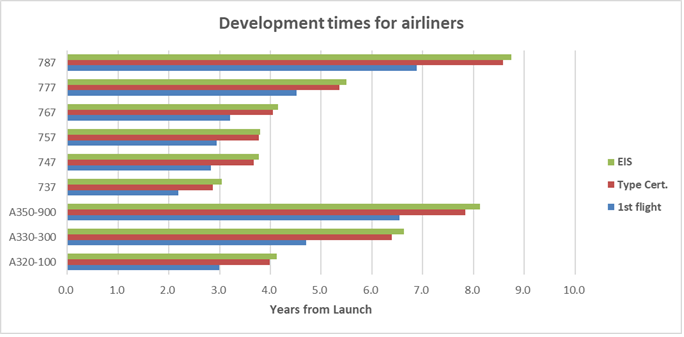
Figure 1. The development times for airliners over the years. Source: Leeham Co.
On a Program Level, Can AI Shorten Development Times?
In Part 27, we mentioned four areas that led to longer development time. They are: Use of Advanced Materials, Widespread Use of Advanced Electronics, Electric Wiring Interconnection System, and Regulatory Interaction and Oversight. Can AI help speed up these areas?
Where can AI Help?
From these examples, we could see potential in some areas. With the advancement of generative AI, it is foreseeable that AI can help write software based on requirements to support the development of advanced electronic systems. A separate system could then test the source code to ensure that each requirement is met and that each line has a purpose. Presently, though, machine coding is giving mixed results. I am sure we will see more debates (hopefully with data) on this topic this year.
Where does AI need improvement?
While AI can generate static images or short videos, it is still at a very early stage in terms of spatial intelligence. When the technology is available, it may reduce EWIS engineers’ workload by facilitating wire-bundle layouts based on analysis results, such as Particular Risk Analyses.
Where does AI offer less potential?
Coordination among regulatory authorities, OEMs, and industry stakeholders may have less potential with AI. Regulatory authorities tend to be more conservative. If it uses its AI tool to generate new Means of Compliance (MOCs) or Special Conditions, OEMs and industry stakeholders may find them overly stringent. On the other hand, if an OEM uses its AI tool to generate these documents, the regulatory authorities may find them unacceptable.
Industry stakeholders can further complicate this process. Stakeholders could align with the authorities, support the OEM, or advance their own arguments for various strategic or tactical reasons. As a result, good old debates and negotiations by humans may still be the most effective solution.
Can AI Reduce the Overall Aircraft Development Times?
We have analyzed the possibilities for AI assistance in the development work at each phase of the Program Plan for the airliner, Figure 2.

Figure 2. The different development phases of a medium-sized airliner. Source: Leeham Co.
In the early phase of Feasibility studies, we tried ChatGPT and a reader Google’s Gemini to see if these could help list feasible configurations and their salient features. The results were far from convincing; the listings were incomplete and uninspiring. We could conclude that the AI agents need high-quality, comprehensive training material that is not available on the free internet (which is the training content of most of today’s AI agents).
Conceptual design was not much different. An established OEM has content from past conceptual studies to train an AI agent, but Startups are limited to what the internet provides, and there is not much on the conceptual design of a Part 25 airliner using hybrid techniques.
In Preliminary design, the interaction with the Regulator increases, as shown in Figure 3. We could use AI to prepare document templates, but not much more.
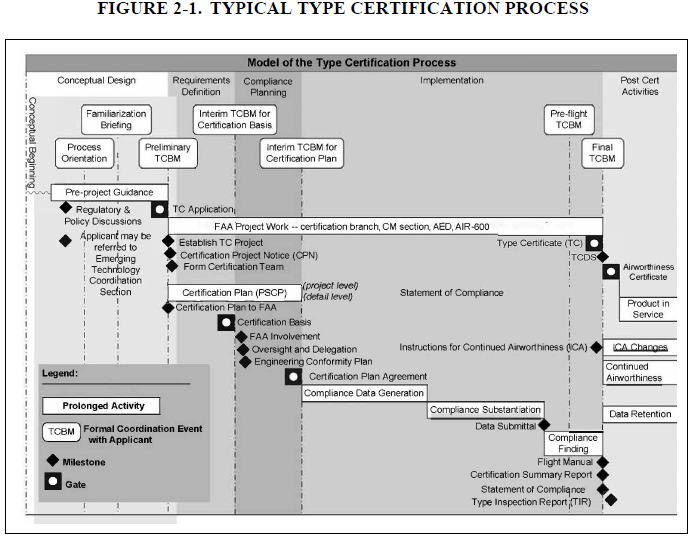
Figure 3. The typical Certification Process for a new airliner. Source: FAA.
In Detail design we could use AI for designing, analyzing, and documenting the simple parts of the airframe structure. An airliner contains a lot of wires, tubes, and system components. All of these need to be carefully attached during their routings in the airframe. The result is the need for thousands of brackets, where an established airframer might have many from previous projects, then collected in an OEM-proprietary Standard Parts Catalog. For an Upstart, it remains to design, prove, and document the different bracket types.
AI technology will have reached a stage where such simple parts can traverse a tool chain, enabling an AI-enabled CAD/CAM chain to choose material type, design, and an optimized bracket type, and to prepare both manufacturing and regulatory information.
The big problem in Detail design is the creation and verification of all the software components used in modern systems, whether it’s Fly-By-Wire, Engine Control, Electrical System, Hydraulic System, Fuel Systems, Environmental Control Systems (ECS), or APU.
There is a lot written about AI gradually taking over the writing of software code. This is currently for a non-critical system. The first negative experiences are also evident, with Microsoft having to stop the AI-generated code for Windows 11 updates. The feedback was that AI-generated code is very hard to review; it looks good, with perfect structures and grammar. But there are omissions that a human coder wouldn’t have made.
Before AI-generated code is allowed in the highly sensitive logical operations of critical airliner systems (and most of the listed systems are flight system-critical), it will take several generations of successful AI-generated code in non-aeronautical, non-14 CFR Parts 23 and 25-regulated applications.
Once flight-test aircraft production begins, we are in a phase where AI has no natural application beyond sifting through flight-test data and structuring it. The same goes for the documentation of the ground-based system and the flight tests. Data structuring and generation of the base documents can be done but not much more.
Conclusion
AI can help with basic work across several phases in Figure 1. It will reduce the work-years needed to complete the design and regulatory documentation during the initial phases of aircraft development. We don’t see that AI can affect the critical path of a Part 25 airliner development, however.
We also see that an OEM startup is at a disadvantage when using AI to reduce workload compared with an established OEM, which has a historical database of prior work that an AI agent can train on.
You forgot the C919 Launched in 2008 (Comac was formed in 2008) …first test flight 2017 EIS 2023 just saying…
Thanks for this informative post.
Telling fig 1. It seem the more automation, integration the more complication, certification and time is needed.
On topic, we, the West, are apparently alarmed by the speed at which Chinese engineering, manufacturing, certification and industrialization demonstrates/ed on the stealth fighters J20, J35, J36 and J50. Much faster then western programs.
But also the speed at which Oekraine, China and Russia develop, industrialize and field new drone technology. Although it is know war boosts innovation.