
Leeham News and Analysis
There's more to real news than a news release.



Bjorn’s Corner: Faster aircraft development. Part 30. Wrap-up.

By Bjorn Fehrm and Henry Tam
March 6, 2026, ©. Leeham News: We started the series on developing a new airliner in the 14 CFR Part 25 class (i.e., not a commuter-class aircraft) on August 1st 2025. The objective was to write a series about such development with people I knew that has “been there, done that”?
Here is how the series started:
Four years ago, I did a series on aircraft development with Henry Tam and Andrew Telesca, both part of the canceled Mitsubishi SpaceJet program. The series was about the arduous task of developing and producing a certified aircraft for the FAA Part 23 standard and its EASA equivalent. The idea was to better describe what’s ahead for the many upstarts that wanted to develop green aircraft and VTOLs. Now we will do a series about recent ideas on how the long development times for large airliners can be shortened. New projects talks about cutting the development time by one-third. Is this realistic?
The Development Times for Airliners Designed to 14 CFR Part 25 Rules
In order to do a thorough job, we analyzed each phase of the development of such an airliner, Figure 1

Figure 1. The different development phases of a medium-sized airliner. Source: Leeham Co.
We took care to analyze for each phase what the difference in workyears spent would be between a qualified upstart and an established Part 25 airframer. We write qualified upstart, different from the number of upstarts that lack qualified management and R&D teams, while making wide-ranging announcements with nice renderings that these will develop and field a new revolutionary airliner within five to six years.
Unless these have hundreds of experienced people on their payroll, it’s a waste of time to even look into the project. Part 25 airliners are for the professionals of this business. Such upstarts shall try their luck on a commuter class nine- and 19-seater developed to the less demanding Part 23 ruleset.
The Established Part 25 Airframer’s Development Times
We have gone through the established airframers’ development times, as shown in Figure 2. The typical duration for a well-run project, such as the Airbus A350, was eight years from launch.
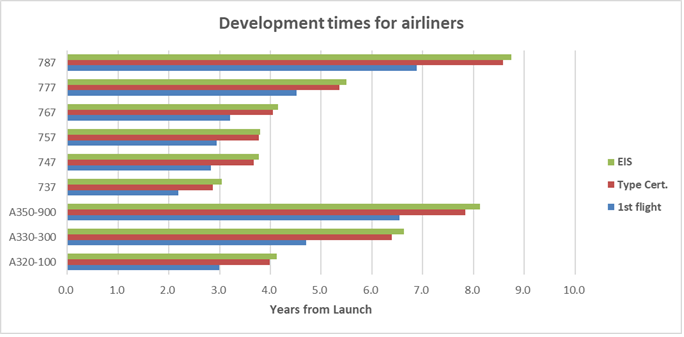
Figure 2. The development times for Airbus and Boeing for Part 25 airliners. Source: Leeham Co.
Could this be made shorter, and if so, would an established OEM or a startup have the advantage? When we went through the different phases, we could see that the established airframer had several advantages:
- The airframers had all the processes needed for a development of this size and complexity in place, such as development and certification procedures, active development tools, and trained personnel on these tools. In short, the established OEMs are complete companies by the time the project starts.
- The organization has prior experience in running new-aircraft development projects. There is a lot of data available from previous projects, and established databases with ready-made trivial parts such as rivets, fasteners, nuts, bolts, pipes, joints, and brackets. There are also approved and certified material systems, such as different aluminum alloys and Carbon Fiber Composite Polymer (CFRP) Processes, that are ready to use and are certified. All these parts are readily available and previously certified for the intended use.
- The airframer has an established supply chain with years of experience in development and deliveries. There are agreements in place on how to work and how to compensate the supplier economically for its work.
- There is a long-standing, established relationship with the Regulator, with mutual knowledge of each other’s capabilities and clear roles and responsibilities.
- Should the incumbent decide to deploy AI assistance, there is a lot of OEM proprietary data to train the AI tools on.
The Advantages of a Qualified Startup
Let’s first reiterate that when we write a qualified startup, we talk about a company that is adequately funded and has a management team that has developed this type of airliner in their previous lives. A Part 25 airliner is not the first project you do if you are an entrepreneurial group of people without extensive Part 25 experience who want to change air transport.
It took COMAC, a well-funded company with government backing, 15 years to develop the C919, from launch to entry into service, and it had AVIC, a 400,000-person state-owned aeronautical group with 50 years of aircraft development experience to recruit personnel from.
Smaller (Part 23) business jets are not exactly easier. It took Honda 10 years to commercialize the HondaJet, from its first public debut to the issuance of its initial type certificate. Similarly, it took Eclipse about eight years to develop the Eclipse 500, from founding the company to type-certifying the aircraft. Keep in mind that the Eclipse 500 was developed from the existing Williams V-Jet II by Burt Rutan.
Given these caveats, the Qualified Startup would have the following advantages:
- The qualified startup could pursue and have special competence in a new idea for designing a Part 25 airliner. If these ideas are professionally pursued and with a qualified team, they can attract other aeronautical professionals who want to be part of “something new” in their career. With a good idea and a good team, it can attract the necessary investment to develop the aircraft.
- The advantage of a startup is then that it doesn’t have legacy systems or ideas about aircraft configurations to deal with. It can acquire the latest technologies without hindrance from legacy tools and apply them to new architectural ideas. It can also design the development process around the latest and greatest toolchains.
- The challenge is proving that their analyses, simulations, etc., are correct. Often, authorities will require a non-trivial number of tests to validate results. Startups may spend a lot of time, effort, and money on such validations to demonstrate that their toolchain and personnel produce valid results.
- One of the non-legacy tools where a startup could be more aggressive in its employment would be AI. While it could plan for a more aggressive application of AI methods, the problem is that it lacks the legacy data to train the AI tools on previous Part 25 project results. The legacy OEM has a major advantage here as it has documents from several programs. The quality of these documents is also higher because they are approved type-certification documents.
- Startups often present Program Plans that are much shorter than those in Figure 2. Part of it is by necessity. Investors want fast results; an eight-year plan is too long for Investors. But part of it is that it lacks the knowledge to identify program bottlenecks. Their “estimates” are often based on consultants’ or management’s recollections.
- In addition, the Program plan likely has missing scopes. For example, a consultant who worked at an incumbent OEM before may only know the development portion. He/she might not have set up all the engineering and business processes, the IT infrastructure, a brand-new manufacturing site, or a customer support department. These things already exist for him/her and hence were “not a part of the program”.
Conclusion
It’s the rule that Startups that declare they have ideas for a better airliner and that their product will revolutionize air transport announce program plans that span shorter times than the latest successful projects we have in Figure 2.
Part of it is the need to present an aggressive plan to attract investors, but part of it is a conviction that development toolchains and processes have advanced since the development of the Boeing 787 and the Airbus A350.
The latter is true, but at the same time, the demands for an even more optimized product, the use of new aircraft architectures and materials, and the increase in software code lines in modern aircraft work against shortening development time.
AI agent assistance has developed rapidly over the last 10 years. The problem for the ambitious startup claiming it will help it develop more quickly is that the analysis in the series shows it will actually help the legacy player more, not the startup.
To be successful you normally have to start small, like Robinson R22, Cirrus VK-30/SR20, Diamond aircraft HK36 . Then as you certify, deliver and support you customers you normally introduce bigger models with more payload/range offering a family of aircrafts. One misstep and you are out of cash and someone “often Chinese” comes in and take over the company and keep expanding. One major problem for electrical hybrid 20-70 seat aircrafts is its cost of operation with 2 pilots for a limited amount of paying pax. That is why you in principle only have ATR left making passenger aircraft of this size.
Hi Claes,
Yes, the Crew cost part of the cost pie has increased as fuel has stayed low for a long period and other costs have had a more normal development (maintenance, airport, and airway fees). The US shortage of flight crews has increased costs, which are then gradually spreading globally.
I would add in to what Claes said and that is a market opening has to be there as well.
Robinson is a great example. Non one was making an entry low cost Helicopter. They also had a history of Helicopters to draw on for design select. They did not have to invent the wheels. Once they got into the market, they would own it (done right and they did) and the cost to get into it for a mere Me Too offering? Why would you. And the advanced stuff was well covered. Airbus in a nutshell.
Thanks for this very interesting series.
Something I have been contemplating is how 4 of the recent entreis have failed.
Mitsubishi, like Honda, no lack of trying but a Plane too Far as they did not have enough background to do it.
BBD failed, like Mitsubishi, great aircraft, they could not move it over the line into serial production.
E2-175: Failed for a different reason but failed it is (and I hate to see that, I like the E series a lot)
C919: I know its hard to say its a failure but like BBD, they have not gotten over the line to serial production. They got the money unlike BBD, but the progress is agonizingly slow.
Hard to call it a success when its target is an Embraer yearly production level for a regional jet.
Bombardier and Mitsubishi were already interlinked on the CRJ and related business jet lines.
For the life of me I cant understand why Mitsubishi didn’t partner on the Cseries and have Bombardier as a partner on CRJ replacement , the MRJ/Spacejet?
The expertise and financial resources would have complemented each other.
Since 2018 and devolving the airliner side Bombardier has made around 900 business jets many of them big iron
Global 350+
Challenger 300 400+
Challenger 600 100+
Lear jet around 50 before it closed in 2022