
Leeham News and Analysis
There's more to real news than a news release.



Bjorn’s Corner: Faster aircraft development. Part 20. Flight Testing.

by Bjorn Fehrm and Henry Tam
December 12, 2025, ©. Leeham News: We do a series about ideas on how the long development times for large airliners can be shortened. New projects talk about cutting development time and reaching certification and production faster than previous projects.
The series will discuss the typical development cycles for an FAA Part 25 aircraft, called a transport category aircraft, and what different ideas there are to reduce the development times.
We will use the Gantt plan in Figure 1 as a base for our discussions. We have completed the articles on Prototype Manufacturing and Ground Vibration Tests (GVT). We now conduct the program’s flight tests with the manufactured test aircraft.

Figure 1. A generic new Part 25 airliner development plan. Source: Leeham Co. Click to see better.
Flight Test
After high-speed taxi tests, the flight test aircraft is ready for its first flight. Starting from the first flight, the team would cautiously expand the operating envelope, such as speed, altitude, and center of gravity. The team would go on to verify the flight characteristics, systems functionalities, etc. Keep in mind, tests at this stage are company tests, not certification tests. The FAA Part 21, Certification Procedures for Products and Articles, states:
21.35 Flight tests:
(a) Each applicant for an aircraft type certificate (other than under §§ 21.24 through 21.29) must make the tests listed in paragraph (b) of this section. Before making the tests, the applicant must show—
- (1) Compliance with the applicable structural requirements of this subchapter;
- (2) Completion of necessary ground inspections and tests;
- (3) That the aircraft conforms with the type design; and
- (4) That the FAA received a flight test report from the applicant (signed, in the case of aircraft to be certificated under Part 25 [New] of this chapter, by the applicant’s test pilot) containing the results of his tests.
(b) Upon showing compliance with paragraph (a) of this section, the applicant must make all flight tests that the FAA finds necessary—
- (1) To determine compliance with the applicable requirements of this subchapter; and
- (2) For aircraft to be certificated under this subchapter, except gliders and low-speed, certification level 1 or 2 airplanes, as defined in part 23 of this chapter, to determine whether there is reasonable assurance that the aircraft, its components, and its equipment are reliable and function properly.
The OEM’s test pilots must fly each test case before the authority’s test pilots (or their delegates) jump onboard for certification test flights. The test aircraft must also conform to the type design. We will cover some of the processes in a future article on the certification Implementation phase.
In practice, a flight-test aircraft is rarely 100% conformal to the type design. The OEM, for each deviation, must justify why the difference would not affect the test result for each test. For instance, the team plugged one of the cabin windows with flight test instrumentation. This would not impact a water ingestion test.
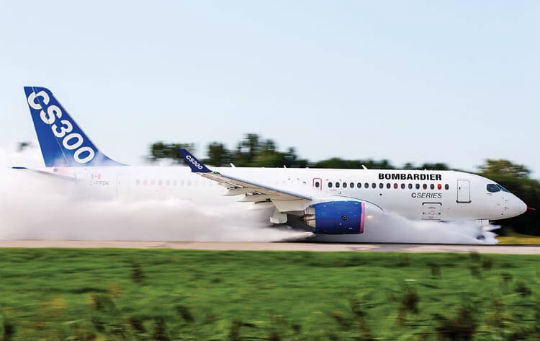
Figure 2. Water ingestion tests on the CS300. Note the plugged cabin window. Source: Bombardier.
The flight test program must generate all the data necessary for the OEM to show compliance and the authority to find compliance with the airworthiness standards. It takes thousands of flight test hours to go through all the company test cases and certification test cases. For example, the Boeing 787-8 took approximately 5,000 hours of flight test to obtain the initial type certificate (source: Wikipedia). The Gulfstream G650 business jet took approximately 2,000 hours (source: AOPA).
In an ideal world, a flight test campaign is intended to confirm results from simulations and analyses.
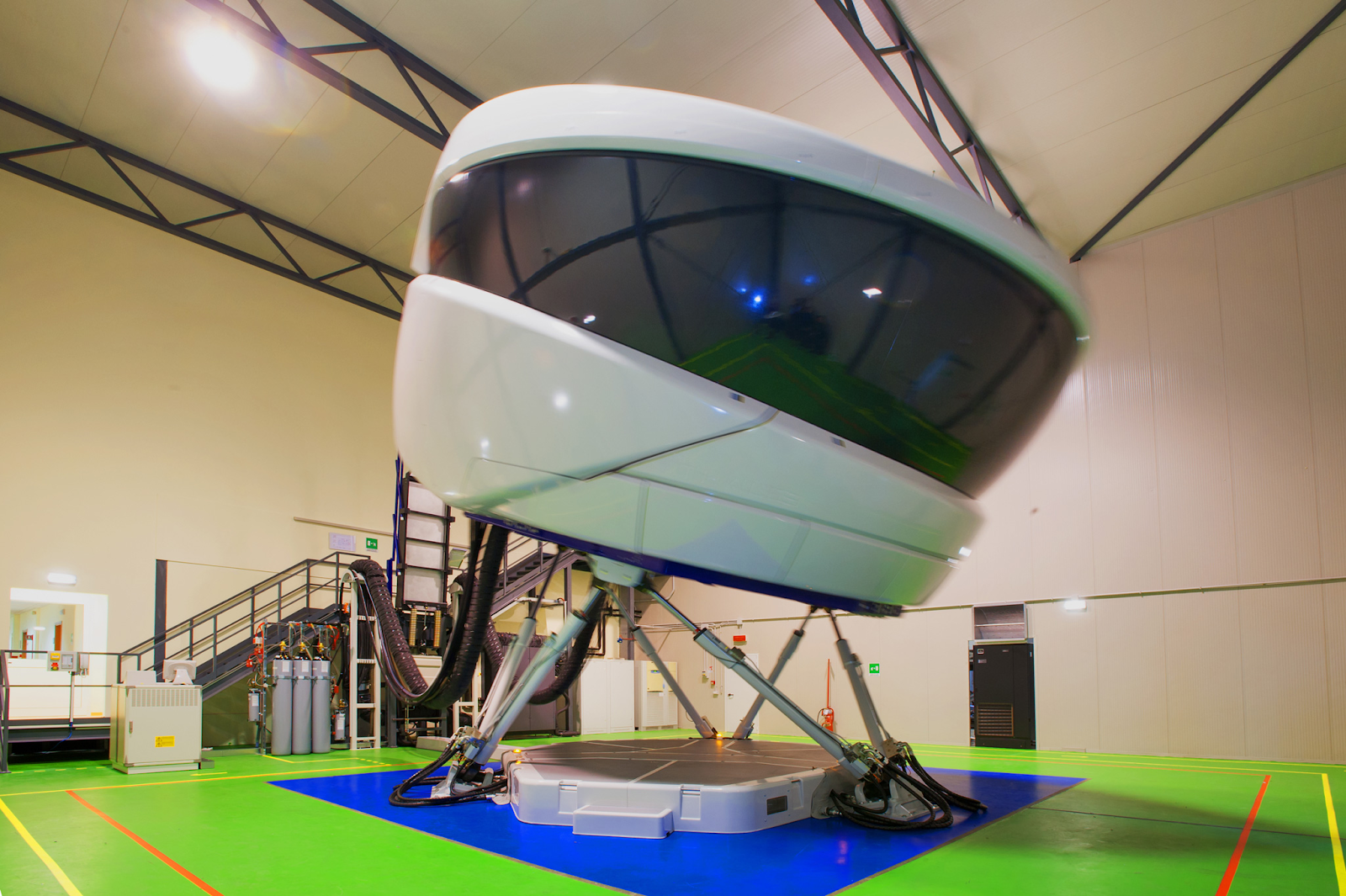
Figure 3. Flight test preparation in the Simulator. Source: Wikipedia.
The team can also fine-tune a few things during the flight test campaign. For example, the aircraft performance team could optimize the takeoff distance by trying out a few flap angles for one of the flap detents. Hopefully, there are no major lessons to be learned during the flight test phase for a to-be-certified product.
Function and Reliability Test
The last test campaign of the flight test program is the Function and Reliability (F&R) test. The following is the set of requirements for it:
21.35 Flight tests:
(f) The flight tests prescribed in paragraph (b)(2) of this section must include—
- (1) For aircraft incorporating turbine engines of a type not previously used in a type certificated aircraft, at least 300 hours of operation with a full complement of engines that conform to a type certificate; and
- (2) For all other aircraft, at least 150 hours of operation.
For our hybrid airliner, we likely need to fly at least 300 hours to show compliance with this regulation. The main purpose of the test is to make sure that the aircraft, its components, and its equipment are reliable and function properly, as per §21.35(b)(2). The test may or may not involve customers/operators, depending on the company. There is no requirement to involve operators, but the FAA Advisor Circular on flight test encourages cooperation with operators. Keep in mind, 300 flight hours is not trivial. Even if the crew flies 8 hours a day, 7 days a week, it would still take more than a month to complete the test.
During the Function & Reliability test campaign, the team needs to fly many missions representative of real operations. For our aircraft, the crew may need to do some short-range missions, such as Los Angeles to San Francisco. They may need to fly some longer-range missions, such as Seattle to Miami. The team may also need to have different types of environmental exposures, such as departing or arriving at Denver (high elevation).
The Function & Reliability test aircraft must be representative of the type design, with all features and functions available at entry-into-service. The team needs to use ground support equipment similar to that used by operators and fly multiple missions per day to simulate an airline’s operation. They need to record and address snags. The crew may even need to dispatch an aircraft with inoperative equipment using the master minimum equipment list. At this stage, passengers are still not allowed because of the experimental flight permit. There may be opportunities to conduct demonstrations for customers, but this requires a different flight permit.
Operational Evaluation
Since our hybrid airliner is a new aircraft and requires a new type rating, we need to apply for an Operational Evaluation (Ops Eval). The objective of the evaluation is to establish training, checking, and currency requirements for pilot training and qualification. The evaluation also enables human factor and workload assessments. Ops Eval may take place concurrently with the Function & Reliability test campaign if the aircraft OEM accepts risks related to manual availability, failures during parallel Function & Reliability or certification activities, and potential repeat of tasks due to failed parallel activities.
For Ops Eval, the team needs to use a group of pilots with a wide range of experience. These pilots need to be trained using the training program proposed by the OEM, such as classroom and simulator training. They need to learn about the aircraft and its procedures in the aircraft flight manual. These manuals and documents need to be in customer-usable formats, not engineering drafts. The type rating test needs to be conducted in an aircraft that is representative of the final configuration for a new aircraft, with no anticipated credit for similarities with previously type-certificated aircraft.
Ops Eval can also lead to some late changes. Although airline pilots may be involved during the design, the implementation could look or feel different in an actual cockpit. Automation behaviour, alerting philosophy, display layout, legibility, etc., may require some fine-tuning, resulting in software changes.
Flight Test Completion
Once the flight test program is complete, the engineering team should have sufficient data to generate all required reports to substantiate compliance. The authority now needs to complete the compliance finding. We will go into more detail in the next article on the certification Implementation phase.
Additional Work for Startup
Startups have quite a bit of additional work to do. When producing flight test aircraft, they need to establish processes and procedures to maintain configuration control of each flight test aircraft. Also, they need to develop processes to handle the installation and removal of test equipment. Configuration control is critical because authorities often perform audits in preparation for conformity inspections. Successfully demonstrating the ability to control the configuration of each aircraft during the manufacturing of flight test aircraft is used to support the Production Certificate, which will be needed to enter into production following Type Certificate issuance.
Having many prototypes/iterations also does not equate to a shorter program. I have heard from several startups that they want to learn by flying prototypes. Unless there is some physics that is not very well understood, it may be cheaper and less risky to conduct these tests on test rigs. Crashing a prototype can spell disaster for startups. Showing a lot of random datasets to authorities does not shorten a development program.
Ways to Speed Up This Phase
The A350-900 program had one of the faster clean-sheet aircraft flight test programs. The A350 first flew in June 2013 and received its initial type certificate in September 2014, just under 15 months. You can read a previous Leeham News article on this topic. It is a good case study. Keep in mind that the program still took seven years from the redesign-launch to initial type certification. The company also spent many years before launch to conduct the feasibility studies and conceptual design.
Bjorn, this series is an excellent primer for students in Aero engineering to understand the scope of what it takes to design, produce, test, and support a jet transport. I appreciate the use of the A350 as a recent example of good work on that process. As a 42 year Boeing veteran (started in 1958 retired in 2000), I can also cite several Boeing programs that meet or beat that record; most recently the initial 777.
Thanks for this very detailed series. Interesting that the A350
was one of the quicker certifications in recent times; I’ll have
to read that linked article.
a problem is the rolling modifications incorporation of most hardware and software and agree what test done in one configuration is applicable for subsequent modification incorporated into the test fleet. After certification this continues as how to substantiate Service Bulletines, the latest example is the new RR T1000/T7000 HPT turbine blade. Exactly the same for T7000/T1000 but requiring separate flight tests on the A330neo and B787. You could think that the A330neo testing will count to the 787 application but it seemed not, letting 787 T1000 operators suffer for an additional year.
Among the many, many management absurdities of the initial 787 program was the decree that the flight test program shall take six months, and woe to anyone who dared to question how that would be possible. Of course, once first flight finally did occur (a mere two years late to another absurd management decree), the actual flight test program took more than three times the allotted duration.
Having been on the inside and being part of this disaster still causes me to shake my head in disbelief.
Sounds that they wanted a much cheaper and quicker test/certification of the 787 than the 777 that was a bit over budget and time that Alan got blamed for. They also assumed a similar cost reduction curve in production even though it is a composite aircraft. So there were some wishful thinking not backed by execution back then.
Mulally jumped ship at the right time, I guess.