
Leeham News and Analysis
There's more to real news than a news release.


Fourth EU Clean Aviation funding proposal recognises hydrogen’s upcoming importance
Subscription Required
By Charlotte Bailey
Feb. 3, 2026, © Leeham News: The European Union co-funded Clean Aviation project has announced its fourth call for proposals, with an initial draft set to be followed by a formal version issued this month.
The upcoming call will provide up to €329.5m ($386m) in EU funding for disruptive new aircraft technologies, providing an estimated €824m ($966m) when combined with input from the private sector.
 Speaking at the November 2025 Sustainable Aero Lab’s Future Aviation Festival in Amsterdam, EU Clean Aviation executive director Axel Krein explained that the next round will focus on technologies applicable to short-to-medium range aircraft, including regional aircraft architectures.
These will be augmented by the development of “transverse activities” (such as applicable certification standards) and other complementary “fast track areas.” The largest of five separate funding streams will be allocated to the development of ‘Ultra-Efficient Short to Medium Range (SMR)’ aircraft, with €130m ($114m) split across five projects.
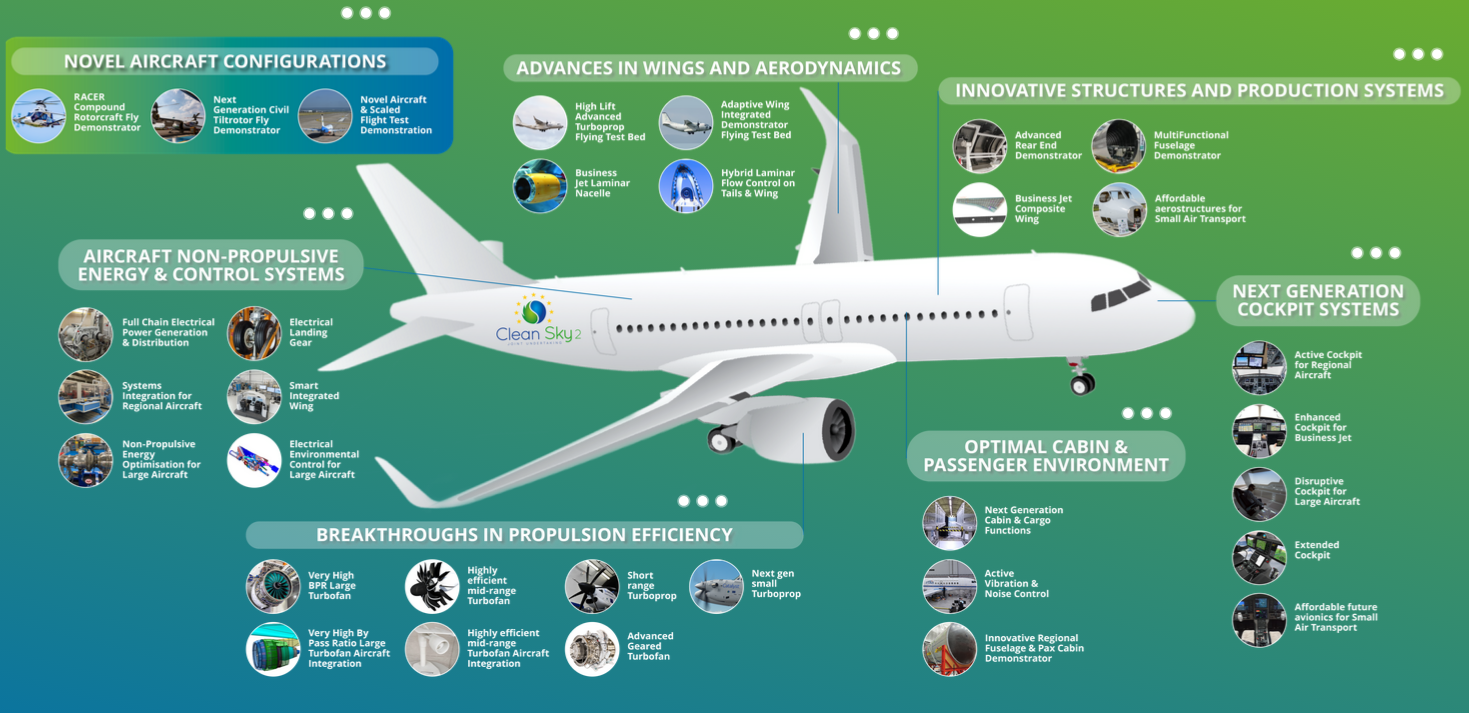
The research and technology roadmap focuses on demonstrators up to ground testing, “addressing all key technologies,” states the proposal. This will validate the performance of technologies up to Technology Readiness Level (TRL) 6.
Flight demonstrations could also be used to validate testing “in realistic operational conditions.” Clean Aviation expects to complete a flight test demonstrator configuration freeze by the end of 2026 to support the start of flight testing by the end of 2029. A hybrid-electric Ultra-Efficient Regional Aircraft has been proposed as the baseline concept for this 50-100 passenger regional aircraft. Clean Aviation will also award €40m ($46m) for the development of an “advanced airframe for ultra-efficient regional aircraft.”
Electric taxi solution aims for 2027 certification
Subscription Required
By Charlotte Bailey
Dec. 15, 2025, © Leeham News: US startup Green Taxi Aerospace is optimistic about receiving 2027 FAA certification for its all-electric, APU-powered taxi system, a solution it says can save up to 5%-20% of the fuel burn of a short-haul flight. Having submitted its certification plan to the regulator a few weeks ago, the company is currently working with Delta Air Lines and Embraer to launch its retrofitted concept with the E175 regional jet.
 Although many aerospace sustainability initiatives are focusing on the efficiencies of engine optimisation, SAF, or alternative propulsion, Green Taxi believes “there is nothing else that can save this [level of fuel reduction] that we can have deployed in under five years.” CEO and founder David Valaer explained, “A jet engine is not designed to run on the ground, where its fuel flow is about 60% at idle.” This additional power on the ground also causes additional wear on the brake components, something he describes as akin to unnecessarily “driving a car with the gas pedal halfway down.”
Valaer appeared at the Sustain Aero Lan Future Aero Festival conference this month in Amsterdam.
Avolon: Looking to long-term eco-aviation investment opportunities
Subscription Required
By Charlotte Bailey
Dec. 11, 2025, © Leeham News: With around 50% of the world’s operational commercial aircraft owned by lessors, companies such as Avolon are keeping a weather eye on the technologies that could power the fleet of the future.
And as the aircraft purchased today are likely to be operating well into the 2050s, understanding the impact of upcoming sustainability incentives and technologies is already a relevant consideration.
The airliners of tomorrow: understanding the opportunities
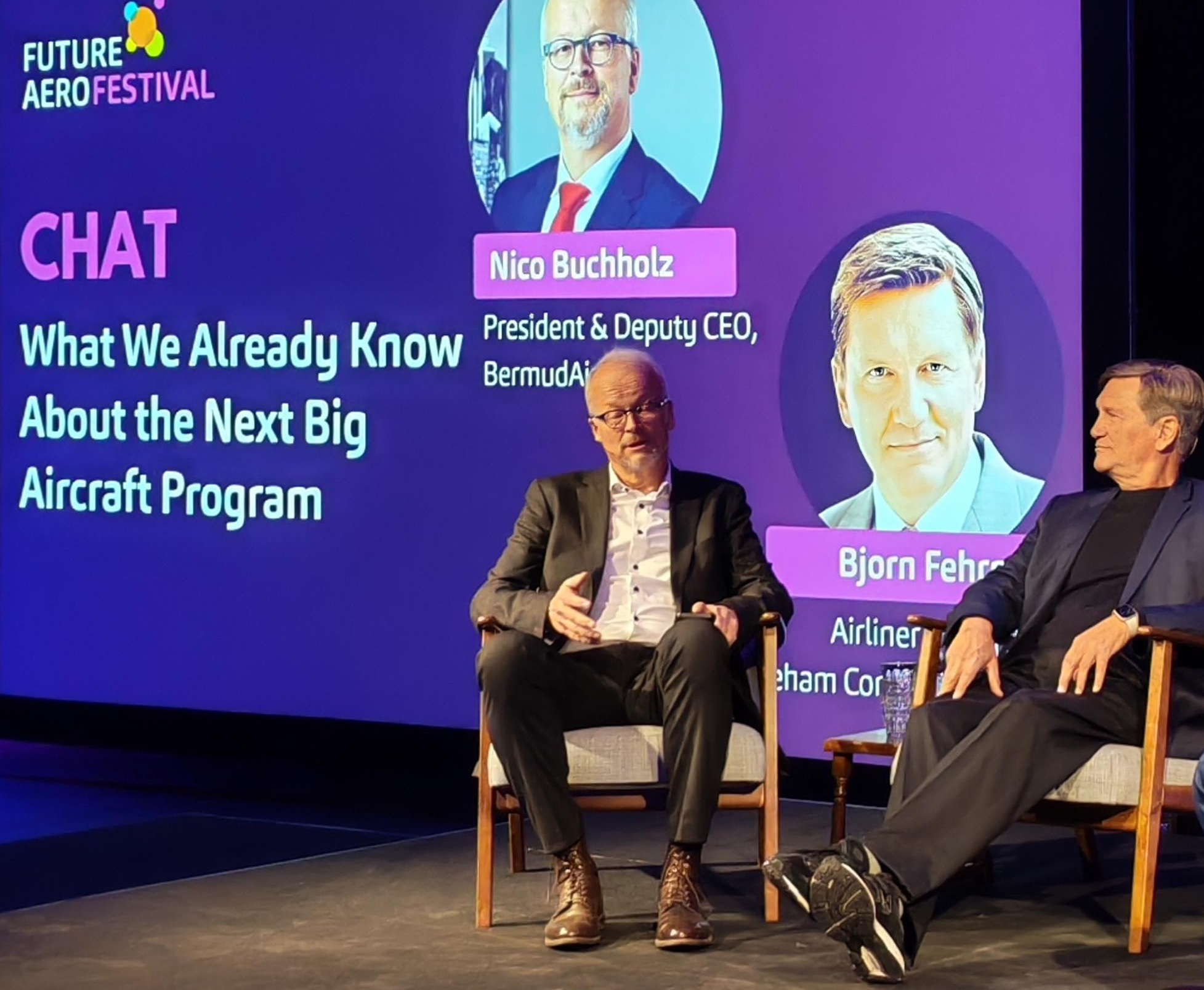
Bjorn Fehrm (right) discusses the industry’s challenges with Nico Buchholz (left). Credit: Charlotte Bailey, Leeham News.
By Charlotte Bailey
Dec. 2, 2025, © Leeham News: As aerospace companies, investors, and industry analysts gather in Amsterdam for the second iteration of the annual Future Aero Festival, the attributes and advantages offered by clean-sheet aircraft concepts are in the spotlight.
The first program point was when Bjorn Fehrm, analyst and consultant at Leeham Co., and Nico Buchholt, president and deputy CEO of BermudAir, were interviewed by Sustainable Aero Lab’s founder and CEO, Stephan Uhrenbacher.
The ’next big aircraft program’: a simultaneously inevitable yet somehow elusive concept OEMs and airlines alike are already considering with a view to future operations. Certainly, the scale of the challenge facing aircraft developers is significant.
From alternative propulsion strategies to entirely clean-sheet designs, industry insiders agree that tomorrow’s airliners are likely to be substantially different from currently operational concepts. But how are these ideas starting to shape up, and what is currently understood about commercial aviation’s future direction?
An aircraft is a “production tool for an airline: it exists to satisfy a certain need,” clarified Nico Buchholz. Although Buchholz has personally participated in the launches, demo flights, and entry into service of more than ten aircraft types, “on the other side, we see the slowness” of development, he added.
Fehrm of Leeham Co believes that a combination of motor, generator, and battery “makes a lot of sense on turbofans and turbofan engines,” he said, citing complexities with gas turbine acceleration and deceleration. “You actually have to design the engine a little less efficiently because of that. So, if you have the electrical motor in there to help, you can actually make a more efficient engine.” Read more