
Leeham News and Analysis
There's more to real news than a news release.



Boeing’s Ortberg’s first year as CEO: progress, but lots remaining to do
By Scott Hamilton
Analysis

Kelly Ortberg, shortly after assuming his position as the the CEO of The Boeing Co. on Aug. 8, 2024. It was his first visit to Boeing’s 737 production line. Credit: Boeing.
Aug. 8, 2025, © Leeham News: Today is the one-year anniversary of Kelly Ortberg stepping into what is probably the most challenging career move of his professional life: becoming the chief executive officer of The Boeing Co.
He took on a company that was in yet another existential crisis. It was still reeling from the Jan. 5, 2024, accident of Alaska Airlines flight 1282. On that date, a door plug of an inactive emergency exit on a new 737 MAX 9 that had been in service for a mere 10 weeks blew at 14,800 ft, minutes after takeoff from the Portland (OR) International Airport. But because of the circumstances and the skills of the pilots, there were only a few injuries, no fatalities, nobody was sucked out of the pressurized airplane, and the flight crew landed safely 16 harrowing minutes after taking off.
A new crisis was underway.
Progress Boeing had made in recovering from the twin MAX disasters of October 2018 and March 2019, the COVID-19 pandemic, and major production issues in the 737 and 787 lines ground to a halt. A new crisis of confidence in Boeing’s leadership, safety, and relationship with the Federal Aviation Administration (FAA) emerged.
As a result of AS 1282, CEO David Calhoun announced in March his “retirement;” sources say this wasn’t his decision, despite the public relations spin that it was. Calhoun said he would stick around until a new CEO was named.
Stan Deal, the CEO of Boeing Commercial Airplanes (BCA), likewise was “retiring” immediately. Board Chairman Larry Kellner would step down in April.
Related Stories
Summary
- Early Missteps with the unions
- Inaction on a SPEEA safety plan
- Returning to higher rate production
- Certification challenges remain
- Restoring Boeing’s financial health
- The next new airplane
Ortberg Joins Boeing
By August, the board of directors found a new CEO. Ortberg, then 64, had previously been CEO of one of Boeing’s major suppliers, Rockwell Collins. He had retired and was available. His aerospace supplier credentials were considered a significant plus. Once he assumed office on Aug. 8, 2024, Calhoun was out. He left Ortberg a mess to deal with.
A year later, few will argue that Ortberg hasn’t made substantial progress. But there is a long way to go before Boeing returns to financial health and an even longer path to returning to the engineering glory that was synonymous with the Boeing name.
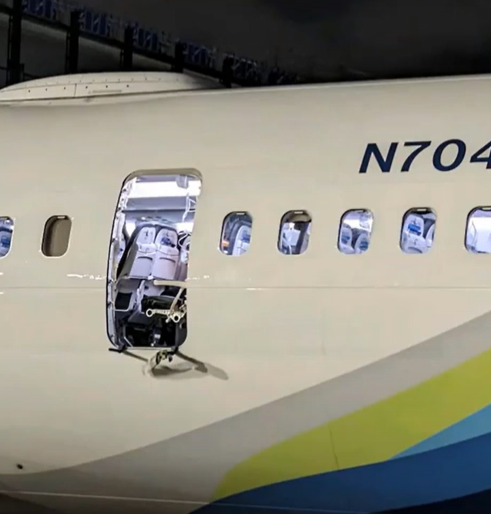
The emergency exit door plug blew off the new Boeing 737-9 MAX shortly after takeoff from Portland (OR) on Jan. 5, 2025. The incident threw Boeing into another existential crisis.
Ortberg joined Boeing at a difficult time. It was still reeling from the Alaska accident. The US Department of Justice reopened a criminal investigation into Boeing generated from the first MAX crisis (2018-19). Families of the second of the MAX fatal crashes urged a federal judge to reject a previously negotiated agreement with the DOJ. The FAA instituted increased oversight on the 737 production line. The National Transportation Safety Board (NTSB) investigating the Alaska accident revealed new shortcomings in Boeing’s safety protocols. And Congress planned new hearings that Ortberg, as the new CEO, would have to face.
His most burning issue upon taking office on Aug. 8, 2024, was contract negotiations already underway with the militant touch-labor union, the IAM 751. This local represents 30,000 workers in the greater Seattle area and smaller Boeing facilities in Oregon and elsewhere. Sixteen years of pent-up anger over management’s war on the unions, resulting in benefit givebacks, stagnant wages, and repeated threats to move work outside the state, meant an angry workforce was almost sure to strike regardless of any agreement reached between the company and the union negotiating team.
Early Missteps
Boeing’s negotiating position and tactics for the IAM contract, which expired on Sept. 12, were set under CEO Calhoun. Talks had been underway for a couple of months. It’s unknown if Ortberg, upon his arrival on Aug. 8, did anything to alter Boeing’s stance and tactics or let the labor relations department proceed on a path already set, given its institutional knowledge.

IAM 751 members awaiting contract and strike vote results over Boeing contract, September 2024. Credit: Leeham News.
The union wanted a 40% wage increase over a three-year period; claw back of certain benefits; restoration of a defined pension plan that was given up in 2013 during a contentious negotiation over locating the 777X assembly line in Everett; and a commitment to build the next new airplane in the Seattle area facilities.
Days before the contract expired, Boeing and the IAM negotiating team reached a tentative agreement that would be submitted to the membership for a vote. There were many details, but the top ones were a 25% raise (not 40%) was offered, and a commitment to building the next airplane in Puget Sound. The big one that was missing: a return to a defined benefit pension plan.
Both sides hailed the agreement as the best ever offered. Within days, the president of 751, Jon Holden, started backtracking after an overwhelmingly negative reaction. The members voted by 95% on Sept. 12 to reject the contract and strike within hours.
Boeing and Holden miscalculated the depth of nearly two decades of animosity built up among the membership.
Dead on arrival: Boeing’s “Best and Final Offer”
Boeing’s next move, however, was roundly criticized as bone-headed—and this fell entirely under Ortberg’s watch. Two weeks after the strike began, Boeing unilaterally made what it called its Best and Final Offer (BAFO) and gave the union four days to vote on and accept it. The offer bypassed the union’s negotiating team. The move outraged the members, dissipating anger felt over the leadership’s support for the first agreement. Holden wouldn’t even put the BAFO to members for a vote.
No fingers could be pointed at the disgraced Calhoun for this move. The decision was Ortberg’s.
The strike was eating through Boeing’s meager cash position at the rate of $1bn a day. If the strike continued for long, as it appeared that it would, Boeing would run out of cash. Only an untapped $10bn line of credit remained.
To make a long story short, members rejected a third contract offer, this one negotiated with the union, reached in October by a 64% margin. Concurrently, Boeing raised $24bn in new funds from the equity and debt markets, taking the risk of bankruptcy off the table—for now.
Eventually, on November 4, the union approved what truly was Boeing’s BAFO, with 59% of the vote.
Ortberg’s arrival had been marked by a pledge to reset relations with the unions. But the mishandling of the first BAFO damaged the initial goodwill. With the strike settled and money in the bank, Ortberg could turn his attention to the myriad other pressing problems.
Restoring trust
Ortberg had (and still has) years of distrust of Boeing to overcome. Restoring trust with the IAM was still on the plate, despite the favorable terms (but no return to a defined pension plan) of the approved contract. Trust with the FAA still had to be restored. Boeing’s other major union, SPEEA (for engineers and technicians), was waiting for its first meeting with Ortberg. (This would finally happen the following February, but it was little more than a meet-and-greet affair.)
Boeing’s supply chain—something dear to Ortberg’s heart—was distrustful after two decades of being beaten down by Partnering for Success, other cost-cutting measures, dragging out payment terms to as long as 120 days, and highly erratic production schedules.
And the all-important customers: airlines and lessors, disappointed by nearly two years of MAX groundings, a 20-month suspension of deliveries of the 787, and an interminably stalled certifications of the 737 MAX 7, MAX 10, and 777X (none of which have been certified even today).
This analysis focuses on Boeing Commercial Airplanes, but Boeing’s defense unit had equally disappointing results and customers who were also disappointed, which Ortberg had to deal with, too. Trust from these customers, employees, and suppliers had also been sorely tested.
At long last, progress
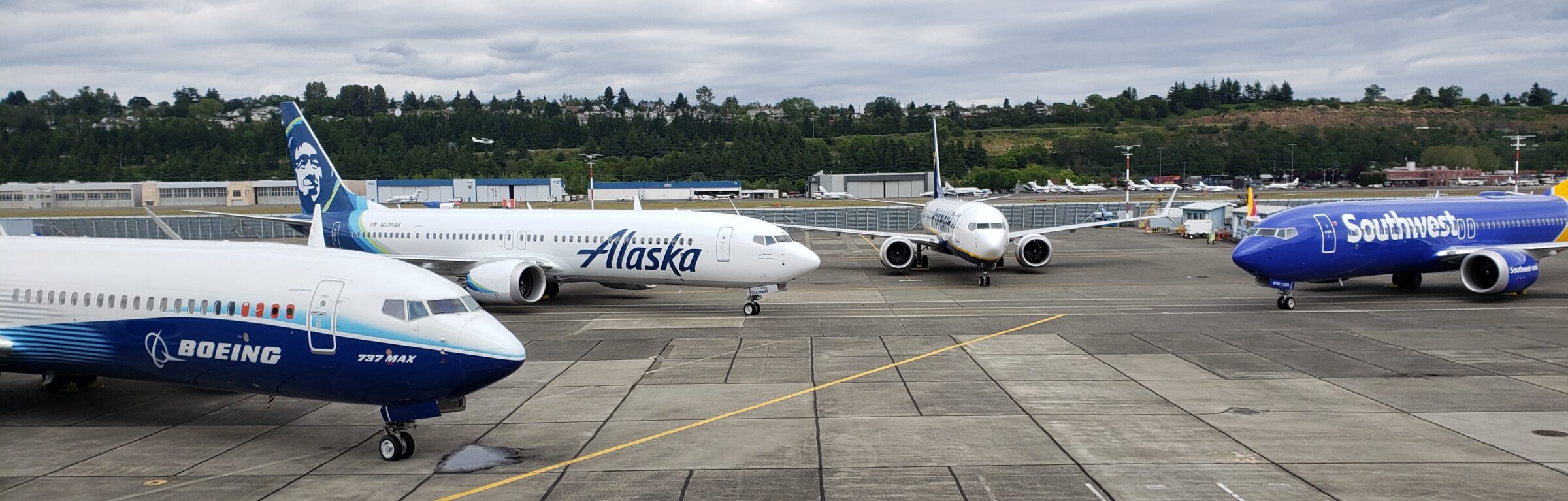
Boeing 737 MAXes lined up for a media event in June 2022. Credit: Leeham News.
With Ortberg’s first anniversary today, he can point to solid progress being made. Production of the 737 finally reached the long-delayed goal of 38/mo, the cap the FAA imposed as a result of the Alaska accident. This rate was achieved at the very end of May. Ortberg demands that this rate be stable and quality achieved before asking the FAA for permission to move to a rate of 42/mo. Rate 38 isn’t profitable, but it helps reduce losses. It’s unclear, but rate 42 may be profitable.
The 787’s production rate is now at 7/mo on its way to the long-stated goal of 10/mo. Boeing is making plans to expand the final assembly plant to go beyond a rate of 10. Twelve is the most often-cited number. At its peak, pre-COVID, the production rate was 14/mo between Everett and Charleston. All production is now in the latter. Boeing is studying a rate of 16/mo.
Certification of the MAX 7/10 remains mired in design challenges for an engine anti-icing issue discovered during the in-service operation of the MAX 8/9. The FAA wants a fix done before certifying the 7 and 10, so there’s no retroactive work that would need to be done on these models.
There is progress in the certification of the 777X. Absent some significant unknown, it finally appears that the 777X will be certified in the coming months and the first delivery in the first half of 2026.
Financial fixes
Boeing isn’t yet cash flow positive or making money, but the losses and cash bleed are reduced. Boeing Defense reported its first profit in years with the 2Q2025 results. As Boeing returns to profitability as a company and cash flow becomes positive, it will be in a better position to pay down the more than $50bn in debt than it has in years.
Acquisition of Spirit AeroSystems, the source of many of Boeing’s quality control issues, should be completed in the fourth quarter. Spirit makes the nose sections for the 767/KC-46A, 777, and 787; and the entire fuselage for the 737. The root of the Alaska accident was traced to Spirit—but it was Boeing that touched the airplane last on the final assembly line and bore the responsibility for the accident.
The Spirit deal is an $8bn transaction: half in stock and half in debt assumption. In addition, Spirit has to pay Airbus—for which it does substantial work—around $500m to compensate Airbus when it acquires its share of the Spirit operations. This cash payout must come from Boeing, as Spirit is essentially bankrupt. It had only $397m at the end of the second quarter, which is needed for operations. Airbus and Boeing have been advancing cash to Spirit for years.
Next Steps
Ortberg met with SPEEA this month. The topics of the meeting haven’t been disclosed. But SPEEA’s contract expires next year, and a safety initiative it proposed nearly two years ago remains at an impasse. Boeing’s labor relations department is handling this initiative as a labor relations matter, rather than Boeing’s safety unit. Boeing’s new head of the safety unit refused to meet with SPEEA after his appointment. But in May, the new safety officer, Don Ruhmann, said he would do so. This meeting hasn’t happened yet.
Boeing won an important, high-profile USAF fighter contract, the F-47, its first under the Boeing name. (Previous fighter contracts were inherited in the 1997 merger with McDonnell Douglas.) Significantly, this is a cost-plus contract, not a fixed price deal that has so bedeviled Boeing in recent decades. Boeing also won a second significant contract from the Pentagon.
As customer confidence improves, Boeing is winning major deals for its commercial airplanes. Some of this is due to more favorable delivery positions than Airbus can offer, but many of the orders reflect the emerging turnaround at Boeing.
Production quality is improving. Traveled work is down by 50%, so there remains a lot of work to do in this arena. But progress is significant, and it is trackable.
Ortberg still has an uphill climb, some of it steep. But it’s measurable progress.
The Next Boeing Airplane
One big question that remains to be answered is when Boeing is going to launch a new airplane program and what it will look like.
There are no answers today. Ortberg responds to these questions that the technology isn’t ready, the airlines aren’t prepared, and Boeing isn’t ready to pursue a new airplane. He’s right on all three elements, and he’s refreshingly candid on the last one. (Calhoun, in contrast, only pointed to the first element.)
LNA believes Boeing will be ready to make its move around 2027 or 2028. By then, production rates and with them profits and cash flow should be back to normal or close to it. Debt will be coming down. Clarity on new engine technology should be evident. New technology for airframes, wings, materials, and production should also be in sight.
The wild card will be whether the airlines and lessors will be ready for new technology. Today, all they want are the airplanes they’ve already ordered to be delivered and for the engines to work as promised. There’s still a lot of work to be done on both elements.
Ortberg’s job today is still on the upward bell curve. Getting over the peak isn’t going to be easy, or quick. A lot remains out of his control (the supply chain is just one), and at any point, progress could be stalled or even upended. There is a lot that also remains unanswered about Ortberg’s vision for the future. Aside from what he has outlined, an underlying question remains: will Boeing return to its roots as a company known for its engineering prowess? Or will it continue the Jack Welch-inspired focus on shareholder value and financial performance, something some would say (and have) at the expense of engineering?
Perhaps as some of the more pressing issues are resolved in Ortberg’s second year, this fundamental question will be answered.
Is Ortberg still seeking to sell off (more) “non-core” operations so as to raise cash?
-He has a large debt repayment (ca. $8B) coming due in the next 12 months, and currently doesn’t have enough cash to cover it.
-He has some short-maturity investments that he might liquidate — though that might entail some loss of ROI if sold early.
-He could do a debt rollover, or tap into revolving credit — though that may lead to a rating downgrade.
Selling some more family silver may be the best option…if he can find buyers.
Ortberg has said there are a number of non-core subsidiaries on the table, but none of them are factored into financial planning, and none of them involve existing production contracts.
The first of these are Jeppesen, ForeFlight, AerData and OzRunways, which collectively generated about $10B in cash.
“He has some short-maturity investments that he might liquidate — though that might entail some loss of ROI if sold early.”
Some?
Assets
Cash and cash equivalents $7,087
Short-term and other investments 15,880
More than double cash and ce. We don’t know what the terms are, or when the capital is freed up, though. Ortberg may have planned to be able to access the funds, when needed. Not a big deal, at any rate.
If you knew you were going to need the funds, you would put them away for 30 or 90-day stints and earn what you can.
In fairness to Ortberg, with the union negotiations, the stumbling block was the defined pension plan. The union was at odds with reality on that issue. Very few such plans remain in the US commercial world.
Even in the civil sector, which traditionally relied on good benefits as opposed to salary, those plans are being dismantled. That had started even before I left the university, and Trump is accelerating it by withdrawing from federal union contracts.
I don’t know what happened between the union leadership and the union, but clearly the leadership was not connected to the union anger over the last negotiation, and the pension issue.
One thing positive about Ortberg is that he seems to embrace the change in safety culture that is needed at Boeing. And he seems to get that labor is 50% of that, they have to be actively engaged. It can’t be decreed from on high. If you aren’t integrating management objectives with ground truth on the assembly floor, cultural change will fail.
A good question is if the Union Leadershp was that out of touch, how could Boeing be better in touch?
A bit of a flip is the Fighter unit on strike. A better first offer at least
“UK competition regulator clears Boeing and Spirit AeroSystems merger”
“(Reuters) -Britain’s competition regulator said on Friday it had cleared Boeing’s planned acquisition of Spirit AeroSystems after deciding against an in-depth investigation into whether the deal would be anti-competitive.
“The UK’s Competition and Markets Authority did not provide details in its initial statement, which said the probe would not go to a so-called “phase 2″. The full text of its decision would be published shortly, it said.”
https://finance.yahoo.com/news/uk-competition-regulator-clears-boeing-090709793.html
***
That’s one regulator in the bag — but others have yet to move.
Clearing the Chinese regularory hurdle will be interesting, in view of the severely deteriorated US-China relationship.
From the link:
“For transactions in strategically important sectors — notably, including those in semiconductors, semiconductor manufacturing equipment, AI, rare earth materials, information technology (IT) and telecommunications, and agriculture — the SAMR review process can be used to extract protections and benefits for Chinese consumers, delay and encumber strategic U.S. deals, and even scuttle such deals altogether if they are seen as a true strategic challenge to China.”
“Such behavioral remedies have been imposed in many high-profile technology-related deals in the past four years, including MaxLinear/Silicon Motion (2023), Broadcom/VMware (2023), II-VI/Coherent (2022), AMD/Xilinx (2022), GlobalWafers/Siltronic (2022), SK hynix/Intel (2021), Cisco/Acacia (2021), Nvidia/Mellanox (2020) and Infineon/Cypress (2020).
“These measures have been used to secure favorable access to products and technologies that are considered critical for China’s economic development, such as graphics processing units (GPUs) used for AI development or automotive-grade semiconductors used for autonomous driving vehicles.”
https://www.skadden.com/insights/publications/2025/01/2025-insights-sections/the-global-and-cross-border-outlook/china-merger-control-process
With regard to the pending Boeing charge dismissal agreement with the DoJ, the court hearing has been extended to September 3.
Also the judge has issued a court order to provide entry visas to accident families wishing to speak at the hearing. Visas are no longer assured under the current administration.
Between a third and a half of the accident families have withdrawn as plaintiffs, favoring the agreement which adds roughly $1M per beneficiary to the overall settlement.
Many of the remaining families who oppose the agreement, will attend and speak at the hearing.
Thanks for this state-of-affairs article. Interesting to read
that Mr. Calhoun’s departure might not have been voluntary.
I never thought it was. I believe the Airline meeting with the board was the final stake into his pumping organ (he had no heart) .
Seriously, some think he left of his own accord?
AB had 67 deliveries in July:
5 A220s.
54 A320/A321neo (35 of which were A321).
6 A350.
2 A330 neo.
No official BA order tally yet.
It will be interesting to see how close to 38 the 737MAX line deliveries were.
https://www.aviation24.be/manufacturers/airbus/airbus-registered-7-orders-and-delivered-67-aircraft-in-july-2025/
Thanks Scott, good report out. Personally I think Kelly, considering the obstacles, has performed well and I wish him continued success. Although I’m perplexed that he didn’t clean house of many incompetent senior mangers/directors and VP’s that really are the brunt of poor morale. He also continues the practice of rearranging the deck chairs on the titanic with so many senior management.
The lack of engineering skill set shows with the continued problems with solving the Max engine A/I a problem that should have been resolved long ago. Blue Origin and SpaceX continue to bleed off much of the competent skill.
With the delays in certification of the -7/-10 Max the Everett line will wait sucking more money.
I don’t think we know that the MAX anti-ice problem is a lack of engineering skill. I haven’t seen any description of the issue, other than inlet airflow needed to be improved for specific conditions.
As Ortberg noted, that can be a tricky problem as surface heating affects the boundary layer flow in the inlet, which in turn impacts engine performance. There could also be an issue with ice shedding. It’s hard to say without more information.
Maybe we will get an article in the Boeing engineering newsletter that talks about the work.
Went down the dead end alley and has to back out! “Nothing to see here, everything is fine”!
Suggested guide to help more managers spend time with family.
A- were you a jack welch intern ?
B- were you ever employed at GE, Douglas, McDonnel Douglas ? prior to 2000 ?
C-Do you agree with Harry Stonecipher about stock price uber alles ?
D-Were you stationed in Chicago?
E Do you make over 10 times the average Grunt annual pay? (including stock options )
If you answer yes to the above – “enjoy time with your family starting in 30 days.”
Production may be “under control” but engineering is not. Still waiting on certification of anything. The existing development timelines have been opaque.
It’s an incomplete grade. Ortberg certainly sucks less than Calhoun but I’m not ready to declare victory
@Rob/Casey, good comments both! Especially the engineering conundrum which relates to Rob saying he’s not sure the mad max A/I is an engineering problem – WTH?
Well just who’s gonna solve this?
The flight crews are hindered with this stupid fix of monitoring A/I times with their wrist watches.
Good grief we put a man on the moon 66 years ago thru amazing engineering prowess, which by the way is one year later after the first flight of the 737..
We don’t know the engineering details, or the exact issue that caused the current delay.
There are composite cowlings on the 787 as well, and recently it was found that the duct seals can dry out in certain weather conditions, leading to leakage of bleed air into the engine inlet section. So there is an improved seal being provided by Collins.
The fact that the 737 composite cowl is undergoing wind tunnel testing, suggests that the solution was to redesign the cowl. That’s not a trivial task.
And as far as the AD for the MAX fleet, it supplements the existing instruction to turn off the de-ice system in clear air, by limiting it additionally to within 5 minutes. If the crew forgets, there is no immediate consequence. It takes many such cycles to embrittle the composite cowling.
I mentioned earlier that the B-52 re-engine inlets also had to be retested in the wind tunnel, after distortion was found under certain conditions. It’s not unusual to find things like that in a new design, during testing.
It’s easy to make statements without knowledge, something that occurs here at an alarming rate. A case in point was the thrust linkages on the 777X. We were assured that this was a massive, fatal problem. Yet it turned out to be a minor issue related to cooling airflow. Best to wait for the detail and the understanding, before drawing conclusions.
“It’s easy to make statements without knowledge, something that occurs here at an alarming rate”
Look who’s talking 🙈
Common MO: Rosy fantasy presented as hard fact, usually without any form of supportive evidence.
Airdoc and Casey are 100% correct.
Simple benchmarking provides a clue — other OEMs aren’t plagued by straightforward problems like this that persist for years without a solution. Look how quickly Airbus modified the design of the conformal fuel tank in the A321XLR, in response to FAA/EASA feedback — fixed, certified, flying.
We’ve seen many reports on the braindrain at Boeing. It seems that only the dregs are now left in the engineering barrel.
p.s. Airdoc: you-know-who recently asserted here that MCAS didn’t assume control of the aircraft in the MAX crashes…🙈
Thank you for this excellent example of the point I was making. These angry responses to factual posts are the issue I described.
In fact, as been established by multiple investigations and agencies including NTSB and BEA, MCAS could be disabled by multiple means, and further those means were trained responses for the crew. Those are simple facts, they do not imply anything other than the truth.
Similarly the claim that other manufacturers don’t have regularly discovered issues, is openly false. The AD system exists to address those issues, and AD’s are regularly issued by both FAA and EASA for all manufacturers. That is what makes aviation safe. And it’s self-evident from an inspection of their database systems, or from any record of aviation incidents.
And in fact, the A321XLR certification was delayed multiple times by concerns raised both by the FAA and by EASA. For which Airbus altered the design in response, just as Boeing is altering the design in this case.
The main difference is that people did not make posts claiming how terrible Airbus is, or that their design was flawed, or that they lack engineering skills. It was simply part of the certification process, and it would be both false and nonsensical to claim otherwise.
No “angry responses” — just straightforward counter-responses. Trying to cast oneself in a victim role when the narrative is inconvenient — that’s another hallmark.
Also: no “factual posts” — just opinion presented as fact, without evidence. Along with selectively misreading what others write.
***
The potential presence of a means to disable MCAS doesn’t negate the fact that MCAS took over control of the plane. Another selective/manipulated narrative.
More attempted deflection:
We all know that the A321XLR was delayed — nobody asserted otherwise. But the underlying cause of the delay was promptly fixed and certified. Unlike the continuing, years-long litany of kludged “fixes” over at the competitor.
I will continue to full on disagree about MCAS. The kind of authority it had been ramped up to and failure to list it for the pilots from the get go and training not specified (no MAX Sims at the time becau8se, of course you don’t need them)
Bjorn did a well reasoned article on the issue and shifted my view from about 50/50 to 70/30 to the pilots.
My issue was I was using my mind set and reactions vs a line pilot making a living.
Flip the issue around, if MCAS had been done right, its not an issue.
We have speed trim, why in the daylights would you not have MCAS trim (faster less affect, that in fact is what it started out as).
The points on the airframe MFGs have issues that are AD happens all the time.
Boeing caused the quality problems by not addressing them at all. Just shove it down the line. That is a separate category is issue.
His point is valid that the auto anti Boeing and US kicks in regardless.
Same things were being said before the Orange Angry One and now its just being used endlessly.
@Abalone Talk about manipulated narrative… it not “the POTENTIAL presence of a means to disable MCAS”; it is “the means to disable MCAS.” And if a pilot doesn’t use those means one can say “the pilots allowed MCAS to control the airplane”, not “MCAS took control of the airplane.” In fact, the flight data recorded shows that on all three flights that experienced a runaway stabilizer due to MCAS activation, the pilots DID counter the runaway by normal use of the electric trim. One flight then shut off the trim system and flew on to their destination, the next flight countered the runaway 22 times then stopped and the third flight went so far as shutting off the trim system then turned it on again and didn’t attempt to counter the runaway.
@TW: Notions of MCAS authority being excessive and beyond the pilot’s ability to override were started by ignorant news reporters who applied a high school education to understanding an issue that required an aero engineering education. Thus, when it was decided that MCAS needed to operate at low speeds too, the speeding up of the stabilizer trim rate was interpreted using “common sense” as being made “more powerful.”
In reality, how fast a control surface moves is not a measure of power (how much force it produces), the amount of control surface deflection is. The force produced is a function of air density, the airspeed squared, surface area and deflection. At 150 kts the force produced is 1/4 the force produced at 300 kts everything else remaining unchanged. But the force needed to maneuver the airplane remains the same, so the control surface deflection has to increase to produce the same force. To deflect the stabilizer more, the trim rate was increased to the trim rate the autopilot uses at low airspeeds (when flaps are extended). This provides adequate responsiveness.
MCAS could run the stab to its physical stops in multiple 10 second drives, at which point the stabilizer would be difficult to counter by elevator alone, so MCAS was designed to be interruptible by pilot use of electric trim to assist, which is a natural action when control forces become excessive. All three flights recovered pitch attitude and altitude lost due to the runaway trim by using elevator and electric trim to override MCAS. MCAS had no more authority than any other cause of a runaway stab trim, but being interruptible made it far more benign than a runaway caused by shorted wiring, a broken switch or a stuck relay.
BTW, pilots are not trained on what can cause a runaway stab trim and MCAS is no exception. Aside from the fact that MCAS has no human interface by which a pilot can monitor or control it—thus no training is even possible—there’s no way to determine or confirm the cause of a runaway stab trim and attempting to troubleshoot to pinpoint the cause would be a waste of time that could jeopardize the recovery process, for which there is only one procedure, regardless of cause. The procedure (essentially shut off the electric trim system) is supposed to be trained as part of acquiring the basic type rating.
MCAS trim is exactly what MCAS is; it de-trims the elevator to increase the force the pilot needs to apply, thus compensating for the nacelle lift generated at very high AOA that would otherwise make the elevator force required feel abnormally light. It is the Speed Trim software modified for a different set of conditions and a different calculation for how long to drive the stabilizer (to achieve the desired deflection). I don’t know why you think MCAS needed to have less effect. It was designed to cancel out the nacelle lift, anything less would be inadequate to address the control force linearity issue. The “fix” in MCAS2.0 that introduced cross-checking with the other AOA sensor reduces the likelihood of a runaway stab (dual AOA failure on encountering a flock of birds is quite possible and WILL still result in a runaway stab) but makes MCAS availability 50% of what it was.
MCAS WAS done right. It was maligned by prejudiced simpletons who pretended to have—or believed they had—the competence to understand aero engineering documents and the design and operation of airplane systems. Their flawed analyses and conclusions were easily understood by people who likewise only had “common sense” at their disposal and what is easily understood is easily accepted as the truth when not contradicted. The ramifications are captured in the centuries old phrase: Little knowledge/learning is a dangerous thing.
Its worth pointing out that if the Inlet Heat was part of the original dosing, that work would be conducted in parallel with the other work.
When a design does not work, then it stands out and becomes a delay item.
Why this is an issue, as Rob pointed out, you don’t know. We are getting into composites and flow design and what was a non issue on metal is an issue on composites.
I dealt with intakes and ice fog building up solid blocks. Bigger screens? More ice into the filters. Smaller screens, faster blockage.
Vibration devices (how do you time them?). Heat elements (same issue)
One designer (Pakistani of all things) went with narrow slits and screens. Maybe worked in his environment but failed terribly in ours.
Ego, the Infamous Ice Fog tour. Up on the roof, knock off the build up, any intakes (doomed type) on the buildings sides and up to 6 times a day in bad ice fog.
Ironic the only real solution an inspection and manual labor.
My refrigerator, now 24 years old, manages to defrost itself by monitoring the temperature variances due to opening the doors and scheduling a defrost cycle for the stable periods, usually night.
@ Casey
Agreed 100%.
Ortberg produces a lot of warm, fuzzy PR — but not much meat on the bone.
Certifications continue to slip into the future.
Backtracked plans as regards MAX production rate.
Over-stated MAX production rate earlier in the year.
Still dressing up the balance sheet using the DPB.
Still running a loss, with continuing cashburn.
@Casey:
Agreed its mixed and will never be what it should be.
Europe does not take threats seriously, we have CEO that are leveraged to do profits over common business sense.
The St Louis strike is a good case in point. Maybe Ortberg could not do a full on no strike offer, but he could have come a lot closer in my opinion.
He may well know it, but he failed to get full carte blanch when he took the job and will be under the boards thumb.
There may be elements of I told you so and the future SPEA contract he may be allowed to do right. Shrug, lots of unknowns.
The good: Boeing can make airplanes again. It won F47.
The bad: the production rate is 2/3 where they want it. They are delivering aircraft that have no real profit margin. Billions more in equity dilution
The ugly: they cannot certify anything even variants. They had a 50 day strike and eventually gave up most everything in end. Starliner
@Casey:
Boeing is clearly not fixed. It is better than it was, in some areas I think a lot better, labor relations not so much.
Production is better at 2/3 than 1/3, the less production the more you loose larger amounts of money. No production and they go bankrupt. It might have been better to do so.
No question the variants are an issue. Most of that goes back further than Ortberg. You never can fix everything you need to.
Keep in mind that Ortberg has Muallay (one other guy) as close advisers.
And not, I don’t claim to have answers to all of it, Mullaly tore Ford down the bedrock and rebuilt it. He had the authority to do so.
I don’ think Ortberg does.
One comment he has not cleaned out the riff raff. Sometimes bad is better than worse which is not good. Where do you focus your attention when you can’t focus on everything?
In theory as you rebuild the organization, it gets better and you can let effective managers do their job and focus on the bad ones.
You also have to be you. Advice is great but you have to operator in a way that works for you not someone else.
I am disappointed on the labor aspect but I have to wonder if that is something that we always will not deal well with.
That strike last fall was a dumpster fire. I was not impressed with ortbergs handling of it.
I will not pass judgement on matters that ortberg had no chance of fixing. The fact that deliveries don’t make money is a reflection of past penalties and bad deals.
Boeing is in a trap. They are too invested in these refreshes to give up. But even if they finish the Max they have nothing special to show for it. And the 777 is too big and late for most airlines to care
The 777X sales have not been cancelled.
You keep referring to making money, but that is a factor of production. Airbus has made the same deals. Boeing has undercut them in some cases (Hawaii) but Boeing issue has been the mess of quality failures, gutting the company.
Reality is what is better than a MAX? A320NEO is not. The latter architecture is, so you get the A321 that Boeing can’t quite match.
They are still selling a major backlog of MAX. 787 is booming.
Aircraft are a mature industry, no major game changers. CRFP was an increment not a revolution. PW with the GTF is the most forward move in engines, everyone is matching them.
Right now when Boeing gets the MAX rate up, they are not in bad shape short and mid term. Long term? Conundrum, Airbus has shown nothing but incremental in that area as well.
Yea labor is a problem. I don’t have any answer for that.
“787 is booming.”
Well shoot, Trans.
If I was an auto manufacturer and I was selling a car which cost me $100,000 to make – for $75,000, I could corner the market.
Lose my shirt, but I could sell a lot of them…
It’s amusing when people complain about opaqueness. Ever hear of trade secrets and confidential information that constitute a competitive advantage? It’s why sometimes an airplane goes through the build process with a white tail, airline/buyer’s name held secret. Just because one runs a gossip column doesn’t mean that Boeing owes one the fodder. Besides, most of the gossip blogs do well enough just making stuff up.
“Spirit AeroSystems Announces Definitive Agreement with CTRM for Acquisition of Facility in Subang, Malaysia”
Selling price: $95.2M
https://www.prnewswire.com/news-releases/spirit-aerosystems-announces-definitive-agreement-with-ctrm-for-acquisition-of-facility-in-subang-malaysia-302525585.html
Ortberg may be an engineer, but he doesn’t appear to be shy as regards financial windowdressing.
From the excellent LNA article earlier this week (first link below) — and/or by more carefully examining BA’s earnings statements — we see that the actual Q2 (unit) loss at BCA was about *three times higher* than the headline (program) loss — $1.523B vs $557M. That amounts to an average loss of $10.15M on every plane delivered — equivalent to a 14% operational loss per frame.
Q1 was even worse: the actual (unit) loss at BCA was *five and a half times* higher than the headline (program) loss –a staggering $2.933B vs. $537M.
This continues a trend followed by Muilenberg and Calhoun: the total in the deferred production balance has swelled by more than $39B since the MAX grounding in 2019 — creating a huge hole in future earnings (second link below).
How many investors are aware of this windowdressing?
The usual BA advocates on CNBC never talk about it 🙈
https://leehamnews.com/2025/08/05/boeing-adds-back-deferred-production-costs-for-777x-in-1h2025/
https://leehamnews.com/2025/02/04/boeing-deferred-production-costs-39bn-since-2019-max-grounding-22bn-for-737/
You ignore completely Airbus financial window dressing as it ‘partly’ uses program accounting , using the term contract accounting.
No details to show how many planes are covered under contract accounting, nor details in financial statements with unit and contract accounting side by side.
The A400M and A380 programs were financial disaster so many tricks tried there, even a proposal to ” onsell the A400M IP” to cover the losses. It was of course a very bad management decision to include the TP engine development contract under the Airbus head contract.
I wont even get into the corruption/bribery financial scandals of Airbus
Repeating what happened more than a decade ago? Do you have anything new and relevant to say? How about more recent debacles by Boeing??
Your AB talking points have become stale.
Let me repeat what I posted previously, what is your response??
Simple: tell me how much BA has kept their spent extra production costs deferred on their balance sheet? How does that compare with AB?
Then we can see clearly who’s in a deeper hole.
Back to reality:
AB commercial recorded €1,144m EBIT in Q2, why BCA lost over $1.5 billion?
Have you got any figures, Duke – to back up your whataboutisms?
Reported in LNA last year.
Im betting all those A350F orders will be ‘contract accounting in the books as they say its launch order. Follow on from the A321XLR
https://leehamnews.com/2024/10/30/airbus-9-month-2024-results-inventory-build-up-for-q4-and-space-business-lowers-results/
Very opaque dont you agree . Wheres the numbers compared to unit accounting .
Then theres ‘european accounting’ like they do for orders that arent really there
Sorry, the report from LNA doesn’t even mention ‘contract accounting’. You pull that out from thin air? 😂
Here’s the thing about those DPC balances:
737 went up by $1.3bn in 6 months
777X went up by $1.1bn in 6 months
787 went up by $142m in 6 months
Customer compensation went up by $408m in six months, ostensibly to keep the orderbook intact.
These are production costs. Expenses to produce planes.
What the heck is costing BA so much?
FYI: the most advanced fighter jet: not once, but twice
British F-35B jet makes emergency landing in Japan
No wonder both Spain and Switzerland have a second thought.
F-35 isnt made by Boeing
Equally funny is the most advanced is the most complicated by definition.
So yea its going to have issues. Brits are deploying a long way from home and their Navy is not what it used to be. Obviously a bad combination to mix with the even more complex F-35B.
Backed into a corer with a non CAT carrier setup.
Spain has no functional carrier sans the F-35B. So far the Orange one likes to make himself look big by selling things. Its all for sale. Stuff for Ukraine as long as Europe will buy it.
So buck up with the money and its all good!
The F-35 needs intensive maintenance. Well this isn’t the first time the Brit’s F-35 has an emergency and lands in a foreign airport unplanned. The question is how soon this F-35 is able to fly back to the carrier?
The carrier – PoW -is in Yokusuka naval base for 3 weeks. so not going anywhere soon.
They RN had detached 3 F-35B from the carrier , with an A330 tanker, to operate with the air forces of Korea and Japan. So the F35 B wasnt operating from the carrier at the time it diverted
British F-35 stealth jet makes emergency landing in Japan after mid-air malfunction
F-35B Lightning from HMS Prince of Wales aircraft carrier is second British stealth fighter to make emergency landing in a foreign country in less than two months
> It was operating from the HMS Prince of Wales as part of the UK Carrier Strike Group in the Indo-Pacific.
> The Japanese defence ministry confirmed the plane had suffered an engineering issue and was undergoing inspections to enable it to rejoin the carrier group as soon as possible, according to the Telegraph.
> This is the second such incident involving a British F-35B fighter in less than two months.
> Although marketed as the most advanced fighter plane in the world, the F-35 is plagued by reliability concerns.
A declassified Pentagon report earlier this year found that the “overall reliability, maintainability and availability” of the US F-35 fleet remained below service expectations.
https://www.independent.co.uk/asia/japan/british-f35b-jet-emergency-landing-japan-a-b2805230.html
The Daily Mail
> Last month the National Audit Office warned it will cost around £71billion over its lifetime – which includes aircraft, personnel and infrastructure costs.
> This is significantly higher than the Ministry of Defence’s own estimates of around £18.76billion.
> However, the programme, one of the most complicated engineering schemes in the world involving collaboration between the US, Britain, Japan and other global partners – has been blighted by problems.
Plans to equip the jets with ‘important weapons’, including the integration of UK-developed missiles, and to assure the MoD that the aircraft retains its stealth capabilities, have been pushed back until the 2030s, the NAO warned.
> The full delivery of the first batch of 48 aircraft is also behind schedule due to a combination of financial pressures and problems relating to the global programme.
> Concerns have also been raised over the poor availability of the aircraft, which has resulted in fewer flying hours for pilots.
In its report, the NAO warned costs for the project would likely continue to skyrocket, pushing the MoD further into a multi-billion pound financial black hole that has put a strain on spending for years.
‘The MoD has spent £11 billion to date on its F-35 programme – more than it has reported, and more than it anticipated it would spend at the time of the 2013 business case,’ the spending watchdog said.
https://www.dailymail.co.uk/news/article-14988947/Second-British-F-35-stealth-jet-emergency-landing-japan.html
Why is stuff about the Lockheed F-35 in Boeing comments?
Hamilton
@DoU
FYI: The F-35 was stranded in India for 37 days, far more than three weeks.
Let’s wait and see if another team of engineers have to be dispatched to rescue the jet.
This is quick:
Air India to suspend services to Washington, D.C. from Sept. 1
“Air India has decided to suspend its Delhi-Washington DC service blaming a planned shortfall in its fleet and the continued closure of airspace over Pakistan.
The airline announced the move on August 11, 2025, confirming the service will cease from September 1, 2025, “due to a combination of operational factors, to ensure the reliability and integrity of Air India’s overall route network”. “
👇 The amazing June delivery doesn’t last for long
> Boeing’s July aircraft deliveries tumble 20% from June, trailing Airbus
June delivery: 60
July: 48
> Boeing continued to fall further behind European rival Airbus in deliveries this year.
> Airbus is also leading the U.S. planemaker in single-aisle jet deliveries, with 286 A320neo family jets compared to Boeing’s 243 737 MAX jets. About 66% of all commercial jets are single-aisle planes.
> Airbus has struggled with delayed deliveries from its largest engine supplier, CFM International, co-owned by GE Aerospace and Safran, but delays have spread to its RTX-owned rival Pratt & Whitney in the wake of a recent strike, the European planemaker said.
As is normal, deliveries rise and fall. Its the averages that counts.
https://archive.ph/tcil9
We also do not know (yet) how many MAX were pulled out of the storage pool, so production is probably not at rate 37, maybe 32.
Next few months will tell us more.
Good delivery numbers is a sign of progress. BA is in reverse now?
From a financial perspective – this is troubling.
Seats and engines are BFE, which would indicate that BA would NOT be on the hook, for any costs related to those delays.
But they added a ton to the DPC’s.
Plenty inventory according to Boeing??
> Ortberg responded that Boeing has a lot of inventory from the supply chain built up from advanced purchases.
“We’ve got a tremendous amount of inventory in place,” Ortberg said. “I think in the near-term, as we ramp the MAX, the supply chain is not going to be a challenge for us because of the inventory levels. …”
Per Frank P, Boeing does not control BSE.
Of course Pedro knows that, constant harping.
@TW
Recall that Boeing had a “three-digit” stockpile of LEAP-1B engines?? 🙄
What do you know, TW? Why the personal attack?
Is there any indication there’s a shortage of seats or engines that led to lower delivery or it’s the result of Boeing’s own issues?
@TW
Can you explain how exactly does it work? How could BA took engines belonging to one customer and sent them away to another customer? 😑
“Boeing CEO David Calhoun says the company won’t build 737 gliders. […]
Planning is underway to take engines from the large inventory of stored 737 MAX aircraft to install on new production airplanes, LNA confirmed.”
As a general rule…the engines belong to the airframer or engine maker until the check clears from the customer. While certain operators may show a preference…it is ultimately not their call on which engines they receive.
It is more of an issue since I presume these “older engines” are of an older configuration without durability improvements.
Unnerving at best. Clearly the Captain had get there itis and it was not a mistake, it was outright deception. Hopefully he is canned.
https://archive.ph/gadyf
By September this year Airbus will have delivered more A320 than Boeing 737.