
Leeham News and Analysis
There's more to real news than a news release.


Odds and Ends: 777X site; A380 reconfiguration; 777 flashback; PNAA’s 13th annual conference; A350; MC-21
Build 777X “where it makes the most sense:” A Boeing executive, in a CNBC interview, said the 777X would be built “where it makes the most sense.”
CNBC writes that Shephard Hill, president of Boeing International, said, “Honestly, we’re looking within the United States at this point because of the large infrastructure we have there. But again, with the mandate to do it on time, to do it in a quality way, that will drive the decision.”
Meanwhile, Alabama officials revealed they talked with Boeing about locating “some [777X] work” at Boeing’s Huntsville operation. Stories are here and here.
A380 reconfiguration: After our post concerning the secondary market of the Airbus A380 and a figure cited by a lessor that it could cost as much as $20m to reconfigure the airplane (assuming all bells and whistles), we received two emails from readers giving a different perspective.
One wrote that Airbus took the Emirates Airlines specification, which is not as customized as perceived, and outlined three scenarios for reconfiguration.
- Simply change the cabin colors: $600,000 from Airbus and $500,000 for Buyer Furnished Equipment (BFE).
- Change three class to two class, with only the upper deck changing: $3.6m in Airbus costs, $1.6m for BFE.
- High-density, all Y-class, both decks: $4.3m for Airbus costs, $3.5m for BFE.
Another reader wrote that the $20m figure is correct if all existing cabin stuff is tossed and the reconfiguration starts from scratch, but seats and other equipment could be sold to reduce the cost. Going one class, this reader wrote, had a price of between $8m-$10m (slightly higher than that reported by the first reader) and a two class configuration would cost about $5m, roughly the same as noted above.
Flashback on 777 successor: Jon Ostrower, when he was with Flight Global, Tweeted out a flashback down memory lane when we did a podcast with him six years ago, talking about a Boeing 777 successor. We looked pretty smart back then, as it turns out.
PNAA’s 13th Annual Conference: The Pacific Northwest Aerospace Alliance has released the agenda for its 13th Annual Conference held Feb. 4-6, 2014, in Lynnwood (WA), north of Seattle and south of Everett. Crafted well before the Boeing 777X events of last week, the conference is entitled “What’s Driving Change in the Aerospace Industry”.
Boeing says it will decide within three months where it will build the 777X, or in December or January, the latter just before the conference. Whatever this decision, this specific action will clearly come up at the conference, though it is not specifically a topic on the agenda.
We’re presenting on the State of the Airline Industry on the first day and share a panel on the third day with analysts Michel Merluzeau of G2 Solutions and Richard Aboulafia of The Teal Group. We’ve done this panel each year for several years now, and it’s a free-wheeling discussion of what we’ve heard throughout the conference and events generally.
This conference has now become the largest of its kind on the US West Coast, with nearly 450 attendees this past February. The Big Four airframe OEMs, the Big Three engine OEMs and a host of suppliers and lessors present.
MC-21 program update: ATO.ru, a Russian publication, has this update on the Irkut MC-21 program.
A350-1000: Akbar Al-Baker, CEO of Qatar Airways, is known for his about-faces at a whim, so much so that he has the nickname U-Turn Al. Once a vocal critic of the Airbus A350-1000, he now says it is a great airplane, according to this interview in Gulf Business. He urges Airbus to consider a larger version of the plane.
Odds and Ends: easyJet’s ‘neutral’ engine; Airbus, Boeing futures in Puget Sound
easyJet’s ‘neutral’ engine: We were amused at the Airbus photo release concerning easyJet firming up its orders for 100 A320neos, announced at the Paris Air Show. In the past, aviation geeks scrutinized the photos to see what engines were depicted to gain a clue if an engine order wasn’t announced with the airframe order. With the easyJet photo release, Airbus entitled it, Airbus “A320neo easyJet Neutral engines.”
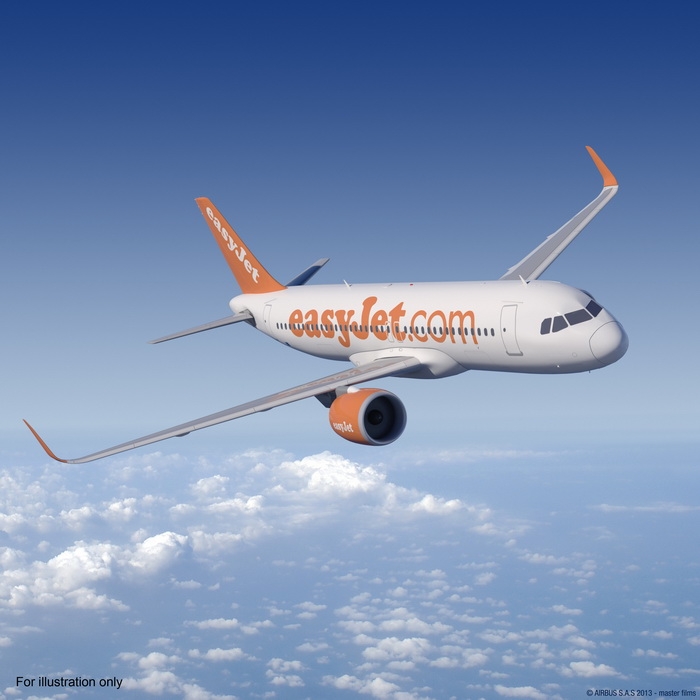
.
Airbus in Puget Sound: Next week the Pacific Northwest Aerospace Alliance and the Washington Department of Commerce are hosting the first Airbus suppliers fair here in the State.
- This is something near to our heart. We’ve been working on getting Airbus here for a suppliers fair since 2009 as part of the “Beyond Boeing” strategy we outlined in an October 2009 speech at a conference in Spokane (WA). When we began consulting to the Washington Department of Commerce the following year, Commerce (which previously had expressed interest) also took up the cause. The whole thing fell apart at the height of the vitriolic USAF tanker competition, when the Washington Congressional delegation became so political about the affair. Since then, Commerce and the Pacific Northwest Aerospace Alliance took up the cause and next week is the culmination of this effort. According to the State, 40 percent of the Washington suppliers it surveyed already serve Airbus, and the State is the Number 2 supplier in the US to Airbus by company count. Airbus wants to increase its US dollar-based footprint and is even talking about opening an engineering center in Washington during the next 10 years.
- The Puget Sound Business Journal article linked above has several links within it with more background.
Boeing in Puget Sound: Meantime, the Puget Sound Business Journal has several articles about Boeing’s future here:
The South is Winning: Why Puget Sound keeps losing jobs
The South is Winning: New composites could hasten drift
The south is Winning: Could Washington become a Right-to-Work State?
- In this one, we note that the unions “saved Boeing’s ass” during the 747-8 and 787 debacles but if Washington wants to truly be competitive with the South, it needs to become a right-to-work state. Fat chance.
There is also this editorial comment from The Everett Herald.
Allegiant Air sees starting commercial service at Paine Field by the fall
Allegiant Air, a discount carrier that serves Bellingham and other cities in Washington, and which started the studies for commercial aviation service for Paine Field in Everett (WA), said it sees starting air service at Paine Field this fall. “We’re in negotiations now. The first opportunity is in the fall,” says Jude Bricker, VP of Allegiant, who made the announcement at the PNAA conference.
Other stuff:
- Allegiant serves a half dozen cities from Bellingham, including Phoenix, Las Vegas and two cities in Hawaii with 15 flights a week.
- I am as bullish today about the business as ever. Will see real rationalization come to the space. Capacity will be rationalized. There is more ability to pass on higher costs.
- Allegiant serves about 200 markets. Scheduling is done for price. Thursday into Vegas, Sunday out. We don’t fly anything on Tuesday.
- We unbundle product because people who fly Allegiant are extremely elastic as to fares.
- $1.5bn market cap at $78 stock price.
- We schedule by week, by market. We always ask ourselves, what is the least crappy thing we can do with this airplane?
- Roughly we don’t make any money on air fares. We would lose money selling only fares. Ancillary revenue is the profit base.
PNAA Endorses Commercial Air Service at Paine Field
The Pacific Northwest Aerospace Alliance today endorsed commercial air service at Paine Field in Everett (WA). The move is highly controversial. The Snohomish County Council and the City Councils of Edmonds and Mukilteo, adjacent suburbs, oppose the service.
PNAA made the announcement at its conference in the Seattle suburb of Lynnwood, a few miles from Paine Field.
Allegiant Air, which also spoke at the conference, first proposed commercial service at Paine a few years ago. Alaska Air Group, based in Seattle and the largest carrier at SEA-TAC Airport, opposes service at Paine but has filed the paperwork with the FAA to commence service if Allegiant does. Alaska Airlines and sister company Horizon Air would provide some 50 flights a week to a half-dozen destinations. Allegiant proposes four or five flights a week to two or three cities.
PNAA, a trade group that represents more than 100 companies with nearly 100,000 employees, said commercial service will benefit the supply chain, employees and residents who live north of Seattle who currently have to rely on the congested I-5 and I-405 corridors to go to and from SEA-TAC. The Seattle area is considered one of the Top 10 most traffic congested cities in the country.
Paine Field has about 400 flights a day, only one-third of the airport capacity. Boeing’s wide-body production is at the airport and accounts for only about 5% of the operations. The balance is private aviation and MRO traffic.
PNAA Conference Pt 3: Renewable biofuels
The future of bio-fuel is different from the bio-fuel today, says John Plaza, CEO of Imperium Renewables. He is speaking at the Pacific Northwest Aerospace Alliance conference in suburban Seattle. It will be drop-in fuel, potential to be cheaper, meet same specifications as petroleum, equivalent to civilian (JP-8) and military fleets (JP-10).
First generation of bio-fuel is bio-diesel. Second generation will be the drop-in described above. Bio-fuels have to become multiple products as in the petroleum industry.
- We’re seeing increasing density of bio-fuels, which increases BTUs and efficiency on long-haul flights.
- WA State has one of highest recycling programs in the country but still generates a lot of trash (much of which is trained to Oregon). Trash can contribute to bio-fuel.
- Bio-fuel without subsidy costs around $4/gal vs $3.25 or so for jet fuel, so there is still a price disparity.
- 200 million gallons of jet fuel within 100 mile radius of wood slash can be generated.
- Other feed stocks: Jatropha, Eucalyptus, mixed growth plots. Algae is interesting but requires more research.
PNAA Conference, Pt 2: Odds end Ends–Executive Director named; now largest conference in sector on West Coast
PNAA Executive Director: The Pacific Northwest Aerospace Alliance named its first Executive Director, Melanie Jordan. Jordan has been very active in Puget Sound aerospace matters for years and has been on the board of the Future of Flight Museum and the Historic Flight Foundation, both at Paine Field in Everett.
PNAA Growth: PNAA is 15 years old and has been holding its conference for 12 years. This year 400 are attending, a record. This has now become the largest conference of its kind on the West Coast. This is a mix of airlines, OEMs, suppliers, training institutions.
Aircraft interiors: Complexities of interiors are greater than seems obvious. Cockpit doors are example of conflicts: you want authorized and emergency access, but doors have to be able to withstand unauthorized access. Diaper changing tables need to weight no more than 2 pounds but be capable of withstanding 1,200 lbs of pressure and still be 3/4 in thick and three feet long. A light-weight door can be designed but the cost goes beyond the 12 month return on investment, so not favored despite long-term fuel savings. Airline Marketing wants a certain look and battles finance. Engineering has another opinion. Market conditions might suddenly change and make them rethink everything. Lower lobe crew rest takes away cargo space, impacting cargo revenue–but this can be offset by more passengers.
PNAA conference, Pt 1: Traffic data; AA-US merger thoughts, 787
Each airline region of the world is different and many going through transitions US went through previously, says Bob McAdoo, the airline analyst for Imperial Capital (a boutique investment banking company in California).
McAdoo is speaking at the Pacific Northwest Aerospace Alliance conference in suburban Seattle today. Highlights:
- IATA traffic data doesn’t make a lot of sense any more. I can always get traffic–all I have to do is charge $19. Without knowing the data behind the numbers, traffic data is meaningless. People say US isn’t a growth market, but it’s making money.
- American Airlines-US Airways: Turn back clock to 2005/6: America West took over US Airways and in less than a year had best profit margins in the industry. Boeing is on AA creditors committee and I think there will be MD-80s coming out sooner and these guys (Doug Parker) will run it like a business. These guys will look at a route structure and say what works and won’t work, not a route planning department that likes the look on a map. I think you will see a lot of markets shut down.
- These guys have been in the top one or two in profit margin. US carries more people out of Philly than AA does out of New to Europe.
- This is a non-growth world in many respects.
- McAdoo recalls when he was at Texas International and his job was to put Southwest out of business. “I wasn’t very good at that.”
- Allegiant and Spirit are, in effect, next Southwest. Tells a story of a friend who rode Spirit once and will never ride them again, “but I’ll buy their stock.”
- 737-400 rent $65,000, 737NG (older) $135,000.