
Leeham News and Analysis
There's more to real news than a news release.



Boeing’s Long Arc from Disciplined Rework to Distributed Chaos
Subscription Required
By the Leeham News Team
Part 1 of a five part series about Boeing's path to recovery.
May 4, 2026, © Leeham News: From a 30-airplane cockpit rework crisis on the 767 to a supplier-driven configuration mystery on the 787, the history of Boeing’s pre-production change incorporation process is a master class in what happens when an industry’s best practices are forgotten in the name of financial engineering.
Getting it right the first time and avoiding time-consuming, costly rework are crucial for Boeing’s future airplane programs—and its long-term financial recovery.
In a previous article, LNA detailed “the high cost of getting it wrong.” We continue our in-depth exam of some of the fundamentals of Boeing’s path to recovery.
Related Story
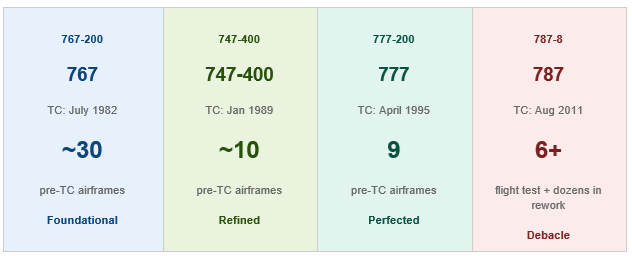
The change incorporation events for the Boeing 767, 747-400, 777, and 787 are examined in the five-part Leeham News special report. Credit: Leeham News.
What Change Incorporation Actually Is—And Why It Is So Hard
When Boeing builds an entirely new type of airliner, the factory does not wait for regulators to complete their final review before rolling jets off the assembly line. Assembly of pre-production aircraft begins months or years before the FAA issues a type certificate.
There is a powerful economic logic driving this decision. A new commercial jet program represents an investment of billions of dollars. Every month that passes between the start of certification flight testing and the first revenue-generating delivery is a month of continued capital consumption with no return.
Airlines that signed purchase agreements are planning route networks, crew training schedules, and fleet retirements around contracted delivery dates. The manufacturer’s entire financial model for a new program depends on compressing the interval between first flight and first delivery to the greatest extent possible.
To read the rest of the article Login or Subscribe today.