
Leeham News and Analysis
There's more to real news than a news release.


Outlook 2026: The state of the major eVTOL projects
Subscription Required
Now open to all readers.
By Bjorn Fehrm
February 9, 2026, © Leeham News: The eVTOL market saw a sobering 2025 after two of its high flyers, Lilium and Volocopter, both ceased operations in 2024. The remains of Volocopter were bought by Diamond Aircraft, which now markets a stripped-down VoloCity as a Light Sports eVTOL.
Further players ceased in 2025, with Hyundai’s Supernal halting further development, as did Airbus with its CityAirbus. Textron halted Nexus development, then shuttered the division, and Overair ceased operations after Hanwa stopped investing.
 We have one VTOL that received local Chinese Type Certification in 2023, and one in 2024. EHang got the Type Certificate in 2023, Production Certificate in 2024, and Air Operator Certificate (AOC) in 2025. The drone multicopter looking Ehang EH216-S (Figure 1) was cleared to operate tourist flights in China. The other Chinese project was AutoFlight’s Prosperity five-seater, which achieved Chinese Type Certification in 2024.
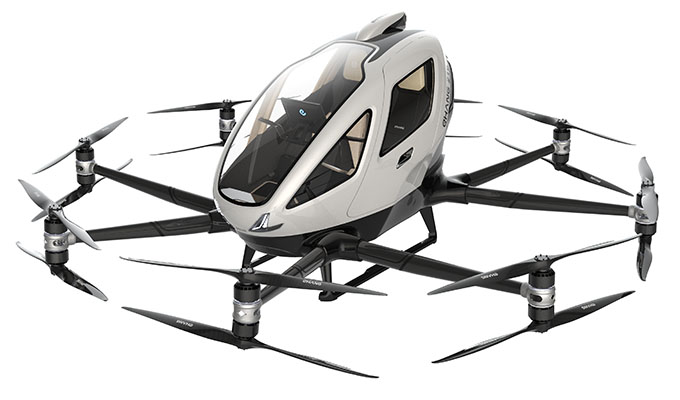
Figure 1. The only certified eVTOL, the EHang EH216-S. Source: EHang.
The almost euphoric enthusiasm over eVTOLs that existed before COVID, where car manufacturers got involved as this could be the thing that took over personal transport for crowded cities, has now calmed down, as the operational use of the current generation of eVTOLs is 10 to 15-minute missions in fair weather, replacing helicopter services from the airport to the city centre.
The original story was different as early developers like Joby Aviation painted with a broad brush. There were statements about 150nm trips, 200 kts speeds, and unbeatable economics, with batteries that lasted 10,000 flights. What investors and pundits didn’t understand was that these were unrelated statements about physical limits: there was no AND between them.
Lilium on the clock to survival or dissolution
Update, Jan. 4, 2025: A German investment group will pump €200m+ into Lilium, purchasing all its assets.
By Scott Hamilton
Dec. 19, 2024, © Leeham News: Lilium, one of the earliest battery-powered eVTOLs, has two weeks to raise €1m to give it more time to fully reorganize—or on Jan. 1, the company moves into dissolution.
Lilium filed for bankruptcy in the US and insolvency under German law in November. As a German company, its future is governed by much stricter insolvency laws than in the US where bankruptcy laws give the debtor wide latitude and almost unlimited time to reorganize.
Under German law, Lilium has until Dec. 31 to raise €1m to tide it over while substantial funding is raised or a merger with a healthy partner can be arranged.
Lilium has an order and commitment book for more than 700 of its eVTOL, a 6-8 passenger Advanced Air Mobility (AAM) design that is flown by one pilot. The advertised range is enough to fly from New York City to Philadelphia. Lilium calls the AAM an electric jet, but in reality the powerplants are electric motors—a lot of them.

Lilium’s “jet” eVTOL battery-powered aircraft. Credit: Lilium.
But Lilium has gone through $1.1bn. It pays its executives handsomely, with critics complaining that they are way overpaid for a start-up company with no revenue. It purchased the former Dornier executive offices and built three big hangars to house parts and components, pre-production and final production.

Lilium bought the former Dornier headquarters at Munich’s research airport, and built three hangers. Critics point to this expense as an example of overspending. Credit: Lilium.
Critics say Lilium’s design is impractical, far behind schedule, and has yet to undergo meaningful flight testing.
Be that as it may, the company believes that German politics got in the way of approving a $100m Bavarian state loan that was a prerequisite for an equal investment from private sources. The critics say Lilium’s spending and executive pay played a role in Bavaria’s rejection.