
Leeham News and Analysis
There's more to real news than a news release.


Bjorn’s Corner: Faster aircraft development. Part 30. Wrap-up.

By Bjorn Fehrm and Henry Tam
March 6, 2026, ©. Leeham News: We started the series on developing a new airliner in the 14 CFR Part 25 class (i.e., not a commuter-class aircraft) on August 1st 2025. The objective was to write a series about such development with people I knew that has “been there, done that”?
Here is how the series started:
Four years ago, I did a series on aircraft development with Henry Tam and Andrew Telesca, both part of the canceled Mitsubishi SpaceJet program. The series was about the arduous task of developing and producing a certified aircraft for the FAA Part 23 standard and its EASA equivalent. The idea was to better describe what’s ahead for the many upstarts that wanted to develop green aircraft and VTOLs. Now we will do a series about recent ideas on how the long development times for large airliners can be shortened. New projects talks about cutting the development time by one-third. Is this realistic?
Bjorn’s Corner: Faster aircraft development. Part 29. AI and the Program Plan.
By Bjorn Fehrm and Henry Tam.
February 27, 2026, ©. Leeham News: Last week, we looked at the development timeline for Part 25 airliner programs to reach Entry Into Service (EIS) after launch, Figure 1.
We can see that development times have doubled from the 1960s to the 1980s, compared with development since the year 2000.
The main change is the complexity of the aircraft, both in terms of highly optimized structures using new materials and avionics/flight control systems with many software code lines that require extensive verification.
We concluded that modern toolchains, with the capability to produce so-called Digital Twins, helped avoid further slip in development times, but they could not reduce them. The question then remains, can the employment of AI change this?
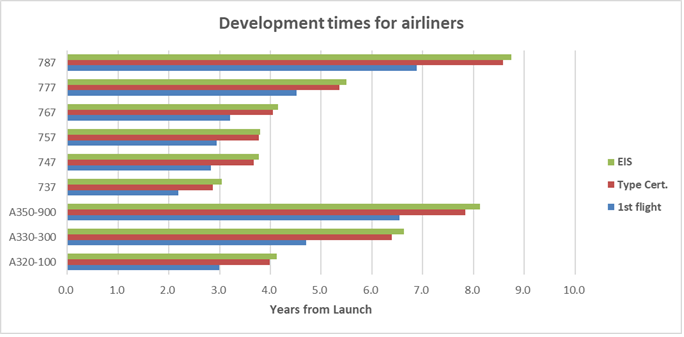
Figure 1. The development times for airliners over the years. Source: Leeham Co.
Bjorn’s Corner: Faster aircraft development. Part 28. Development times.
By Bjorn Fehrm and Henry Tam
February 20, 2026, ©. Leeham News: We have, since August 2025, gone through an FAA CFR 14 Part 25 development project of an airliner in the 200-seat class. The aim was to identify the activities required for such a project and the regulatory actions needed to achieve Type Certification (TC) and Production Certification (OC) for the aircraft.
The program followed the time plan in Figure 1, which indicated that it would take about seven years from the start of conceptual design to deliver the first aircraft and enter service (EIS). At each phase, we assessed whether modern support techniques, such as AI, could help with development and certification and whether they would accelerate the program plan.

Figure 1. A typical Program Plan for a smooth-running Part 25 airliner development. Source: Leeham Co.
We now summarize the findings and incorporate additional modern support, such as Digital Twin support, to assess the overall impact of today’s technologies on the program plan timeline in Figure 1. Read more
Bjorn’s Corner: Faster aircraft development. Part 27. Where Speed-Up gets Tough.
By Bjorn Fehrm and Henry Tam.
February 13, 2026, ©. Leeham News: We are summarizing how modern tools, processes, and AI can help reduce the time required to develop a clean-sheet 200-seat replacement for the Airbus A321neo and the Boeing 737 MAX 10.
We discussed some ideas in the last article on how current AI can support development. We could see it helping reduce the time spent on templating documents and on designing and verifying simple parts, such as mounting brackets for pipes and cables.
To address the more challenging parts where AI struggles to assist, we need to understand why development programs now take longer than in the past and what can be done to shorten the timeline.
Outlook 2026: The state of the major eVTOL projects
Subscription Required
Now open to all readers.
By Bjorn Fehrm
February 9, 2026, © Leeham News: The eVTOL market saw a sobering 2025 after two of its high flyers, Lilium and Volocopter, both ceased operations in 2024. The remains of Volocopter were bought by Diamond Aircraft, which now markets a stripped-down VoloCity as a Light Sports eVTOL.
Further players ceased in 2025, with Hyundai’s Supernal halting further development, as did Airbus with its CityAirbus. Textron halted Nexus development, then shuttered the division, and Overair ceased operations after Hanwa stopped investing.
 We have one VTOL that received local Chinese Type Certification in 2023, and one in 2024. EHang got the Type Certificate in 2023, Production Certificate in 2024, and Air Operator Certificate (AOC) in 2025. The drone multicopter looking Ehang EH216-S (Figure 1) was cleared to operate tourist flights in China. The other Chinese project was AutoFlight’s Prosperity five-seater, which achieved Chinese Type Certification in 2024.
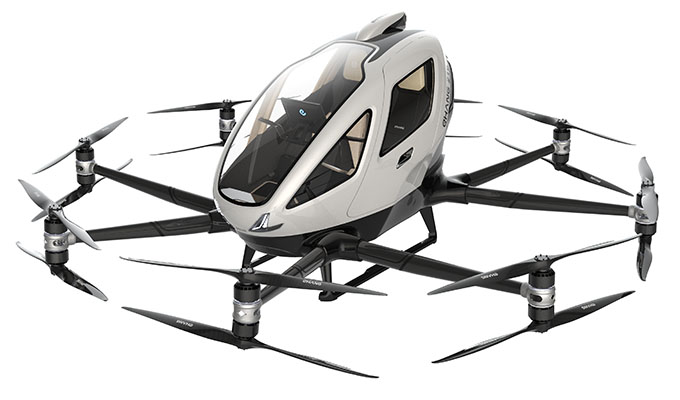
Figure 1. The only certified eVTOL, the EHang EH216-S. Source: EHang.
The almost euphoric enthusiasm over eVTOLs that existed before COVID, where car manufacturers got involved as this could be the thing that took over personal transport for crowded cities, has now calmed down, as the operational use of the current generation of eVTOLs is 10 to 15-minute missions in fair weather, replacing helicopter services from the airport to the city centre.
The original story was different as early developers like Joby Aviation painted with a broad brush. There were statements about 150nm trips, 200 kts speeds, and unbeatable economics, with batteries that lasted 10,000 flights. What investors and pundits didn’t understand was that these were unrelated statements about physical limits: there was no AND between them.
Bjorn’s Corner: Faster aircraft development. Part 26. AI speeds up processes.
By Bjorn Fehrm and Henry Tam
February 6, 2026, ©. Leeham News: We have completed a detailed, step-by-step analysis of the certification requirements a Part 25 Air Transport airliner in the 200-seat segment must meet.
In our series, we have seen work that could benefit from an AI agent, and other work where we conclude it will be difficult.
We begin this week by outlining areas where we expect AI to reduce the number of work hours required to complete a task. We will attribute these AI-driven work-hour reductions to the appropriate areas of the aircraft Program Plan in Figure 1.
Figure 1. A generic new Part 25 airliner development plan. Source: Leeham Co. Click to see better.
Bjorn’s Corner: Faster aircraft development. Part 24. Post certification, Sustainment phase.
By Bjorn Fehrm and Henry Tam.
January 23, 2026, ©. Leeham News: We do a series about ideas on how the long development times for large airliners can be shortened. New projects talk about cutting development time and reaching certification and production faster than previous projects.
The series will discuss the typical development cycles for an FAA Part 25 aircraft, called a transport category aircraft, and what different ideas there are to reduce the development times.
We will use the Gantt plan in Figure 1 as a base for our discussions. We have looked at the preparation work around entry into service; now we talk about post-certification work and the support of the new airliner generating revenue flights for the airline customer.
Figure 1. A generic new Part 25 airliner development plan. Source: Leeham Co. Click to see better.
** Special thanks to Andrew Telesca for helping with this article **
Bjorn’s Corner: Faster aircraft development. Part 23. Preparing for Entry Into Service.
By Bjorn Fehrm and Henry Tam
January 16, 2026, ©. Leeham News: We do a series about ideas on how the long development times for large airliners can be shortened. New projects talk about cutting development time and reaching certification and production faster than previous projects.
The series will discuss the typical development cycles for an FAA Part 25 aircraft, called a transport category aircraft, and what different ideas there are to reduce the development times.
We will use the Gantt plan in Figure 1 as a base for our discussions. We have looked at the production preparations and the challenges of the serial production phase. Now we look a the preparation work around entry into service for our new airliner.
Figure 1. A generic new Part 25 airliner development plan. Source: Leeham Co. Click to see better.
Bjorn’s Corner: Faster aircraft development. Part 22. Serial Production.
By Bjorn Fehrm and Henry Tam.
January 9, 2026, ©. Leeham News: We do a series about ideas on how the long development times for large airliners can be shortened. New projects talk about cutting development time and reaching certification and production faster than previous projects.
The series will discuss the typical development cycles for an FAA Part 25 aircraft, called a transport category aircraft, and what different ideas there are to reduce the development times.
We will use the Gantt plan in Figure 1 as a base for our discussions. We have completed flight testing of the flight test aircraft and obtained a design Type Certificate (TC). We now examine the production preparations and the serial production phase.
Figure 1. A generic new Part 25 airliner development plan. Source: Leeham Co. Click to see better.
Bjorn’s Corner: Faster aircraft development. Part 21. Certification Implementation.
By Bjorn Fehrm and Henry Tam
December 19, 2025, ©. Leeham News: We do a series about ideas on how the long development times for large airliners can be shortened. New projects talk about cutting development time and reaching certification and production faster than previous projects.
The series will discuss the typical development cycles for an FAA Part 25 aircraft, called a transport category aircraft, and what different ideas there are to reduce the development times.
We will use the Gantt plan in Figure 1 as a base for our discussions. We have concluded the articles about flight tests with the aircraft. Now we revisit the Certification subject and look at how we can show compliance with requirements and work our way to a Type Certificate. We are at the end part of the Testing and Certification phase in our Program Plan in Figure 1.
Figure 1. A generic new Part 25 airliner development plan. Source: Leeham Co. Click to see better.
** Special thanks to Andrew Telesca for helping with this article **