
Leeham News and Analysis
There's more to real news than a news release.


Bjorn’s Corner: Faster aircraft development. Part 29. AI and the Program Plan.

By Bjorn Fehrm and Henry Tam.
February 27, 2026, ©. Leeham News: Last week, we looked at the development timeline for Part 25 airliner programs to reach Entry Into Service (EIS) after launch, Figure 1.
We can see that development times have doubled from the 1960s to the 1980s, compared with development since the year 2000.
The main change is the complexity of the aircraft, both in terms of highly optimized structures using new materials and avionics/flight control systems with many software code lines that require extensive verification.
We concluded that modern toolchains, with the capability to produce so-called Digital Twins, helped avoid further slip in development times, but they could not reduce them. The question then remains, can the employment of AI change this?
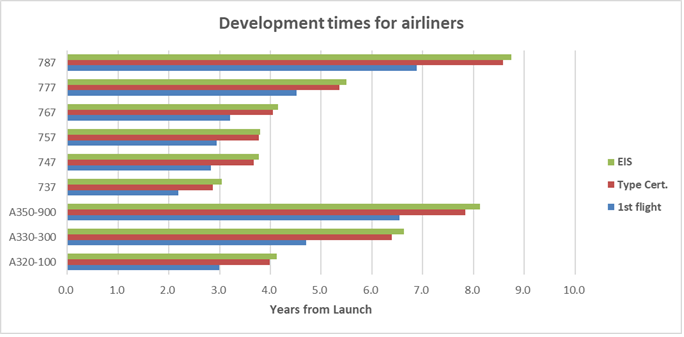
Figure 1. The development times for airliners over the years. Source: Leeham Co.
Bjorn’s Corner: Faster aircraft development. Part 28. Development times.
By Bjorn Fehrm and Henry Tam
February 20, 2026, ©. Leeham News: We have, since August 2025, gone through an FAA CFR 14 Part 25 development project of an airliner in the 200-seat class. The aim was to identify the activities required for such a project and the regulatory actions needed to achieve Type Certification (TC) and Production Certification (OC) for the aircraft.
The program followed the time plan in Figure 1, which indicated that it would take about seven years from the start of conceptual design to deliver the first aircraft and enter service (EIS). At each phase, we assessed whether modern support techniques, such as AI, could help with development and certification and whether they would accelerate the program plan.

Figure 1. A typical Program Plan for a smooth-running Part 25 airliner development. Source: Leeham Co.
We now summarize the findings and incorporate additional modern support, such as Digital Twin support, to assess the overall impact of today’s technologies on the program plan timeline in Figure 1. Read more
Bjorn’s Corner: Faster aircraft development. Part 25. The Difference between Continuing and Continuous Airworthiness.

By Bjorn Fehrm
January 39, 2026, ©. Leeham News: We have done a series about ideas on how the long development times for large airliners can be shortened, while at the same time describing all the regulatory work that must be done, regardless of work practices.
It’s now time to sum up what we have looked at in terms of speeding up the development of a Part 25 Air Transport airliner in the 200-seat segment. But before we do that, we will look at what an operator of the aircraft we have delivered will have to do to qualify it for operation with its local regulator.
For an operator to operate our aircraft, Continued Airworthiness, as described in last week’s article, is not enough; the Operator must add what can be called Continuing Airworthiness. These words are close but not the same, and there is a substantial difference in what’s behind them.
Bjorn’s Corner: Faster aircraft development. Part 13. Preliminary Design Review, PDR.
By Bjorn Fehrm and Henry Tam
October 24, 2025, ©. Leeham News: We do a series about ideas on how the long development times for large airliners can be shortened. New projects talk about cutting development time and reaching certification and production faster than previous projects.
The series will discuss the typical development cycles for an FAA Part 25 aircraft, called a transport category aircraft, and what different ideas there are to reduce the development times.
We will use the Gantt plan in Figure 1 as a base for our discussions. Today’s topic, the Preliminary Design Reviews, PDRs, are marked in the chart.
Figure 1. A generic new Part 25 airliner development plan with PDR marked in time. Source: Leeham Co. Click to see better.
Bjorn’s Corner: Faster aircraft development. Part 3.
By Bjorn Fehrm
August 15, 2025, ©. Leeham News: We do a series about recent ideas on how the long development times for large airliners can be shortened. New project talks about cutting development time and reaching certification and production faster than previous projects.
The series will discuss the typical development cycles for an FAA Part 25 aircraft, called a transport category aircraft, and what different ideas there are to reduce the development times.
We will use the Gantt plan in Figure 1 as a base for our discussions. Before we start the discussions, we outline the process to certify a transport category aircraft under the US FAA 14 CFR Part 25 regulations and how it relates to the Figure 1 plan.

Figure 1. A generic new Part 25 airliner development plan. Source: Leeham Co. Click to see better.
Bjorn’ s Corner: New aircraft technologies. Part 45. Continued Airworthiness
By Bjorn Fehrm
January 12, 2024, ©. Leeham News: We are discussing the different phases of a new airliner program. After covering the Design and Production, we now look at the Operational phase of a new airliner family.
For the operational phase, the airplane must pass scrutiny for Continued Airworthiness. Today, we discuss the different means available to the Regulator, such as Airworthiness Directives ( ADs) and System Bulletins (SBs) to the OEM to make sure any detected issues get noticed and corrected.

Figure 1. The Boeing MAX 9 Door Plug Emergency AD issued last week. Source: FAA.
Bjorn’ s Corner: New aircraft technologies. Part 44. Operation and Continued Airworthiness
By Bjorn Fehrm
January 5, 2024, ©. Leeham News: We are discussing the different phases of a new airliner program. After covering the Design and Production, we now look at the Operational phase of a new airliner family.
For the customer, the design and production are exciting and interesting, but it’s the information and services around the operational phase (Fleet Support in Figure 1) of the airliner that are most important to the airline customer.

Figure 1. The development plan for a new airliner. Source: Leeham Co.
Bjorn’s Corner: New aircraft technologies. Part 34. Design for Certification
October 13, 2023, ©. Leeham News: We are discussing the Detailed design phase of an airliner development program. We have discussed program management methods, development techniques, tools for Detailed design, that improved production methods are as important as improved technology, and that the interaction with the suppliers is key.
But another consideration that affects detail design is the influence of the Certification process. Certification has a major influence on the program work in every step of the aircraft program.

Figure 1. The online version of the FAA 14 CFR Part 25 Airliner Airworthiness regulations. Source: US CFR.
Growing Opposition to ALPA’s Attack on Regionals
Subscription Required
Kathryn B. Creedy
Analysis
May 15, 2023, © Leeham News: Using the same tired arguments, the Air Line Pilots Association (ALPA) on May 5 urged the Department of Transportation to reject SkyWest’s year-old proposal to create a Part 135 public charter under Part 380 of the Department’s regulations to serve Essential Air Service (EAS) markets.
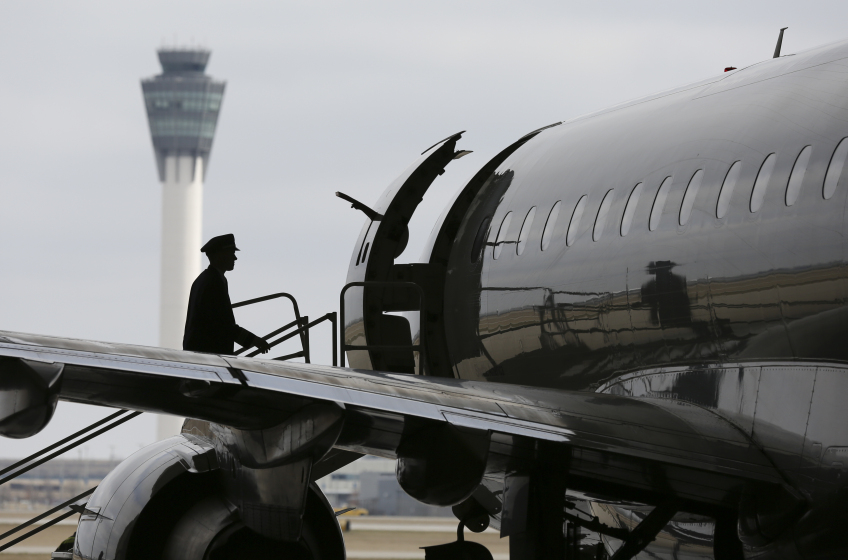
Credit: Republic Airways
ALPA, in a letter co-signed by nine other unions, claimed SkyWest Charter is a backhanded attempt to bypass the 1,500-hour pilot experience rule. The airline says its proposal is to continue serving most of its EAS points under the same regulations governing other EAS carriers. Further, it attacked the public charter rule objecting to JSX operations, a catalyst for engaging the business aviation against the union.
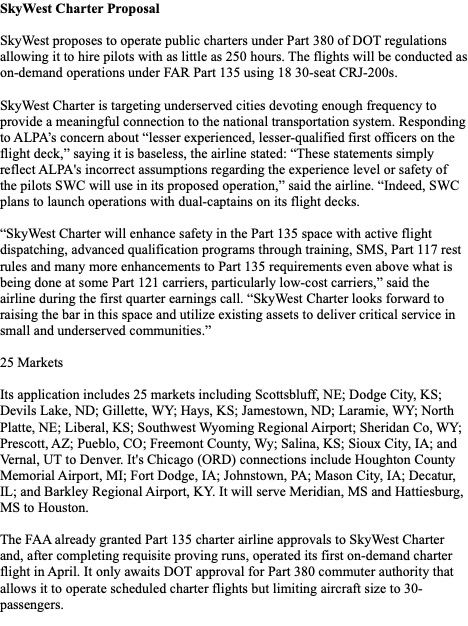
ALPA may be skating on thin ice, not realizing the 1,500-hour rule is increasingly irrelevant given statements on Capitol Hill favoring pilot training reform and the popularity of the EAS program among legislators.