
Leeham News and Analysis
There's more to real news than a news release.


Part 1: Workforce Shortage Stunting Industry Growth, Costing Billions
Summary:
- This two-part series outlines the threat posed by workforce shortages to the future growth of aviation and aerospace, since industry-wide costs of workforce shortages are unquantified. Estimates suggest the industry is leaving tens of billions on the table as a result
- Technology alone cannot solve the problem as the workforce changes
- Current industry efforts to address the workforce are fragmented and, to elevate aviation/aerospace pathways and careers, must be coordinated with organizations delivering educational and career programs
- The solution is a collaborative, professionally managed Early-Learning-to-Career Pipeline leveraging existing programs and alliances to guide youth to aviation/aerospace careers
- Industry must pivot from relying on government to investing in organizing the army and educational and career assets we already have.
- Success requires industry-wide proactive collaboration, cultural change, and investment.
By Kathryn Creedy
May 5, 2026, © Leeham News: Not one of the numerous studies from every aviation/aerospace policy organization has quantified the costs of not addressing our workforce shortages at an industry-wide level, although concerns are rising at the academic level. And there is little effort in developing a unified career pipeline guiding the kids we are already inspiring into our careers, as other industries have long been doing.
Only a few estimates exist on the cost of workforce shortages:
- Aeronautical Repair Station Association (ARSA): Perhaps ~$14bn for the maintenance industry.
- Boston Consulting Group (BCG): Unavailable aircraft and MRO inefficiencies cost the industry $27bn annually.
- McKinsey & Co: Cost of Attrition for one medium-sized company is ~$300m–$330m
- International Air Transport Assn. (IATA)The additional cost borne by the airline industry from the supply chain was over $11bn in fuel and maintenance.
Aviation and aerospace policy groups in Washington, in their rush to convince policy leaders about the importance of their multi-billion-dollar impact on the economy, might be missing the forest for the trees in not quantifying the costs.

Raisbeck Aviation High School in Seattle is privately funded. Students study to become aerospace engineers. Credit: Raisbeck Aviation High School.
It is clear that the aviation, aerospace, and defense industries contribute billions to the economy, but two important facts are missing.
The total talent forecast for all segments of the industry and the cost of failing to meet workforce needs.
All studies cite rising compensation, higher maintenance, repair and overhaul (MRO) and manufacturing costs, and the costs associated with delays in returning aircraft from maintenance and in delivering new aircraft off the production line. But none quantifies how much those rising costs are.
Nor are they calculating the cost to safety, despite rising concerns over the loss of seasoned aviators and aviation maintenance technicians, and the resulting “juniority” on the flight deck and in the maintenance bay. Exacerbating our shortages is the training pipeline with a shortage of instructors, professors, and teachers.
Growing Opposition to ALPA’s Attack on Regionals
Subscription Required
Kathryn B. Creedy
Analysis
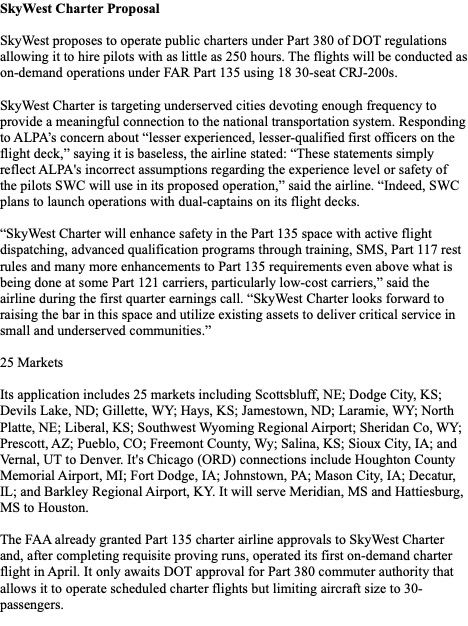
May 15, 2023, © Leeham News: Using the same tired arguments, the Air Line Pilots Association (ALPA) on May 5 urged the Department of Transportation to reject SkyWest’s year-old proposal to create a Part 135 public charter under Part 380 of the Department’s regulations to serve Essential Air Service (EAS) markets.
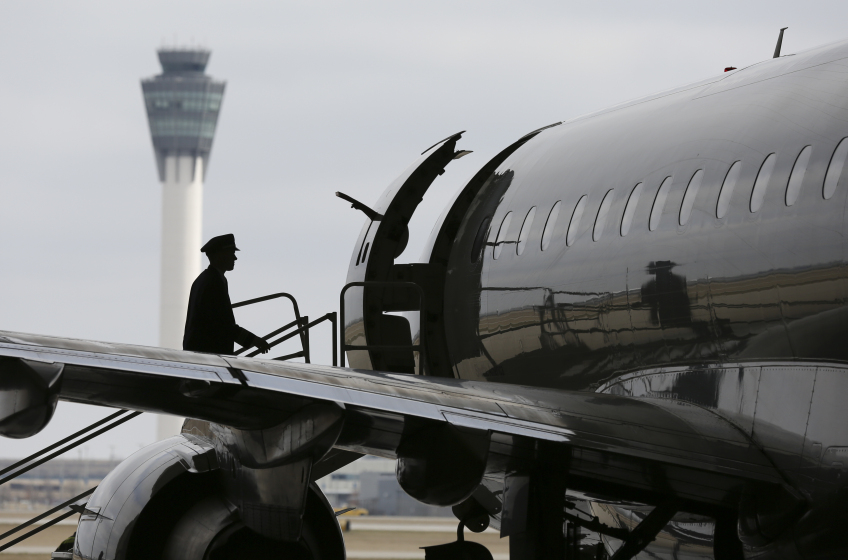
Credit: Republic Airways
ALPA, in a letter co-signed by nine other unions, claimed SkyWest Charter is a backhanded attempt to bypass the 1,500-hour pilot experience rule. The airline says its proposal is to continue serving most of its EAS points under the same regulations governing other EAS carriers. Further, it attacked the public charter rule objecting to JSX operations, a catalyst for engaging the business aviation against the union.
ALPA may be skating on thin ice, not realizing the 1,500-hour rule is increasingly irrelevant given statements on Capitol Hill favoring pilot training reform and the popularity of the EAS program among legislators.