
Leeham News and Analysis
There's more to real news than a news release.


Larger engine, longer range A350-1000 to be announced at Paris Air Show
Airbus and Rolls-Royce have agreed to up-size the Trent XWB engine powering the A350-1000, which will add about 500nm of range, Leeham News has learned.
The formal announcements have been planned for the Paris Air Show. Airbus issued a “no comment” to our inquiry and Rolls-Royce did not return calls.
Emirates Airlines CEO Tim Clark has been urging Airbus to add power to the airplane and enlarge it to 380 passengers in three-classes and add range to allow non-stop service from Dubai to Los Angeles. Qatar Airways and Korean Airlines have also encouraged Airbus to enlarge the airplane.
Odds and ends: More on DC-7B trip
Here are some more photos from our DC-7B trip. All photos by Scott Hamilton.
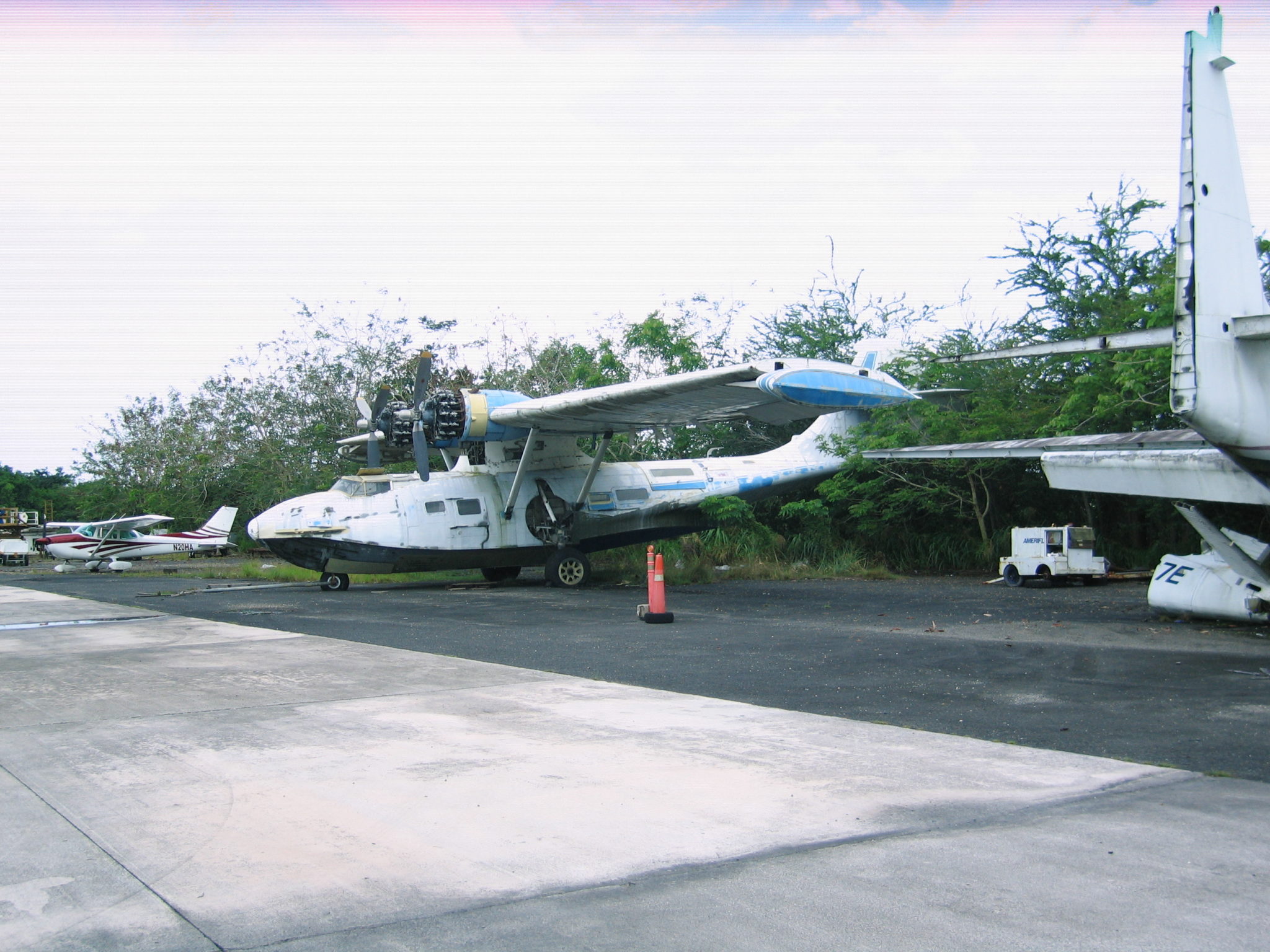
This PBY Catalina, a derelict but intact condition, is at the San Juan Airport. Given the loss of a PBY several years ago in a landing accident, could this become a new, restored edition?
Flight recorders narrow cause of AF447
Recovery of the flight recorders from Air France 447, an Airbus A330-200 that crashed into the Atlantic two years ago, appears to have quickly identified the events that led to the crash–and contrary to all those who claimed the vertical tail fell off or the A330 is a deathtrap, it appears the pilots simply weren’t trained properly to handle the events.
The Wall Street Journal has this detailed account of what investigators have found.
Lest anyone now charge that the failure to fly through the frozen pitot tube situation is exclusively an Airbus problem, Flight Global’s David Kaminsky-Morrow posted a link to a National Transportation Safety Report from 19– in which a crew stalled an airplane after the pitot tubes froze up and crashed, killing all aboard.
The aircraft? A Boeing 727-200.
The point: accidents like these often happen across OEM lines. And the actions of Airbus-haters was pretty disgusting.
We’re back, looking at the WTO’s ruling on Airbus case
While we were gone, the WTO issued its ruling on the Airbus case, which was appealed by both sides.
There’s been plenty post-ruling analyses written already, and since we’re nearly a week later, we’re not going to add much to it except to point you to Aspire Aviation’s analysis and say this: Both sides won some and both sides lost some in this case. The USTR failed to achieve its top goal, and that is to have the WTO rule launch aid illegal, so blocking aid to Airbus to make the A350 XWB was a failure.
Flightblogger has a very good take on how both sides “spin” the final appeal report. The Wall Street Journal has a balanced view on who won and who didn’t.
This is a major defeat for the US–and for Boeing.
Government subsidies for healthy companies
Two news items caught our eye this morning.
The first was the financial reporting for EADS today. Although EADS reported a small loss on foreign exchange and financing costs, the company increased its cash position. This came under criticism in Germany for the bailout of the A400M program.
Boeing’s clarity provided at BCC meeting
Update, May 11: UBS had Boeing’s Mike Bair, the head of the 737 future program, for presentations yesterday and issued its report. Much of the UBS report is similar to the Credit Suisse and Buckingham information captured below; here’s some of the new stuff.
- While still not taking a re-engined 737 off the table entirely, it was clear from our discussion that BA’s preference remains an all new NB for initial delivery in 2019-20. While no major announcement is expected in Paris, BA anticipates material selection in 2012 (metal vs. composite), followed by component selection strategy
(make vs. buy) in 2013 and official program launch in 2013-14, assuming a launch order is in place. BA envisions an eventual production rate of 60-70/month, which it sees as high enough to justify a dual source strategy for some major components. - While still not taking a re-engined 737 off the table entirely, it was clear during our discussion that Boeing’s preference remains an all new narrowbody with initial delivery in 2019-20.
- Boeing does not expect to make a major announcement at the Paris Airshow. It commented that it would expect a launch decision on a potential new aircraft to come roughly five-six years ahead of first delivery, putting program launch in the 2013-14 timeframe,
assuming a launch customer is in place by then. - Boeing commented that it would take a defection by a current 737 customer to get it to think more seriously about re-engining. Boeing sees this as unlikely and noted that Easyjet is the only 737 operator ever to defect to A320 and that it took very aggressive pricing by Airbus to achieve that outcome.
Our comment on the last point: Bair is wrong, of course: United and Frontier were two 737 customers to defect and Air Berlin also bought A320s; we believe there were more but don’t recall specifically.
Original Post:
In what is the clearest picture yet of Boeing’s intentions for program development, Boeing Capital Corp. officials met May 3 with aerospace analysts and financial types in one of BCC’s periodic meetings. What emerged from the meeting is a clear understanding of Boeing’s current thinking for the current 737 line and the New Airplane, which for this report we will identify as the 7X7.
This report is based on conversations with participants of the meeting, subsequent analyst reports that were issued and presentations to the group by Boeing.
The WSJ on Steve Hazy
We’re still on hiatus, but we could not resist this piece of art from the Wall Street Journal illustrating Steven Udvar-Hazy’s return to the public stock market today for his Air Lease Corp.

The Wall Street Journal article is, at the moment, for paid subscribers only but here is an LA Times article that gives some background.
Separately, Aspire Aviation has a good analysis of the COMAC C919 and its competitive threat to Boeing and Airbus.
Going on hiatus
Due do a number of special projects with near-term deadlines, this column will be a hiatus for a while. In the meantime, please see our affiliate, AirInsight, for commentary and news.