
Leeham News and Analysis
There's more to real news than a news release.


Who has authority to close US airspace–DOD, DHS or the FAA?

Figure 1. A Locust laser direct energy weapon, shown here mounted on an infantry squad vehicle, was used in the area near El Paso International Airport in February. Photo: US Army.
By Colleen Mondor
April 1, 2026, © Leeham News: On Feb. 26, the Federal Aviation Administration (FAA) announced another Temporary Flight Restriction (TFR) in southern Texas airspace. As it did two weeks prior when closing the airspace over El Paso International Airport and a portion of southern New Mexico, the agency cited “Special Security Reasons.”
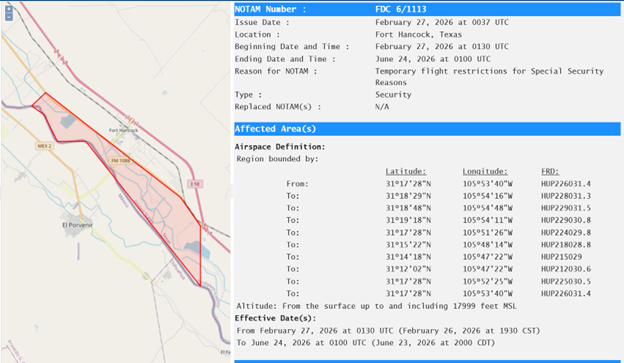
Figure 2. Fort Hancock TFR #FDC 6/1113 courtesy tfr.faa.gov.
Within 24 hours of the new closure, which was centered on Fort Hancock, about 50 miles southwest of El Paso, multiple media outlets reported that the TFR involved operations of the Customs and Border Protection Service (CBP) and were not coordinated with the FAA. The Fort Hancock closure, coupled with a recent report of the military’s plans to possibly fire lasers near Reagan National Airport, has reinforced concern over the FAA’s control of the national airspace, a task with which it has been legally mandated by Congress since its 1958 inception.
Boeing’s Starliner history shows safety, quality concerns exist systemically across the company
Editor’s Note: The National Aeronautics and Space Agency (NASA) on Feb. 19 released its investigative report of the failures in 2024 of the Boeing Starliner space vehicle. Defects in the Starliner resulted in its crew being housed in the International Space Station for nine months before being returned to earth in a SpaceX capsule.

Boeing Starliner, docked at the International Space Station. Source: Boeing.
The investigation into the failures faulted NASA and Boeing. The 311 page report was triggered by the Starliner incident, and examines the NASA-Boeing Defense, Space and Security (BDS) cultures that led to the Starliner problems. The Boeing Co. is engaged in high profile efforts to change the culture at Boeing Commercial Airplanes (BCA). The Starliner incidents reveal similar cultural and safety issues at BDS that corporate CEO Kelly Ortberg must address.
The NASA report may be downloaded here: nasa-Starliner report 021926
In this Special Report, LNA dissects the NASA study. The shortcomings at BDS are eerily similar to those at BCA.
Special Report
By the Leeham News Team
Three Disasters
Lion Air and Ethiopian Airlines
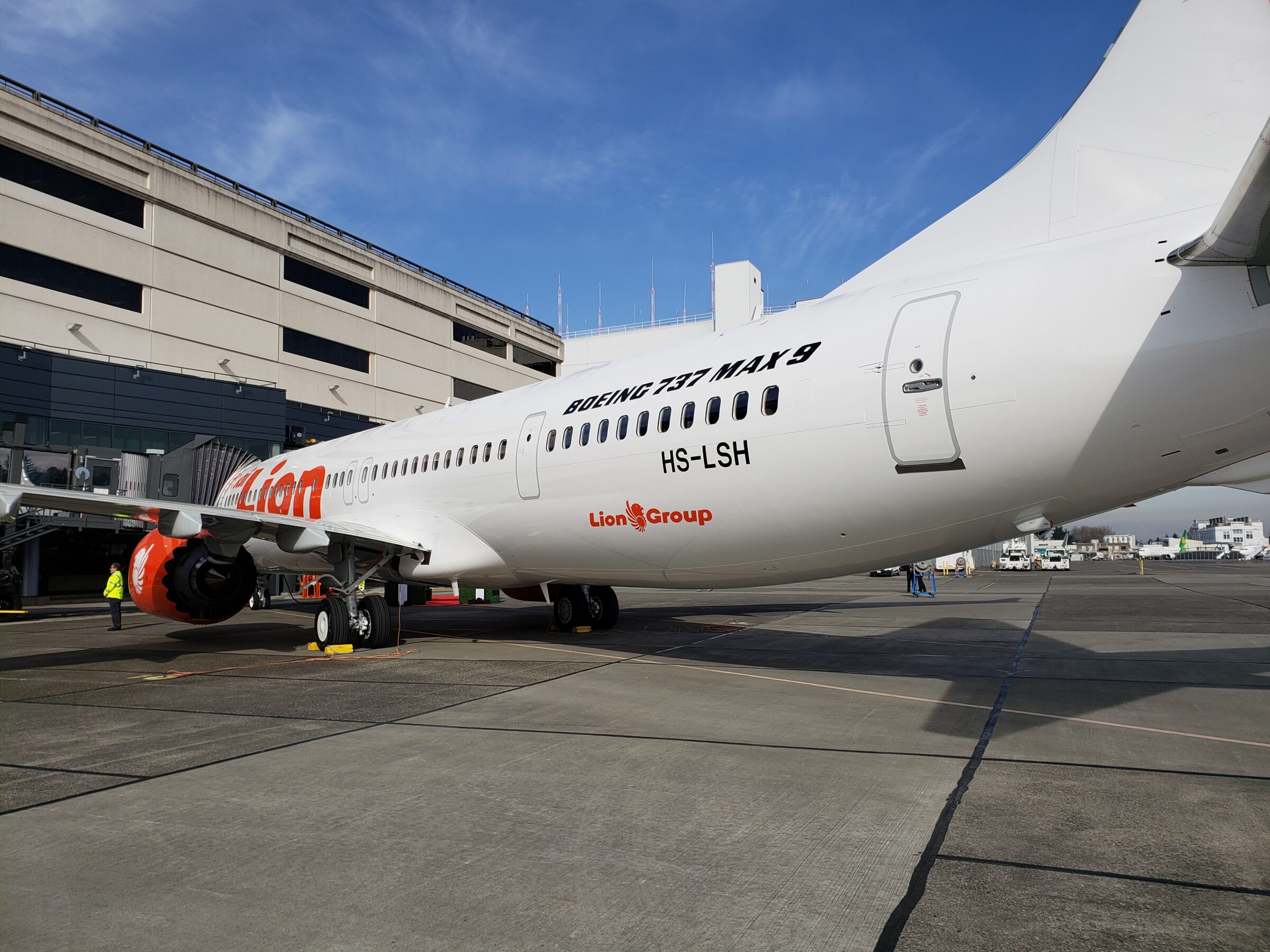
The first Boeing 737-8 delivered, in May 2017, which happened to be to Lion Air. Source: Leeham News.
March 30, 2026, (c) Leeham News: On Oct. 29, 2018, Lion Air Flight 610—a Boeing 737 MAX 8—crashed into the Java Sea, killing all 189 aboard. The Maneuvering Characteristics Augmentation System (MCAS), a flight control system that Boeing had withheld information about from airlines and the Federal Aviation Administration (FAA)—including its existence and how it works—drove the aircraft into an unrecoverable dive.
The pilots had never been trained on it because Boeing determined that disclosing MCAS would require simulator training, which would make the MAX less competitive against the Airbus A320neo. Southwest Airlines, for example, which ordered hundreds of MAXes, required Boeing to pay $1m per airplane if simulator training was required.
Less than five months later, on March 10, 2019, Ethiopian Airlines Flight 302 crashed under virtually identical circumstances. It was another MAX 8 with another MCAS-driven dive. Another 157 people were killed. Combined death toll: 346 passengers and crew, plus one recovery diver in the Lion Air accident. The global fleet was grounded for 21 months.
Congressional investigations revealed what investigators called Boeing’s “culture of concealment” and the FAA’s systematic overreliance on Boeing’s Organization Designation Authorization (ODA) for self-certification. While federal government agencies routinely designate company employees to represent the overseeing agencies, the level of the FAA’s hand-off to Boeing came under withering criticism.
Following the long recovery period, the FAA clamped down on Boeing’s production of the 737 and to a lesser extent (and for different reasons), production of the 787. By late 2022, Boeing executives appeared confident that BCA was on the path to normal operations.
Bjorn’s Corner: Faster aircraft development. Part 25. The Difference between Continuing and Continuous Airworthiness.

By Bjorn Fehrm
January 39, 2026, ©. Leeham News: We have done a series about ideas on how the long development times for large airliners can be shortened, while at the same time describing all the regulatory work that must be done, regardless of work practices.
It’s now time to sum up what we have looked at in terms of speeding up the development of a Part 25 Air Transport airliner in the 200-seat segment. But before we do that, we will look at what an operator of the aircraft we have delivered will have to do to qualify it for operation with its local regulator.
For an operator to operate our aircraft, Continued Airworthiness, as described in last week’s article, is not enough; the Operator must add what can be called Continuing Airworthiness. These words are close but not the same, and there is a substantial difference in what’s behind them.
Bjorn’s Corner: Faster aircraft development. Part 16. Certification Compliance Planning.

By Bjorn Fehrm and Henry Tam
November 14, 2025, ©. Leeham News: We do a series about ideas on how the long development times for large airliners can be shortened. New projects talk about cutting development time and reaching certification and production faster than previous projects.
The series will discuss the typical development cycles for an FAA Part 25 aircraft, called a transport category aircraft, and what different ideas there are to reduce the development times.
We will use the Gantt plan in Figure 1 as a base for our discussions. We are in the Detailed Design phase and working with the Certification Compliance plan.

Figure 1. A generic new Part 25 airliner development plan. Source: Leeham Co. Click to see better.
*** Special thanks to Andrew Telesca for helping with this article ***
Bjorn’s Corner: Faster aircraft development. Part 12. Preliminary Design; Requirements Definition.
By Bjorn Fehrm and Henry Tam
October 17, 2025, ©. Leeham News: We do a series about ideas on how the long development times for large airliners can be shortened. New projects talk about cutting development time and reaching certification and production faster than previous projects.
The series will discuss the typical development cycles for an FAA Part 25 aircraft, called a transport category aircraft, and what different ideas there are to reduce the development times.
We will use the Gantt plan in Figure 1 as a base for our discussions. We added two milestones to our Program Plan, which we will refer to in the articles: Preliminary Design Review and Critical Design Review. Here is their definition according to NASA:
The Preliminary Design Review (PDR) demonstrates that the preliminary design meets all system requirements with acceptable risk and within the cost and schedule constraints, and establishes the basis for proceeding with detailed design. It shows that the correct design options have been selected, interfaces have been identified, and verification methods have been described. The PDR should address and resolve critical, system-wide issues and show that work can begin on detailed design.
The Critical Design Review (CDR) demonstrates that the maturity of the design is appropriate to support proceeding with full-scale fabrication, assembly, integration, and test. CDR determines if the technical effort is on track to complete the system development, meeting mission performance requirements within the identified cost and schedule constraints.
Figure 1. A generic new Part 25 airliner development plan. Source: Leeham Co. Click to see better.
*** Special thanks to Andrew Telesca for helping with this article***
Bjorn’s Corner: Faster aircraft development. Part 3.
By Bjorn Fehrm
August 15, 2025, ©. Leeham News: We do a series about recent ideas on how the long development times for large airliners can be shortened. New project talks about cutting development time and reaching certification and production faster than previous projects.
The series will discuss the typical development cycles for an FAA Part 25 aircraft, called a transport category aircraft, and what different ideas there are to reduce the development times.
We will use the Gantt plan in Figure 1 as a base for our discussions. Before we start the discussions, we outline the process to certify a transport category aircraft under the US FAA 14 CFR Part 25 regulations and how it relates to the Figure 1 plan.

Figure 1. A generic new Part 25 airliner development plan. Source: Leeham Co. Click to see better.
Analyzing Boeing’s 90-Day Plan
Subscription Required
By the Leeham News Team
Analysis
 June 3, 2024, © Leeham News: There is no timetable for Boeing to gain approval to boost production rates of the 737 MAX. And there is no timetable for the beleaguered company to regain “ticketing” authority for certification of its 737s or 787s. The Federal Aviation Administration (FAA) will be calling the shots indefinitely.
Boeing last week presented the FAA with its plan to improve safety. The long PowerPoint, said FAA Administrator Mike Whitaker in a press conference on Thursday, wasn’t released to the public. But press releases from the FAA and Boeing, and an 11-page Executive Summary released by the manufacturer, were in many ways recitations of what’s already been done.
“All those highlighted bullet points posted below were all being done when I worked as a delivery manager 14 years ago,” a retired Boeing employee emailed LNA after reviewing the Boeing press release and Executive Summary.
“Eliminate defects? They’ve been saying that for 100 years. Of course, we want zero defects. The KPIs are nothing new. Been there done that. Nothing’s changed. Nothing.”
KPI stands for Key Performance Indicators. Boeing, and Whitaker, highlighted these in statements. There are six KPIs:
- Employee proficiency measures share of employees who are deemed proficient in core skills.
- Notice of Escape (NoE) rework hours measures time performing rework in Boeing’s final assembly facilities to address non-conforming work from its fabrication division and external suppliers.
- Supplier shortages measures shortages per day from Boeing’s fabrication division and external suppliers.
- Rework hours per airplane measures time spent performing rework in Boeing’s final assembly facilities.
- Travelers at factory rollout measures unfinished jobs traveling from Final Assembly
- Ticketing performance measures quality escapes per ticketed airplane prior to delivery.
FAA, Boeing meet; “They must follow through on corrective actions.” Update 3: Boeing’s issues its statement
Update #3: Boeing released its own press release. Here it is:
Boeing’s plan is based on findings from FAA audits, recommendations from the FAA’s ACSAA panel review and feedback from our employees. This Safety and Quality Plan generally fits into four categories of actions:
- Invest in workforce training
- Simplify plans and processes
- Eliminate defects
- Elevate safety and quality culture
Statement from Dave Calhoun: “After the Jan. 5 accident involving a 737 airplane, we took immediate containment and mitigation actions to ensure airplane safety. We also made the decision to slow production as we took a hard look across every facet of our operations. We listened to our employees, engaged transparently with our regulator, welcomed the findings and recommendations from the FAA’s ACSAA panel review, and invited scrutiny from customers and independent experts. Based on that feedback and oversight, today we presented to the FAA our comprehensive plan to strengthen our safety management, quality system, safety culture and ODA responsibilities.
Many of these actions are underway and our team is committed to executing on each element of the plan. It is through this continuous learning and improvement process that our industry has made commercial aviation the safest mode of transportation. The actions we are taking today will further strengthen that foundation.
We thank Administrator Whitaker and the FAA team for their feedback today and we will continue to work under their oversight as we move forward.”
Statement from Stephanie Pope: “Our plan is built on the feedback of our employees who know best how to design, build and deliver safe, high-quality airplanes. We also incorporated the requirements and feedback from our regulator and welcomed the recommendations from our customers and industry experts.
Based on that feedback, our roadmap includes major investments to expand and enhance workforce training, simplify manufacturing plans and processes, eliminate defects at the source, and elevate our safety and quality culture, along with specific measures to monitor and manage the health of our production system.
We are confident in the plan that we have put forward and are committed to continuously improving. We will work under the FAA’s oversight and uphold our responsibility to the flying public to continue delivering safe, high-quality airplanes. We are also grateful for our customers’ patience as we implement this plan and return to predictable deliveries.”
From: Stephanie Pope
|
Update #2: The FAA issued the following press release in the wake of its meeting with Boeing. Boeing is expected to release its own statement today. Additional updates will be made as developments occur.
FAA Continues to Hold Boeing Accountable for Implementing Safety and Production Quality Fixes
Agency meets with company on next steps following submission of their safety roadmap
WASHINGTON – The Federal Aviation Administration (FAA) will continue to hold Boeing accountable after reviewing the company’s roadmap to fix its  systemic safety and quality-control issues, Administrator Mike Whitaker said Thursday following a three-hour meeting with senior Boeing leaders at FAA headquarters.
In February, Whitaker directed Boeing to develop a comprehensive action plan to set a new standard for safety and how the company does business following the January 5 Alaska Airlines Boeing 737 MAX door plug incident. This roadmap is necessary to reset the safety culture at Boeing, as well as address the findings of the FAA’s special audit and the expert review panel report.
The company has developed this proposal over the last 90 days, with detailed input from the FAA throughout the process. Boeing senior leadership met with the FAA this morning to present the roadmap and discuss future implementation. Boeing is also now required to have a mandatory Safety Management System, which will ensure a structured, repeatable, systematic approach to identify hazards and manage risk.
“In the immediate aftermath of January 5, the FAA took unprecedented steps to increase oversight on Boeing. Over the last 90 days, that has meant everything from more safety inspectors in the facilities to halting production expansion. Today, we reviewed Boeing’s roadmap to set a new standard of safety and underscored that they must follow through on corrective actions and effectively transform their safety culture,” Administrator Whitaker said. “On the FAA’s part, we will make sure they do and that their fixes are effective. This does not mark the end of our increased oversight of Boeing and its suppliers, but it sets a new standard of how Boeing does business.”
Whitaker met Thursday morning with Boeing President and CEO David Calhoun and other senior leaders to discuss next steps to ensure effectiveness.
“I made clear once again that we need to see a strong and unwavering commitment to safety, which must always come first,” Whitaker said. “Systemic change isn’t easy but in this case is absolutely necessary, and the work is never really done when it comes to the safety of the flying public – from Boeing, airlines, or the FAA. But we will hold the company accountable every step of the way to make sure these changes happen.”
The FAA communicated with Boeing officials throughout the last 3 months, including 30- and 60-day check-ins, to ensure they clearly understood the agency’s expectations and were making real-time progress.
The agency required Boeing to provide a detailed update on completed actions as well as mid- and long-term actions Boeing will take. These actions include:
- Strengthening its Safety Management System, including employee safety reporting
- Simplifying processes and procedures and clarifying work instructions
- Enhanced supplier oversight
- Enhanced employee training and communication
- Increased internal audits of production system
Additionally, Boeing had to identify the results of completed actions and how it will monitor those and future actions to validate progress and sustain the changes.
To ensure long-term success, the FAA will actively monitor review Boeing’s progress in a variety of ways, including:
- A team of FAA subject matter experts will continually review Boeing’s progress and the effectiveness of the changes in addressing the audit findings and expert panel recommendations
- Senior FAA leaders will meet with Boeing weekly to review their performance metrics, progress, and any challenges they’re facing in implementing the changes
- They also will conduct monthly reviews to gauge Boeing’s progress
The FAA will continue its enhanced oversight of Boeing and its suppliers. This includes:
- More safety inspectors in the Boeing and Spirit AeroSystems facilities
- More conversations with company employees to gauge the effectiveness of changes
- Additional inspections at critical points of the production process and auditing of the production process
- Monitoring quality system metrics to identify any areas of concern
Additional actions the FAA has taken as part of its aggressive oversight of Boeing and its suppliers include:
- Immediately grounded 171 Boeing 737-9 MAX aircraft operated by U.S. airlines or in U.S. territory.
- Increased onsite safety inspector presence at Boeing’s facility in Renton, Washington, and Spirit AeroSystems’ facility in Wichita, Kansas.
- Halted production expansion of the Boeing 737 MAX.
- Administrator Whitaker visited to Boeing’s factory floor in Renton, Washington, to see the 737 production line and hear directly from Boeing engineers, mechanics, and others about quality control processes. He has actively encouraged all whistleblower complaints, and the FAA investigates every single one.
-
- Concluded an audit of Boeing’s production line that went above and beyond FAA’s standard inspection process. The FAA identified non-compliance issues in Boeing’s manufacturing process control, parts handling and storage, and product control. Our audit is complete but it is part of an ongoing investigation, and we cannot release further details.
- The FAA continues to issue airworthiness certificates for every newly produced Boeing 737 MAX.
Original story:
FAA appears poised to grant Boeing extension on safety report; FAA issues denial (Update)
Update #1: The FAA today said it has not granted an extension for Boeing to submit its report. This story will be updated as developments occur.
By the Leeham News Team
May 29, 2024, © Leeham News: The Federal Aviation Administration (FAA) appears poised to give Boeing a 90 day extension on the 90 days required to come up with an actionable plan to improve safety on its production lines, LNA is told.
Then, according to this information, Boeing will be given three years to implement whatever is finally approved by the FAA.
Boeing CEO David Calhoun is scheduled to deliver the 90-day plan to the FAA tomorrow.
LNA reported on April 18, 45 days into the 90-day mandate, that Boeing would unlikely meet the FAA deadline.
Related article
SPEEA, Boeing at impasse over safety program, union says
By Scott Hamilton
April 23, 2024, © Leeham News: Boeing and its engineers/technicians union, the Society for Professional Engineering Employees in Aerospace (SPEEA) are at an impasse over the proposed creation of a safety program widely used by airlines and other companies, the union says.
 The Aviation Safety Action Program (ASAP) is already in use by Boeing for flight testing. And the touch-labor union, the International Association of Machinists and Aerospace Workers (IAM) District 751 and Boeing recently adopted an ASAP that is in its early stages of implementation.
ASAP is a program, used across the airline and aerospace industries, by which employees may pass safety concerns to the regulators, in this case, the Federal Aviation Administration (FAA), without fear of retaliation or retribution.
“The ASAP program was designed for FAA-certified airmen—pilots, mechanics, dispatchers,” said a former Boeing employee whose duties at one time included safety. “In the airline world, nothing gets pre-screened. For a reason! The ASAP program is set up for Boeing flight tests. Production pilots at Boeing operate this way.”
- SPEEA internal memo with its safety concerns: Safety culture memo 041024
“We have offered SPEEA the same agreement we signed with the IAM and the FAA to strengthen safety, quality, and compliance,” a Boeing spokesperson said in an email to LNA. “We believe it will make a difference in ensuring product safety. This tri-party agreement is modeled after the longstanding and proven Aviation Safety Action Program (ASAP) which is used in the airlines and elsewhere in Boeing.”
Bjorn’s Corner: New aircraft technologies. Part 51. Wrap up
By Bjorn Fehrm
March 22, 2024, ©. Leeham News: Last week we did the first part of the Wrap-up of our 50 article series about the New Aircraft Technologies that can be used when replacing our present single-aisle airliners.
Now, we summarize the last 25 articles in the series, which covered how to develop, produce, and support a new airliner.

Figure 1. The Program Plan for a new airliner. Source: Leeham Co.