
Leeham News and Analysis
There's more to real news than a news release.



Boeing MAX v Airbus NEO; Fan size and optimizing the LEAP for MAX, Part 2
The war of words between Airbus and Boeing continued unabated at the Pacific Northwest Aerospace Alliance 11th Annual Conference this week in suburban Seattle.
As fully expected, Airbus said its planes are better than Boeing and Boeing said its planes are better than Airbus. No news there.
But Boeing revealed a little bit more detail on the 737 MAX vs the A320 neo that suggests their analysis gives another percentage point advantage than was originally announced last August.
When MAX was announced, Boeing claimed, “The airplane’s fuel burn is expected to be 16 percent lower than our competitor’s current offering and 4 percent lower than their future offering” and “It will have the lowest operating costs in the single-aisle segment with a 7 percent advantage over the competition.” The slide shows an additional 1% advantage for fuel burn over neo and 17% over A320CEO (Current Engine Option, as Airbus now calls it), of +5 (VS 4) and +17 (vs 16). We asked Boeing about this, and we’re told the slide reflects rounding up the numbers and not an actual increase in the previously announced economic claims.
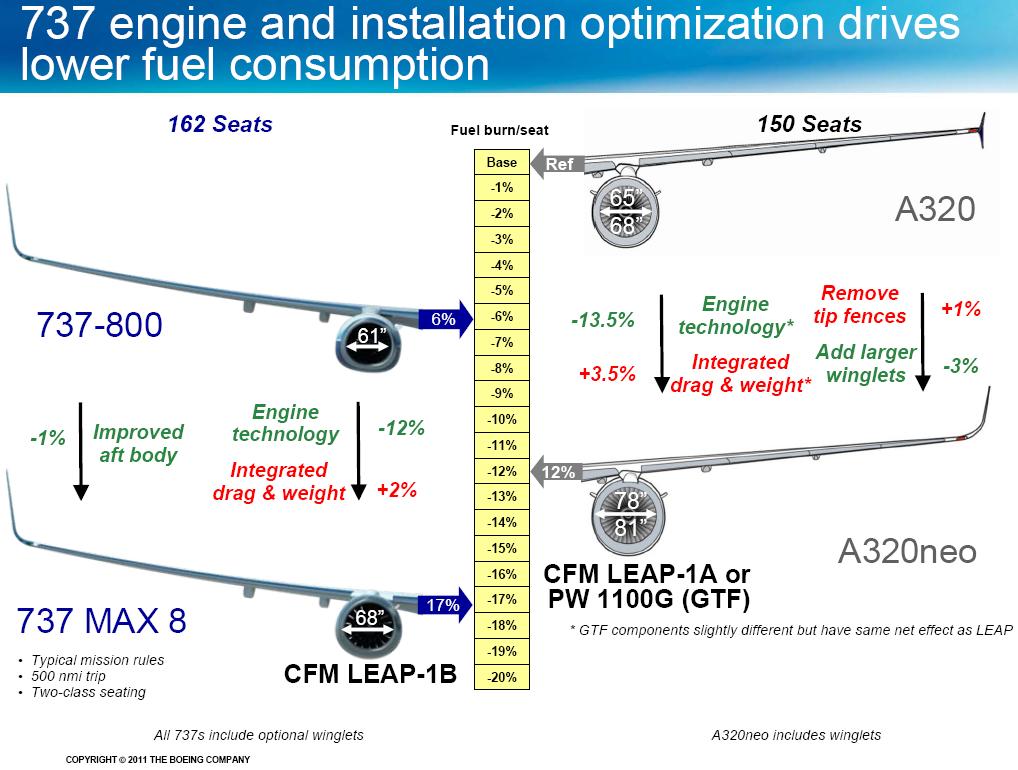 Randy Tinseth, VP Market, showed this slide (click on the slide to enlarge), the first time we’ve seen one like it. The slide shows the improved fuel burn minus the negative impact of additional weight and drag to come up with net figures.
What is also useful is that Boeing includes in the illustration the existing and planned fan diameters for the 737-800, the A320 and their successor airplanes. The assumptions used in the analysis are also listed on the slide.
Airbus disputes the underlying Boeing analysis as well as claiming the assumptions used favor Boeing instead of real-world operating conditions. We covered the Airbus detail following ISTAT’s European Conference in Barcelona. We sought out Boeing at that time in order to include their detail in that posting; Boeing declined. Boeing held a tele-conference November 4, but it could only be characterized as a high-level look at the program. We’ve been trying for months (since last June, in fact) to follow up their briefing in advance of the Paris Air Show and Boeing has been declining all interview requests on MAX.
CFM has likewise declined interview requests (three since August, when MAX was launched). Both companies have left the marketplace in a fog. But information obtained from customers, from Boeing and from within CFM has now painted a reasonable picture of how Boeing and CFM support their claims that the 737 MAX will be more economical than neo and how the LEAP is being optimized for MAX. In addition to the Airbus position, it should also be noted that at least one airline analysis of the MAX vs neo concludes that MAX will only be around 2% better than neo, not the 7%-8% lower operating costs claimed by Boeing.
The purpose of this post is not to attempt an independent analysis, but rather to explain why Boeing and CFM make the claims they do. This report is the result of months of talking with customers and sources within Boeing and CFM; and from public appearances by Boeing and CFM.
Optimizing LEAP for 737 MAX
There has been a great deal of debate over whether Boeing can meet the SFC reduction targets for its 737 MAX. This debate revolves in part because neither Boeing or CFM have been forthcoming about details how the CFM LEAP engine is being optimized for MAX.
We’ve obtained some details to explain how CFM is proceeding.
Details are still sketchy and hard to come by. But our source has direct knowledge of the program.
Our source compared the requirement to reduce the fan size of the 737 LEAP from 78 inches on the Airbus A320 neo to 68 1/2 inches on the MAX to the fan reduction on the GEnx from the 787 to the 747-8. The 747-8 engines are optimized for this aircraft despite the smaller fan size.
Reducing the fan enables CFM to eliminate some LPT stages, our source explains, which also cuts other parts.
This eliminations allow the LEAP to be shorter, which also allows the engine mounting to be shorter.
CFM is also using ceramics to the MAX LEAP.
These are some of the key ways CFM is optimizing LEAP for MAX.
Silly argument by jilted Kansas
Politicians in Kansas have asked for a review on national security grounds of the Boeing decision to close its defense operations in Wichita, according to this news report.
This is just silly.
Boeing has plenty of security clearances and secure facilities in Puget Sound, San Antonio and Oklahoma City, where the Wichita work is going.
This is a desperate move by Kansas. The Secretary of the Air Force should reject this effort as a complete waste of everybody’s time.
Odds and Ends: 737 MAX development cost; another range boost for A330
737 MAX: We did this story last week on the development cost of the Boeing 737 MAX.
A330: Airbus is going to boost the range of the A330 to make it more closely match that of the Boeing 777 and 787, according to this story.
Fill ‘er up: Here’s a scary story about a goof in aerial refueling of a Boeing 707-based JSTARS.
CFM aftermarket drives Safran revenues, profits
A recent report by Bernstein Research takes an in-depth look at Safran, the French company that is the parent of Snecma, a joint venture partner with GE to form CFM International.
CFM, of course, is the sole-source engine provider on the Boeing 737 and has about half the market share on the Airbus A320 family.
In the January 17 note, Bernstein looks at the after-market engine business of Safran, which is dominated by the CFM56. There are nearly 17,000 CFM 56 engines in service today, mostly what Bernstein calls the second generation.
Bernstein’s report illustrates what we have occasionally written: the importance of after-market parts sales and MRO (maintenance, repair and overhaul) is to the engine market.
We’ve noted previously that the after-market is more important than the sale price of the engine where there is competition for a power plant.
As we’ve previously noted, it is not unknown for engine makers to deeply discount engine prices even more than the airframers discount their airplanes. In the lawsuit between Pratt & Whitney and Rolls-Royce over patent claims for the engines powering the Airbus A380, court documents revealed discounts as steep at 80% or more.
Norwegian Air splits order with Airbus, Boeing
In a surprise, Norwegian Air Shuttle split a large order between Airbus and Boeing for A320 and 737 families. The Airbus order is only for the NEO and 737 order is a mix of MAX and NGs.
We expected only the 737 order; we had previously reported NAS was one of the “commitments” for the MAX.
This represents the third all-Boeing customer Airbus has won for its NEO.
NEO deliveries will begin in 2016, equipped with the PW GTF. Engine selection for later deliveries remains open. The GTF enters service on NEO in 2015 and the NEO CFM Leap engine enters service a year later.
Boeing reports 2011 earnings, estimates for 2012: just 35-44 787 deliveries
Boeing reported its earnings for 2011 and its estimates for 2012, including delivery estimates for the 787–which were surprisingly low.
Boeing forecast 70-85 787/747 deliveries this year, with half (35-44) being 787s. This is will below Wall Street consensus, though David Strauss at UBS predicted 40. We find this a stunningly low number that doesn’t reflect well on either production ramp up or fixing the rework necessary for the more than three dozen 787s at Everett.
Boeing’s own Z24 production plan for this year had a production rate of 45 787s.
We are, as the Brits say, gobsmacked by this information. (Update, 0800 PST: In Q&A, McNerney says 787 deliveries affected by large number of change incorporation required.)
From the conference call: