
Leeham News and Analysis
There's more to real news than a news release.


Boeing 777X engineering assigned outside Washington State
The Seattle Times, Reuters and others are reporting that Boeing has decided to assign 777X engineering outside the State of Washington.
The news went down like the proverbial lead balloon in Seattle. The fear, of course, is that this is a precursor of locating the Final Assembly Line away from Everett, to either Charleston or the “undisclosed location” that is also said to be under consideration, which is thought to be Texas.
Boeing hasn’t ruled out doing engineering work in Seattle, but Boeing has been moving engineering jobs out of Washington all year as it clearly works to diminish the influence of SPEEA, the engineers’ union.
SPEEA Tweeted in response to The Seattle Times story, “This would appear to be work that had been outsourced on the 787 program…..not work being moved out of Puget Sound.”
We think this is an ominous development for Washington, but at the same time it could well be another of Boeing’s masterful chess game to extract incentives from Washington, South Carolina or the undisclosed state.
Update: The Wall Street Journal has this story. The WSJ broke the news.
This WSJ story from April is worth re-reading.
CFM LEAP accelerating in test program; Airbus and the A350-800
Aviation Week has a long, detailed story about the test program for the CFM LEAP engine, which is accelerating rapidly.
In its 737 MAX program update yesterday, Boeing said the LEAP-1B has begun testing and it will benefit from the testing already underway for the LEAP-1A, the version that is designed for the Airbus A320neo family. The LEAP-1C for the COMAC C919 is on its original schedule for certification in 2015, despite the fact the C919 has slipped to at least 2017, reports AvWeek.
The 737 MAX is exclusively powered by the LEAP, as is the C919. The former has more than 1,600 firm orders and the latter just hit its 400th order/commitment. CFM faces competition on the A320neo family from Pratt & Whitney’s P1000G Geared Turbo Fan, where PW holds a 49% market share against CFM, which previously held a larger, more dominate position in the A320ceo competition. A large number of orders don’t yet have an engine selection.
PW is the sole-source engine provider for the Bombardier CSeries, the Mitsubishi MRJ and the Embraer E-Jet E2. PW splits the engine choice on the Irkut MC-21 (soon to be renamed the YAK 242) with a Russian engine.
Just as Boeing’s LEAP-1B will benefit from the experience of the LEAP-1A now in testing for Airbus, Airbus will benefit from the testing and experience of PW’s testing of the GTF on the Bombardier CSeries.
Aviation Week also has a story about the Airbus A350-800 with the blunt headline, The airplane Airbus doesn’t want to build. This refers to the A350-800. AvWeek muses that the outcome of the merger between US Airways, now the largest customer for the airplane, and American Airlines, may be the deciding factor for the airplane. We agree. With American’s large order for the Boeing 787-9, the A350-800 would be unnecessary.
That would then leave Hawaiian Airlines as a key decision-maker. We hear in the market that Hawaiian is just sitting back and waiting to see what kind of incentives Airbus will offer to entice a switch to the larger A350-900.
737 MAX program update
Boeing today gave an update for the 737 MAX program. Keith Leverkuhn, VP of Program Manager, provided the briefing. Michael Teal, chief project engineer, was also on the call. The highlights, paraphrased:
KL:: We’ve had firm systems definition, firm design definition.
- We now promise fuel improvement of 14% over today’s 737, vs 13% at the pre-Paris Air Show briefing. This is the integration of the engine performance, and the weight. This will widen gap between the MAX and the competitor.
- CFM will begin assembly of the LEAP 1B in the next several weeks. Ground testing begins next year. Will get benefit of LEAP 1A testing [the one on the Airbus A320neo-Editor].
MT: We see airplane having an 8% operating cost per seat over competition.
- The MAX will remain the lighter airplane vs A320neo.
- The 737 historically had more reliability vs competitor’s.
- Carefully offering new systems that will only give advantage without affecting reliability. Will add some of these first to the 737NG before the MAX.
- Introducing on-board Digitable Flight Data system to NG to have paperless cockpit, on-board connectivity features to NG. MAX will build from these. MAX will be able to offer real-time data to prepare for maintenance actions. MAX will also have built-in maintenance test systems.
- Leveraging from the lessons learned on recent development programs from 747-8 and 787. We implemented non-recurring development on these programs to predict future performance of design releases. These programs have been integrated on the MAX.
KL: With the recent audit numbers coming in and the 14% fuel efficiency, and continuing to make progress and pulling delivery date from 4Q to 3Q 2017, the MAX just keeps getting better.
Q&A
777X FAL: 50/50 for Washington, decision boils down to tactical or strategic considerations, says trade group chair
The decision where to site the Boeing 777X Final Assembly Line–Everett (WA), where the current 777 is built, or Charleston (SC), where Boeing is rapidly acquiring land and shifting work from Washington–will boil down to tactical or strategic considerations, says the chairman of a suppliers trade group.
It’s 50/50 whether Washington will be selected, says J. C. Hall, chairman of the Pacific Northwest Aerospace Alliance. PNAA represents small- to medium suppliers in the Pacific Northwest, with concentration in Puget Sound around the Boeing plants in Everett and Renton.
We spoke with Hall today, with plans to post the interview tomorrow. But today The Wall Street Journal posted a story about this topic, so we’re advancing the posting. Jon Ostrower wrote:
Boeing is now evaluating using the South Carolina plant for both final assembly of the 777X and to build the jet’s new carbon-fiber composite wings, according to two industry officials briefed on Boeing’s development of the 777X. “South Carolina looks more and more promising.”
And:
The South Carolina plant has had some hitches. Boeing initially planned to be building three 787s a month by the end of this year, but the new site wasn’t prepared to make that jump and the company now expects to build two to three 787s a month there by year-end. The Everett plant will build eight 787 a month by year’s end, relying further on its twin assembly lines. Boeing announced Wednesday it would accelerate total 787 production to 12 a month in 2016 and 14 a month before the end of the decade.
We’ve previously written that our market intelligence tells us Boeing Commercial Airplanes wants to build the 777X in Everett but that Boeing Chicago (i.e, headquarters) seems to favor Charleston.
[youtube=http://www.youtube.com/watch?v=RJ5MotPlUu4&w=420&h=315]
How the Scimitar has an advantage over winglets
Alaska Airlines is the latest carrier to order the Aviation Partners Boeing Scimitar split winglets. Here is the press release. United Airlines was the launch customer for the Scimitar.

Alaska Airlines image.
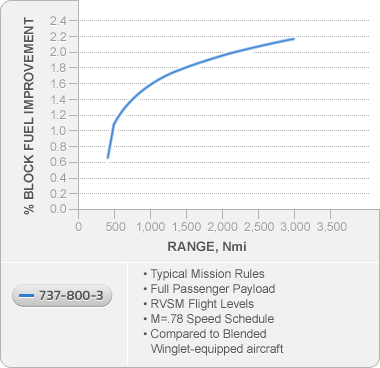
The Scimitar provides additional fuel burn savings over the blended winglet, also created by APB. The blended winglet has been retrofitted to most Boeing 737NGs, some Classics and some Boeing 757s and 767-300ERs.
Boeing has adopted a split winglet for the 737 MAX, but of its own design, which is similar in look to the APB Scimitar. APB’s cost for the Scimitar is a list price of $545,000 for the 737-800-3, a designation for the Scimitary-equipped 737-800.
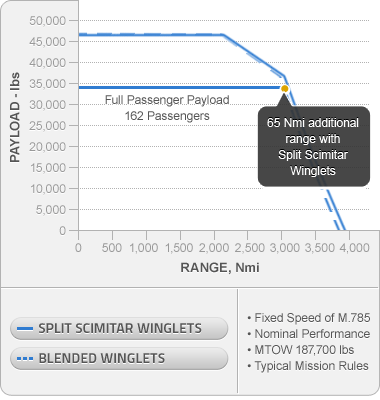
Range increase in nominal over the blended winglet, according to APB.
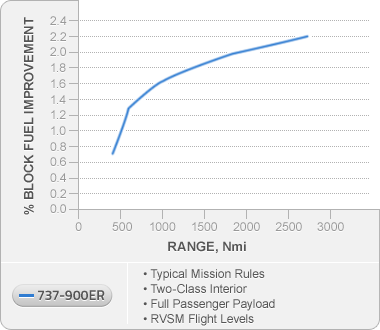
Here are APB’s charts showing the advantage of the Scimitar over the blended winglets:
737-800-3
.
.
737-900ER
.

Future for the 777, A330 as 777X nears launch, A350 nears EIS
With the launch of the Boeing 777X expected to be approved this month by the Boeing Board of Directors, followed by the public launch at the Dubai Air Show next month, the future sales of the in-production 777 will be closely watched by the industry as well as by Boeing itself.
It is conventional wisdom that sales will fall off as entry-into-service nears for the 777-9X, said to be “late this decade” by Boeing but more likely 2020 or even 2021, according to customers.
Sales of the Airbus A320ceo and Boeing 737NG families have, so far, held up surprisingly well despite the launch in 2010 of the A320neo and in 2011 of the 737 MAX families. Most of the neo and MAX orders have been combined with the current generation aircraft. This has been viewed as a way to keep the production lines full in advance of the EIS of the new airplanes.
Further, Airbus and Boeing plan an overlap of production of the two generations of about two years. This contrasts with Boeing’s decision to cease production of the 737-300/400/500 concurrent with the launch of production of the 737NG, a move Boeing today says was an arbitrary choice.
Boeing plans to begin building the MAX on a third line in its primary Renton (WA) factory before phasing out the NG. Airbus hasn’t specified how it plans to integrate the production of the ceo and neo.
What will happen for the current Airbus A330 and Boeing 777 lines as the A350 and 777X come on line?