
Leeham News and Analysis
There's more to real news than a news release.



Pontifications: Airbus grows in China while Boeing remains on the sidelines

By Scott Hamilton
April 11, 2023, © Leeham News: Airbus last week firmed up an order for 150 A320neos and 10 A350-900s with China. The deal was announced last year.
Additionally, Airbus and the Chinese government agreed to add to the A320 family assembly site in Tianjin, increasing the capacity of the plant. This will be another step in Airbus’ goal to achieve a production rate of 75 per month by 2026 for the A320 family.
And that’s not all. Airbus and the China National Aviation Fuel Group (CNAF) signed a Memorandum of Understanding to increase the development of Sustainable Aviation Fuel.
Meanwhile, Boeing remains essentially frozen out of China. Deliveries of the 737 MAX remain stalled. Although China Southern Airlines outlined expected deliveries this year and through the next few years, we’ve seen this sort of thing before. Until an official announcement comes from Beijing authorizing deliveries, or some of the stored airplanes are delivered, words are just words.
That said, there are some solid indications we’re seeing that Boeing deliveries to China may well resume in the not-too-distant future, but on a glacial pace. The financial viability of some airlines within China, while opaque to outsiders, is monitored by the CAAC, China’s regulator. Some airlines are deemed too financially risky now to accept delivery of any new aircraft, whether the OEM is Boeing or Airbus.
While Boeing’s 140 MAXes originally ordered by China remained in a Twilight Zone of sorts, delivery of some Airbus A320neos also has been blocked. Generally, though, Airbus continues to tender airplanes and win orders while Boeing sits on the sidelines.
MCAS, The Aircraft Certification Act and the unintended consequences of Congressional Intervention
Third in a Series
Subscription Required
By the Leeham News team

Boeing whistle blower Ed Pierson testified about issues surrounding the 737 MAX following the two crashes that killed 346 people. New York Times photo.
April 10, 2023, © Leeham News: Action by the US Congress following the Boeing 737 MAX crisis resulted in a host of new laws intended to fix shortcomings in regulations that contributed to the crisis. Sections in the legislation involved safety reporting and Whistle Blower protections. The Act provides for the establishment of Safety Management Systems.
But as we’ve seen in our series, there have been shortcomings in the legislation. These sections are no different.
Bjorn’s Corner: New aircraft technologies. Part 7. Propulsion

By Bjorn Fehrm
April 7, 2023, ©. Leeham News: This is a summary of the article New aircraft technologies. Part 7P. Propulsion. The article discusses how developments in the next-generation airliner propulsion system will be the second most important area for improved efficiency and lower emissions after we have decided on the fuselage type.
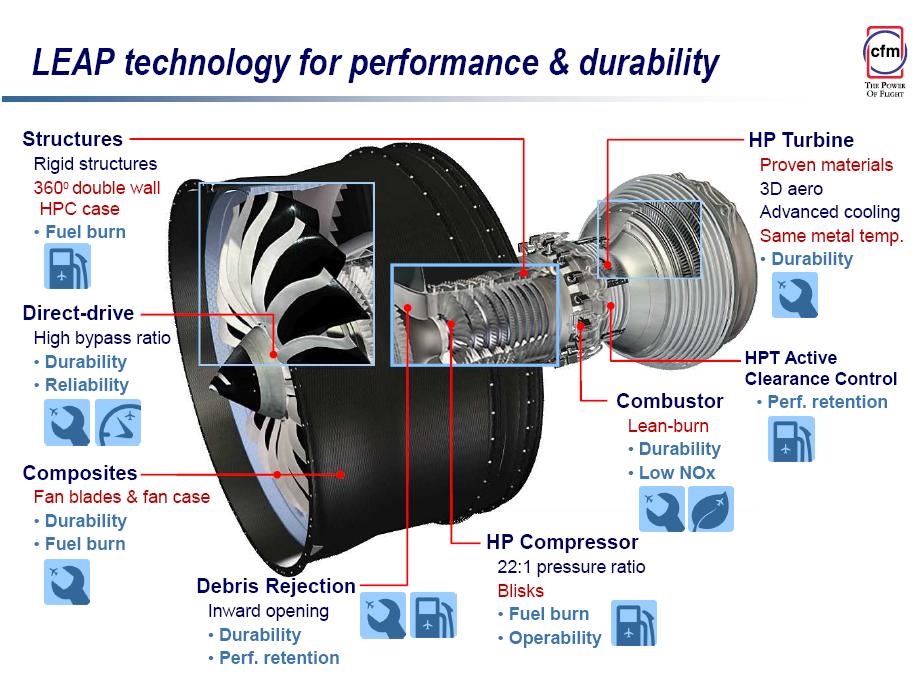
Figure 1. The CFM LEAP engine gained 15% efficiency compared to the engine it replaced, the CFM56. Source: CFM.
Bjorn’s Corner: New aircraft technologies. Part 7P. Propulsion
Subscription required
By Bjorn Fehrm
April 7, 2023, ©. Leeham News: This is a complementary article to Part 7. Propulsion. It discusses in detail the next-generation propulsion systems and what to expect from their possible increase in performance and efficiency.
The production cost trap for upstarts
Subscription Required
By Bjorn Fehrm
April 6, 2023, © Leeham News: The last five years have been among the busiest in aeronautical history, with announcements of new aircraft and VTOLs based on greener propulsion technologies. The public focus has been on the hurdle for these projects to achieve regulator certification, how long this will take, and how much it will cost. We have hundreds of experts publishing articles on the subject.
But there is another hurdle as large as certification for these projects: the initial production cost. It’s just that the knowledge about this more difficult-to-understand phase is poor among the experts. But, looking at history, the majority of new airliner entrants die during early production, not during development.
Why? We use our production cost model to explain.

Figure 1. Heart Aerospace ES-30; a typical startup project. Source: Heart Aerospace.
Summary:
• Startup projects fight to get the investments for development.
• Little do they know this is only halfway to success.
Pontifications: New GAO report shows how aviation industry repeatedly failed to meet eco-aviation goals
By Scott Hamilton
April 4, 2023, © Leeham News: A new study by the US Government Accountability Office (GAO) makes clear how the US airline industry effort has been anemic in reducing emissions over the last 20 years.
In fact, despite all the rhetoric and genuine efforts in certain elements of commercial aviation, it might be fair to say that the airline industry’s effort overall has been pathetic.
Despite all the fanfare in 2021 when the International Air Transport Association (IATA) adopted a resolution with goals to decarbonize, that resolution was little more than regurgitating previous, similar goals. The same goes for the goals adopted by the International Civil Aviation Organization (ICAO) shortly after IATA.
I’ll explain below. Suffice it to say that when Tim Clark, the president of Emirates Airline, told the 2021 IATA conference, “Don’t make promises you can’t keep,” he wasn’t whistling past the graveyard.
The GAO report, Sustainable Aviation Fuel, is an unintentional indictment of just how pathetic commercial aviation has been in setting and failing to meet goal after goal, after goal.
Despite tripling the production in 2022 of Sustainable Aviation Fuel (SAF) compared with 2021, use by US airlines barely moved the needle. Even though airline use also tripled, SAF still represented marginally less than 0.1% of aviation fuel.
A goal set in 2007 called for 10% of fuel used would be SAF by 2017.
Examining the FAA’s Organization Designation Authority (ODA)
Part 2 of a Series
Subscription Required
By the Leeham News Team
April 3, 2023, © Leeham News: Organization Designation Authorization (ODA) has been a critical relationship between Boeing and the Federal Aviation Administration. In the wake of the 737 MAX crisis, the FAA rescinded Boeing’s ODA. It was restored, but the FAA retains oversight.
The absence of ODAs continues to slow Boeing’s return to normalcy.
ODA: What is it, why it exists, and what is changing?
Long ago, when aircraft were far simpler than today, FAA inspectors would validate the airworthiness of products using well-defined existing bodies of knowledge. FAA engineers
could use sheet metal skills and their electrical and mechanical engineering backgrounds to monitor and assist in the certification of more and more complex products.
With the birth of the jet age, aerodynamics became much more complex and software was applied to airframes in the form of advanced avionics and fly-by-wire flight control programming.
The industry started to outpace the skills of the regulators and it got even more complex with the advent of composite structures. Things that weren’t on the radar of the regulations—and the regulators–became important as time went by.
Flammability standards for cabin and cockpit materials created a huge need for oversight. So did the increased cockpit automation and how the human interfaced with the machine.
The FAA fell behind, for a couple of reasons.
Bjorn’s Corner: New aircraft technologies. Part 6. Fuselage manufacturing
By Bjorn Fehrm
March 31, 2023, ©. Leeham News: This is a summary of the article New aircraft technologies. Part 6P. Fuselage manufacturing. The article discusses how a non-circular cross-section drives material use towards composites and the difficulties of manufacturing aeronautical composite structures in high volumes.
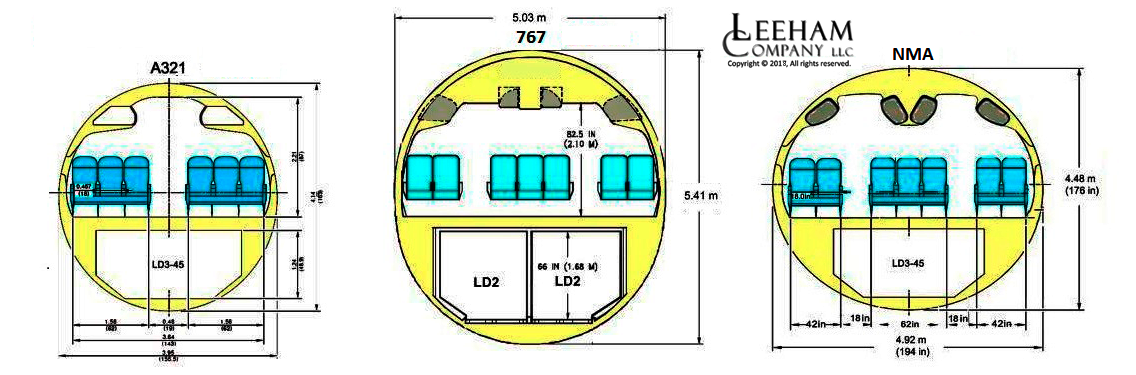
Figure 1. The elliptical NMA cross-section compared with A321 and 767 cross-sections. Source: Leeham Co.
Read more
Bjorn’s Corner: New aircraft technologies. Part 6P. Fuselage manufacturing
Subscription required
By Bjorn Fehrm
March 31, 2023, ©. Leeham News: This is a complementary article to Part 6. Fuselage manufacturing. It discusses in detail how to manufacture a non-circular fuselage that avoids fatigue problems.
MCAS, The Aircraft Certification Act and the unintended consequences of Congressional Intervention
First in a Series of Articles
Subscription Required
By the Leeham News team
March 30, 2023, © Leeham News: Boeing is suffering delays getting the 737-7, 737-10, and 777X certifications completed.
Airbus delayed the certification of the A321XLR over the design of its integral fuel tank. Boeing has gotten the brunt of the blame for its delays, a stance not without some merit. Airbus is fully responsible for the design and integration of the XLR fuel tank. But, unlike Boeing, less has been said about the certification delays of the XLR than the Boeing aircraft.
These delays may not be completely the fault of the manufacturers.
A brief history. We know that two 737 MAXes were lost due to the Maneuvering Characteristics Augmentation System (MCAS) overpowering the flight crew’s ability to hand fly the airplane, although there were contributing factors. Congress got involved and demanded that the industry refocus on the safety of the flying public. The end result was the creation and passage of the Aircraft Certification, Safety and Accountability Act (ACSAA). This legislation mandated changes to how the Federal Aviation Administration oversees the manufacture of Transport Category Aircraft and set timelines for implementation.
We also need to remember that the industry is much larger than Boeing and Airbus. All manufacturers from those building agricultural aircraft and piston-powered helicopters and bizjets all the way through to Large Tier 1 subcontractors such as Spirit Aerospace and avionics manufacturers must respond to these changes. The Act affects everybody.
The addition of EICAS
We have seen references to the act and how it set a timeline for a monitoring program called Engine Indicating and Crew Alerting System, or EICAS, and its implementation. A deadline of last December was included in the ACSAA, adopted two years before. The inclusion of EICAS was adopted on the assumption Boeing would certify the MAX 7 and MAX 10 before the deadline. Exempting these two MAXes at the time was approved because the MAX 8 and MAX 9 were already certified without EICAS, and cockpit commonality was considered important among the four types.
But Boeing was unable to complete certification of the MAX 7 and MAX 10 in time. Steeped in controversy, Congress in January continued the exemption to September this year.
Certification by the deadline of the MAX 10, the last in the family, was always deemed a challenge because the -10 hadn’t entered flight testing at the time of the legislation’s approval. But the MAX 7 was well into its flight testing. People couldn’t understand why Boeing was unable to certify the MAX 7 before the end of last year.
An analysis by LNA lifts the veil on this mystery.