
Leeham News and Analysis
There's more to real news than a news release.


Airbus adds emphasis for A220 to regional airlines; adding high-density version
Subscription Required
By Scott Hamilton
 Jan. 6, 2026, © Leeham News: Airbus is tweaking the marketing messaging for the A220 to boost sales for regional airline operations.
Marketing for the A220 began as the C Series when Bombardier launched the program in 2008. Bombardier positioned the 100-seat CS100 as a replacement for the Airbus A318 and Boeing 737-500/600. The 130-seat CS300 was designed to replace the Airbus A319 and Boeing 737-700. The Airbus and Boeing airplanes are considered mainline aircraft as opposed to regional airliners.

The A220-100 is a “necessary” part of the family, Airbus says. Credit: Airbus.
Bombardier also design a larger CS500, but didn’t launch the program. The CS500 would be a direct competitor to the A320 and 737-800/8.
Airbus continued this marketing approach when it agreed to purchase control of the C Series program in 2017, renaming it the A220-100 and A220-300. Airbus says it’s a matter of when, not if, it will proceed with the A220-500.
However, at an event hosted by the European Regional Airlines Association, Airbus told regional carriers the A220 is a choice airplane for them if they have ambitions to spread their wings, so to speak.
Benjamin Peiron, VP Single Aisle Marketing for Airbus, told LNA in an interview last month that this message didn’t represent a shift in marketing strategy. “It’s more focused, I would say. If we look at the operator base of A220, it’s about half composed of legacy carriers, [like] Air France, Delta, Air Canada. About one third is from so-called regional airlines, whatever the exact definition is. The rest is hybrid low-cost or equivalent.”
European Regionals Face Hostile Operating Environment
Subscription Required
By Kathryn B. Creedy
Third in a Series. Previous articles:
- The future of regional jets is limited by choices, Scope Clause
- US Regional Consolidation Began Before Covid
Introduction
Aug. 31, 2020, (c) Leeham News: European regionals face far greater challenges than Covid and, sadly, much of what is happening to the industry is beyond its control. The result is similar to failures seen in the U.S. Flybe’s recent loss resulted from pre-Covid problems which also led to the pre-Covid failures of such airlines as Flybmi and Cobalt.
The failures illustrate, however, the three reasons why European regionals are so fragile – low-cost competition, geography, and challenging government policy.
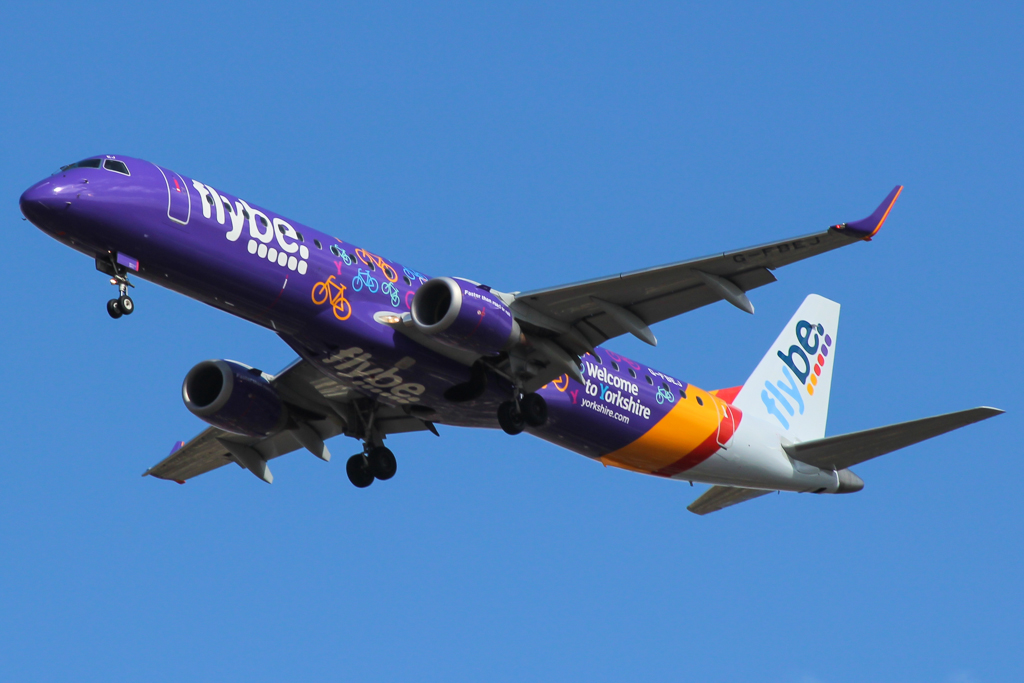
Flybe is just the latest of many regionals to cease operations owing to harsh conditions in Europe.
Summary
- Government Policies Hardest on Regionals
- LCC Competition Challenging
- Consumer Protections Crushing
- Turboprops Have Large Role