
Leeham News and Analysis
There's more to real news than a news release.



PW Media Day 1: next gen GTF to cut fuel costs 10%-15% over today’s GTF
We’re at the Pratt & Whitney media days today and tomorrow. This is the Technology at PW panel. Participants are:
Alan Epstein, engineer and moderator. (AE)
Michael Winter, chief technologists (MW)
Graham Webb, MRJ, CSeries and EJet engines. (GW)
Jimmy Kenyon, advanced military programs. (JK)
All information is paraphrased.
GW: At $4/gal, over 60% of cost to an airline is for fuel. Engines must cut these costs. A380 and 787 consume less than 3 liters per passenger, about that of a compact car.
GTF is certified [on CSeries]. GTF now on five airframes with 12 sub-types. The engine reduces fuel and maintenance costs, reduced emissions. Fuel savings now demonstrated at 16% less than today’s engines.
Next generation of GTF will further reduce fuel burn by 10%-15%.
MW: The noise footprint will stay predominately within the airport boundaries, using 2,000 fewer foils, about half of our competitor’s engine. Emissions are about 50% below current regulations and working with NASA toward 88% below current levels.
Current bypass ratio about 13:1 and currently testing with NASA 15:1 and 18:1.
375% improvement in efficiency since the days of the Whittle jet engine.
We have the most advanced cooling system in the industry and we are exploring inserting advanced materials into the engines when there is real benefit to the customer.
JK: We’re seen similar trends to improve efficiency in military as with commercial. The Department of Defense is the biggest user of energy in the country, with about 80% in engines.
The military has seen really tight budgets in recent years. There is more than just a cost issue, it’s also an energy security issue (Iraq, Afghanistan challenges). There is a real interest in cutting energy usage and aviation being such a large part, it is a natural place to look.
The strategy considers places where you have to fly farther and/or stay on station longer. We’re working on technology to provide fuel management and efficiency to reduce costs, fly father and stay on station longer.
We’re working with USAF to obtain 25% improvement in fuel efficiency on next engines, and with Navy to also improve efficiency, and leveraging work in the commercial arena to improve thermal efficiency.
AE: Are you a one-trick pony? What have you got besides the gear?
GW: We have advanced fan module, bringing forward light weight fan cases, the next generation combustor, advanced core, state-of-the-art high pressure turbine and high speed low pressure turbine, all of which designed for the very high speeds. There are control system enhancements, working on next gen of the fan-drive gear system, short inlets for enhanced efficiency.
ILA Berlin Air Show begins tomorrow
The ILA Berlin Air Show begins tomorrow. The Air Show is a poor cousin to the Farnborough Air Show (July this year) and the Paris Air Show (in odd-numbered years). We went to this show in 2006 and were more excited about returning to Berlin for the first time since before the Berlin Wall came down than we were about going to the event itself.
Boeing doesn’t place much stock in the show since it is viewed as an Airbus star vehicle. Best we can tell from the ILA website, Boeing isn’t even an exhibitor.
Airbus tries to have some major announcements for the show, although Farnborough and Paris–being the bigger draws and having greater international prestige–are clearly the favored forum.
What might Airbus announce at the Berlin show, other than a few orders? The aviation world is waiting and watching for what Airbus will do about the A330neo and, with it, the future of the A350-800. Airbus is sending the A350-900 to the Air Show for the first time–will this be the place Airbus puts the nail in the coffin of the A35-800? We have our doubts about that.
Could Airbus launch the A330neo at the ILA? We received an email over the weekend that an announcement could be forthcoming at this show, but the source is from outside Airbus (though information from this source is usually reliable). Expectations for the A330neo have centered on Farnborough, however. Our Market Intelligence tells us few potential customers have actually seen proposals from Airbus on the A330neo as yet, so we think it might be a bit premature to have a launch of the program. Information is also that Airbus has been looking at the “second half” of 2014 to make a decision (at least publicly). May isn’t in the second half–but July is.
Other than this suspense, if you can call it that, we don’t expect much out of ILA this week.
EU may challenge 777X tax breaks from Washington State
Reuters is reporting that the European Union may challenge the $8.7bn in tax breaks Washington legislators voted to grant Boeing in return for locating assembly of the 777X and its wing in the state.
Readers know we worried about this when the Legislature voted for these in a hurry-up session. We were blown off by the state and even the mainstream media in raising these concerns.
State officials asserted at the time that the State was merely “extending” the 2003 tax breaks voted for the 787, totaling $3.2bn, for the 777X. The 787 tax breaks had been ruled illegal by the World Trade Organization, and state officials brushed this aside saying the ruling was under appeal.
We found this to be an astounding position, particularly considering that Gov. Jay Inslee, as a Congressman, demanded that the WTO findings of illegal tax breaks to Airbus be considered during the KC-X USAF tanker competition, despite a pending appeal.
In the Reuters story, Tim Hepher writes:
Boeing said tax decisions by Washington were meant for the whole industry in the state, including some Airbus suppliers, and have been designed to comply with WTO rulings.
“The $8.7 billion figure that’s mentioned is the state’s estimate of the total value of its incentives for the entire commercial aerospace industry over 16 years,” Boeing spokesman Charlie Miller said. “The benefit to Boeing will only be a fraction of that amount.”
The first statement is certainly true. We’re a bit flabbergasted by Miller’s claim that Boeing will receive only a “fraction” of the tax breaks.
The tax breaks have come under much after-the-fact criticism when Boeing announced that more engineering jobs would be moved out of state. Critics of the tax breaks noted that there had been no job guarantee provisions in the Legislation, freeing Boeing to move jobs–and it is doing just that.
Although Boeing hasn’t said how many jobs will be associated with the 777X in Washington, it’s clear that more automation and robotics will be used on the X than on the 777 Classic.
Odds and Ends: Gooney Bird; UAV helicopter
Gooney Bird: Britain’s The Economist has an interesting look back at The Gooney Bird, one of the affectionate names of the Douglas DC-3.
Any aviation enthusiast knows the DC-3 has a unique place in history, a description that is often over-used but which is true in this case. The feats, particularly during World War II, are legendary. The plane has been withdrawn from service in all of Europe (the article explains why) but remains in operation elsewhere in the world, including here in the United States.
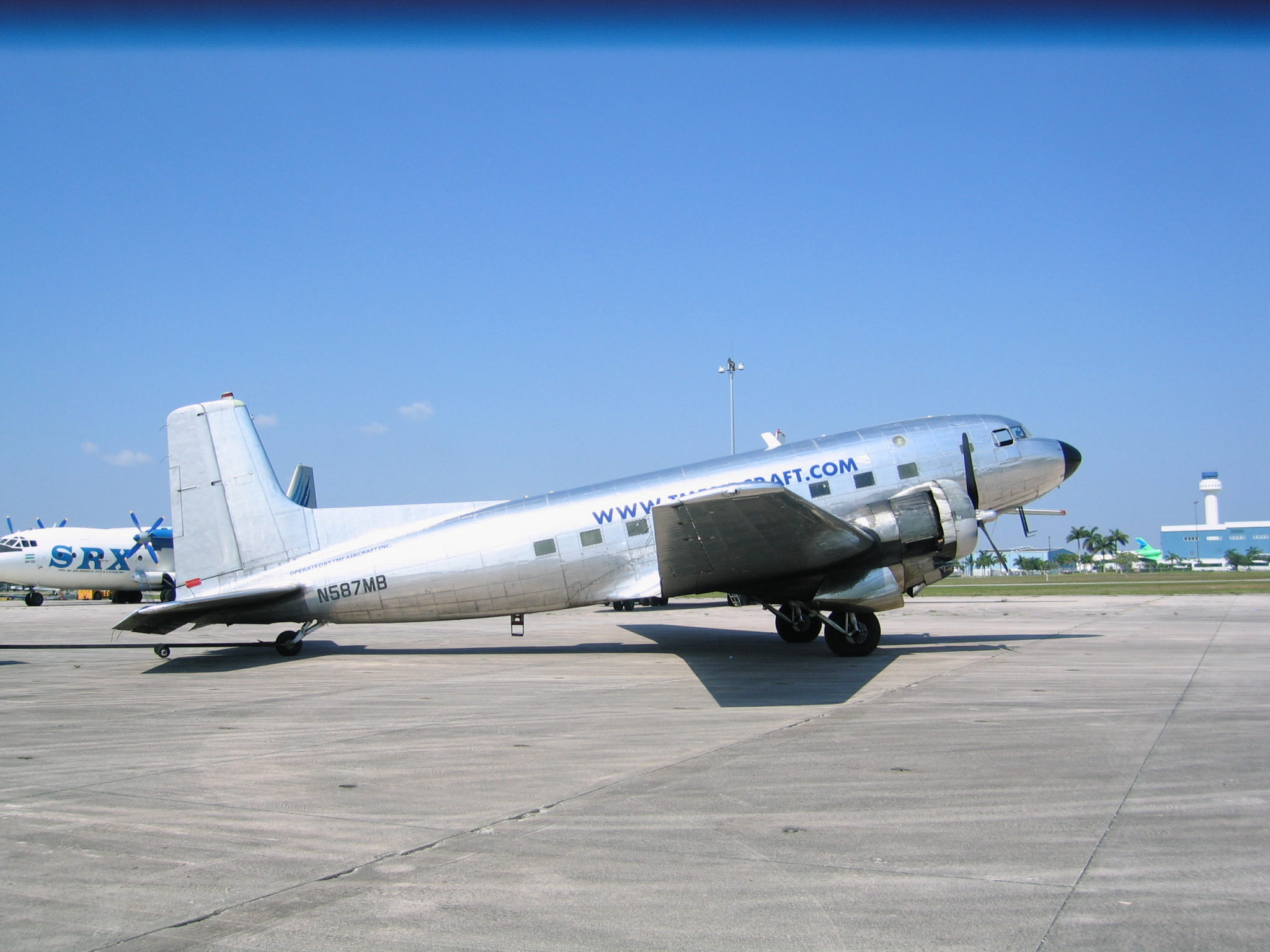
A Super DC-3 at Opa Locka Airport in Miami in 2011, still in use then. Photo by Scott Hamilton
After WW II, Douglas tried to breath new life into the airplane, creating the Super DC-3, with a square tail, wheel covers, a small fuselage stretch and more powerful engines. Capital Airlines bought a small number (three, if memory serves) but with cheap, surplus DC-3s left over from the War and modern competitors in the form of the Convair 240 and Martin 202, airline sales were a bust. The Navy bought a fair number.
Unmanned Helicopter: Sikorsky has entered the unmanned helicopter business to provide the military with heavy lift capability at no risk to the troops.
Airbus Group beats expections for first quarter results
Airbus Group beat expectations for its first quarter profit. Continuing research and development costs weighed on earnings before one-time charges. Earnings before interest and the charges were actually down slightly vs 2013 but were better than expectations.
Group still expects the A350 to enter service with Qatar Airways late this year. According to Ascend, there will be one airplane delivered in December (at one time we thought it would slip to January, so we may not be far off). Group continues to call the A350 program “challenging” and notes there could be more charges against earnings. Under European rules, Airbus writes off charges as they occur rather than using Boeing’s program accounting method that spreads charges across hundreds of airplanes.
Cash declined nearly 1bn euros year-over-year to 13.1bn euros.
Links to the PPT presentation and financial statements may be found here.
Separately:
- Philippine Airlines is retiring its Boeing 747-400 fleet, replacing it with the 777-300ER.
- Virgin America beat Southwest Airlines for two gates at Dallas Love Field. The gates were leased to American Airlines, which had to give them up as a condition of its merger with US Airways.
Update, 0800 PDT:
- The prospect of an A330neo continues to gain momentum. Aeroturbopower has this recap from the Air Lease Corp earnings call. Boeing delivers its last passenger 767-300ER this week to Air Astana. Flight Global has this analysis, including thoughts on the A330neo. More intriguing is the possibility of the 767-300ER replacing the aging, and out-of-production, 757. Bloomberg News has this story about the A330neo, originating from the Airbus Group earnings call.