
Leeham News and Analysis
There's more to real news than a news release.


737 MAX vs A320neo: the debate continues
During yesterday’s tele-press conference by Boeing with a program update for the 737 MAX, 737 chief program engineer John Hamilton frequently said the MAX has a 7% operating cost advantage over the A320neo.
He also touted the advantages of the 737-900ER over the A321, with the obvious implications that the 737-9 MAX will have an advantage over the A321neo.
Here is a recap by the Puget Sound Business Journal (there are many others which may be found through Google News).
AirInsight, our affiliate, has written several pieces of the 737NG and 737 MAX vs the A320 family, both legacy and NEO.
See the following articles for additional color on this debate.
737 MAX ‘commitments’ and what these mean
Note: As a follow up to our previous post about the 787 break-even, Blog by Javier added a third post to simplify his very detailed analysis. You may jump to the link here.
Also: AirInsight has this commentary on the MAX.
Boeing today (Nov. 3) announced it now has more than 600 commitments for the 737 MAX, as well as confirming the 68 inch fan selection and discussed some other issues related to MAX.
Our immediately preceding post synopsized Jim Albaugh’s presentation to Goldman Sachs. Shortly after this, Boeing offered up to the media a tele-press conference with John Hamilton, 737 chief program engineer, to update the status.
One of the things he also referred to was the 600+ commitments by eight airlines for the MAX. Based on questions from the media, focusing on when “commitments” become “orders,” we thought it might be useful for the Reader to discuss this.
Albaugh announces more than 600 commitments for 737 MAX
At an appearance with Goldman Sachs today, Jim Albaugh, CEO of Boeing Commercial Airplanes, announced there are now more than 600 commitments for the 737 MAX.
- Announced what we reported weeks ago: Boeing selected 68 inch fan for CFM Leap 1B. Also talking to CFM about a custom core for the engine.
- Striving for an EIS earlier date than 2017.
- Doesn’t want team to use “simple” and “re-engine” in the same sentence, but wants to minimize changes.
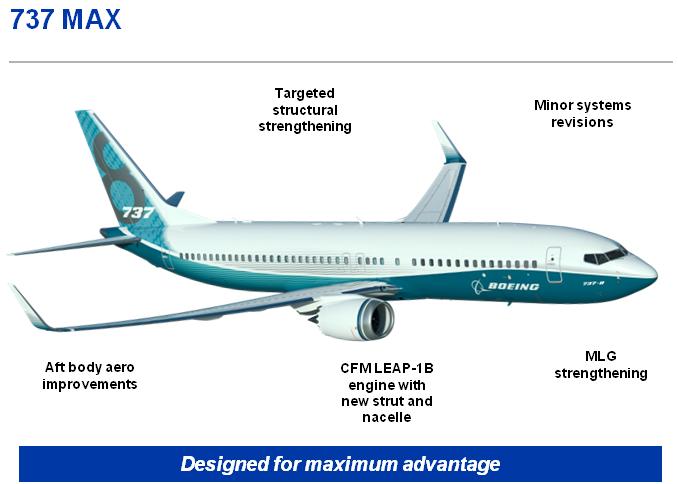
Boeing slide from Goldman Sachs investors’ conference Nov. 3, 2011
- I want to be more responsive to customers we have [by increasing rate]. We drive customers to competitors if we don’t have availability.
- We certainly over-promised and under-delivered on 787. The composites are coming together very well. I’m not going to tell you getting up to rate won’t be a challenge. Biggest challenge is in Charleston. It’s month-by-month. I see a very detailed dashboard on supply chain.
- We have brought a lot of 787 work back in-house. We have 500 engineers who have nothing to do but to drill down…and manage our suppliers as if they were in our factory.
- Final assembly won’t be in quite three days, as originally promoted. But we are pleased we now own Charleston because we have control over it. If we didn’t we wouldn’t be as far along as we are today.
- I’d be getting ahead of myself if we are going to do the Dash-10, but I think we will. It won’t have the range but it will have the value.
PW gains major wins in Rolls-Royce deals
Here are some additional thoughts about the Rolls-Royce/Pratt & Whitney deal announced yesterday.
PW is a real winner in this set of transactions.
- Buying RR out of the International Aero Engines partnership gives PW far more latitude in making deals for the V2500 engines and the ability to connect V2500 transactions to transitions to Geared TurboFan orders. RR had no incentives to make connected deals, since there was nothing in it for them if a customer ordered the GTF instead of the V2500. CFM had the competitive advantage in offering the CFM56 for legacy airplanes and the LEAP for the A320neo. With PW now controlling the V2500 partnership, PW has come closer to leveling the playing field. Read more
Rolls-Royce, PW join forces for 120-230 seat engine–and to focus on GTF technology
It is a stunning announcement. Not so much the buyout of Rolls-Royce by Pratt & Whitney from the International Aero Engines partnership. This has been expected for more than a year.
What’s stunning in the new partnership RR and PW announced to develop engines in the 120-230 seat market and to focus on Geared Turbo Fan technology.
AirInsight has a commentary on the tie-up.
This is a major shift in the engine competition and a major endorsement of the GTF engine and techn0logy, creating a more formidable competitor to the dominate CFM International.
We’ll have more to say after we digest this a bit and talk with the market.
It’s official: 737NE launched
Here is Flight Global’s story with a couple of artist renderings of the airplane.
Boeing made it official this morning: launch of the 737NE (New Engine) has been approved, bypassing the Authority to Offer.
Boeing said it has commitments for 496 NEs from five airlines. Only American Airlines has been announced, for 100. We expect Southwest Airlines to be another. Delta Air Lines’ order for 100 737-900ERs did not include conversion rights.
Boeing claims the 737NE will be 7% more efficient operating costs than the A320neo, but in its announcement today did not detail how. Boeing also says the 737NE will have 16% lower fuel burn than today’s A320 and 4% lower than the neo.
737RE up at Boeing Board today
Update, 930am: The Daily Express of L0ndon (of all places) reported yesterday BCA got the approval Friday for the 737RE and that the announcement is to come today. Thanks to Heidi Wood of Morgan Stanley for this one.
Original Post:
Approval for Authority to Offer the 737 re-engine is expected to come from the Boeing Board of Directors today, according to sources.
Last Friday we published our story reporting this in Commercial Aviation Online in London and, per our arrangement with CAO, the following day on this site.
Bloomberg News published this story later on Friday also confirming ATO was expected.
Official launch of the airplane isn’t expected until fall, likely after the October Board meeting, predicts Credit Suisse.
Full design definition of the 737RE isn’t expected until next month, we are told. While it is widely expected that the CFM LEAP engine will have a 66-inch fan in order to avoid any changes to the landing gear that would complicate the work statement, as of today this isn’t definitively settled. A 68 inch fan is still a possibility, though it’s considered more remote.