
Leeham News and Analysis
There's more to real news than a news release.


Putting the MH370 search in perspective–literally
The search area for Malaysian Airlines Flight MH370 now encompasses an area the size of Oregon. So we pulled it up on Google Earth and marked the Portland International Airport. You can’t see the airport let alone a Boeing 777. This illustrates the task at hand.
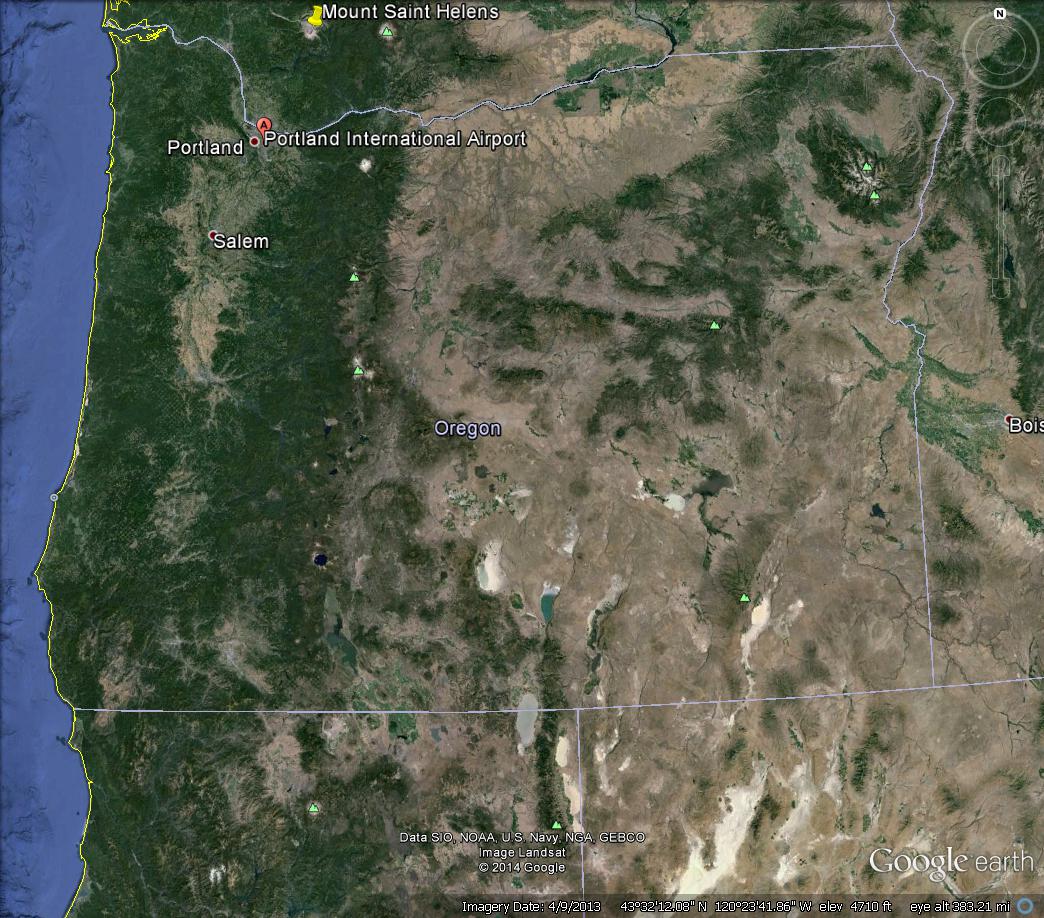
Then we zoomed in on PDX Airport, though we don’t know what “altitude” this represents; we’re not smart enough to take a measurement of the airplanes (a known size) and extrapolate to compute the altitude–we’re sure some of our readers are.
Read the Comment from Andrew about the altitude (and our response).
Odds and Ends: No butts about it; 737 Norway to Houston; MH370
No butts about it: Flight Global has this story (free registration required) about the Airbus campaign for an international seat width standard. But while Airbus is touting comfort, it’s now promoting five abreast in the center section of its A380 economy section, reducing the 18.5 inch seating to 18 inches. The London Telegraph has this story on seat width and other stuff related to the increasingly crowded cabins.
737 Norway to Houston: No, this isn’t a type. The USA Today explains.
Tossing a lawsuit: An Illinois judge tossed the first lawsuit filed in connection with Malaysian Airlines Fight MH370 and threatened sanctions on the law firm that filed it.
And this has become indicative of CNN’s breathless, sometimes ridiculous coverage of MH370:

While Greg Feith thinks a probable cause of MH370’s disappearance may not be solved, another former NTSB member has a different opinion. John Goglia, however, was a board member, not an investigator, although he was a US Airways accident investigator.
MH370 wreckage, probable cause may never be found, says ex-NTSB investigator
During the three weeks since Malaysian Airlines Flight MH370 disappeared, “talking heads” (including our own) have become a staple on the news and cable 
Source: Aviation Week
shows. The trouble with talking heads is that short sound bites don’t really allow us to take a deep dive into the issues.
We arranged to have an extended interview with Greg Feith, a former investigator for the National Transportation Safety Board and today a consultant for private industry and another of the talking heads. Feith investigated two accidents that may have particular relevance to MH370: the pilot-suicide crashes of Egyptair 990 and a Silk Air 737 in Indonesia. He’s familiar with the national cultures involved and events leading to conclusions of these two previous incidents. Feith early in the MH370 events concluded this incident has its roots in the cockpit of the Boeing 777.
He’s appeared throughout the MH370 search on CNN and NBC, among other places. Here is our interview with Feith.
A former lead crash investigator for the US National Transportation Safety Board (NTSB) doesn’t believe the wreckage of Malaysian Airlines Flight MH370 will ever be found—and with it, the data recorded on the black boxes will be lost to the investigation.
“I hope I am wrong but I personally don’t believe we will ever find the wreckage. I think we will find pieces that drifted,” Greg Feith, the investigator, said in an exclusive interview with Leeham News and Comment.
Sequence of Events of MH370 and the probabilities
The mystery of Malaysian Airlines Flight MH370 continues, as the search area today shifted nearly 700 miles to the northeast following continued analysis of known data of the flight.
Investigative focus also is on the pilot of the flight, while others continue to support mechanical, fire or depressurization theories.
We felt from the second day this was a criminal act of some kind, not some issue with the airplane. The information, we felt, clearly pointed to movements of the airplane as a result of someone in command control of the Boeing 777.
We put together this sequence of events that, to us and apparently also to investigators, that we believe points to no other explanation but human intervention.
Filling the production gap for A330 and 777 Classic: huge challenge ahead
Two orders were announced this week for the Airbus A330 and Boeing 777-300ER, important for filling the production gaps of each airplane. In the aggregate, the current backlogs go through 2016, though in reality, they stream beyond that date. See our charts below.
Airbus announced an order for 27 A330s from China, but these were the airplanes long frozen in the push-back by China against Europe in the emissions trading scheme objected to by China and a number of other countries. China routinely freezes airplane orders (among other commercial deals) to express its political displeasure.
At current production rates for the A330 or 10/mo, this adds 2.7 months to the Airbus backlog, but offset with deliveries, the aggregate backlog (i.e., if all deliveries were bunched together) means the backlog ends in 2016. With the Chinese order, Airbus announced 31 sales year-to-date.
Large debris field spotted in MH370 search–is it from the airplane?
A large debris field has been spotted in the search for Malaysian Airlines flight MH370. A satellite from Airbus Defence and Space photographed 122 large and small pieces of something. Searchers are en route to eyeball and recover this to determine if the debris is from the plane.
We plotted the location and created this image to further illustrate the remoteness of the location. This is at the edge of the potential search zone we plotted shortly after the airplane disappeared.
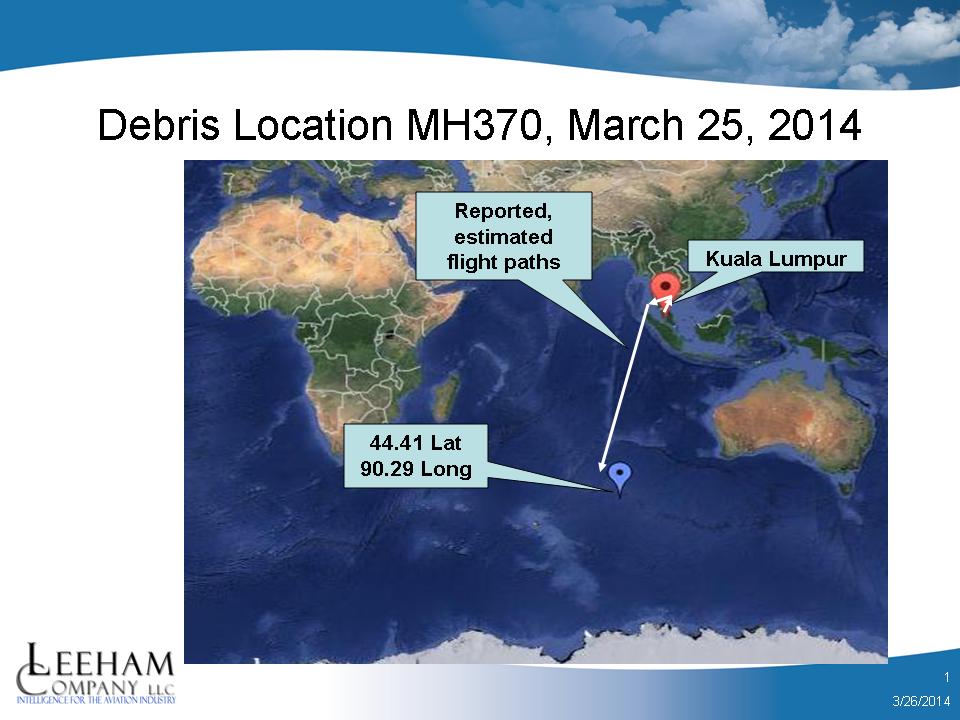
We also added the reported and estimated flight paths, though we were unable on this scale to include the several reported turns within the Strait of Malacca area. There are distinct turns from the intended flight path (and several more within the Strait of Malacca that were reported) which, to us, indicates a pilot-in-command of some kind, rather than a “ghost” airplane.
As we linked yesterday, former pilot John Nance believes a criminal act took illegal command of the airplane and then once on the southward tract put the plane on auto-pilot and then depressurized the airplane, killing all on board. The Boeing 777 then flew south to fuel exhaustion.
Odds and Ends: MH370 tracking; Garuda rules out A380, 747-8; last 747-400 flight; E-Jet vs Turbo-props
MH370 tracking: With Britain’s Immarsat and the Air Accident Investigation Board key to determining the general location of Malaysian Airlines Flight MH370, The London Telegraph has one of the best narratives of of the behind-the-scenes story of how this came about. The London Independent also has a good story. And here is a story that explains the difficulties of searching in remote oceans.
- Update, 10:30am PDT: Aviation analyst and former pilot John Nance is profiled in this Puget Sound Business Journal account that includes’ Nance’s theory of MH370. It’s an intriguing theory. He believes this was a deliberate act–either terrorism or murder-suicide–and that once the flight settled out southbound from Malaysia, it was set on auto-pilot and all aboard, including the pilot, were killed by asphyxiation. The airplane flew until it ran out of fuel and crashed into the Indian Ocean; he even gives a speed and angle-of-attack estimate.
Garuda rules out A380, 747-8: The Australian reports that after planning to order either the Airbus A380 or Boeing 747-8 last year, officials have ruled this out.
Last 747-400 flight: Japan’s All Nippon Airlines plans to complete its last Boeing 747-400 flight this month, ending an iconic era in the country where 747s once ruled the skies.
E-Jet vs Turbo-Props: At the ISTAT conference last week, we reported that Embraer says its E-175 E2 is more efficient than similarly sized turbo props on missions of more than 250 miles. This story in The Economic Times of India follows through on this theme.
Caution on recovering data from MH370 FDR, CVR
With the news that the Malaysian authorities announced that Malaysian Airlines flight MH370 ended in the Southern Indian Ocean, and the US Navy is sending a “pinger locator” there to look for the black boxes, we need to raise some caution about assumptions that these will reveal all there is to know about what happened on the flight.
The flight data recorder (FDR) and cockpit voice recorder (CVR) are located in the rear of the airplane, inaccessible to the cockpit or cabin, a Boeing 777 instructor tells us. Unlike the Boeing 737 in which a rogue pilot turned off these devices before plunging the airplane in a suicide dive, the 777’s FDR and CVR power controls are only accessible in the electronics bay and the access is through a floor panel outside the cockpit, in the cabin of the aircraft.
Assuming the FDR and CVR, therefore, were operational right up until the time of the crash of the airplane, there should be data recoverable if these units are eventually found. The FDR, being digital, has a 24 hour capacity and should provide a wealth of information. The CVR has only a two hour capacity and may yield much less, however. Clearly, it won’t reveal anything that happened over the Gulf of Thailand—this will have been overwritten by the end of MH370. But whether there is anything to be revealed on the last two hours for the flight is going to be uncertain.
In the US, by law the cockpit conversations recordings are only in 30 minute increments-the most recent 30 minutes. If this practice is true for other countries, including Malaysia, anything said in the cockpit as to what transpired when the plane originally was “lost” while still over the Gulf of Thailand will be lost to history. But the final 30 minutes of cockpit conversation, and any noise from the cabin within “earshot” of the cockpit microphones, should be retained on the CVR. But also in the US, pilots have the ability to erase the CVR once at the gate—and it’s certainly possible this occurred before MH370 went into the ocean.
Given the success, albeit two years after the crash, investigators had in recovering the FDR and CVR of Air France Flight 447 (the one that crashed into the South Atlantic in 2009, with main wreck recovered from around 12,000 ft), we feel reasonably confident MH370 will eventually be found and the recorders recovered. But manage your expectations about what might be found on the recorders.