
Leeham News and Analysis
There's more to real news than a news release.


Boeing’s next airplane will eventually come; what will it be?
Subscription Required
By Scott Hamilton
Part 1
April 9, 2026, © Leeham News: CEO Kelly Ortberg has been clear: there won’t be any new airplane program launched until the airlines are ready, the technology is ready, and Boeing is ready.
Ortberg became CEO of The Boeing Co. on Aug. 8, 2024. One of his first decisions was to kill the research and development of a concept called the X-66A, the moniker for a Transonic Truss Brace Wing (TTBW) single-aisle airliner that could replace the 737 MAX in the coming decade.
However, he said that Boeing, coupled with NASA, would continue to research and develop an advanced wing for a new, highly efficient airplane. NASA, the National Aeronautics and Space Administration, has a long history of partnering with Boeing to evaluate new aerospace development.
Ortberg’s decision to kill the X-66A demonstrator project reversed a decision by the man he replaced, David Calhoun, who was the TTBW’s leading proponent within Boeing. Calhoun became CEO in January 2020 when his predecessor, Dennis Muilenburg, was fired during the prolonged 737 MAX crisis.
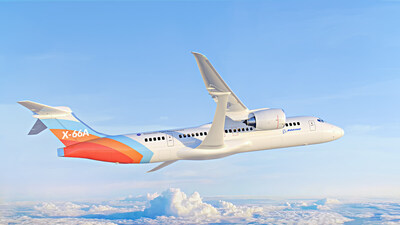
Figure 1. The Boeing-NASA concept X-66A TTBW airplane. Source: NASA.
One of Calhoun’s first decisions was to kill the R&D project of a New Midmarket Airplane (NMA), a twin-aisle design roughly the same dimensions as the Boeing 767-200ER and -300ER. The NMA had been under study since at least 2012. Muilenburg was on the path to seek board approval to launch this program in 2019, when the MAX was grounded by global regulators. Calhoun, the lead director, didn’t support the plane. With Boeing’s cash-cow 737 grounded, Calhoun used the crisis to kill the NMA. Given the billions of dollars in losses Boeing was and would incur, the decision was an obvious one.
Boeing’s Starliner history shows safety, quality concerns exist systemically across the company
Editor’s Note: The National Aeronautics and Space Agency (NASA) on Feb. 19 released its investigative report of the failures in 2024 of the Boeing Starliner space vehicle. Defects in the Starliner resulted in its crew being housed in the International Space Station for nine months before being returned to earth in a SpaceX capsule.
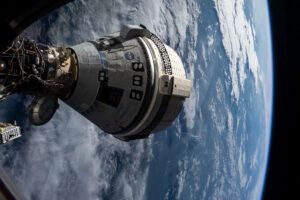
Boeing Starliner, docked at the International Space Station. Source: Boeing.
The investigation into the failures faulted NASA and Boeing. The 311 page report was triggered by the Starliner incident, and examines the NASA-Boeing Defense, Space and Security (BDS) cultures that led to the Starliner problems. The Boeing Co. is engaged in high profile efforts to change the culture at Boeing Commercial Airplanes (BCA). The Starliner incidents reveal similar cultural and safety issues at BDS that corporate CEO Kelly Ortberg must address.
The NASA report may be downloaded here: nasa-Starliner report 021926
In this Special Report, LNA dissects the NASA study. The shortcomings at BDS are eerily similar to those at BCA.
Special Report
By the Leeham News Team
Three Disasters
Lion Air and Ethiopian Airlines
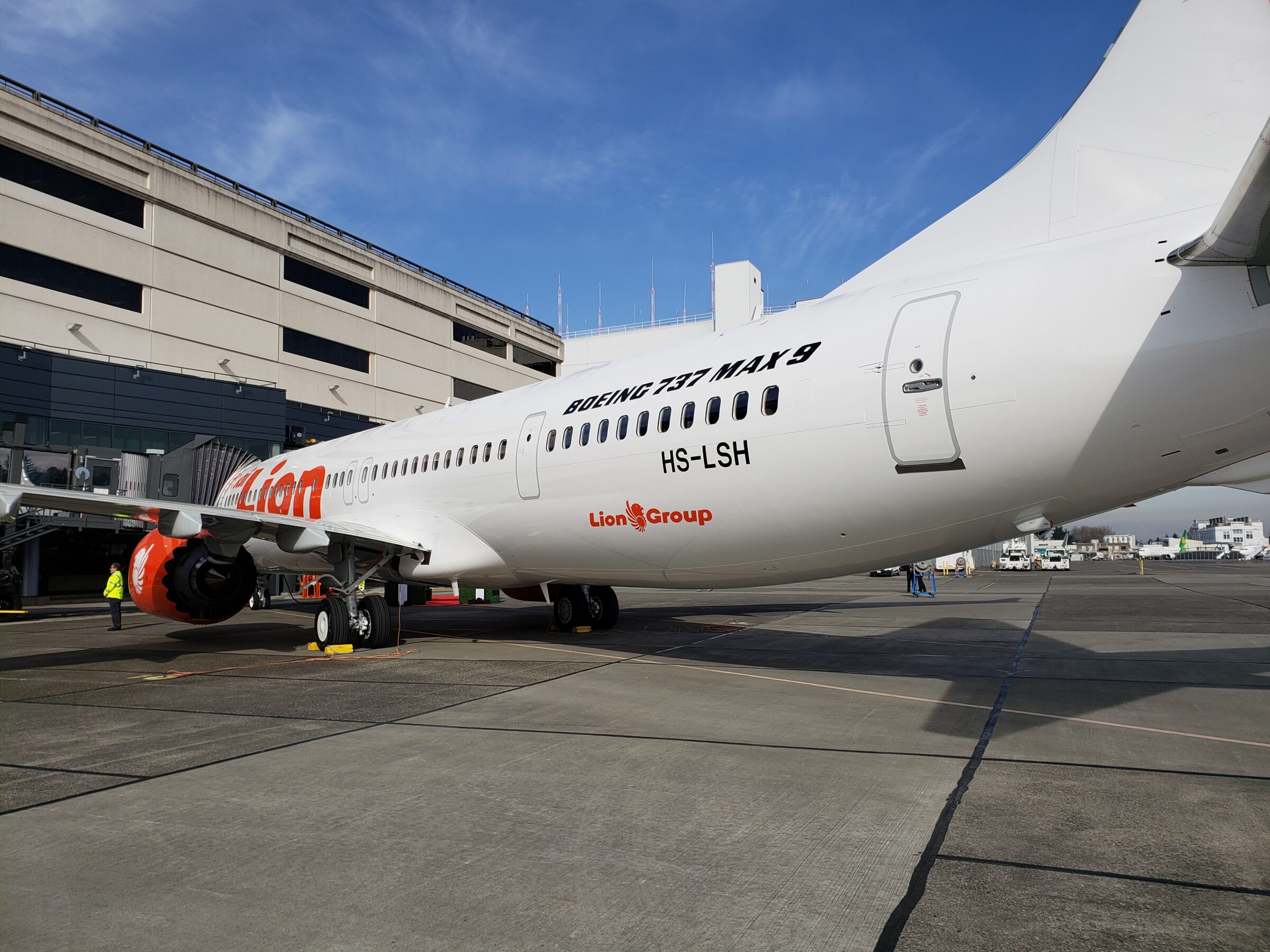
The first Boeing 737-8 delivered, in May 2017, which happened to be to Lion Air. Source: Leeham News.
March 30, 2026, (c) Leeham News: On Oct. 29, 2018, Lion Air Flight 610—a Boeing 737 MAX 8—crashed into the Java Sea, killing all 189 aboard. The Maneuvering Characteristics Augmentation System (MCAS), a flight control system that Boeing had withheld information about from airlines and the Federal Aviation Administration (FAA)—including its existence and how it works—drove the aircraft into an unrecoverable dive.
The pilots had never been trained on it because Boeing determined that disclosing MCAS would require simulator training, which would make the MAX less competitive against the Airbus A320neo. Southwest Airlines, for example, which ordered hundreds of MAXes, required Boeing to pay $1m per airplane if simulator training was required.
Less than five months later, on March 10, 2019, Ethiopian Airlines Flight 302 crashed under virtually identical circumstances. It was another MAX 8 with another MCAS-driven dive. Another 157 people were killed. Combined death toll: 346 passengers and crew, plus one recovery diver in the Lion Air accident. The global fleet was grounded for 21 months.
Congressional investigations revealed what investigators called Boeing’s “culture of concealment” and the FAA’s systematic overreliance on Boeing’s Organization Designation Authorization (ODA) for self-certification. While federal government agencies routinely designate company employees to represent the overseeing agencies, the level of the FAA’s hand-off to Boeing came under withering criticism.
Following the long recovery period, the FAA clamped down on Boeing’s production of the 737 and to a lesser extent (and for different reasons), production of the 787. By late 2022, Boeing executives appeared confident that BCA was on the path to normal operations.
Boeing’s “hangover” of the MAX is over, says former acting FAA administrator who dealt with crisis
By Scott Hamilton

Dan Elwell, former acting administrator of the Federal Aviation Administration. Credit: Alaska Airlines.
Dec. 3, 2025, © Leeham News, Washington (DC): Boeing’s “hangover” and PTSD (post-traumatic stress syndrome) following the 737 MAX crisis of 2019 and beyond is over, says the former acting administrator of the Federal Aviation Administration (FAA) who had to deal with the fallout before Congress.
Dan Elwell faced investigations from hostile Congressional hearings, a criminal probe, civil litigation, an Inspector General’s inquiry from the FAA’s parent department, and in-depth reporting from many newspapers and television media in the months after the second of two MAXes crashed in March 2019, five months after the first fatal accident. The probes, lawsuits and civil and criminal discoveries revealed serious safety and quality control shortfalls at Boeing and shortcomings of the FAA’s oversight of the company and certification of the MAX.
“The FAA still is sort of feeling and nursing sort of the wounds,” Elwell said during an appearance on Dec. 2 at the monthly luncheon of the AeroClub of Washington (DC). “There was a certain amount of MAX PTSD after the pressures that hung around for a while” at Boeing and the FAA.
Elwell said that the biggest challenge he felt was trying to get both the agency and the “really outstanding engineers and people” who work at Boeing to sort of put it behind them, and do what they know best with confidence. Then, Elwell said, it was necessary to support those who were doing what they know how to do best.
“I think…the FAA is getting there,” he said, adding that Boeing is also making progress. Then company is meeting Key Performance Indicators (KPIs) that they’re following, and recently received FAA approval to increase the 737 production rate from 38/mo to 42/mo. Boeing wants to further increase rates to 47/mo and 52/mo in two “rate breaks” next year.
Perspective on Boeing’s 737 replacement
By Scott Hamilton
Sept. 30, 2025, © Leeham News: The Wall Street Journal billed the story as an exclusive, and it did contain details previously unreported.
But the fact that Boeing is working on a 737 replacement isn’t new, even if Boeing has been super-quiet about it. The breadcrumbs have been dropped into public sight all along, and within aviation circles, more has been discussed as well.
Under former CEO David Calhoun, he and other executives discussed the 737 replacement in the form of the transonic truss brace wing (TTBW) single-aisle concept. The very wide, thin wing had about 35 feet of folding wing (as opposed to the folding wing tips on the 777X).

Boeing and Airbus are designing future wings with long folds to allow much greater wingspan than today’s wings. The future folding wings will have a much long fold than the Boeing 777X. Credit: Leeham News.
What Boeing didn’t say publicly, but which was known within aviation circles, was that Boeing was also designing a conventional wing-and-tube 737 replacement in parallel. Boeing always has a Plan A and a Plan B under study, so this was no surprise. But a former 737 program engineer told LNA that Boeing needed a Plan B in this case to serve as a baseline against which the TTBW could be compared for efficiency.
When Calhoun’s successor, Kelly Ortberg, killed the TTBW, Boeing said research and development on the wing would continue. Of course, it would be a replacement for a 737. Why else continue this very specific R&D? Not inconsequentially, Airbus has long been designing a folding wing “Wing of Tomorrow” for the A320 replacement.
Furthermore, the underlying research into the TTBW’s fuselage and systems may be applied to a new airplane, just as elements of the Sonic Cruiser made their way into the 787 in the early 2000s.
What’s the next new aircraft? Part 3
By Scott Hamilton and Bjorn Fehrm
Subscription Required
July 24, 2025, © Leeham News: In Part 3 of our five-part series on examining the potential next generation of aircraft in the coming decades, we take a closer look at Aircraft projects 1 to 4 in our Figure 1.
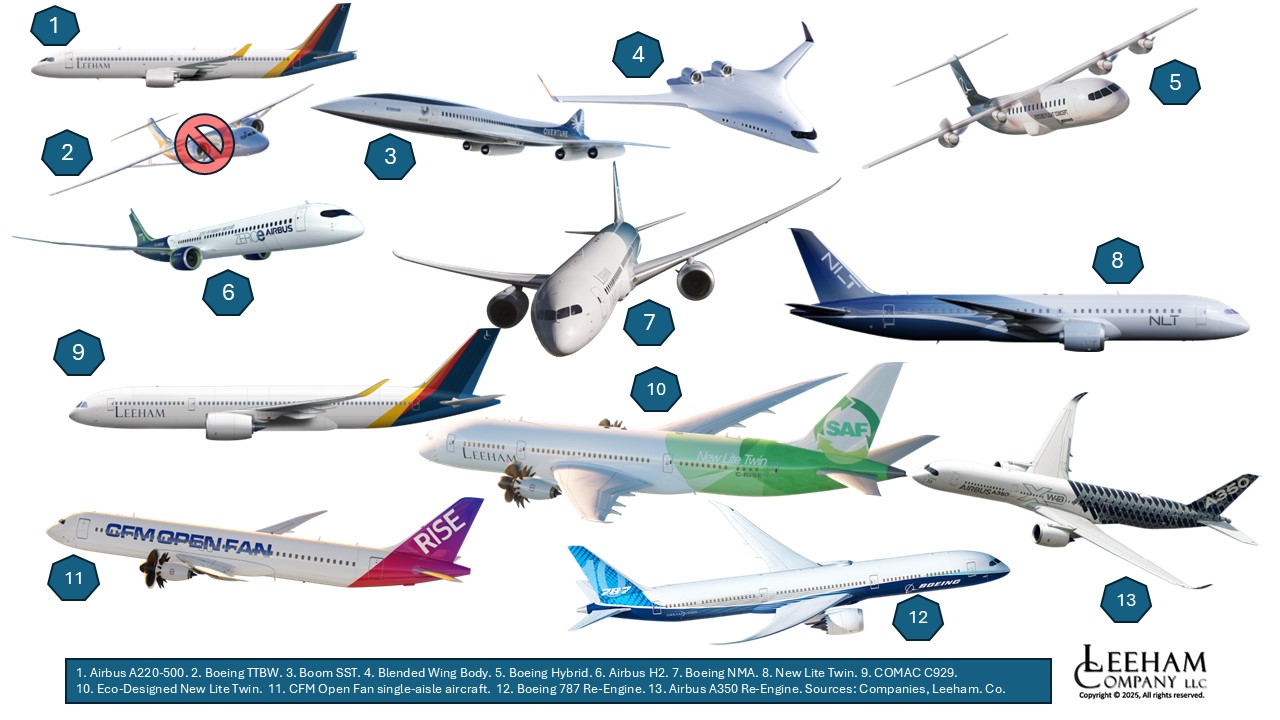
Figure 1. The 13 airliner ideas we look at in the series. Source: Leeham Co.
These are the (1) A220-500, (2) Boeing’s Transonic Truss Brace Wing (TTBW), (3) Boom’s Overture Super Sonic Transport (SST), and (4) the Blended Wing Body (BWB) aircraft suggested by leading proponent Jet Zero.
Boeing CEO: Lessons learned are key to certification of 737-7/10 and 777X
By Karl Sinclair
Analysis
 June 2, 2025, © Leeham News: Boeing CEO Kelly Ortberg believes that lessons learned from the 737 MAX crisis and subsequent in-depth oversight by the Federal Aviation Administration (FAA) are key to certifying the 737-10 MAX and the 777X.
He explained why during an appearance last week at an investors conference organized by Bernstein Research.
“We’re watching real closely to make sure that we aren’t over committing in terms of how many different seat configurations we can get certified in a certain period of time and the complexity,” Ortberg said. “It’s something that we’ve got to watch, particularly the Dash 10s that have types of complex seat configurations.”
Ortberg added that the 777-9 also features complex configurations for international airlines, offering luxurious passenger accommodations.
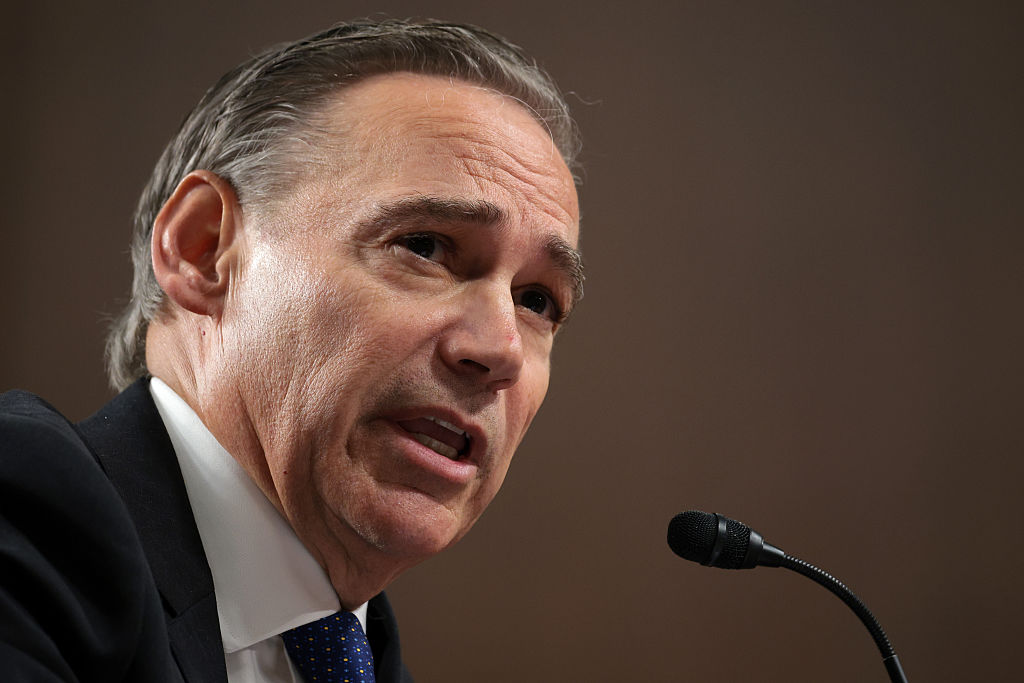
Kelly Ortberg, CEO of The Boeing Co. Credit: Getty Images.
“It’s going to be with us also on the 777-9 as we bring that into service, making sure we incorporate lessons learned here so that we don’t have seating delays on those aircraft,” he said. “Those aircraft will have the most complex configurations in the front of the airplane.”
Certification of the 777X stalled because of the MAX certification review. There have also been some technical issues that have been and must be resolved. But at long last, flight testing with all four test aircraft has resumed.
“I’m hopeful that we’ll get through the certification flight tests by the end of the year,” Ortberg told the Bernstein conference. “We may still be doing some ETOPS testing going into next year, but there is no real change to our forecast of getting that certification done so that we can start deliveries next year.
“It’s an airplane that has had the most flight testing done of any other aircraft we’ve ever done in terms of hours. We feel pretty good about the stability and our entry into service for the airplane that we’ve done enough flight testing on that it’s going to be a great airplane.”
A decade to normal? Delivering every airplane in backlog won’t clear debt to 2018 levels
Subscription Required
By Karl Sinclair
Dec. 20, 2024, © Leeham News: In 2018, the Boeing Company (BA) delivered a whopping 806 commercial aircraft to customers.
 That year, the corporation declared revenues of $60.715bn at Boeing Commercial Aircraft (BCA) and an operating margin of $7.879bn.
Operating cash flow was $15.322bn and Free Cash Flow (FCF) was $13.6bn.
2016 was the last year that Boeing did not have a negative net debt position (cash and cash equivalents less short and long-term debt).

In 2018, Boeing increased its net debt position by ($4.158bn), year over year, while spending $12.946bn on buybacks and dividends.
It borrowed money to give to shareholders.
Fast-forward to the end of 3Q2024. Boeing was forced to raise $21bn in a stock offering on Oct. 28, with $57.65bn in total debt and a ($47.18bn) net debt position.

How long will it take Boeing to get back to a position where it can invest in a much needed clean-sheet design to replace the beleaguered 737 MAX family?
Bjorn’s Corner: New engine development. Part 28. Wrapup.

By Bjorn Fehrm
October 11, 2024, ©. Leeham News: We have done an article series on why engine development takes longer than airframe development. Part of the reason is that advancements in engine technology can deliver considerably higher fuel consumption reductions than airframe advancements.
The change of engines for the A320 series and 737 MAX delivered a 15% improvement in engine efficiency. In contrast, the airframe improvement was less than half, mainly by stacking cabin seats closer together.

Figure 1. The 4:1 gear ratio Utrafan demonstrator in the Rolls-Royce test cell. Source: Rolls-Royce.
Calhoun’s biggest failure at Boeing: fixing safety
By Scott Hamilton
Commentary

David Calhoun
Aug. 8, 2024, © Leeham News: Kelly Ortberg becomes president and chief executive officer of The Boeing Co. today. He replaces David Calhoun, who was named to the position in January 2020. Calhoun replaced Dennis Muilenburg, with a charge to save Boeing from the first 737 MAX crisis and extended grounding; and fix, among other things, the safety culture failures that led to the 21-month grounding of Boeing’s cash cow.
Ortberg has a long list of things to fix, including but not limited to:
- The union contract with the IAM 751, in negotiations now; the contract expires in September
- Fixing Boeing’s safety culture
- Quality control at all the BCA and BDS factories
- Stemming losses at BDS
- Getting BCA production back up to normal rates (50+ for the 737, 10-12 for the 787)
- Getting the MAX 7, MAX 10, and 777X certified
- Regaining the confidence of the FAA, EASA, and other regulators; getting authority to oversee its operations and ticket airplanes back from the FAA
- Repairing the balance sheet
- Integrating Spirit AeroSystems into Boeing
- Returning BCA to profitability
- Launching a new airplane to replace the 737
- Regaining global market share closer to parity with Airbus
- Repair relations with the supply chain
- Negotiate a new contract with the engineers union, SPEEA, in 2026
- Repair relations with the airlines and lessors
- Repair relations with the IAM 751 and SPEEA unions
Ortberg’s long list of things to do reflects a failure of leadership by Calhoun.
New Boeing plea deal filed with court
By Scott Hamilton
 July 25, 2024, © Leeham News: The new, second plea agreement between Boeing and the US Department of Justice (DOJ) has been filed with the US federal court in Northern Texas. Boeing agreed to plead guilty to criminal charges. The DOJ proposes a criminal penalty of $243.6m and requires Boeing to spend $455m on internal safety protocols.
The criminal penalty matches the amount in the first plea agreement of January 2021. Under the terms of that agreement, Boeing had three years to shape up, or the DOJ could pursue criminal charges. The three-year monitoring period was due to expire two days after the Jan. 5, 2024, door plug blowout of an Alaska Airlines Boeing 737-9 MAX on climb out from the Portland (OR) airport. This incident occurred at 16,000 ft. Nobody died but there were minor injuries.
The airplane was damaged throughout the cabin and into the cockpit with the sudden depressurization. Boeing bought the airplane back from the airline.
The 2021 fine and the proposed current fine have been roundly criticized as inadequate.