
Leeham News and Analysis
There's more to real news than a news release.


Bjorn’s Corner: Electrical flight, how real?

By Bjorn Fehrm
10 July 2015, ©. Leeham Co: We have just witnessed the first solar electrical aircraft, Solar Impulse 2, cross the ocean from Tokyo to Hawaii. Today, Friday, Airbus Group will cross the English Channel with a battery powered electrical aircraft, the E-Fan.
How real is electrical flying? Real enough to make demonstration flights like the one to Hawaii and to Calais. Both these aircraft are technology demonstrators but it is symptomatic that they do these hops now, 2015.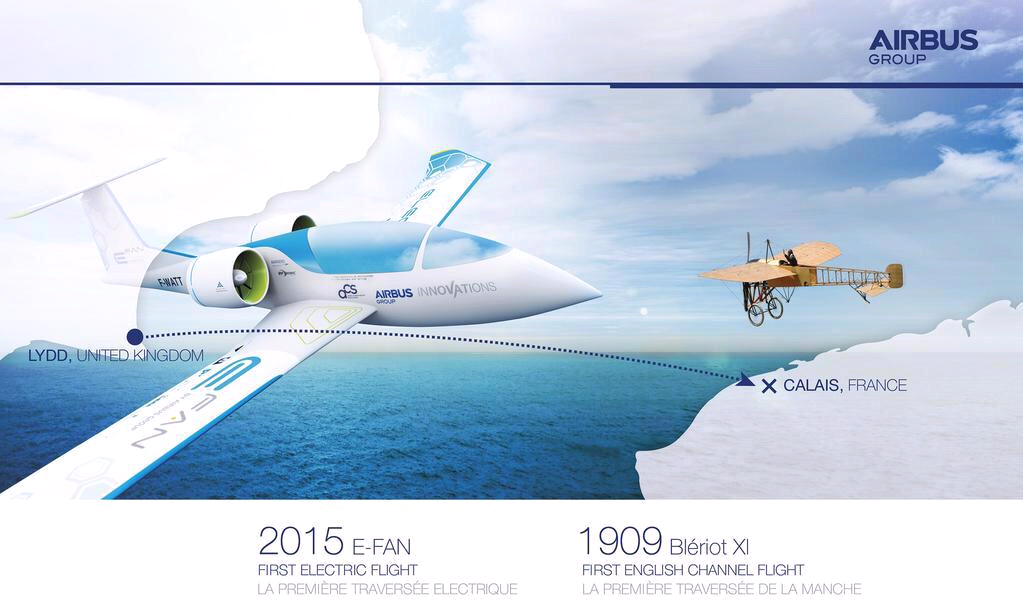
Airbus Group’s E-Fan aircraft is preparing to cross the English Channel. Source: Airbus.
We live in the years when electrical cars have gone from exotic one-offs to serial produced products, still expensive but more and more practical. Why should not the aircraft industry follow? Read more
Bjorn’s Corner: What Paris Air Show taught us about East and West.
By Bjorn Fehrm
25 June 2015, © Leeham Co: With a few days in the office one can look back at Paris Air Show with a bit of perspective. So what are the impressions?
It was surprising how many orders Airbus and Boeing landed. Both had played down the expectations, telling that it will be a decent show but nothing close to record. Yet both were booking orders or commitments which were better than expected going into the PAS. Read more
Bjorn’s Corner: Paris Air Show review
By Bjorn Fehrm
June 18, 2015, c Leeham Co: With the industrial part of Paris Air Show over (the public portion continues through the weekend), one can start to summarize impressions. I have over the years participated in around 10 Paris Air Shows or Farnborough International Air Shows. This was one of the first where one could see that people were stopping and looking up to observe the aircraft which were quiet.
Bjorn’s Corner: Airbus Innovation days, activities and program updates.
By Bjorn Fehrm
Introduction
28 May 2015, C. Leeham Co: I am in Toulouse today attending Airbus Innovation days for Leeham News. It has been a good day’s briefings and I have presented what was perhaps the biggest change since we last met Airbus in the article “Airbus A350-1000 getting real”.
Apart from this program, there were more standard updates on Airbus other activities and programs. Here follows a rundown on these updates in a more paraphrased form.
Redefining the 757 replacement: Requirement for the 225/5000 Sector, Part 6.
By Bjorn Fehrm
Subscription required
Introduction
18 March 2015, c. Leeham Co: In Part 1 of of this series we investigated the market sector 225/5000, which is our name for the market segment beyond the capacity of single aisles A320 and 737 aircraft. Boeing calls this Middle Of the Market, MOM, and is studying which aircraft type would best cover this segment.
In Part 5 of the series we concluded that beyond 220 seats a dual aisle aircraft can be competitive as it can increase utilization due to shorter ground turn-around time. We now conclude the investigation by looking at what Airbus response can be based on a further developed A320 and how it would stack up against optimized seven abreast dual aisle alternatives from Boeing’s MOM study, one of these using Boeing’s patented elliptical fuselage, Figure 1.
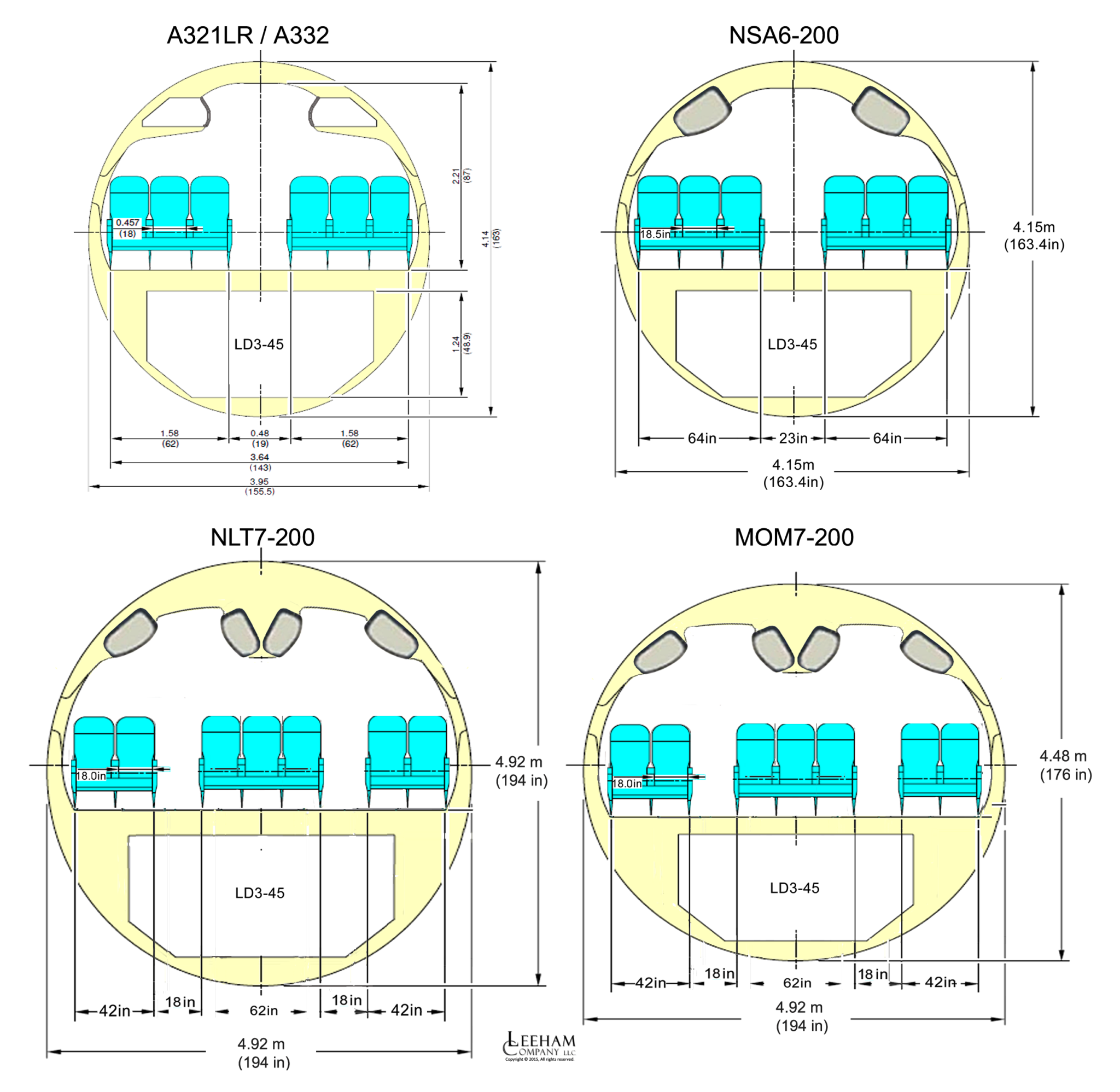
Figure 1. Compared cross sections for MOM market. Source: Leeham Co.
Summary
- The rational further stretch of Airbus A321LR is a re-winged/re-engined A322 with 30-40 more passengers, or five to seven additional rows.
- We compare this development with optimized models from our MOM studies and the A321LR.
- For the comparison we focus on efficiency in weight, drag and fuel for the different alternatives. How competitive will a stretched A321 be and how close in weight and drag comes an elliptical MOM model?
Redefining the 757 replacement: Requirement for the 225/5000 Sector, Part 4.
By Bjorn Fehrm
Subscription required
Introduction
08 March 2015, c. Leeham Co: In the third part of the article series around the need for a more capable solution for 180-240 seats and 5,000 nautical miles, we compared different clean sheet single and dual aisle aircraft to the Airbus A321LR and Boeing’s 787-8, the two aircraft that form the border to the segment.
We could see that a single aisle aircraft started to have trouble with weight at around 220 passengers using our normalized seating rule set. This would with normal OEM seating rules be around 230-240 passengers. At the same time the dual aisle aircraft becomes stronger the more seats one assumes. The reason is their thicker fuselage, Figure 1, lends itself better to aircraft which passes 50 meters/160 feet in length.
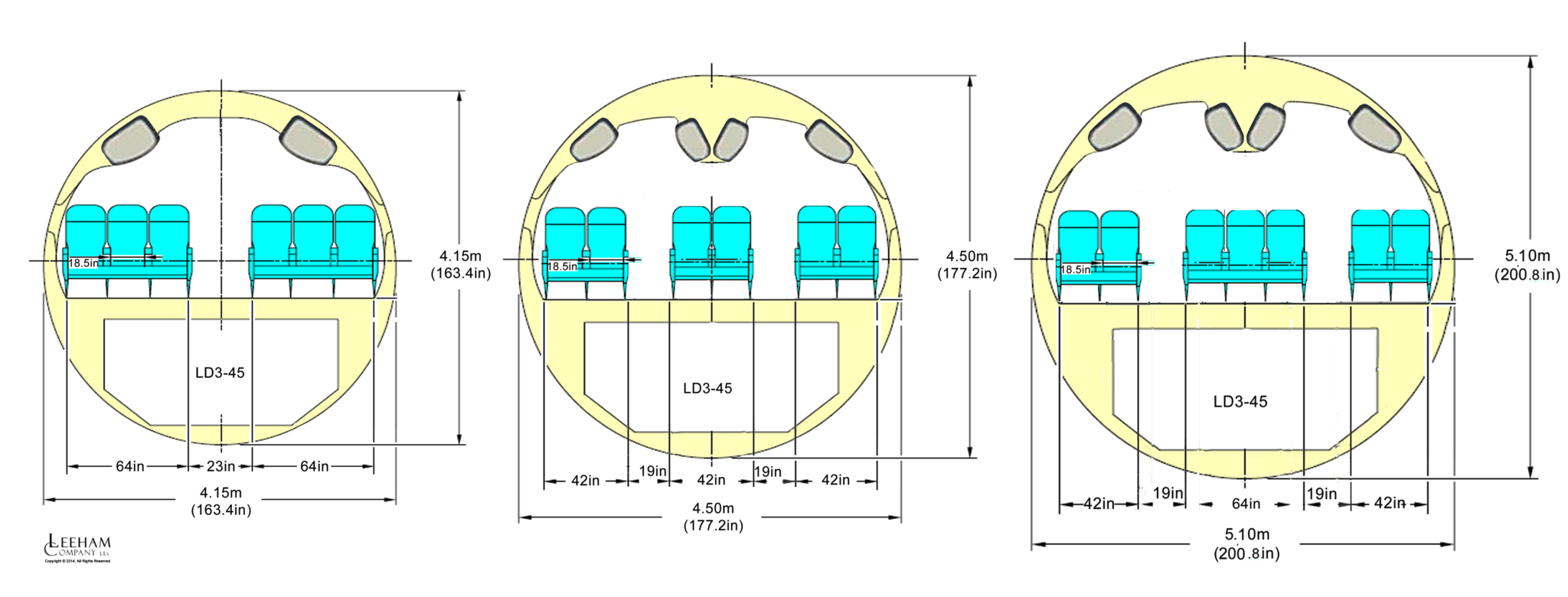
Figure 1. Cross sections for our studied clean sheet designs; NSA6 (New Single Aisle 6 abreast), NLT6 (New Light Twin 6 ab.) and NLT7. Source: Leeham Co.
Their advantages in boarding and deplaning then starts to outweigh their disadvantages in weight and drag. This trend is explored further in this part where we add Cash Operating Cost, COC and Direct Operating Cost, DOC, to the analysis.
Summary
- The trends seen for NAS6, NLT6 and NLT7, our Middle Of the Market, MOM, models in the segment 180 to 240 passengers gets further reinforced when we go to COC and DOC.
- A factor supporting this is the broader spread of fixed and semi-fixed costs over larger aircraft seat numbers.
- Another is that the shorter ground turn-around time for dual aisles increases the utilization for the aircraft, once again forming a broader base for fixed and semi-fixed costs.
- Introducing CFRP for the fuselage brings clear gains in weight and therefore operating costs. Key for its inclusion in the MOM designs will be the manufacturing advances that will have been made by 2025.
Redefining the 757 replacement: Requirement for the 225/5000 Sector, Part 3.
By Bjorn Fehrm
Subscription required
Introduction
04 March 2015, c. Leeham Co: In the first and second part of the article series around the need for a more capable solution for 180-240 seats and 5000 nautical miles, which we have labeled the 225/5000 Sector, we went through the derivatives we have analyzed as competitors to Airbus A321LR and showed why none of them are effective as a Boeing solution.
We also looked at the wetted area and weight for our common single and dual aisle aircraft. These parameters are the principal components that determine an aircraft’s efficiency given a certain engine efficiency. We also developed the market picture, outlining a substantial market by the time of entry into service of a clean sheet design by 2025, given that certain market requirements could be fulfilled.
We will now project different solutions to the requirements, thereby utilizing the preliminary design part of our proprietary aircraft model. We will look at three different cabin configurations in four different size classes between 180 to 240 seats and calculate size and weights and the resulting efficiency of the different variants. Against the key data for these different aircraft and their operational efficiency we will be able to postulate what will be the next move from Boeing and Airbus in this segment.
Summary
The findings in this our third article include:
- Aircraft capacity and size for 12 different possible aircraft, named NAS6, NLT6 and NLT7 each in the variants 180, 200, 220 and 240 passengers.
- With this collection of characteristics it will be possible to compare the efficiency and costs for the different sizes and to see how competitive a wider dual aisle aircraft will be in this segment compared to a single aisle.
- In a subsequent article will be compare the operational characteristics of these aircraft thereby also covering the increased revenue potential with a dual aisle aircraft compared to a single aisle.