
Leeham News and Analysis
There's more to real news than a news release.


PNAA Day 1: Boeing’s view of the global market
- Feb. 9, 2016: Today is the first of three days of conference meetings organized by
 the Pacific Northwest Aerospace Alliance (PNAA), in Lynnwood (WA). We’re providing live reporting throughout the three days.

Randy Tinseth, VP-Marketing for Boeing, said forecasts predict oil as low as $7/bbl and as high as $80/bbl–as always, “giving themselves a lot of leeway.”
Asia remains the top growth market, adding 100m passengers every year (the size of Atlanta’s international airport, the world’s busiest, which served 100m passengers lasgt year.
The cargo market has been challenged over the last six years, and it comes and goes, but it will come back when trade comes back, Tinseth said.
- Tinseth compared the 787-10 with the A330-900 to show a claimed 165nm range advantage–but the A350-900 (new generation-to-new generation) was omitted. The A350-900 has a much longer range than the 787-10. (Updated to correct the A330-800 to the A330-900.)
The single-aisle market represents 70% of the market and half the value, including Airbus and all other competitors.
“We as an industry and we as a company have to focus on doing the right things…and build at the right cost” to be successful, Tinseth said.
He said that given the total forecast of 35,000 airplanes from regional jet to Very Large Aircraft, there is a need for 60% of the sales still to be made.
Tinseth said the company will deliver fewer 737s this year because the supply chain can’t keep up as the transition between the NG and MAX takes place.
Update: This email was received later from Boeing’s Corporate Communications department:
I wanted to touch base on this bullet in your coverage of Randy’s PNAA presentation.
After talking to Randy, I believe his response was lost in translation.
He was making the point that the transition to MAX is the reason we’ll deliver fewer 737s—because we’re producing several MAX airplanes this year that won’t deliver until 2017.
On a follow up question about separate production lines, he was simply making the point that the NG and MAX share a common supply chain.
So the supply chain is delivering precisely to our 42 per month rate. We’re producing 42 per month, but won’t be able to deliver to that rate this year due to MAX certification.
His point was the opposite of “can’t keep up.” Our suppliers are doing exactly what we need them to do. We can’t expect them to deliver at a rate higher than 42 right now just so we can build more NGs to make up for the MAXs that won’t deliver this year. And of course, that would go against our own rate hike schedule.
China’s market has slowed, but the government is restructuring the economy but “we see robust, double-digit growth” for the future, he said.
Despite the fluctuation of oil prices, “we haven’t seen a change in the replacement pattern,” Tinseth said. Aircraft reach maintenance requirements, interior upgrades and certain ages that simply need replacement.
PNAA Conference Day 1: Aerospace Clusters
- Feb. 9, 2016: Today is the first of three days of conference meetings organized by the Pacific Northwest Aerospace Alliance (PNAA), in Lynnwood (WA). We’re providing live reporting throughout the three days.
Aerospace clusters are evolving throughout the world, said Kevin Michael, vice president of ICF International.
California is on the decline. Two new clusters on the rise are Mexico and the Southeastern US. The Netherlands and Singapore are successful, long-term clusters.
California was the premier aerospace cluster for decades, but its demise began when Lockheed chose Georgia as the location to build the C-130. The founding of Airbus was not good news for SoCal, and neither was the end of the Cold War. The acquisition of McDonnell Douglas by Boeing in 1997 further precipitated the decline of SoCal.
A320 FAL “good for US aerospace,” says Airbus
Sept. 16, 2015, © Leeham Co., Mobile (AL): The opening of the Airbus A320 Final Assembly Line here achieves a major set of goals set by the company 10 years ago for its own strategic purposes, but officials are also mindful of the larger impact on US aerospace.

David L. Williams, VP Procurement, Airbus Americas. Photo via Google images.
Top executives point out that the Mobile plant reestablished a second commercial aviation assembly site in the US since the last MD-11s and MD-95s rolled out of the former McDonnell Douglas plant in Long Beach (CA) after its acquisition by The Boeing Co in 1997. Boeing continued production of the MD-11 until the end of 2000 (with deliveries occurring in 1Q2001). The last MD-95, renamed the Boeing 717, was produced in 2006. There were 200 MD-11s and 156 717s produced.
With nearly 10 years elapsing between that last 717 and the first A321ceo coming out of Mobile, Airbus officials say the creation of the FAL is not only good for Airbus and Alabama, it’s good for US aerospace.
Boeing’s dedicated freighters views an improving market
Subscription Required
By Scott Hamilton and Bjorn Fehrm
Introduction
Feb. 22, 2015: An improving global freight market gives Boeing hope that air cargo demand will support the production of two new main-deck freighters a month for years to come. Boeing is struggling to sell 747-8Fs to keep the 747 line alive and needs to sell the 777F to support its goal of maintaining the current 777 production rate of 100/yr through the transition in 2020 to the new 777X.
Randy Tinseth, VP Marketing for Boeing included the projection as a passing reference in remarks Feb. 11 to the 14th Annual Conference of the Pacific Northwest Aerospace Alliance in Lynnwood (WA). The following week we spoke at length with Tom Crabtree, Boeing’s Regional Director, Airline Market Analysis, Marketing & Business Development, about the long-suffering global cargo market and Boeing’s forecast for recovery.
Summary
- Increasing reliance on belly capacity doesn’t negate need for large main deck freighters, Boeing says.
- Boeing sees need for two new-build, large freighters per month.
- Accepting Boeing’s demand forecast, Leeham Co. sees another production rate cut for the 747-8.
Odds and Ends: 737 MAX order breakdown; Airbus to top Boeing; Embraer to PNAA event
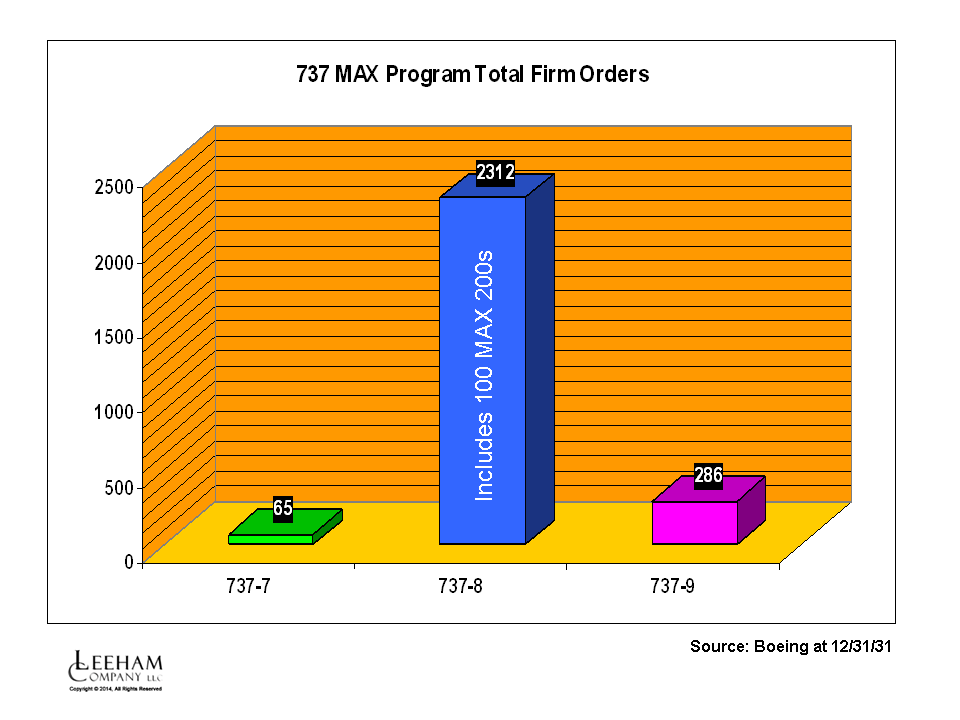
Click on image to enlarge into a crisp view. Source: Boeing.
Jan. 6, 2015: 737 MAX Orders: Boeing has broken down the 737 MAX orders for the entire program in response to our inquiry. The 737-8 has captured 87% of the program orders since launch in 2011. The MAX 8 includes the 100 MAX 200 orders for the high density version, placed by Ryanair last year. The MAX 9 has 11% and the MAX 7 just 2% (figures are rounded).
Airbus to top Boeing: It’s not really a surprise, because it seems to happen just about every year. Reuters is reporting that Airbus will top Boeing in gross and net orders when it reports its 2014 performance next week.
Embraer to PNAA: Embraer’s chief commercial officer, John Slattery, will speak at the Feb. 10-12 conference for the Pacific Northwest Aerospace Alliance. EMB has presented previously but this is the first time Slattery is joining the conference. Click on the banner ad above to go directly to the conference website.
Odds and Ends: AirAsia 8501, PNAA Conference, FWIW
Jan. 2, 2014: AirAsia 8501: Our friend Geoff Thomas has an interesting commentary about the AirAsia 8501 story. Also, an Airbus A330 pilot for a major US airline, offered these observations about QZ8501. A Linkedin profile suggests this pilot flies for Delta Air Lines.
We are now beginning to see more and more “conclusions” about what happened to 8501 from people who are being described as “experts.” Some of these are people we’ve never heard of, although this isn’t necessarily indicative that they don’t know what they are talking about–but we don’t think they do.
Since the airplane hasn’t been confirmed as found (searchers only think they’ve found it, but bad weather and bad seas have, at this writing, prevented confirmation), nor have the black boxes been recovered, the conclusions being set forth are interesting theories but that’s all they are.
Most of these possibilities are precisely what we’ve reported as areas of investigation and questions to be asked and answered. They way these “experts” are positioning possibilities is actually pretty embarrassing.
Treat these reports with the skepticism they deserve.
One thing we are surprised at: how quickly one of the few victims recovered has been buried. We thought an autopsy would take longer, and an autopsy would be the first clear indication of what happened: whether the victims died by blunt force trauma (i.e, impact with the water) or from decompression (suggesting an inflight fuselage rupture or mid-air break up).
Sixteen bodies are now reported to have been recovered (at 8:30pm PST Jan. 1).
Aviation conferences this month
There are two aviation conferences in Washington State this month.
The first is from the Pacific Northwest Aerospace Alliance October 8. The PNAA Space & Security conference, a one day event, will be at the Museum of Flight at Boeing Field in Seattle. The conference is quite timely, considering Boeing just announced job transfers out of Puget Sound from its Defense unit. Two local defense programs that remain, the P-8A Poseidon (based on the 737) and the KC-46A (based on the 767) are on the program for updates.
The British American Business Council (Northwest), or BABC, holds a one day Aerospace Conference, also at the Museum of Flight, on October 28. Airbus Americas will discuss the A-Series Neo programs. NASA will discuss future airplanes, with composites, interiors and other materials also on the agenda.
Repost: Pratt & Whitney GTF program update at PNAA conference, plus Q&A PW, RR and GE
Due to technical issues we don’t begin to understand, the PW GTF engine program update didn’t display the videos, only the links. We are re-posting to correct the situation because we couldn’t fix it within the original post.
Bob Saia, VP of Next Generation Engine development at Pratt & Whitney, provides a program update of the Geared Turbo Fan engine and its prospect of growing into a “Big Engine” serving the twin-aisle market. He appeared at the Pacific Northwest Aerospace Alliance 2014 conference in the Seattle area last week.
.
[youtube=http://www.youtube.com/watch?v=CYUUtVEKhIs]
.
http://www.youtube.com/watch?v=02RgF1So-X4
Questions and Answers
The following videos are questions and answers of the representatives of the Big Three engine manufacturers. Sound is soft on these two videos; best to use headphones.
.
[youtube=http://www.youtube.com/watch?v=nArLnhsMraE]
.
[youtube=http://www.youtube.com/watch?v=-Wtqr4FavP0]