
Leeham News and Analysis
There's more to real news than a news release.



Update 8-3: Contract Approved (St. Louis Machinists vote Wednesday on latest Boeing contract tweaks)
Update, Aug. 3, 2022: The IAM 837 approved the revised Boeing offer for a three year contract. No strike tonight.
By Bryan Corliss
Aug. 2, 2022, © Leeham News: Machinists Union workers at Boeing’s St. Louis-area defense plants will vote on a revised three-year contract offer from the company Wednesday.
Workers on July 24 had rejected a previous offer from the company with a 91% no vote. In addition, 94% of workers voted to strike. The strike was scheduled to start at 12:01 a.m. Monday, but after a marathon weekend bargaining session, the union side agreed to take Boeing’s latest offer to its members in today’s vote.
Negotiators from International Association of Machinists District Lodge 837 had urged their members to reject the company’s previous proposal, saying it did “not equate to a fair and equitable offer.”
As of mid-day Tuesday, the IAM 837 negotiating committee hadn’t issued a public recommendation on the latest offer. However, our read is that it’s doubtful that Boeing has improved its package enough to satisfy Machinists, who are looking for significant improvements in pay and retirement benefits after giving up major concessions in their last contract.
Jump in R&D spending at Boeing Commerical Airplanes points to renewed studies for new airplane
Subscription Required
By Scott Hamilton

Return of the NMA? Photo credit: Leeham News.
Aug. 1, 2022, © Leeham News: Buried in Boeing’s second quarter results released last week was a sharp jump in research and development spending.
It wasn’t just a small increase at Boeing Commercial Airplanes (BCA). Boeing spent more on research and development in the quarter and the half year. Expenses hit $1.33bn for the half-year compared with $996m a year earlier. For the quarter, expenses rose $996m vs $497m. R&D for Commercial Airplanes rose to $693m for the half and $372m for the quarter, compared with $524m and $255m, increases of 32% and 46%, respectively.
Spending is still short of the peak in 2019. But the reduced spending post-grounding of the 737 MAX and the COVID-19 pandemic was reversed in the first six months of this year.
Pontifications: Two books examine GE’s fall from grace
Lights Out: Pride, Delusion, and the Fall of General Electric
By Thomas Gryta and Ted Mann
Mariner Books, $17.99, 361 Pages
The Man Who Broke Capitalism, How Jack Welch Gutted the Heartland and Crush the Sole of Corporate America—and How to Undo His Legacy
By David Gelles
Simon & Schuster, $28.00, 264 Pages
Aug. 1, 2022, © Leeham News: Two recent books about GE and its most prominent CEO, Jack Welch, offer different focus and fascinating insight.
By Scott Hamilton
One, Lights Out, is a detailed chronicle of the Welch era and those who followed. This book goes into much more detail than Gelles’, which is more of a biography of Welch than a corporate history—although obviously, there is pollination of both.
Gelles, a reporter for the New York Times, goes into some discussion about Boeing and the Welch-influenced people who came to lead Boeing, notably Jim McNerney and David Calhoun. But don’t expect Gelles’ book to take a deep dive into how Welch’s tutelage of McNerney and Calhoun affected Boeing. The discussion is superficial. This is, after all, a book focused on Welch.
Update 2: (Boeing modifies offer, strike called off for now) After upbeat air show and 2Q financial report, Boeing faces strike Sunday
Update, 2:45PM (PDT) July 30: Overnight negotiating resulted in a modified offer from Boeing to IAM 837, resulting in postponing the strike set to begin at 12:01 AM CDT Aug. 1. A new vote has been set for Aug. 3.
By Bryan Corliss
Analysis
UPDATE: 4 p.m. (Pacific), July 29: On Friday afternoon, a St. Louis television station reported that Boeing and Machinists Union District Lodge 837 were heading to mediation. The station quoted an IAM 837 spokesman who said a federal mediator would lead the talks. The station said Boeing has not confirmed this.
Meanwhile, the St. Louis Business Journal reported that negotiators on both sides had met with a mediator but made no progress.
Neither side has issued a statement on potential mediation.
We will update if developments warrant.
July 30, 2022, © Leeham News: Boeing’s Wednesday earnings call had some pretty big news in it: After years of red ink, Boeing now anticipates generating free cash flow.
But there’s a big potential blocker on the Defense side of the house, in the form of a looming strike with the Machinists Union workers in St. Louis.
Workers rejected a contract on July 24. Leaders of International Association of Machinists District Lodge 837 said 91% of those voting rejected Boeing’s “best and final” offer, and 94% of voters authorized a strike, which could begin at 12:01 AM Monday. The leadership did not release the vote totals.
Three plants in and near St. Louis would be affected by a walk out.
Boeing didn’t mention it in its earnings press release, and CEO Dave Calhoun didn’t mention it on the earnings call and downplayed the significance of the labor strife during a live interview with CNBC the same day.
“They do have high expectations,” Calhoun said. “We feel we have made a very strong offer.”
The union workers, however, disagree, and that could very well mean another stumble for Boeing, as it moves to bring the key new programs – the T-7A trainer for the U.S. Air Force and the MQ-25 Stingray UAV for the U.S. Navy – into full production.
Bjorn’s Corner: Sustainable Air Transport. Part 30. Lilium Jet VTOL.

By Bjorn Fehrm
July 28, 2022, ©. Leeham News: This week, we analyze the Lilium Jet VTOL.
It’s a vectored thrust design, but it’s different enough in its characteristics from the vectored thrust VTOLs we looked at in Part 28 (Joby S4 ..) to motivate a separate article.

Figure 1. The final Lilium Jet configuration transports six passengers plus a pilot. Note the changed number of wing jets (from 24 to 20). Source: Lilium.
HOTR: Hexcel gives glimpse at 2030 airplane
By the Leeham News Team
July 28, 2022, © Leeham News: Hexcel, a major supplier of composites to Airbus and Boeing, gave a hint of things to come when the next generation narrowbody airplane is developed for late this decade or early next decade.
In its 2Q2022 earnings call, Hexcel forecast that the next-gen airplane may be comprised of more than 60% of composites and thermoplastics. (Figure 1.) This compares with about 50% for the Airbus A350 and Boeing 787. It compares with about 5% of the narrow- and widebody airplanes of the 1970s and 1980s.

Upping composite content in single-aisle airplanes and achieving economic operating gains is more difficult than the gains for widebody aircraft. The weight savings and stage lengths simply don’t match the benefits achieved on widebodies.
Nevertheless, Hexcel’s presentation presents an intriguing look into the future.
Dual or Single Aisle for Long Haul, Part 2
Subscription Required
By Bjorn Fehrm
Introduction
July 28, 2022, © Leeham News: Two weeks ago, we started looking at the most economical way to fly long-haul. The single-aisle alternative or stay with the trusted widebody?
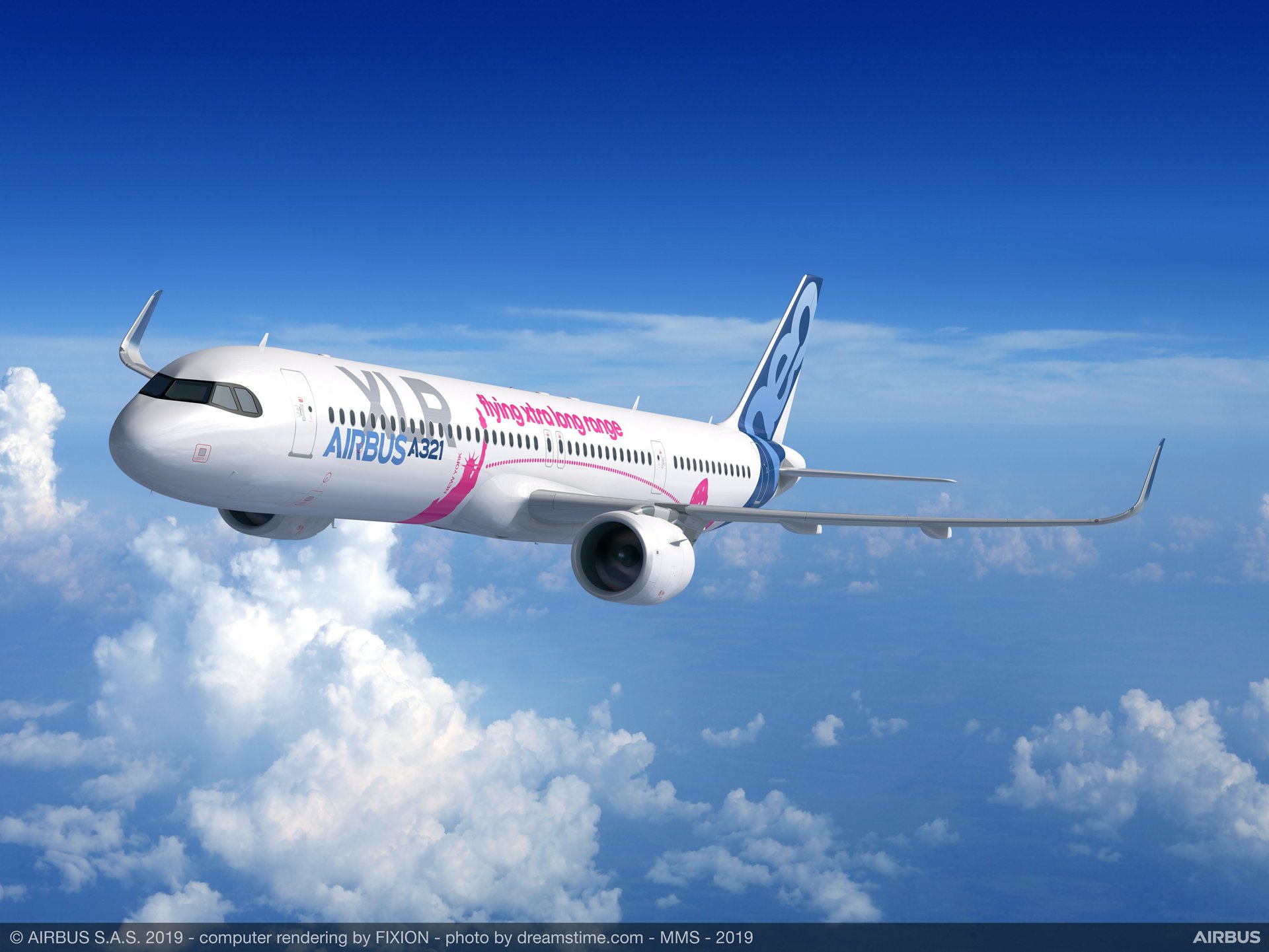
We laid out a route on the practical range limit for an Airbus A321XLR, Milano to New York. With typical headwinds (as we fly west), it’s close to 4,000nm for the aircraft. The first analysis was for fuel burn. Now we add other costs to form Cash Operating Costs.
Summary
- The fuel burn points one way, the Cash Operating Costs another.
- The background is different costs scale differently with size.
Airbus 1H profit; delays A320neo production rate hike due to supply chain challenges
July 27, 2022, © Leeham News: Airbus Group today reported flat revenues for the first half, year-over-year but less profit.
 Revenues for the six months this year were €24.8bn vs €24.6bn. Net income was €$1.9bn vs €2.2bn, a decline of 15%. Free cash flow was €1.65bn vs €2bn. The Group ended the second quarter with €7.2bn in cash, down from €7.7bn a year earlier. Total liquidity was €27.6bn.
Airbus said it still has a goal of producing 75 A320neos a month by 2025 but that it will adjust the ramp-up rate between now and then. Challenges with the supply chain slow the ramp up. Airbus now targets early 2024 for a rate of 65/mo, vs the second half of next year, a six-month delay. Entry into service for the A321XLR is now targeted for early 2024 vs 2023. Increasing production rates for the A330 and A350 depend on the supply chain, the company said.
Boeing has slowed the production rate ramp-up for the 737. It now will maintain a rate of 31/mo for the remainder of this year, also citing supply chain challenges. It had planned to increase production to 38/mo later this year.
Boeing ekes out positive cash flow; earnings numbers mixed; R&D spend jumps
July 27, 2022, © Leeham News: Boeing today reported that it eked out positive operating cash flow for the second quarter of $81m. Revenues his $16.68bn, down slightly from $17bn a year earlier as production and delivery delays continue to hammer the commercial division.
 Boeing reported an operating profit of $774m and a net profit of $160m. This compares with $1bn and $567m respectively. Despite the lower earnings figures, the tiny positive cash flow compares with a negative cash flow of $493m last year.
For the half, Boeing reported revenues of $30.67bn vs $32.2bn, an operating loss of $395m vs an operating profit of $940m, and a net loss of 1.1bn vs a net profit of $6m.
The full press release may be obtained here.
ATR, Embraer, JADC release 20-year turboprop demand forecasts
Subscription Required
By Scott Hamilton
July 25, 2022, © Leeham News: ATR and Embraer released at the Farnborough Air Show their forecasts for the next 20 years for turboprops.

 ATR is the only remaining manufacturer of turboprops in the 40-80 seat category outside of China and Russia. Embraer, which got its start in commercial aviation with the 19-seat Bandeirante, exited the turboprop business after the EMB-120 Brasilia. Now, following decades of exclusively supplying regional jets to the world’s commercial aviation market, wants to resume producing turboprops. It’s proposed a two-member family with 70 and 90 seats. EMB claims it has interest from airlines for 250 turboprops, but the program launch remains elusive.