
Leeham News and Analysis
There's more to real news than a news release.


Pontifications: Washington State out to lunch on aerospace–again

By Scott Hamilton
Nov. 13, 2017, © Leeham Co.: Washington State’s top aerospace official, John Thornquist, resigned early this month, complaining that the State Legislature cut the Department of Commerce’s budget 78% over the past three years—making it impossible for Commerce to promote Washington aerospace.
The Puget Sound Business Journal revealed the resignation Nov. 3. The Seattle Times followed later in the day.
Boeing wins first day with big order at Dubai Air Show
Nov. 12, 2017, © Leeham Co.: In a stinging defeat for Airbus, Boeing won an order for 40 787-10s from Emirates Airline.
Airbus competed for the deal with the A350-900. Emirates previously canceled an order for 50 A350-900s and 20 A350-1000s, an embarrassment at the time. Losing this order was largely expected, but based on comments from airline officials earlier this year, it seemed that the order would be put off until next year.
Bloomberg News has this devastating report.
Unreported from this order is that it seems to indicate a changing strategy for Emirates.
Airbus’ A330 or Boeing’s 787 for LCC long haul?
By Bjorn Fehrm
Subscription Required
Introduction
November 09, 2017, © Leeham Co.: International Airlines Group’s (IAG) CEO, Willy Walsh, said in an Investor presentation last week “LEVEL (the group’s Long Haul LCC) is as well off with the Airbus A330-200 as with a Boeing 787.” He said the lower capital costs of the A330 compensates for the Dreamliner’s lower fuel burn.
As a proof, Walsh said IAG had run flight plans with their LEVEL A330 flying the same mission as a Norwegian 787 and configured as the Norwegian aircraft. The difference in fuel burn Barcelona-Los Angeles would be 6t. But this is easily compensated by the difference in capital costs.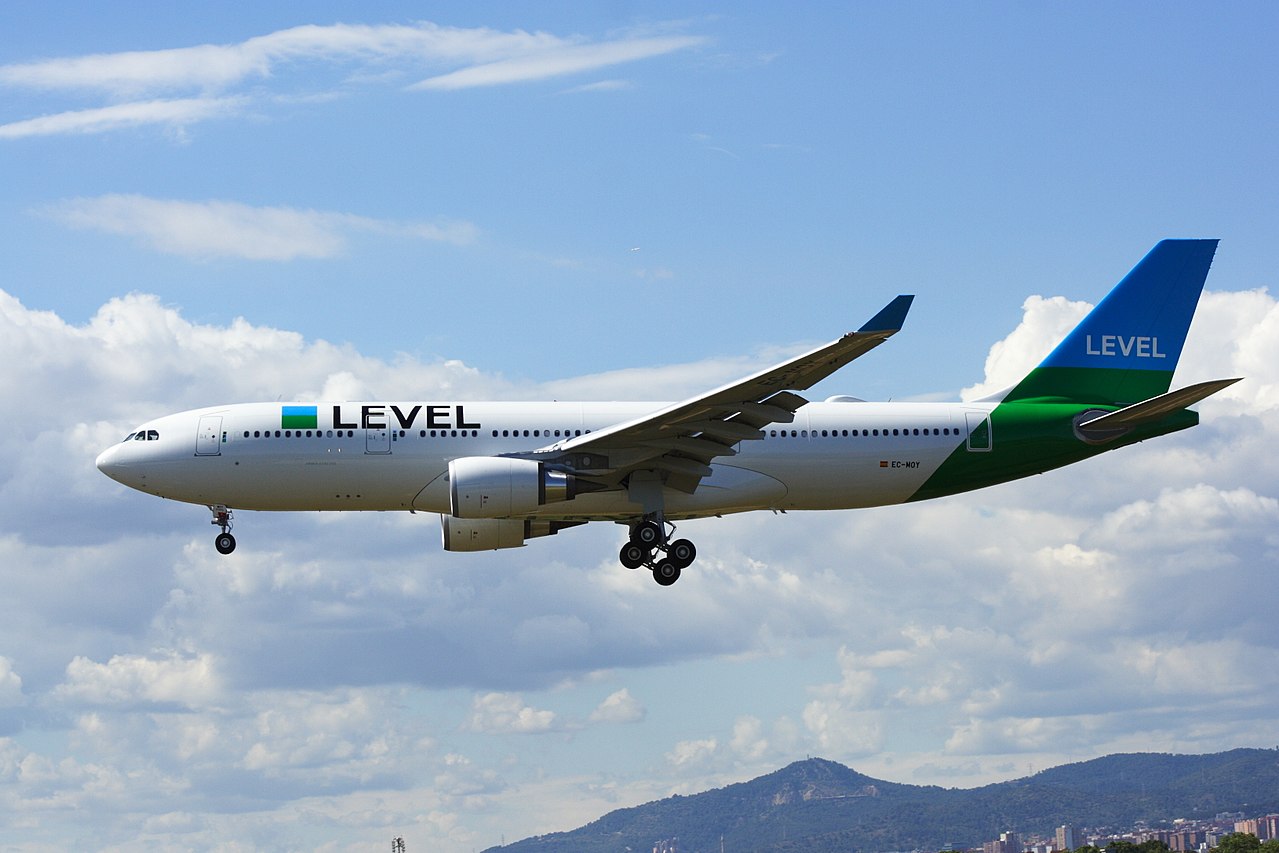 Going forward, LEVEL has the possibility to switch to the 787, said Walsh. Our reaction is; why not include the A330neo in this discussion?
We decided to verify Walsh statements and also check why an A330neo wouldn’t be more appropriate than a 787.
Summary:
- The statement by Walsh about the difference in fuel burn between the A330 and the Dreamliner is correct.
- However, fuel cost is no longer the dominant cost in airline operations.
- We compare the total Cash Operating Costs (COCs) of the aircraft, then we view whether the COC difference between the types can be compensated with capital cost differences.
New mission focus seen for NMA
Nov. 8, 2017, © Leeham Co.: A revised mission focus for the the prospective Boeing New Midmarket Aircraft (NMA) is seen by a New York research firm.
Bernstein Research sees the NMA being redefined as a larger aircraft serving the Airbus A320/Boeing737 market rather than a replacement for the Boeing 757/767 “Middle of the Market” sector.
Bernstein has been cool to the prospect of a 4,500nm-5,000nm airplane. The analyst, Doug Harned, likes the proposed size—220-270 passengers in a 2x3x2 ovoid
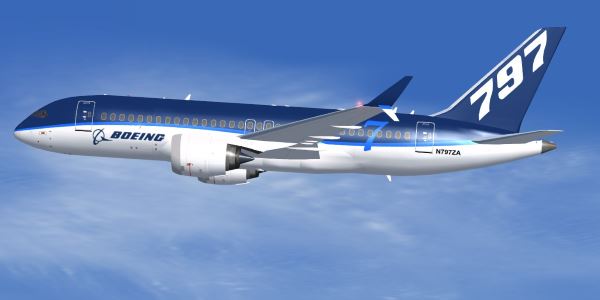
Concept of the Boeing 797 New Midmarket Aircraft. Source: fs2000.org.
composite fuselage configuration. But he sees a stronger market serving ranges of 1,000nm to 4,500nm.
So far, there is no market intelligence LNC knows of to support any inference Boeing has refocused the mission statement of the NMA, also known as the Boeing 797, though Harned is firm in his view: “The focus is now on the NMA category, which we see as the right positioning,” he writes in a Nov. 6 research note.
Airlines LNC checked with yesterday reaffirm Boeing’s focus at this time to be 4,500nm-5,000nm.
Analyst: Airbus could eventually terminate CSeries program
Nov. 7, 2017, © Leeham Co.: The Bombardier CSeries may go the way of the McDonnell Douglas MD-95, a Wall Street aerospace analyst suggests: that is, the
Doug Harned, the analyst for Bernstein Research, draws a parallel between Airbus’ acquisition of a majority stake in the CSeries program and Boeing’s 1997 acquisition of McDonnell Douglas in which the MD-95 joined the Boeing family of airplanes.
The 110-seat MD-95 was renamed the Boeing 717. Boeing attempted to market the airplane, without success. Production was terminated after 156 airplanes were built.
CSeries effect on Airbus, Boeing product strategies
Subscription Required
Introduction
Nov. 6, 2017, © Leeham Co.: Boeing took a pass on assuming ownership of the Bombardier CSeries, according to a report in the Toronto Globe and Mail—the same deal rival Airbus took.
In doing so, Boeing passed on acquiring a new airplane program at pretty much zero risk, no cash investment and no research-and-development cost. The market demand ranges from 4,000 to 6,000, depending on whose study you believe.
Rival Airbus wouldn’t have a response and, given its current turmoil, would have been unlikely to pursue a response.
Instead, Boeing may embark on a risky, high-cost development of the New Midrange Aircraft for which market demand remains a controversy, suppliers are reluctant to take risk-sharing positions and which will almost certainly provoke a response from Airbus.
Artist concept of Boeing 797-7. Source: fs2000.org.
Summary
- Boeing says it’s not worried about Airbus stake in CSeries program; it remains satisfied with its product strategy.
- But 100-160 seat sector won’t be covered by a 737 replacement. Airbus has this covered with CSeries.
- New Midmarket Airplane figures into CSeries impact.
Emirates likely to order new A380s at Dubai Air Show
By Bjorn Fehrm
November 03, 2017, © Leeham Co, Hamburg.: Emirates Airline (Emirates) Chairman and Chief Executive Sheikh Al-Maktoum said at today’s delivery ceremony of the airlines 100th A380, “We hope we will be able to order new A380s next week at Dubai Air Show. The details are being worked out.”
His statement came at a press conference with Airbus CEO, Tom Enders, in Hamburg today, at the delivery of the new A380. The delivered aircraft carries a special tribute to the founder of the Arab Emirates, Sheik Zayed (Figure 1).
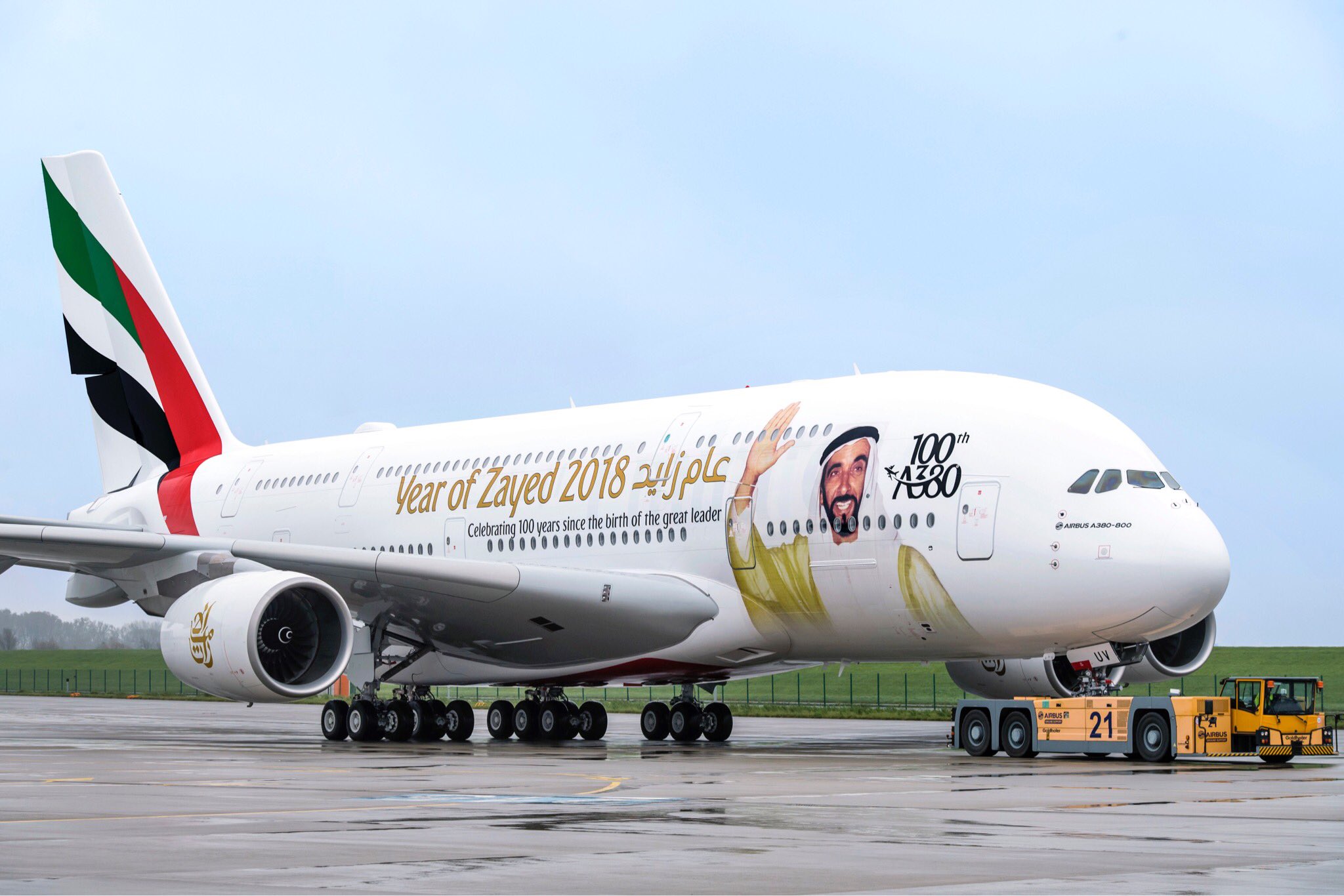
Figure 1. The 100th A380 delivered to Emirates Airlines today in Hamburg. Source: Airbus.
50% increase in CSeries sales forecast–but what does this mean?
Nov. 1, 2017, © Leeham Co.: For years, Bombardier forecast the 20-year market demand in the 100-150 seat sector as between 6,000 and 7,200, depending on the  year of the forecast.
Airbus in 2014, the last year the OEM segmented the sector in its 20-year forecast, predicted a demand of 4,363 aircraft.
Boeing, which hasn’t publicly segmented the sector, is believed to have forecast a demand between 4,185 and 6,275 in 2013, based on information revealed during various executive presentations. The mid-point was 5,230.
In announcing the acquisition by Airbus of 50.01% of the CSeries program, Airbus CEO Tom Enders cited a 20-year demand of 6,000 aircraft.
Bombardier consistently claimed it would capture 50% of the demand it saw, or 3,000 to 3,600 aircraft, over 20 years.
But the numbers don’t match up.
Why is Airbus A330-800 not selling?
By Bjorn Fehrm
Introduction
November 02, 2017, © Leeham Co.: Airbus A330neo flew its first test mission two weeks ago. The test aircraft was the bigger A330-900, the neo version of the A330-300. For the present A330, the sales and delivery of A330-300 (the 290-seater) and the A330-200 (the 246-seater) is almost even, 720 versus 650 (including 70 MRTT and Freighters for the -200). But sales of the -300 in recent years far outpaced the -200, for which sales virtually dried up.
For the A330neo version, the A330-800 is not selling at all. Six aircraft are on order for Hawaiian Airlines while 211 are ordered for the A330-900. Why?
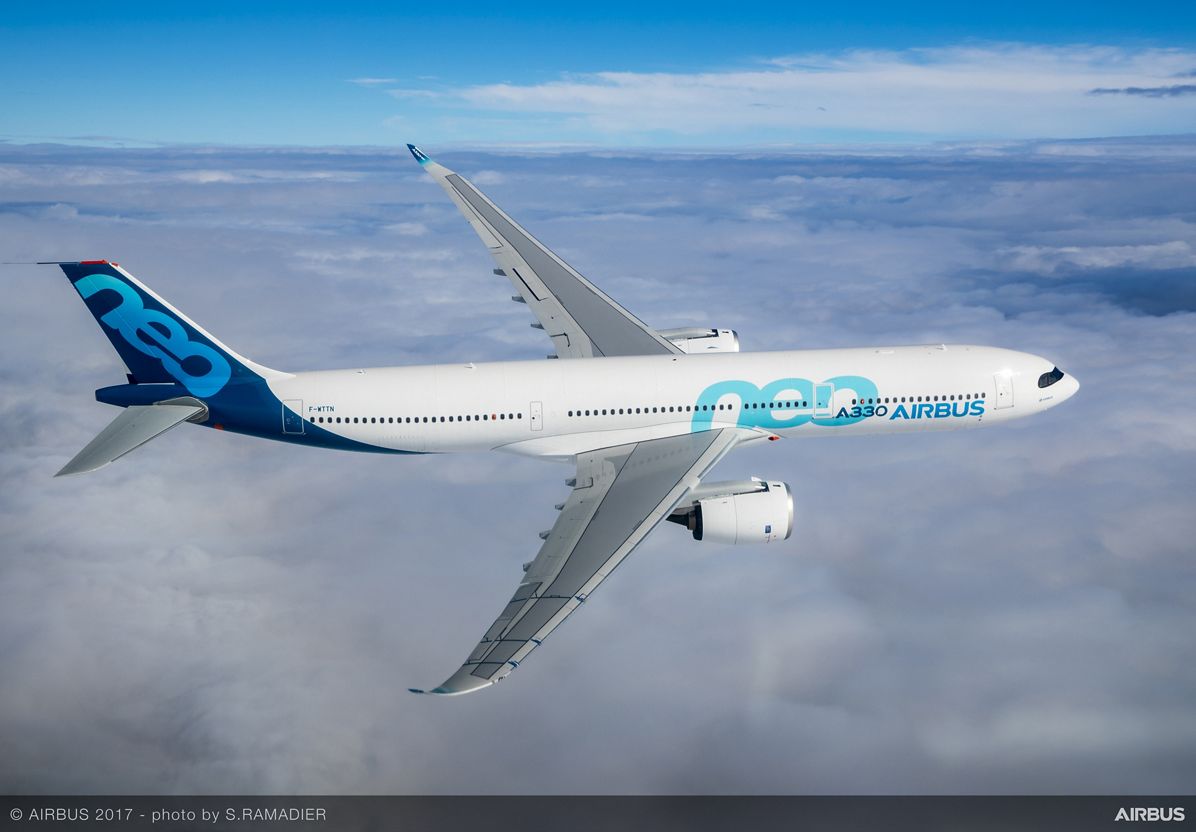
A330-900 during its first flight. Source: Airbus.
We decided to use our performance model to understand why the smaller, longer range A330neo has fallen from grace.
Summary:
- The A330-800 flies longer and with lower fuel burn than the A330-900.
- But the differences are not large. And fuel costs are no longer a dominating cost in the overall cost picture.
- For other costs, the types are too similar. The A330-800 doesn’t have any scale advantages over the A330-900; only range, and the A330-900 is flying longer and longer.
New pictures of the changed Sharklets for A350
By Bjorn Fehrm
November 01, 2017, © Leeham Co: We exclusively revealed last week that Airbus is working on new winglets for the A350 series. The new Sharklets were caught during flight-testing on Airbus A350 test aircraft, MSN001.
Jujug Spotting in Toulouse has provided us with new, better photos of the tests. With these, one can better estimate the changes and their effect.
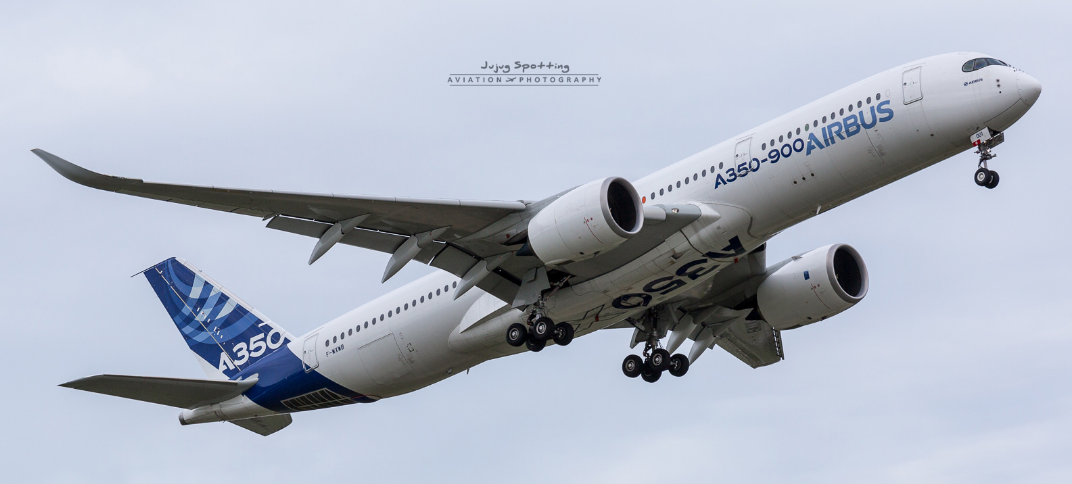
Figure 1. A350-900 test aircraft MSN001 flying with larger Sharklets. Source: Jujug Spotting.