
Leeham News and Analysis
There's more to real news than a news release.


Maeve, P&W Canada team for new hybrid propulsion system airplane
By Bjorn Fehrm and Scott Hamilton
July 24, 2024, © Leeham News at Farnborough International Airshow: Start-up airplane company Maeve and Pratt & Whitney Canada (PWC) have teamed for the design of a new eco-airplane driven by a new type of hybrid electric propulsion system with a target service entry date of 2032.
The M80 aircraft is the latest iteration of a design conceived by Maeve of the Netherlands. It is a 76 to 96-seat twin-engine aircraft that is compliant with the restrictive US pilot Scope Clauses, which limit the size, number, and weight of airplanes operated on behalf of US major airlines. Maeve originally designed a four-engine, 44-passenger electric aircraft called the M01.

Figure 1. The Maeve M80 combines an all-new powerplant from Pratt & Whitney Canada and downward wing droops instead of upward winglets. Source: Maeve.
Bjorn’s Corner: New engine development. Part 16. Compressor air use.

By Bjorn Fehrm
July 19, 2024, ©. Leeham News: We do an article series about engine development. The aim is to understand why engine development now has longer timelines than airframe development and carries larger risks of product maturity problems.
To understand why engine development has become a challenging task, we need to understand engine fundamentals and the technologies used for these fundamentals.
We have covered the problem areas of a compressor and how these achieve power-to-air-pressure conversion efficiencies of over 90% by using advanced 3D airflow modeling. Now, we look at the users of the air from the engin’s compressor.
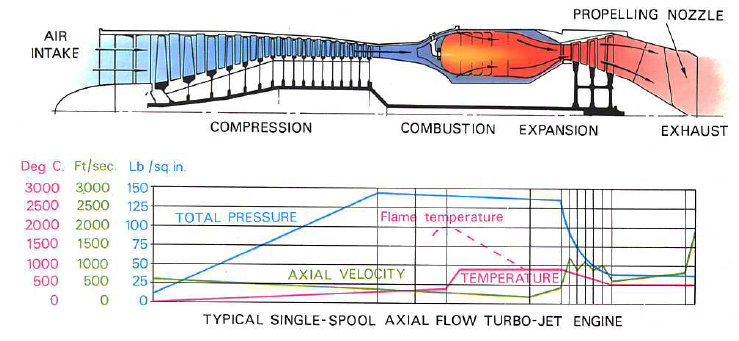
Figure 1. The gas turbine cycle and its parts. Source: Rolls-Royce: The Jet Engine.
Bjorn’s Corner: New engine development. Part 15. Compressor efficiency.
By Bjorn Fehrm
July 12, 2024, ©. Leeham News: We do an article series about engine development. The aim is to understand why engine development now has longer timelines than airframe development and carries larger risks of product maturity problems.
To understand why engine development has become a challenging task, we need to understand engine fundamentals and the technologies used for these fundamentals.
We covered the problem areas of a compressor last week. Now, we will discuss how modern compressors can have over 90% conversion efficiency from turbine power to air compression.
Figure 1. The gas turbine cycle and its parts. Source: Rolls-Royce: The Jet Engine.
Bjorn’s Corner: New engine development. Part 13. The compressor.
By Bjorn Fehrm
June 28, 2024, ©. Leeham News: We do an article series about engine development. The aim is to understand why engine development now has longer timelines than airframe development and carries larger risks of product maturity problems.
To understand why engine development has become a challenging task, we need to understand engine fundamentals and the technologies used for these fundamentals.
We have covered the need for the axial speed of the core air to decrease and increase depending on the needs of the core engine’s sections. Now, we will start to look at the different parts of the core in more detail. We start with the compressor.
Figure 1. The gas turbine cycle and its parts. Source: Rolls-Royce: The Jet Engine.
Airbus lowers 2024 guidance amid A320/A321 supply chain and space system challenges
Bjorn Fehrm
June 24, 2024, © Leeham News: Airbus issued a press release today where it lowered guidance for 2024.
The release highlighted two areas as the drivers for the update:
- Larger-than-expected supply chain issues for the single-aisle segment (A320/A321), where delivery ramp problems in engines, aerostructures, and cabin equipment mean that the guidance for 2024 goes from 800 aircraft in total to 770. Because of this, the ramp to 75 A320/A321 deliveries per month has been moved out a year to 2027 instead of as previously forecasted 2026.
- The Defence and Space Systems management has, after an extensive review, found schedule, workload, and sourcing challenges for certain Space telecommunications, navigation, and observation programs. Airbus has decided to record charges of around € 0.9bn in the H1 2024 report to cover the problems in these programs.
As a result, Airbus has decided to update the 2024 guidance ahead of its 1H2024 results release, which is on 30 July:
- Around 770 commercial aircraft deliveries (was 800).
- EBIT Adjusted of around € 5.5 billion (was €6.5bn to €7bn).
- Free Cash Flow before Customer Financing of around € 3.5 billion (was € 4bn).
Airbus adds the usual caveats to the guidance:
The Company assumes no additional disruptions to the world economy, air traffic, the supply chain, the Company’s internal operations, and its ability to deliver products and services. The Company’s 2024 guidance is before M&A.
Bjorn’s Corner: New engine development. Part 12. Speed change.
By Bjorn Fehrm
June 21, 2024, ©. Leeham News: We do an article series about engine development. The aim is to understand why engine development now has longer timelines than airframe development and carries larger risks of product maturity problems.
To understand why engine development has become a challenging task, we need to understand engine fundamentals and the technologies used for these fundamentals.
After covering the main thrust-generating device, which we can call a propeller, fan, or open rotor, depending on the application, we now look at the core, which provides the power to the thrust device. And there, we look at how we use the properties of the air as a gas to get it into a state that the gas turbine needs for different sections.
Figure 1. The gas turbine cycle. Source: Rolls-Royce: The Jet Engine.
Read more
Bjorn’s Corner: New engine development. Part 10. Propeller, Rotor or Fan?
By Bjorn Fehrm
June 7, 2024, ©. Leeham News: We do an article series about engine development. The aim is to understand why engine development now has longer timelines than airframe development and carries larger risks of product maturity problems.
To understand why engine development has become a challenging task, we need to understand engine fundamentals and the technologies used for these fundamentals.
Following the last Corner on airframe integration, several comments were made about the definition of propeller, open rotor, and/or fan. So, we’ll explore this further.
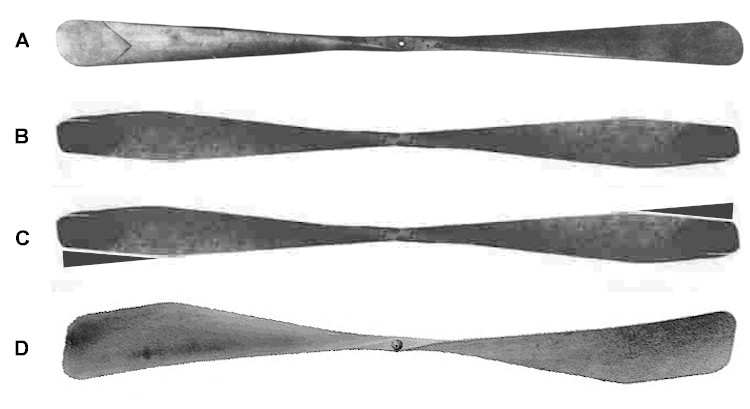
Figure 1. Evolution of Wright Brothers propellers from 1903 to 1905. Source: wright-brothers.org
The all-important cabin. Part 2
Subscription required
By Bjorn Fehrm
May 30, 2024, © Leeham News: We will do an article series about the all-important cabin and its seating for an airliner. The cabin layout and its comfort are the most important part of an airliner for the passenger. For an airline it’s its face to the customer.
We will look at the different types of cabins used and how these use the airliner’s real estate, what the cost is, and what the weight is. With the weight, we can also predict how different cabins affect the aircraft’s performance.

Summary:
- The configuration of the cabin has a large influence on total seating, weight, and cost.
- The relationships change up to 500%.
Bjorn’s Corner: New engine development. Part 9. The role of the Nacelle
By Bjorn Fehrm
May 24, 2024, ©. Leeham News: We do an article series about engine development. The aim is to understand why engine development now has longer timelines than airframe development and carries larger risks of product maturity problems.
To understand why engine development has become a challenging task, we need to understand engine fundamentals and the technologies used for these fundamentals.
In the last Corner, we looked at why Open-Rotor engines have two fan stages, either both rotating in different directions or one rotating followed by a de-swirling stator stage. Now we study the flow field ahead of and around the fans to understand the role of the nacelle and the open rotor spinner.

Figure 1. A graphic showing the different parts of a Pratt & Whitney PW1100G nacelle. Source: Pratt & Whitney.
Bjorn’s Corner: New engine development. Part 6. Open Rotor
By Bjorn Fehrm
May 3, 2024, ©. Leeham News: We do an article series about engine development. The aim is to understand why engine development now has longer timelines than airframe development and carries larger risks of product maturity problems.
To understand why engine development has become a challenging task, we need to understand engine fundamentals and the technologies used for these fundamentals.
We have in previous Corners discussed geared versus direct-drive turbofans. Now the time has come to discuss Open Rotor engines.

Figure 1. The GE 36 Open Rotor engine, the father to today’s CFM RISE. Source: GE Aviation.