It’s an unusually busy news day for a Friday. Bombardier received its clearance from Transport Canada to conduct the first flight of the CSeries. BBD has not announced a date, which will be contingent upon weather and the airplane, but word has leaked out that BBD has a VIP event of some kind on Sept. 17, a Tuesday. The Toronto Globe and Mail reported the date but BBD told the paper that date remains tentative and it is not necessarily the date the first flight will take place. Reuters reports the first flight should precede the 17th. The Financial Post reports that the CSeries will fly during the Sept. 17 event, which is to celebrate the launch for the flight testing program.
BBD will webcast the first flight here.
Here is BBD’s press release about receiving Transport Canada’s authorization.
The other big news today is the win by American Airlines and US Airways for a November 25 trial date over the US Department of Justice lawsuit seeking to block the merger. The lawsuit is also holding up American’s exit from bankruptcy. The federal judge overseeing the bankruptcy case set a hearing on Sept. 12 on motions to approve AA’s exit.
DOJ sought a March trial date, a delay which would have effectively killed the merger as much as the lawsuit itself might. DOJ opposed the early date.
Separately, Boeing is conducting ground tests in preparation for the first flight of the 787-9. No date has been set for the flight.
Posted on August 30, 2013 by Scott Hamilton
MAKS Air Show Summary: This account summarizes the orders placed at the Moscow Air Show, known as MAKS. It appears only Bombardier among Western OEMs made any commercial deals.
Looking at Airbus: Aspire Aviation takes a long look at Airbus.
A350 Launch Aid: Airbus and Germany are at odds over more than 600m Euros of a 1.1bn Euro loan for development of the A350 XWB. The sticking point: job allocation. Why Airbus needs or wants this government-sponsored launch aid remains a mystery to us. Get the governments out of its knickers and be a true commercial company.
Slow freighter sales: This report details slow freighter sales for Boeing and Airbus. This is reflected in the poor sales of the Boeing 747-8F and the Airbus A330-200F.
Posted on August 30, 2013 by Scott Hamilton
Airbus, Boeing, Bombardier, Irkut, Sukhoi
747-8F, A330F, A350, Airbus, Aspire Aviation, Boeing, Bombardier, MAKS
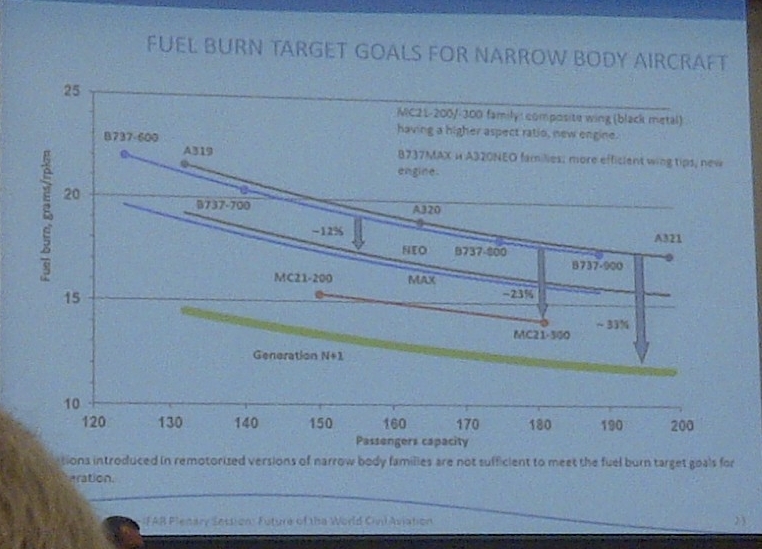
Russia’s Irkurt claims its MC-21 mainline jet, a direct competitor to the Airbus A320/321neo and Boeing 737-8/9 MAX, will be some 10% more economical. Irkut claims the MC-21 will be up to 23% more efficient than the current engine-powered Airbus and Boeing products.
Thanks to a reader who is at the MAKS air show, we received this photo from a slide presentation. Although others may have seen this information before, this is the first time we have.
Other MAKS news:
In other news, Boeing and Canada’s WestJet announced a letter of intent for 65 737 MAXes: 25 MAX 7s and 40 MAX 8s. This will enable WestJet to expand and replace its 737 NG fleet. Delivery begins in September 2017, making WestJet one of the first operators.
Bombardier scored a huge deal at the Russian air show, MAKS, with a letter of intent for an order for up to 100 Q400 turbo-props.
The Q400 has been trailing rival ATR, which is half owned by Airbus parent EADS, for the ATR-72 turbo-prop, by a wide margin in recent sales. ATR recently obtained third-world, gravel runway certification for its airplane.
The BBD deal includes the potential of establishing a second Q400 assembly line in Russia. The BBD deal is for 50+50 and isn’t expected to be completed until next year.
Bombardier has been making a major effort in Russia, placing used CRJ regional jets there, previous orders for the Q400 and an order for 32 CSeries. It’s also signed an agreement to explore customer support services for the Irkut MC-21 150-212 seat mainline jet.
Other MAKS news:
Posted on August 28, 2013 by Scott Hamilton
It’s Actually is Rocket Science: It’s a clever headline from Bloomberg News, explaining why new airplane programs are delayed.
Focusing on smaller airplanes: Steven Udvar-Hazy, one of the craftiest executives in commercial aviation, is profiled in this LA Times story. He discusses his focus on smaller aircraft for his Air Lease Corp.
Boeing 787-9: Boeing rolled out the first 787-9 and is readying pre-flight tests.

Boeing photo
More analysis on DOJ vs AA-US: Here is Part 2 of Airchive’s analysis of the Department of Justice case seeking to block the American Airlines-US Airways merger.
Posted on August 26, 2013 by Scott Hamilton
Replacing the venerable Boeing 747-400s remaining in passenger service is a prime objective of Boeing and of Airbus. The business case for their respective 747-8Is and A380s rests in large part on this approach, though for Airbus the A380 business case also rests on passenger traffic doubling every 15 years and restricted airport slots.
Replacing the 747-400, in fact, doesn’t leave a lot of room. There are just 306 passenger models remaining in service, including VIPs and government uses, according to data provided Leeham News. There are another 23 747-400C (Combis) remaining in service.
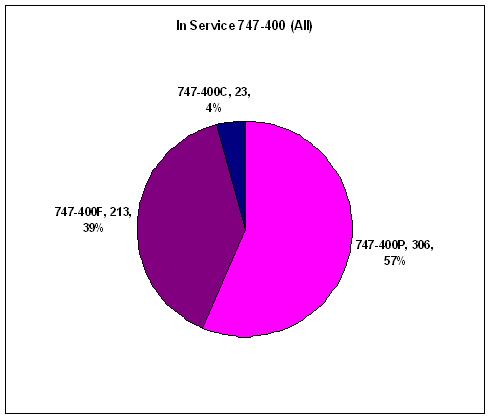
Data at July 2013.
Fully 42 747-400 passenger models are in storage. Many 744 “Ps” have been converted to cargo airplanes, supplementing new-build 747-400Fs (above). The 744Ps in storage and in service are obvious candidates for conversion to freighters, and there are a number of 744Fs in storage ready to return to service when the slow-moving global cargo demand recovers–which has proved to be a maddening slow process.
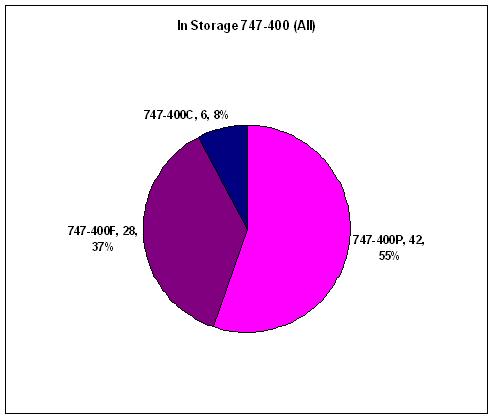
Date as of July 2013
Airbus has been more successful selling its A380 to 747-400 operators than Boeing has in selling its 747-8I. Airbus has likewise been more successful at selling the aircraft to non-747-400 operators, though the customer quality in several cases was dodgy. Kingfisher Airlines has collapsed and it’s unlikely Hong Kong Airlines will take delivery of the A380, openly talking about swapping these orders for smaller aircraft.
And therein lies the rub.
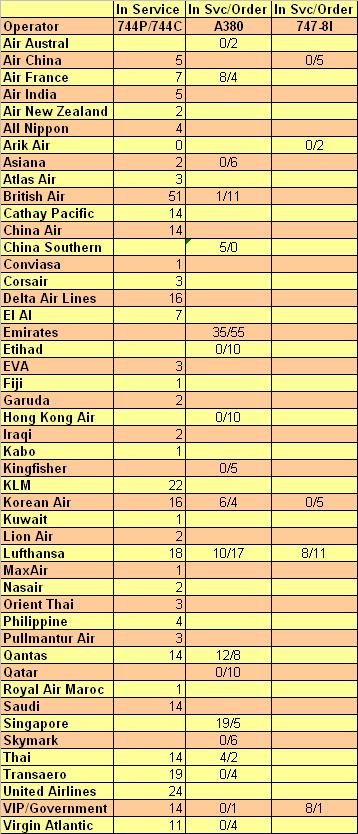
Sources: Airbus, Boeing, Ascend at July 2013
Update: Typo on the Lufthansa remaining orders for A380s: 7, not 17.
Posted on August 26, 2013 by Scott Hamilton
Lufthansa’s Pending Order: As we have written on previous occasions, Lufthansa Airlines has been preparing a large order for twin-aisle, twin-engine aircraft: 50 or more. We’d noted that the order was likely due in September.
Aviation Week has this update.
Mitsubishi MRJ v Embraer E-Jet E2: Flight Global reports that the Japanese OEM says the latest 15 month delay won’t hurt sales of the MRJ (to which one wag notes it’s not selling well anyway–there are only three customers), but what caught our eye is the Mitsubishi reference comparing the MRJ with the Embraer E-Jet E2. This is like the debate of new vs re-engine between Bombardier’s CSeries and the smallest Airbus and Boeing products.
MAXimizing space: Boeing shifted work around at its Renton (WA) factory as it prepares for production of the 737 MAX. The Seattle Times has a good wrap up.
Posted on August 23, 2013 by Scott Hamilton
Airbus, Boeing, Bombardier, CSeries, Embraer, Mitsubishi
737 MAX, 777X, A350, Airbus, Boeing, Bombardier, E-Jet E2, Lufthansa, Mitsubishi, MRJ
China’s military continues to so control–and close airspace–in China that delays are rampant, this AP story reports. We’re reminded on the era when we were doing business in China, going there nine times in a 4 1/2 year period from December 1988-mid 1993.
Visiting a number of airlines there, one of which was operated by the military, along with CAAC, CASC and the McDonnell Douglas Shanghai factory, we were struck by the low aircraft utilization: only six or seven hours. Western standards were 10 or more. Even then, we were told, the military control of the skies was a key factor. The low utilization rate then clearly contributed to the need to buy more airplanes to meet traffic growth than was necessary. We haven’t seen any data on today’s utilization rate, but we have to believe this nexus remains.
Flying Chinese carriers then was pretty alarming at times. A ramp worker smoked while refueling a plane, with the refueling connection spraying fuel on the ramp. Carry-on baggage was in the aisle on take off. A person was in the lav on take off. We’ve read some stories in recent years that suggest not much has changed.
Back then, getting into China had limited options. We flew to Tokyo and pretty much had to take Air China into Beijing. A direct air route would go over Korea. We couldn’t go through North Korean air space and apparently flying over South Korean to China was then forbidden, so we had to route south around the Korean peninsula, adding a great deal of time to the flight.
The McDonnell Douglas Shanghai factory was primitive even by standards of the day then, well before robotics and moving production lines. The factory was producing one MD-80 a month and the planes were essentially hand-built. This antecedent might be why the MD-80-looking ARJ21 is having such difficulty. The factory drew so much power that parts of Shanghai went brown-out or black-out during the day, an issue presumably long-since overcome in the Shanghai power grid.
The MD-80 plant was supposed to be MDC’s “in” to gain market share. While selling something like 40 MD-80s/90s (if memory serves) to China via this plant, the venture clearly was a failure and the Chinese used the operation to learn a bit about commercial aviation. Embraer had an ERJ plant in China for the same purpose, and likewise came up short of its goal while the Chinese benefited more. The Airbus plant in Tianjin seems to have been more successful, but we don’t think it’s coincidence that the COMAC C919 looks a lot like the A320.
Posted on August 23, 2013 by Scott Hamilton
Upgrades for the B-52: The USAF and Boeing are upgrading the Boeing B-52 bomber to further extend the service life. The LA Times via the Seattle Times has this story. This is remarkable; the B-52 was designed in 1948 to be the USA’s aerial backbone against the Soviet Union in the Cold War. It bombed Iraq in the 1991 Gulf War and continues to out-perform the B-1B bomber, which was supposed to replace the old gal, nicknamed by some as BUFF.
More on MRJ Delay: Mitsubishi made it official: the MRJ 90 passenger regional jet will be delayed another year. There are several stories via Google News; this Reuters piece is typical. Aviation Week has a good timeline recap.
Here’s how pending new airplane programs now appear to line up for Entry into Service:
| Original | Current | |
| CS100 | Dec-13 | e4Q2014* |
| MRJ | 4Q2013 | 2Q2017 |
| ARJ21 | 2006 | Good Question |
| C919 | 2016 | 2018–> |
| A320neo | Oct-15 | Oct-15 |
| 737-8 | Jul-17 | Jul-17 |
| 777X | e12-2019** | |
| EJet E2 | 2018 | 2018 |
| * One analyst suggests early 2015 | ||
| ** Market Intelligence estimate. | ||
We don’t have enough visibility on the Irkut MS-21 for inclusion in the Table.
Here’s a real oddity: A man in underwear broke into the German Chancellor’s airplane.
American-US Airways: Airchive has this long analysis (and it’s only Part 1 of 2), taking a look at the DOJ complaint. It’s 15 pages even after copy-and-paste into Word and re-sized to 10 point type.
Posted on August 22, 2013 by Scott Hamilton
AA-US Merger: Plane Business made available Aug. 21 its previous analysis of the proposed American Airlines-US Airways merger outside its paywall.
The analysis of the government’s analysis is pretty devastating to the government’s case. Read it and judge for yourself.
American’s general counsel, meanwhile, writes (in a report in The Dallas Morning News) that there is no Plan B to exit bankruptcy if the merger with US Airways is successfully blocked by the Department of Justice. Instead, AA would have to create a new bankruptcy-exit plan and return to all creditors and the court. This would take probably another couple of years, making it one of the longest (if not the longest) Chapter 11s in airline history–with all the related uncertainty to those affected by a Chapter 11. This is unfair to creditors and employees, and it will also wipe out any gains shareholders obtained in the current plan.
The DOJ clearly failed to take into account these impacts.
Air Canada eyes CSeries: The Globe and Mail reports that Air Canada is considering the Bombardier CSeries to replace the aging Embraer E-190 and Airbus A319 fleets. We expect the competition to be fierce: Airbus will certainly do what it can to block this sale (through pricing, no doubt) and we wouldn’t be at all surprised if Brazil would offer export financing for a replacement E-Jet fleet–something Bombardier can’t match because of the so-called Home Country rule prohibiting government financing for home-country airlines.
And then there is Boeing. The entire Airbus fleet is getting long in the tooth and our market intelligence tells us Air Canada is running a full narrow-body competition between Airbus and Boeing.
A re-fleeting decision is expected by year-end.
MRJ First Flight Delay: It’s been widely hinted, but now a supplier told Flight International that the first flight of the Mitsubishi MRJ is delayed to the end of 2014.
Posted on August 21, 2013 by Scott Hamilton

