
Leeham News and Analysis
There's more to real news than a news release.


Repost: Pratt & Whitney GTF program update at PNAA conference, plus Q&A PW, RR and GE
Due to technical issues we don’t begin to understand, the PW GTF engine program update didn’t display the videos, only the links. We are re-posting to correct the situation because we couldn’t fix it within the original post.
Bob Saia, VP of Next Generation Engine development at Pratt & Whitney, provides a program update of the Geared Turbo Fan engine and its prospect of growing into a “Big Engine” serving the twin-aisle market. He appeared at the Pacific Northwest Aerospace Alliance 2014 conference in the Seattle area last week.
.
[youtube=http://www.youtube.com/watch?v=CYUUtVEKhIs]
.
http://www.youtube.com/watch?v=02RgF1So-X4
Questions and Answers
The following videos are questions and answers of the representatives of the Big Three engine manufacturers. Sound is soft on these two videos; best to use headphones.
.
[youtube=http://www.youtube.com/watch?v=nArLnhsMraE]
.
[youtube=http://www.youtube.com/watch?v=-Wtqr4FavP0]
Rolls-Royce Trent engines program update at PNAA conference
Bill Boyd, senior vice president of Rolls-Royce, provided a program update of its Trent engines that are being developed for the Airbus A350 XWB. He appeared on a panel with GE Aviation and Pratt & Whitney. He appeared at the 2014 Pacific Northwest Aerospace Alliance conference last week in the Seattle area.
Sound is soft; use of headphones is recommended.
http://www.youtube.com/watch?v=5Ps_BuG1_JQ
.
http://www.youtube.com/watch?v=Y2Lgs-oGJYg
.
http://www.youtube.com/watch?v=Euo3TJZlQyc
Updating the A380: the prospect of a neo version and what’s involved
Recent headlines and this column report that Airbus is considering re-engining the popular A330 with GE Aviation GEnx or Rolls-Royce Trent 1000-TEN power plants. A New Engine Option and other changes would improve the A330’s economy by an estimated 10% percent after offsets for increased drag and weight.
But the A330 isn’t the only Airbus airplane being considered for new engines made popular by the A320neo family. Tim Clark, president and chief operating officer of Emirates Airlines, urged Airbus to improve efficiency of the giant A380 with engine technology found in newer generation aircraft.
How feasible is an A380neo? What are the technological issues? Would there be enough of an economic gain? And is there a market for an A380neo?
The A380 of today
The A380 has been hailed as a highly efficient airliner since it went into service 2008, assuming the giant plane can be filled. But only six years later, the first voices have been raised that this will not continue to be the case should the continuous improvements that have been flowing into the airframe not pick up speed.
The launch of the Boeing 777X also brought focus on the state of the A380 come the latter part of this decade when the 777-9X enters flight testing in advance of its planned 2020 entry-into-service. Tim Clark expressed that “it is time that the A380 gets an injection of the new technology which is now becoming available for the A320/737 in the form of GTF/LEAP and GE9X for the 777X. “
Before we look into what can be done short-to–mid-term to inject improved efficiency, let’s establish the baseline as it exists today. The A380 is considered by some the most efficient way of flying passengers between two long haul points if there is enough of demand. The competition today is the Boeing 777-300ER and 747-8i. (Qantas Airways is dropping some A380 flights that have 50% load factors, demonstrating the aircraft is inefficient if the demand is insufficient.)
Let’s assume we want to transport passengers between San Francisco and Hong Kong, one of the longer flights which are made non-stop in both directions. Going West, it takes a Cathay 777-300ER 15 hours and going East, 12 hours, the difference being due to prevailing headwinds going West. For our check, we will use the more demanding of these legs, which then works out as the equivalent of flying 7,200nm. To compare the three different aircraft in a fair way, we need to load them to the same payload, in our case passengers with luggage. We will not consider cargo in this initial analysis. The leg chosen is not one which allows much weight for cargo, but cargo certainly belongs to a complete analysis of an airplane and we will point out where it will affect any conclusions.
When comparing the standard three-class seating numbers between the OEMs, it is clear these are not made to the same standards of comfort. Airbus has admitted that the A380 is too lightly loaded at 525 passengers. The 777-300ER at nine abreast and 365 seats is equipped with a comfortable 18’’ economy class at 32’’ pitch but the business class is modeled with a non-standard 48’’ pitch. The 747-8i at 467 seats is not laid out to any comfort standards comparable to the other two. To ensure an apples-to-apples comparison we have equipped all aircraft with the same three-class cabin with a standard seating consisting of first class at 81’’ pitch, business class at 60’’ pitch and economy class with 32’’ pitch. Seat widths are 37’’, 22’’ and 18’ respectively and the ratios of the different premium seatings vs. economy are kept the same. Here the aircraft are listed with the in-service year and with their respective payload capabilities:
Odds and Ends: A330neo decision could be near; KC-46A; Countdown to Superbowl; A400M
A330neo decision: Aviation Week reports that a decision to proceed with the Airbus A330neo could be “imminent.” The report also discusses the advocacy by Tim Clark, COO of Emirates Airlines, to re-engine the Airbus A380. As with the Reuters and Bloomberg articles we previously linked, the Aviation Week piece also confirms much of what we were the first news outlet to report in December. We have a launch in 2014 rather than 2015 reported in Aviation Week, although we both have a decision to proceed for this year. Aviation Week and Bloomberg report that the decision could come as early as March.
Aviation Week confirms our report that Pratt & Whitney would be unlikely to bid on the project because the short time lime precludes development of the big engine version of the Geared Turbo Fan.
KC-46A at ‘high risk’ for delay: A US government report suggests the Boeing KC-46A tanker is at ‘high risk’ of a six month delay.
These are not unusual for military programs, nor, it seems, is it any longer unusual for new or derivative aircraft programs. Boeing believes the program is on time, but even if a six or 12 month delay does emerge, by today’s standards, this indeed is “on time.”
Countdown to Super Bowl: Boeing painted a Boeing 747-8F test plane in the Seattle Seahawks livery and this week “skywrote” the number 12 on a flight. The Seahawks play the Denver Broncos Sunday in New Jersey for the Super Bowl. The number “12” represents “the 12th man,” of the collective Seahawks fan base.
We think it would be super for the 747 to overfly the game Sunday, the ultimate 12th man appearance. Alas, Boeing says there are no plans to do so.
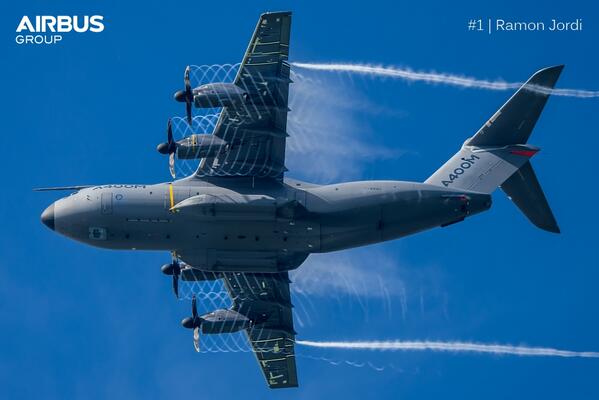
A400M: Cool picture. No other words needed.
Odds and Ends: CSeries timeline; KC-46A roll-out; China’s new airplane
CSeries timeline: Bombardier last week announced a third delay in the CSeries program, this time for as much as a year.
This probably should have been expected. BBD originally planned a five year period between program launch and entry-into-service. As we saw with the Boeing 787, launched with a four year timeline, even five years was too ambitious.
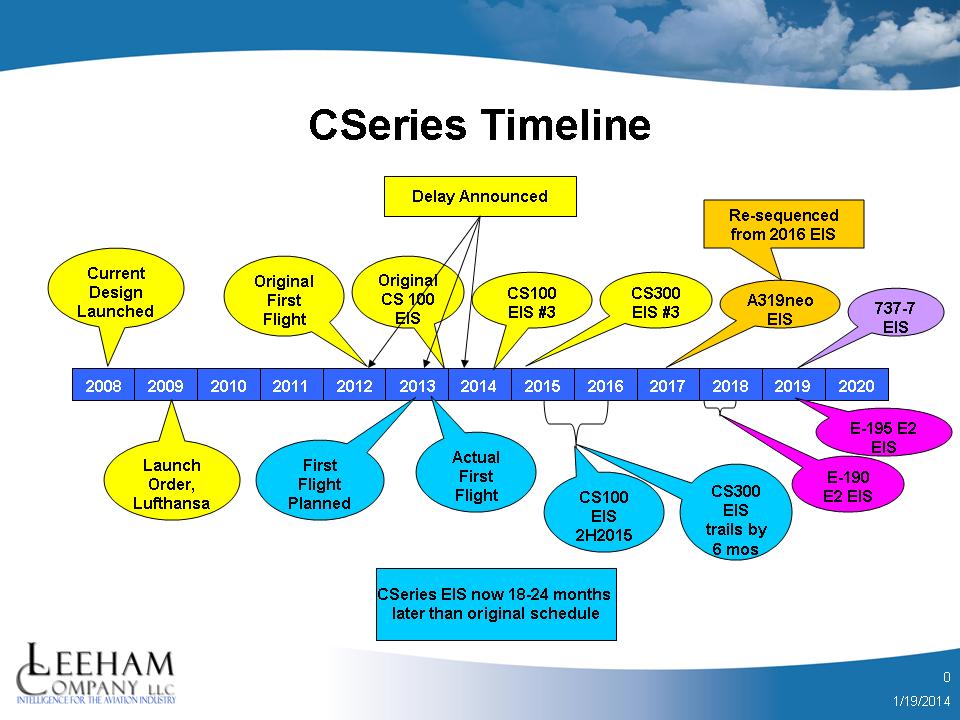
CSeries Timeline. Leeham Co Chart
The EIS period for the 787 turned out to be the standard seven years, almost eight–and even then, the EIS was anything but smooth.
Airbus’ launch-to-EIS for the final A350 version is somewhat more than eight years. Even though BBD is a sub-contractor on the 787 program and said it benefited from lessons learned, it’s clear officials were far too ambitious.
KC-46A roll-out: Boeing’s first tanker for the USAF based on the 767-200ER will roll out this summer. The Everett Herald has this story. The airplane is a somewhat revised 767-200ER called the 767-2C. In addition to upgrades with the airframe, the Pratt & Whitney PW4000 engines will have upgrades which improve fuel consumption.
China’s new airplane: China isn’t just developing the ARJ21, C919 and some military airplanes. It’s also developing the world’s largest amphibian.
Embraer continues and refines its strategy at the low-end of 100-149 seat sector
While Airbus and Boeing slug it out in the competition for the duopoly and Bombardier struggles to gain respect as an emerging mainline jetliner producer, Embraer continues and refines its strategy in the smaller-end of the jet market with its E-Jets, E-Jet “Plus” (our term) and the E-Jet E-2.
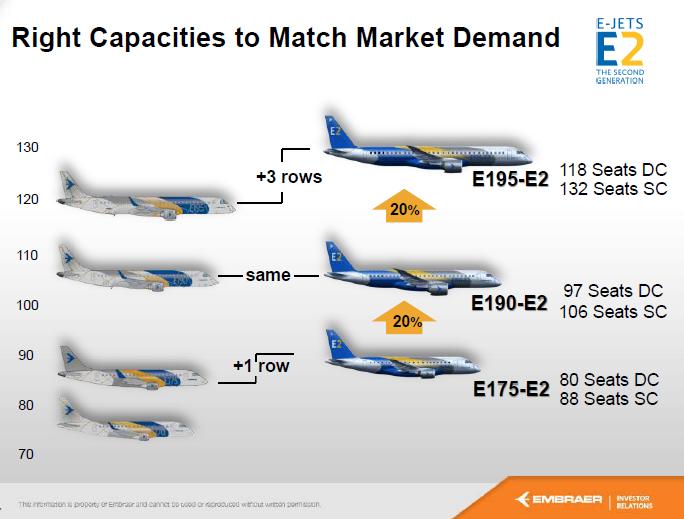
Source: Embraer, Reprinted with permission.
Embraer is broadening its offering from a maximum of 122 seats to a maximum of 132 and dropping its low-end E-170 from future variants. This brings the EMB family to 90-132 seats, following the decision to undertake an extreme makeover of the current E-175/190/195 line by adapting the Pratt & Whitney P1000 Geared Turbo Fan engine to a new wing design and upgrading a variety of systems in the E-Jet E2.
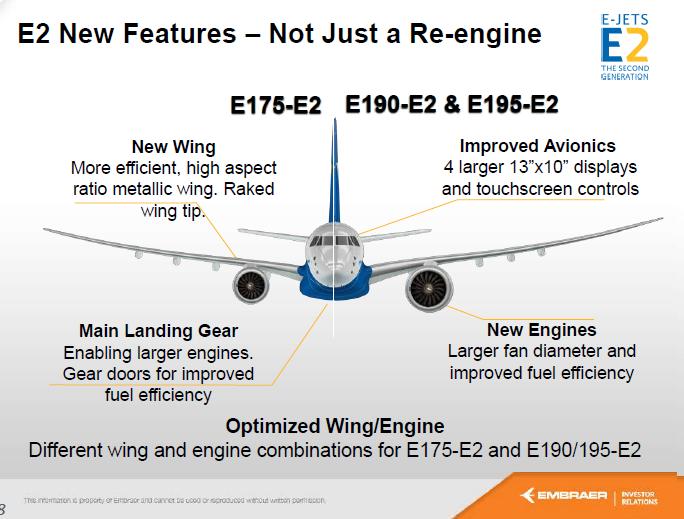
Source: Embraer. Reprinted with permission.
Is tide ready to turn for CSeries?

CS100 first flight, September 16, 2013. Photo via Seattle Times.
Is the tide ready to turn for the Bombardier CSeries?
Following a nine month delay, the CS100 Flight Test Vehicle #1 took to the air September 16. It’s flown only twice since and has been undergoing ground vibration tests and more software upgrades. BBD is pretty mum about the testing program, which causes speculation about whether some issue emerged during the three flight tests. But we’re told by a source familiar with the program, but who is not with BBD, that BBD is being conservative in its pace, counting on the fact that it will eventually have seven FTVs to bring entry-into-service on time. A few Canadian aerospace analysts think EIS will slip to 1Q2015.
Then there are the orders, just 177 firm, which is more than those for the Airbus A319neo and the Boeing 737-7 MAX combined, but which the market perceives as low and a slow-selling program. Bombardier points out that the firm sales are about on par with other new airplane programs at this stage, but the market–dazzled by the thousands of orders placed for the NEO and MAX–won’t make these distinctions.
But it’s possible the tide is ready to turn for the CSeries. Here’s why.
- Potential customers have been waiting for the first flight and to see whether the program will be more or less on time with the new, implied schedule emanating from first flight. We believe a few more months have to pass before any conclusions are drawn on this score.
- Likewise, a few months have to pass before Bombardier and Pratt & Whitney will know whether the economic promises will in fact be achieved.
- There are some key sales campaigns for which decisions should be made in the coming months, both this year and into next, that if BBD wins will serve to build significant momentum.
- Airbus is running out of delivery slots for the entire A320 family. The VivaAerobus order announced October 21 includes deliveries beginning next year. The backlog goes to 2019-2020, and while John Leahy, COO-Customers, is adept at finding slots through juggling the skyline, there simply aren’t too many left mid-term. Bombardier is sold out into 2016 and is a better position to offer deliveries in quantity. This makes it difficult for Leahy to “buy” a deal, which he has done on several occasions, to under-price CSeries to a point where BBD can’t play in the sandbox.
- Boeing remains more focused on the 737-8/9 than on the 737-7, leaving BBD to largely fight its war against the diminishing Airbus and the forthcoming Embraer E-190/195 E2, the latter with a planned EIS of 2018, a good three years after CS100 enters service.
It will likely be next year before solid trends are noticeable. BBD retains its goal of reaching 300 firm orders and 20-30 customers by EIS, at least a year from now. We think this is easily achievable.
Update, Oct. 22: The Iraq-Business News reports that the government has approved the purchase of five CS300s at $40m each.
Odds and Ends: Supply chain demands; Southwest hints?; Retrospective on A320/737 replacements
Supply chain demands: Earlier this week, we talked about the prospect of production wars as Airbus and Boeing ramp up over the next five years, combined with the new entrants and the new offerings from Bombardier and Embraer.
We noted that this will mean opportunity and risk for the supply chain. Ryan Murphy from Salem Partners has a long analysis the starts with the finishing sector but which goes beyond this to discuss the broader implications. It makes for an interesting read.
Southwest: Hints of things to come? Yesterday we wrote about Southwest Airlines and the demise of the Wright Amendment that restricts travel from Dallas Love Field. We suggested several routes that Southwest would launch from Love once the Amendment passes into history.
Here’s a display Southwest erected on its countdown to the end of the Wright Amendment. We think it hints at things to come. Going clockwise: Chicago, New York and Charlotte seem to be where the airplanes are going. Then Los Angeles and Salt Lake City seem to be implied destinations. But the last one? Boise, or some other obscure city?
Or are we reading too much into the placement of these airplanes?

Source: Dallas Morning News
Our thoughts:
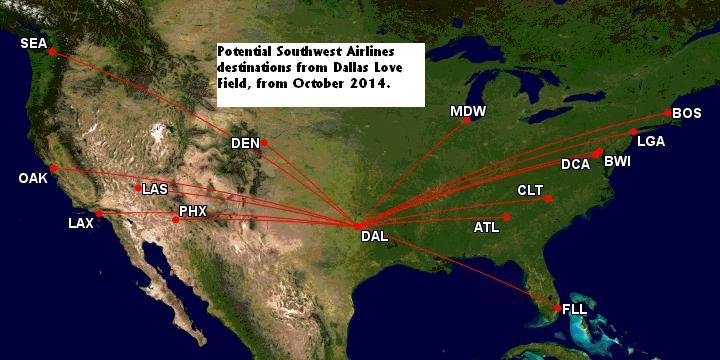
Retrospective: We were looking at previous posts for some specific information and in the process re-read one about replacing the Airbus A320 and Boeing 737. The post dates from 2009. In light of subsequent events, it makes for interesting re-reading. We discuss the internal views of Airbus and Boeing about replacement or re-engining their aircraft and the engines from Pratt & Whitney and GE Aviation/CFM. We also touch on Boeing leaning toward not replacing the 777.
Retrospective, Part 2: Airchive has a nice set of historical looks at the development of the Boeing factory at Everett: Part One and Part Two.