
Leeham News and Analysis
There's more to real news than a news release.


New technology for Boeing’s next new airplane
Subscription Required
By Scott Hamilton
Part 2

Brian Yutko, VP of Product Development for Boeing Commercial Airplanes. Credit: Leeham News.
April 13, 2026, © Leeham News: As Boeing considers its next new airplane, whatever it is, there is a plethora of issues that must be considered.
Last week’s article outlined a high-level view of Boeing’s future airplane programs. Today, LNA details some specifics that Boeing must consider before launching a new airplane program.
Brian Yutko, the VP of Product Development at Boeing Commercial Airplanes, declined to address any questions about new airplane development. However, at the retiree meeting of the Pacific Northwest chapter of AIAA (American Institute of Aeronautics and Astronautics) last month, Yutko discussed some of the issues Boeing will face in the coming years.
Related Articles:
Bjorn’s Corner: Blended Wing Body Airliners. Part 5

By Bjorn Fehrm
April 10, 2026, ©. Leeham News: We have started a series of articles on the Blended Wing Body (BWB) as a potentially more efficient design for passenger-carrying airliners than the classical Tube-And-Wing (TAW) configuration.
In last week’s article, we discussed how the wingspan is an important factor in an airliner’s takeoff performance. The induced drag is about 85-90% of the drag at the critical V2 point after rotation, where regulations require that a twin-engined airliner be able to fly on one engine with a climb rate of 2.4%.
We now go through the entire mission for a BWB airliner and compare its drag characteristics with those of a classical Tube-And-Wing (TAW) design.
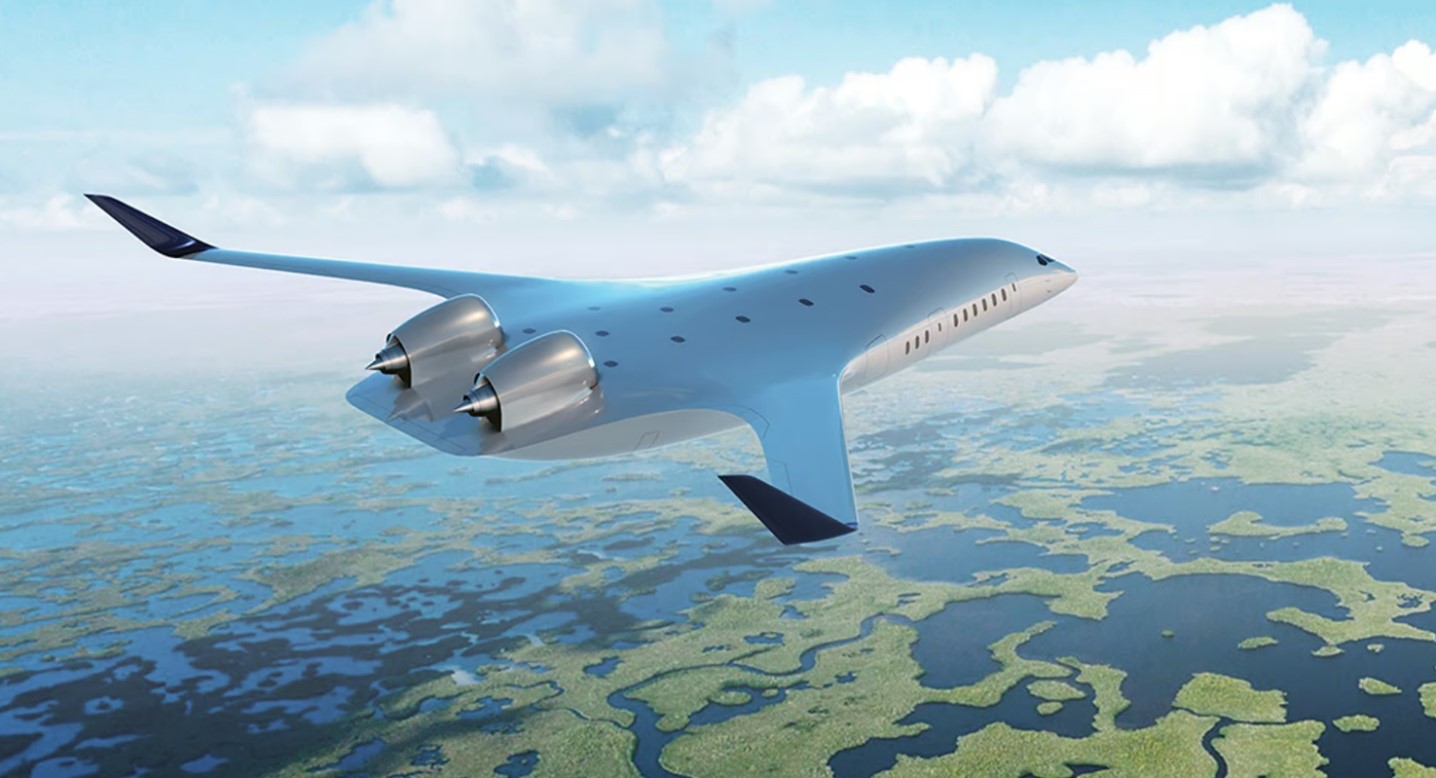
Figure 1. The JetZero Z4 BWB. Source: JetZero.
Boeing’s next airplane will eventually come; what will it be?
Subscription Required
By Scott Hamilton
Part 1
April 9, 2026, © Leeham News: CEO Kelly Ortberg has been clear: there won’t be any new airplane program launched until the airlines are ready, the technology is ready, and Boeing is ready.
Ortberg became CEO of The Boeing Co. on Aug. 8, 2024. One of his first decisions was to kill the research and development of a concept called the X-66A, the moniker for a Transonic Truss Brace Wing (TTBW) single-aisle airliner that could replace the 737 MAX in the coming decade.
However, he said that Boeing, coupled with NASA, would continue to research and develop an advanced wing for a new, highly efficient airplane. NASA, the National Aeronautics and Space Administration, has a long history of partnering with Boeing to evaluate new aerospace development.
Ortberg’s decision to kill the X-66A demonstrator project reversed a decision by the man he replaced, David Calhoun, who was the TTBW’s leading proponent within Boeing. Calhoun became CEO in January 2020 when his predecessor, Dennis Muilenburg, was fired during the prolonged 737 MAX crisis.
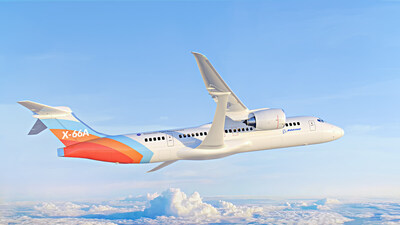
Figure 1. The Boeing-NASA concept X-66A TTBW airplane. Source: NASA.
One of Calhoun’s first decisions was to kill the R&D project of a New Midmarket Airplane (NMA), a twin-aisle design roughly the same dimensions as the Boeing 767-200ER and -300ER. The NMA had been under study since at least 2012. Muilenburg was on the path to seek board approval to launch this program in 2019, when the MAX was grounded by global regulators. Calhoun, the lead director, didn’t support the plane. With Boeing’s cash-cow 737 grounded, Calhoun used the crisis to kill the NMA. Given the billions of dollars in losses Boeing was and would incur, the decision was an obvious one.
Related Article
Boeing’s 30-year march to its next new airplane
Subscription Required
Open to All Readers
By Scott Hamilton
Background
April 6, 2026, © Leeham News: Depending on what starting point you want to choose, it will be up to 30 years between brand new, clean sheet airplane designs at The Boeing Co.
Boeing announced its 787 program in December 2003, with a formal launch the following spring. The entry-into-service goal for the 787 was May 2008. Boeing planned to design a replacement for the aging 737 platform after the 787 entered service. A new design for replacing the 777 was supposed to come after that.
The 787’s EIS date came and went as design and production problems added up to 3 ½ years of delay.
With cost overruns, deferred production, and deferred tooling costs totaling more than $50bn, plus several billion more dollars written off for research and development and abnormal production costs, the 787 still has more than $14bn in deferred costs to recover.
Delays and cost overruns hurt the 747-8 program. The 2019 21-month grounding of the 737 MAX resulted in billions more in charges. The January 2024 door plug blowout on a new Alaska Airlines 737-9 hurt recovery. Scrutiny by the Federal Aviation Administration (FAA) continues to this day. Production rates for the 737 and 787 are well below those that predate the MAX grounding. Certification of the 737-7, 737-10, and 777X remains a hope, not a reality, so far.
A plethora of losses, charges, and delays in defense and space programs added to the losses. Boeing’s long-term debt in 2018, its last normal year, was over $10bn. Today, it’s over $54bn, with big repayments coming soon.
Boeing’s next new airplane program remains years away.
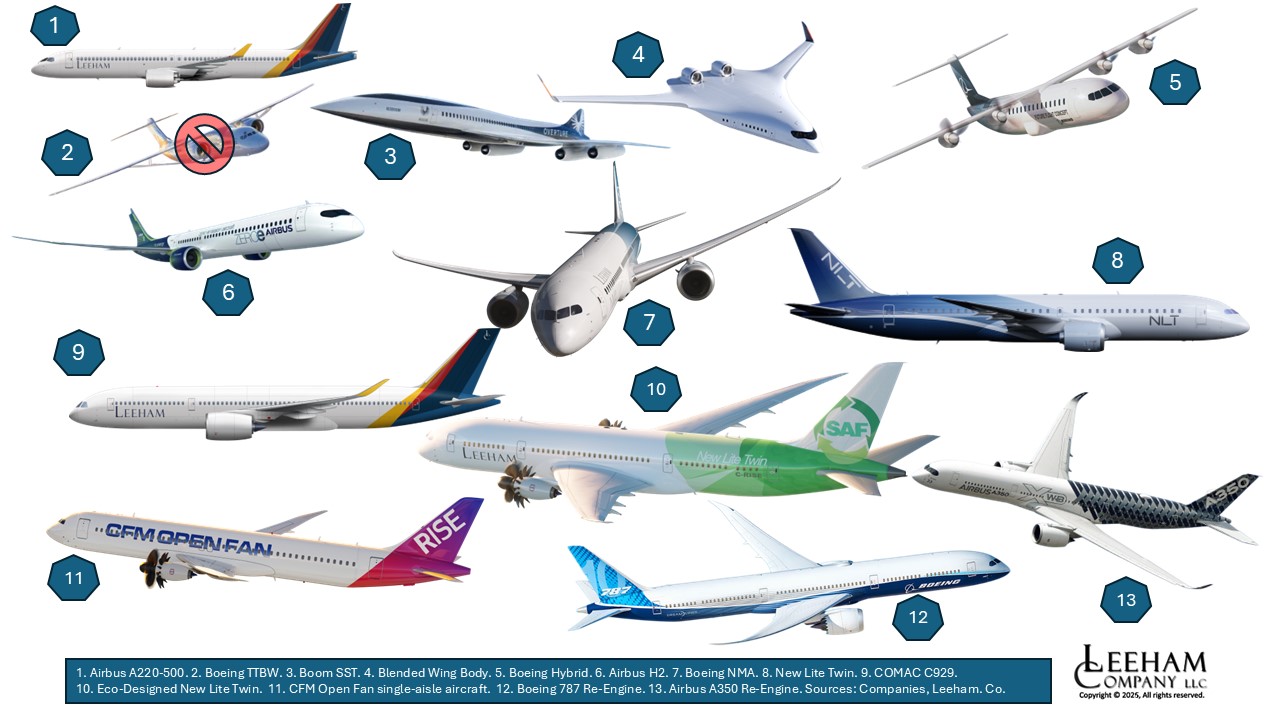
What will Boeing’s next new airplane be? We have a pretty good idea. A new series beginning Thursday explores this question. Credit: Leeham News.
What’s the next new aircraft, Part 4
By Bjorn Fehrm
Subscription Required
July 28, 2025, © Leeham News: In Part 4 of our five-part series on examining the potential next generation of aircraft in the coming decades, we take a closer look at Aircraft 5 to 8 in our Figure 1.
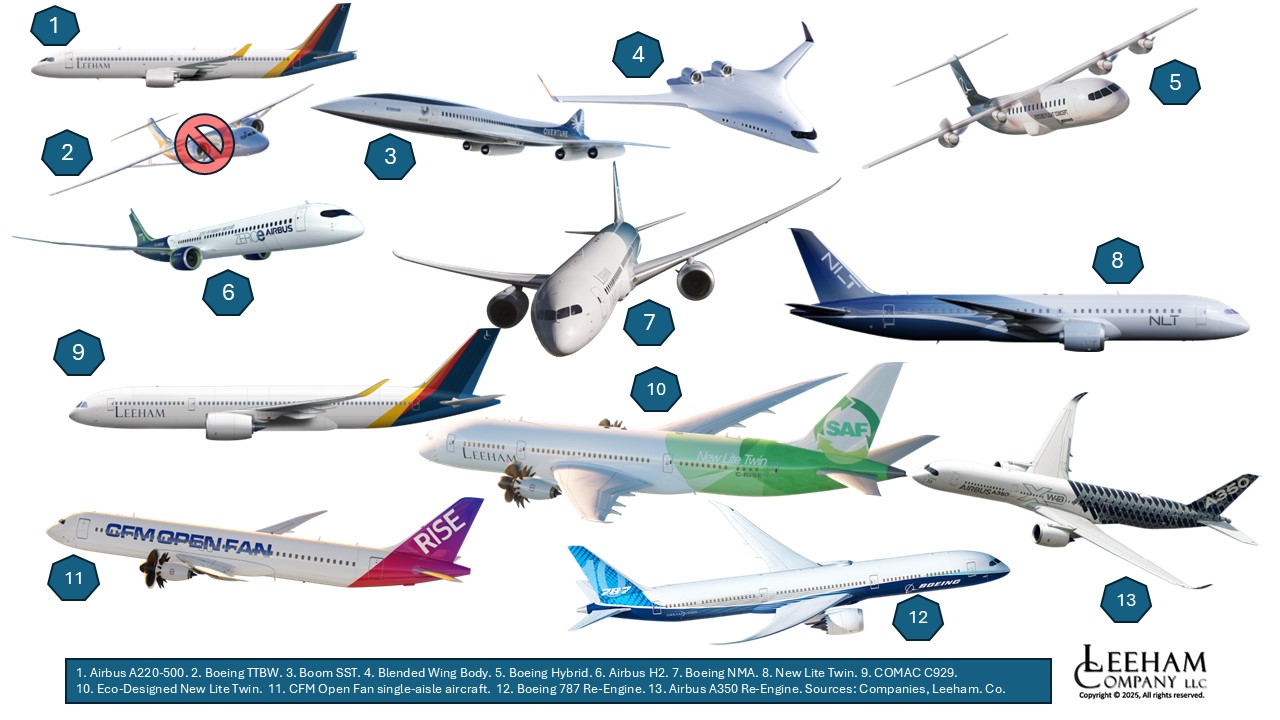
Figure 1. The 13 airliners we look at in the series. Source: Leeham Co.
These are the (5) GE, NASA, and Boeing hybrid airliner, (6) Airbus ZEROe hydrogen airliner, (7) Boeing’s NMA, and (8) the Boeing New Light Twin.
We examine the market for these aircraft, their technological challenges, and their potential future.
What’s the next new aircraft, Part 2
Subscription required
By Bjorn Fehrm
July 21, 2025, © Leeham News: Our series about “What’s the next new aircraft” was introduced last week, where we look at what potential new aircraft could be introduced over the following decades, and what technologies these would use.
In Part 2 of the five-part series, we introduce some basics around aircraft efficiency and examine what areas these 13 new aircraft aim to improve to enhance their efficiency.
In the following Parts, we will look into these aircraft in more detail and write about how challenging it will be to develop and mature the needed technologies.
Figure 1. The 13 new aircraft concepts that we study. Source: Leeham Co.
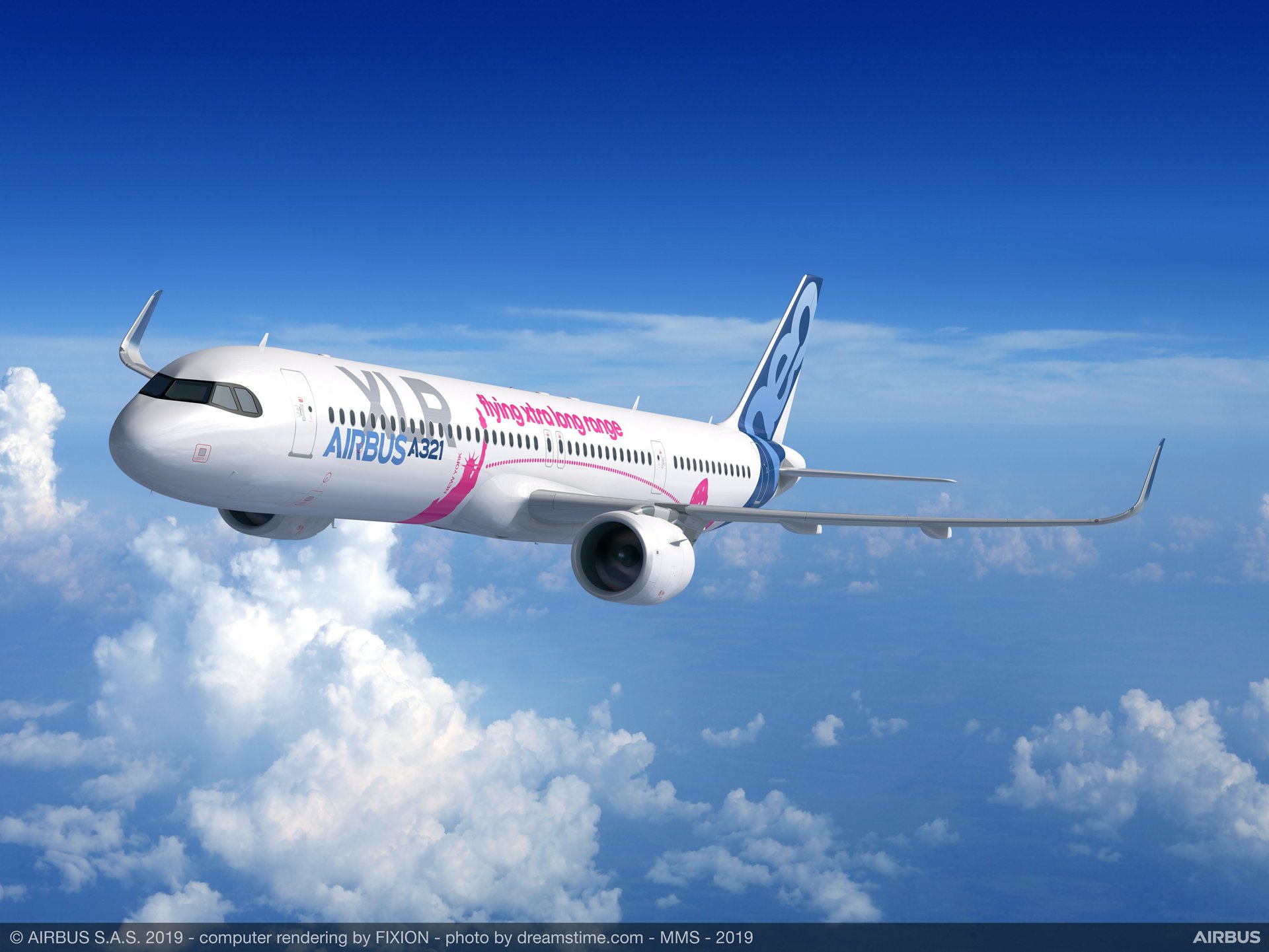
To what extent can the A321XLR replace the Boeing 757, Part 4
Subscription required
By Bjorn Fehrm
August 1, 2024, © Leeham News: We are comparing the Airbus a321XLR to the Boeing 757 to understand to what extent it can replace the 757 on the longer routes it operates for major airlines like United, American, and Delta.
We have examined the aircraft’s development and operational history, their Apples-to-Apples capacity and range, and their operational costs for a typical domestic configuration. Now, we equip the A321XLR with a long-range, lie-flat cabin and look at what long-range routes it can fly in this configuration.
Summary:
- The A321LR/XLR can fly up to 10-hour routes in a long-range configuration, flying from mid-USA to mid-Europe.
- With its passenger capacity, range, and operational economics, it covers most of what Boeing set out to cover in its MOM and later NMA studies.
To what extent can the A321XLR replace the Boeing 757, Part 3
Subscription required
By Bjorn Fehrm
July 11, 2024, © Leeham News: We are comparing the Airbus a321XLR to the Boeing 757 to understand to what extent it can replace the 757 on the longer routes it operates for major airlines like United, American, and Delta.
We have looked at the development and operational history of the aircraft, their Apples-to-Apples capacity and range. Now, we use Leeham’s Aircraft Performance and Cost Model (APCM) to compare the operational costs of the aircraft.
Summary:
- The Boeing 757-200 has the same passenger capacity as the A321LR/XLR and a larger cargo capacity.
- Its range can compete with the A321LR but not the XLR. Both beat the 757 on operational economics.
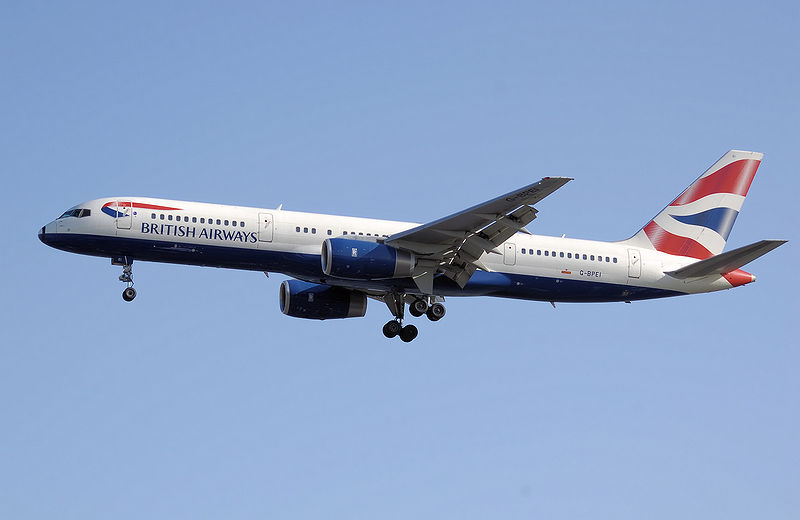
To what extent can the A321XLR replace the Boeing 757, Part 1.
Subscription required
By Bjorn Fehrm
June 27, 2024, © Leeham News: The Airbus A321XLR, the extra-long-range version of the A321neo, will start operational service with IBERIA on the Madrid-Boston trans-Atlantic route later this year. It’s the type of thin, long-range route the Boeing 757 has served to date.
We will use our Aircraft Performance and Cost model (APCM) to examine to what extent the A321XLR can replace the 757 on world routes. What is the difference in capacity and range, and what improvement in operational economics can be expected?
Summary:
- The Boeing 757 was the original MOM/NMA (Middle-Of-the-Market / New-Midmarket-Airplane).
- It had unique characteristics, which Boeing would have followed up with the NMA project.
- Boeing hesitated, and Airbus developed the A321XLR to fill this role. Has it succeeded?
Bjorn’s Corner: New aircraft technologies. Part 32. Design for production
By Bjorn Fehrm
September 29, 2023, ©. Leeham News: We are discussing the Detailed design phase of an airliner development program. We have talked about program management methods, development techniques, and tools for Detailed design.
But there is one area that is more important than even the aircraft aerodynamic, structural, and systems design for a new Heart-Of-The-Market aircraft: how to produce it in higher volumes and at lower cost than before.

Figure 1. The production of an A350 composite airliner. Source: Airbus.