
Leeham News and Analysis
There's more to real news than a news release.



Airbus and CFM reveal ZEROe demonstrator aircraft
February 22, 2022, © Leeham News: Airbus and the CFM partners, GE Aviation and SAFRAN, presented a ZEROe Sustainability demonstrator today that builds on a heavily modified A380 prototype.
On the rear roof of the A380, a pylon is integrated where a hydrogen combustion GE Passport engine is mounted, feed with hydrogen from a sealed enclosure on the main deck that contains four liquid hydrogen tanks.
The choice of the A380 for the demonstrator allows a lot of test equipment and test engineers to be housed in the test aircraft, monitoring the functioning of the propulsion system.
The demonstrator will start the flight tests end of 2026 to prepare decisions around the 2035 Hydrogen passenger aircraft configuration for 2027.

Figure 1. The ZEROe demonstrator is based on the A380. Source: Airbus.
HOTR: Collins Aerospace sustainability
Feb. 22, 2022, © Leeham News: The headlines and debate over ecoAviation focus on the airframe and engine manufacturers, for good reason. But the aerospace supply chain is mindful of its ESG (Environmental, Social, and Governance) issues as well.
 Pratt & Whitney makes the engines that emit emissions and burn fuel. It works to reduce fuel burn and emissions. PW also is exploring electric, hybrid and hydrogen alternatives. Sister company Collins Aerospace works to find solutions to reduce emissions in other areas.
“We play a big role in sustainability,” says LeAnn Ridgeway, Vice President, Sustainability. Collins purchased FlightAware, which is perhaps best know for flight tracking in competition with FlightRadar24. But FlightAware provides route planning and ADS-B services, among others.
Pontifications: Advice for Boeing in the coming KC-Y campaign
Part 6: The KC-X competition from Boeing’s perspective

By Scott Hamilton
Feb 21, 2022, © Leeham News: Jim Albaugh, the former president and CEO of Boeing Commercial Airplanes and of Boeing’s defense unit, retired from the company in 2012. He oversaw the first competitive bid at the defense unit for the US Air Force KC-X refueling tanker. That was lost to Northrop Grumman-EADS (Airbus) in 2009.
As CEO of BCA, he oversaw commercial efforts to get Boeing’s cost down on the 767-200ER, which formed the basis for what became the KC-46A tanker. Defense won this round against a solo EADS bid. Boeing’s winning price was about 10% below the EADS bid for its A330-based MRTT.
Years removed from Boeing but nevertheless an interested observer with experience on the losing and winning bids, Albaugh has some observations and advice as Boeing prepared to compete against Lockheed Martin-Airbus for the KC-Y campaign that already has unofficially begun.
For next new airplane, Pratt appears to trail CFM for next new engine
Subscription Required
By Scott Hamilton
Feb. 21, 2022, © Leeham News: As Boeing ponders whether to launch a new airplane program and industry consensus seems to be that this must happen in 2023 or 2024, Pratt & Whitney seems to face a dilemma.

Pratt & Whitney Geared Turbo Fan engine. Credit: Pratt & Whitney.
Convinced that the Geared Turbo Fan technology is the path to future engines, nevertheless, public statements indicate that by 2035, the GTF in the conventional form will fall short of the Open Fan being developed jointly by GE Aviation and Safran. GE and Safran are 50-50 partners in CFM International, which will sell the engine.
Rick Deurloo, the chief commercial officer for PW, told LNA last October that by 2031 (at the time, 10 years in the future), the GTF will have a 10% improvement in fuel burn and emissions compared with today’s GTF. PW will have a 1% improvement by 2024.
GE’s Travis Harper, who is the program manager for the Open Fan “RISE” engine under development, told LNA earlier this month that the RISE will reduce fuel consumption and emissions by 20% and be ready for entry into service by 2035.
If the goals outlined by Deurloo and Harper are taken at face value and achieved, this means the GTF will be up to 10% short of CFM’s engine ready for EIS four years later.
This was the question LNA put to other representatives of GE and PW at the Pacific Northwest Aerospace Alliance conference Feb. 10.
Cross-defaults led to Airbus cancellation of Qatar A321neo order
By Scott Hamilton
Feb. 18, 2022, © Leeham News: Qatar Airways was in default of its Airbus contracts, allowing the OEM to cancel the orders for two A350-1000s and 50 A321neos, say people familiar with how these things work.
In a court filing last month, Airbus directly made this assertion.
The moves by Airbus over several weeks to cancel the orders from a major customer that is not in financial distress is unheard of.
Qatar and Airbus are embroiled in a very public dispute over flaking paint on A350s owned by Qatar that now is the subject of lawsuits in a London court. The airline seeks nearly $700m in damages. Qatar claims the flaking paint is a safety issue, backed by the government regulator that grounded 23 A350s. Airbus, and its governing regulator, EASA, say no safety issue is at stake.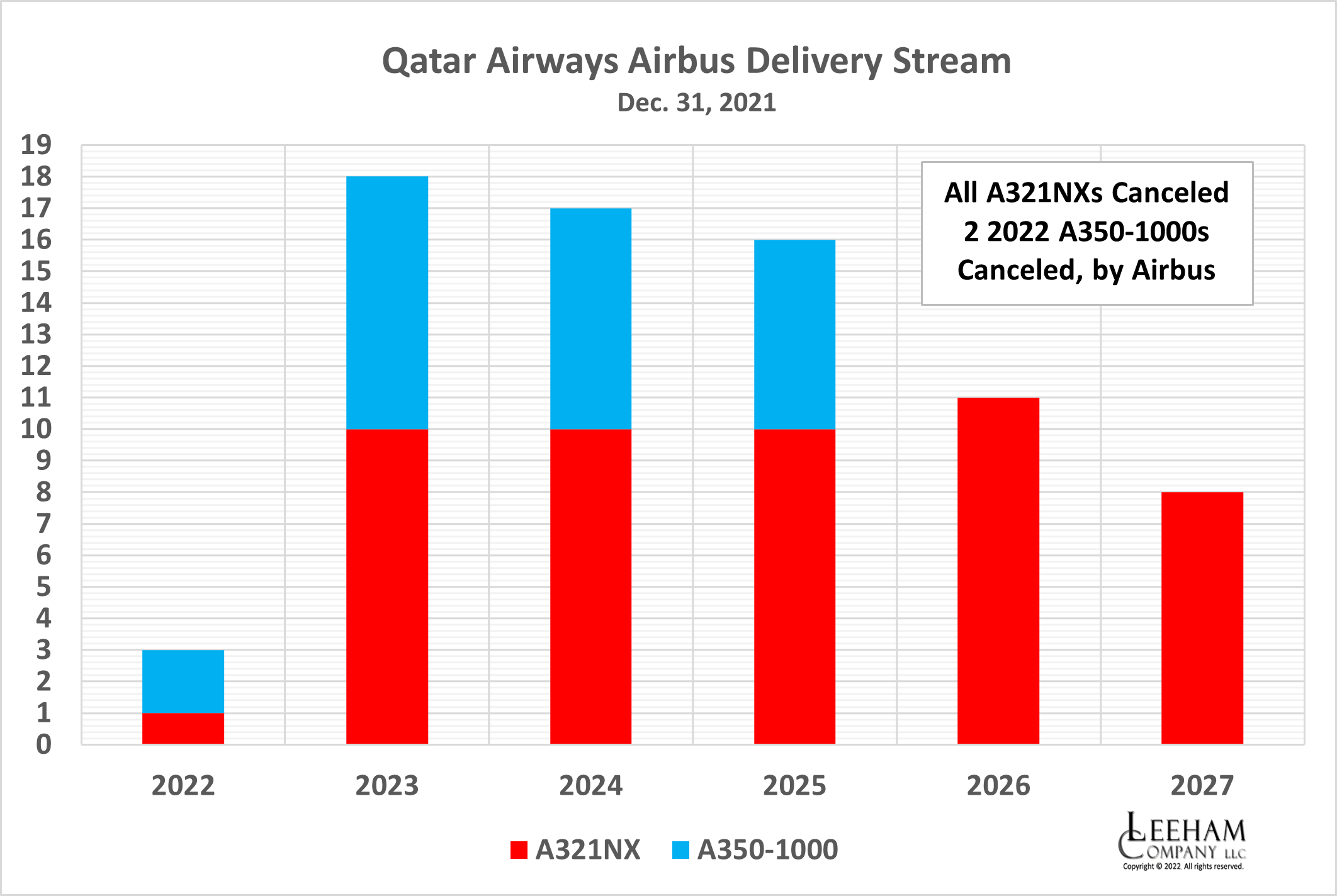
Airbus offered to repaint the airplanes and provide compensation, say people familiar with the situation. The compensation was unacceptable to Qatar Airways, they say.
Bjorn’s Corner: Sustainable Air Transport. Part 7. Hybrids.

By Bjorn Fehrm
February 18, 2022, ©. Leeham News: Having covered batterie-based electric aircraft in the last three articles, we now move to the next ideas to improve our aircraft’s efficiency and burn less carbon-based fuels, hybrids.
A word of caution first. The words Sustainable, Electric, and Hybrid are, because of their success in ground transportation, virtually a must in any news release from anyone involved in aviation these days. We will unveil what is behind all this and what is real and what’s Greenwashing.

Figure 1. The successful ground hybrid, Toyota Prius. Source; Toyota.
Airbus’ 2021 results; Delivery of record net profit as it exits the pandemic
February 17, 2022, © Leeham News: Airbus presented its results for 2021 today. The company announced record net profits of €4.3bn as it exits the COVID restraints of 2020 and first half 2021.
 Airbus’ problem is no longer a depressed market but how to ramp the A320/321 production to capture the demand. It expects to know by mid-year if it can go beyond a planned 65 deliveries per month by 2024.
The strong result came from deliveries of 611 commercial aircraft compared with 566 last year. Guidance for 2022 is 720 airliner deliveries, an operating profit of €5.5bn, and a Free Cash Flow of €3.5bn.
“Downfall” and “Boeing’s Fatal Flaw”
Feb. 17, 2022, (c) Leeham News: Tomorrow the documentary movie Downfall will be available on Netflix and, probably, Youtube. Unveiled during the Sundance film festival, Downfall is about the Boeing 737 MAX crisis.
The producers’ staff of Downfall contacted me during their research. I told them, among other things, that you had to know what else was going on at the time at Boeing when MAX was launched in July 2011 in order to understand the full context of Boeing during that period. The underlying thesis–that re-engining the 737 and decisions made–wasn’t only about profit, shareholder value, or greed, as many suggested. In fact, Boeing reported a $4bn in 2011 despite the pressures.
- The 787 hadn’t been delivered. It was three years late. Boeing was billions and billions over budget.
- The 747-8 was late and billions over budget.
- The tanker contract had been awarded the previous February with a bid 10% less than Airbus—and as we now know, it, too was late and billions over budget.
- Boeing’s engineering resources were stretched to the point where engineers were diverted to the 787 from other programs and outsourcing engineering work to India and Russia was done. The work from India on the 747-8 was poor and had to be re-done by SPEEA, further straining resources.
The new Boeing freighter, 777-8F, versus Airbus’ A350F, Part 3
Subscription Required
By Bjorn Fehrm
Introduction
February 16, 2022, © Leeham News: Last week, we looked at the operating economics of the Boeing 777-8F and Airbus A350F. Both freighters are new launches over the last 6 months with planned service entry 2025 (A350F) and 2027 (777-8F).
We flew the freighters with the help of our Aircraft Performance Model over a typical freight trunk route from Shanghai to Anchorage at a full load and compared their economics with the present freighter in this class, the Boeing 777F. Readers demanded we fly them with a part load and on shorter routes, so here we go.

Summary
- When we vary the payload and the route length, the economic differences between the freighters stay roughly the same.
HOTR: Consensus that Boeing must launch new airplane in 2023 or 2024
By Scott Hamilton
Feb. 15, 2022, © Leeham News: There is a belief that when Boeing clears out much of its 737 MAX inventory, resumes delivery of the 787, and reduces a good portion of its debt that it will launch a new airplane program.
The Next Boeing Airplane (NBA), as LNA calls it, could be launched in 2023 or 2024, which seems to be a growing consensus.
Consultant Michel Merluzeau, who does work for Boeing on occasion, predicted last week that the NBA could be launched late next year or early the following year. The airplane would be a 225-240 passenger aircraft (two-class) and a single aisle. This is like the Boeing 757—which largely has exited passenger service—and the upper limits of the A321neo. Merluzeau made his predictions at the Pacific Northwest Aerospace Alliance conference.