
Leeham News and Analysis
There's more to real news than a news release.



Engine OEMs pushing ahead for next airplane, even as Boeing pauses
Subscription Required
By Scott Hamilton
Nov. 1, 2021, © Leeham News: David Calhoun may not be anywhere near ready to launch the Next Boeing Airplane (NBA), but the engine makers are actively researching and developing engines to hang of whatever that NBA will be.
Calhoun, the CEO of Boeing, repeatedly said the NBA will be more about reducing production costs through advanced design and production methods. For some time, Calhoun said the next engines available on the assumed timeline—to about 2030—will have only 10% better economics than today’s engines.
And 10% isn’t enough for the airlines or the commensurate reduction in emissions.
CFM/GE Aviation/Safran are developing an “open fan” engine that will reduce fuel burn and emissions by 20%. A target date for entry into service is in the 2030 decade. The open fan builds on R&D of open rotors that have been underway since the era of the Boeing 727 and McDonnell Douglas MD-80.
Pratt & Whitney sees an evolution of its Geared Turbofan engine. The GTF was under development for 20 years before an operating engine made it onto the Bombardier C Series (now the Airbus 220), the Airbus A320, and United Aircraft MC-21. The GTF also was selected for the Mitsubishi MRJ90, which launched the GTF program. However, Mitsubishi pulled the plug on the MRJ/SpaceJet program last year. PW remains committed to the GTF for future engines.
Rolls-Royce is developing the Ultra Fan and Advanced engines. GE’s Open Fan and RR’s engines adopt geared turbofan technology pioneered by PW but add new technology.
LNA takes a look at the new engines for the NBA or any other competing airplane in a series of articles.
Pontifications: Boeing’s production system of the future

By Scott Hamilton
Nov. 1, 2021, © Leeham News: Boeing executives have been hinting for years about the production transformation the company sees as critical to the Next Boeing Airplane (NBA), no matter what form it takes.
Boeing’s effort, begun under former CEO Jim McNerney, was code-named Black Diamond. LNA has referred to it many times. The New Midmarket Aircraft was as much about production as it was about the aircraft.
In last week’s 3Q2021 earnings call, current CEO David Calhoun once again mentioned the transformation to a new design and production system.
“In addition, for the 737 MAX 7, the MAX 10, and the 777X, we are investing in our future, laying the foundation for our next commercial airplane development program,” he said. “This quarter, we stood up an integrated product team to bring together a digital environment where the next commercial new airplane and production system can be designed together. While we have not launched a new airplane, this is an important step in our digitization journey and our development journey to evaluate how we holistically design, build, test, certify and support the airplane and production system. It will build on the invaluable experience of our recent Defense programs.”
Bjorn’s Corner: The challenges of airliner development. Part 27. Maintenance competence

By Bjorn Fehrm, Henry Tam, and Andrew Telesca.
October 29, 2021, ©. Leeham News: Last week, we looked into Instructions for Continued Airworthiness (ICAs), and what roles it plays in air safety.
Equally important for air safety is the qualification and training programs we design for the organizations and people that shall carry out the work with our Instructions for Continued Airworthiness.
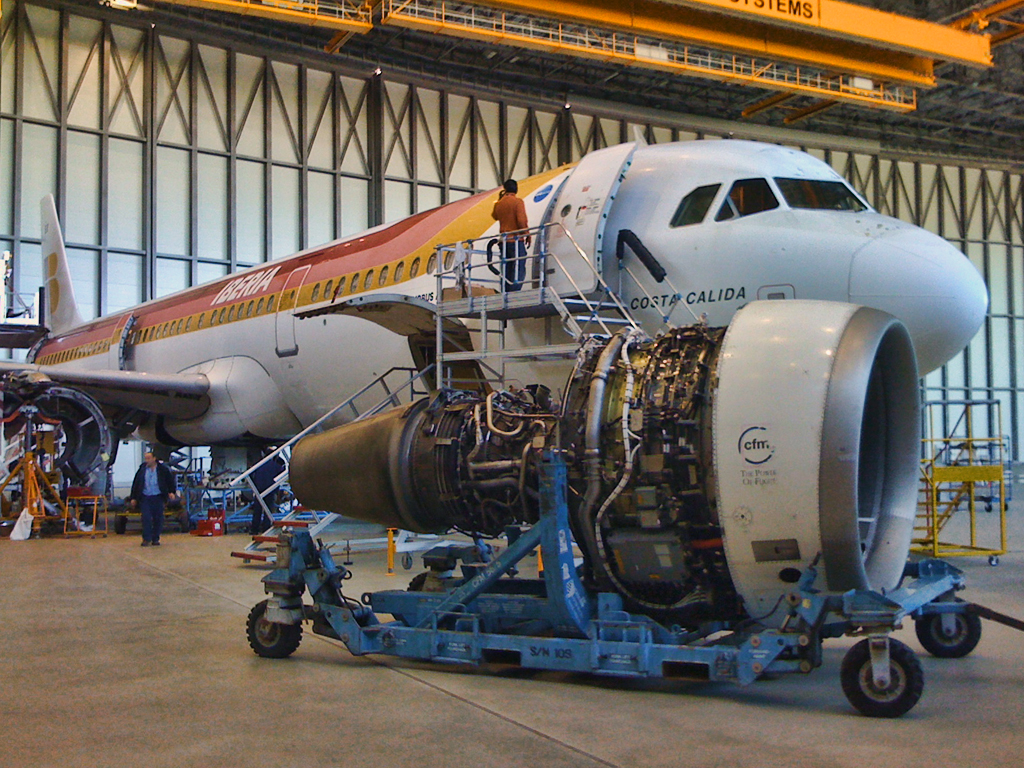
Figure 1. Aircraft Maintenance on an IBERIA A320. Source: Wikipedia.
Boeing and Airbus freighter battle
By Scott Hamilton
Oct. 28, 2021, © Leeham News: Boeing yesterday gave its clearest indication yet that it’s moving closer to launching the 777X Freighter.
In a message to employees in conjunction with its third quarter earnings release Oct. 27, CEO David Calhoun said, “We’re progressing in development across several key franchise defense programs, and on the 737-7, 737-10 and 777X development and certification efforts. We’re also evaluating the timing of a freighter version of the 777X and are beginning to lay the foundation for our next commercial airplane development program.” News reports earlier suggest Boeing may launch the XF at the Dubai Air Show.
On the earnings call, Calhoun was slightly more expansive. “Given the continued robust freighter demand and the compelling economics of the 777X, we are currently evaluating the timing of launching a freighter version of our 777X airplane.”
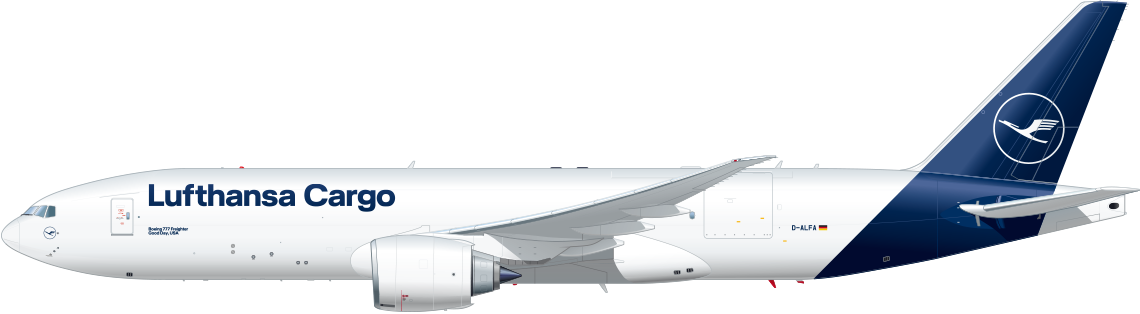
A Lufhansa Boeing 777F freighter.
Airbus’ 9 months 2021 results; Full steam ahead
By Bjorn Fehrm
October 28, 2021, © Leeham News: Airbus presented its results for the first nine months of 2021 today. The company is now heading out of a 15 month COVID hibernation at full steam.
Market demand is strong for its Civil airliners and especially for the larger model in the A320 series. Airbus is now upgrading all four Global Final Assembly Lines (FALs) to A321 production capability.
The strong result came from deliveries of 424 commercial aircraft compared with 341 last year. Guidance remains at 600 airliner deliveries for the year but operating profit is raised to €4.5bn (was €4bn) and Free Cash Flow to €2.5bn (€2bn).
Single-aisle or Widebody over the Atlantic on thin routes?
Subscription Required
By Bjorn Fehrm
Introduction
October 28, 2021, © Leeham News: The headline seems like a no-brainer. On long thin routes over the Atlantic, we have learned a Boeing 757, or its replacement, the Airbus A321LR, is the right aircraft (as long as it’s within its range).
This was the situation in a pre-pandemic market where freight yields were half of today. The single-aisle has lower operating costs than the widebodies, and if the passenger stream and range fits, it was the transport to have on the route.
With the high cargo prices, does this change? We check for several Atlantic routes.
Summary
- The increased yields for air cargo challenge the mantra; a single aisle is preferred for trans-Atlantic service as long as the passenger number and range fits.
- Going forward it will be all about the cargo prices and the number of passengers to transport.
Update 1: Boeing posts small operating profits, net losses in 3Q and nine months (with CNBC comments)
Oct. 27, 2021, © Leeham News: Boeing reported small operating profits and small net losses for the third quarter and nine months.
The third quarter operating profit was $329m and $1.27bn for the nine months. Boeing lost $401m and $4.7bn for the periods in 2020.
Operating cash flow used in the third quarter declined to $262m and $4.1bn compared with $4.8bn and $14.4bn used in 2020. Additional cash was used for spending on property, plants and equipment. Boeing had $20bn in cash at Sept. 30, down slightly from June 30’s $21.3bn. Consolidated debt declined from $63.6bn at June 30 to $62.4bn at Sept. 30.

HOTR: Lessors warn Airbus
By the Leeham News team
Oct. 26, 2021, © Leeham News: Two mega-lessors warned Airbus against dramatically upping production rates of the A320 family, London’s Financial Times reported Oc t. 23.
“[B]old plans to speed up production are unjustified given still subdued demand from airlines after the coronavirus pandemic,” The Times wrote. Airbus notified suppliers earlier this year to study going to a production rate of 70 aircraft per month by 2025. Rates might go even higher, to 75/mo, Airbus said.
“The chief executives of Avolon and AerCap, wrote to Guillaume Faury, Airbus chief executive, in recent weeks to express their concerns that the aircraft market would not support the most aggressive increases in output rates, according to four people familiar with the situation. A surge in supply of new aircraft, potentially flooding the market, could push down the value of the lessors’ existing fleets. They make their money by renting to airlines,” the paper wrote.
Airbus sees encouraging signs of wide-body demand recovery
Subscription required
By Scott Hamilton
Oct. 25, 2021, © Leeham News: Airbus sees some “encouraging” signs wide-body demand is recovering from the global COVID-19 pandemic.

Christian Scherer. Source: Airbus.
Passenger demand is nearing-pre-pandemic levels in key areas of the world where single-aisle aircraft are used. Long-haul international demand remains suppressed, however. Some don’t forecast a return to normal for up to two more years. Others forecast a recovery on key routes next year.
Christian Scherer, the chief commercial officer for Airbus, is optimistic.
“I would say that on the wide-body market, you see encouraging signs,” he said during a press gaggle at the IATA AGM Oct. 3-5 in Boston. “Maybe that has to do with the fact that the ecosystem at large is realizing that the best thing they can do in the short- and medium-term, towards that whole global objective of sustainable air transportation is to equip themselves with the most fuel-efficient and therefore eco-friendly airplanes.
“I think that against that backdrop and the opening of more international corridors sees a regained interest on the wide-body side as well. Now it’s lagging the single arch really and there is no scoop here that rates in the long-range airplanes are going to change imminently, but the general sentiment is positive on the wide-bodies as well and that’s really good.”
Pontifications: Engines drive timing of new Embraer TPNG
The first report appeared Oct. 18, 2021.
By Scott Hamilton
Oct. 25, 2021, © Leeham News: Embraer appears marching toward launching a new turboprop aircraft next year with a targeted 2027 entry into service.
The timing will be determined by the engine. Pratt & Whitney, GE Aviation and Rolls-Royce have development programs. PW and GE are farthest along. PW is thought to have the best chance of winning Embraer’s business. (Pratt & Whitney supplies the engines for the E2 jet. GE supplied the engines for the E1.)
In an interview at the IATA AGM Oct. 3-5 in Boston, Arjan Meijer, the president of Embraer Commercial Aviation, said the competition remains open today.