
Leeham News and Analysis
There's more to real news than a news release.


Is the Redhawk Development process the future at Boeing?
Subscription Required
By the Leeham News Team
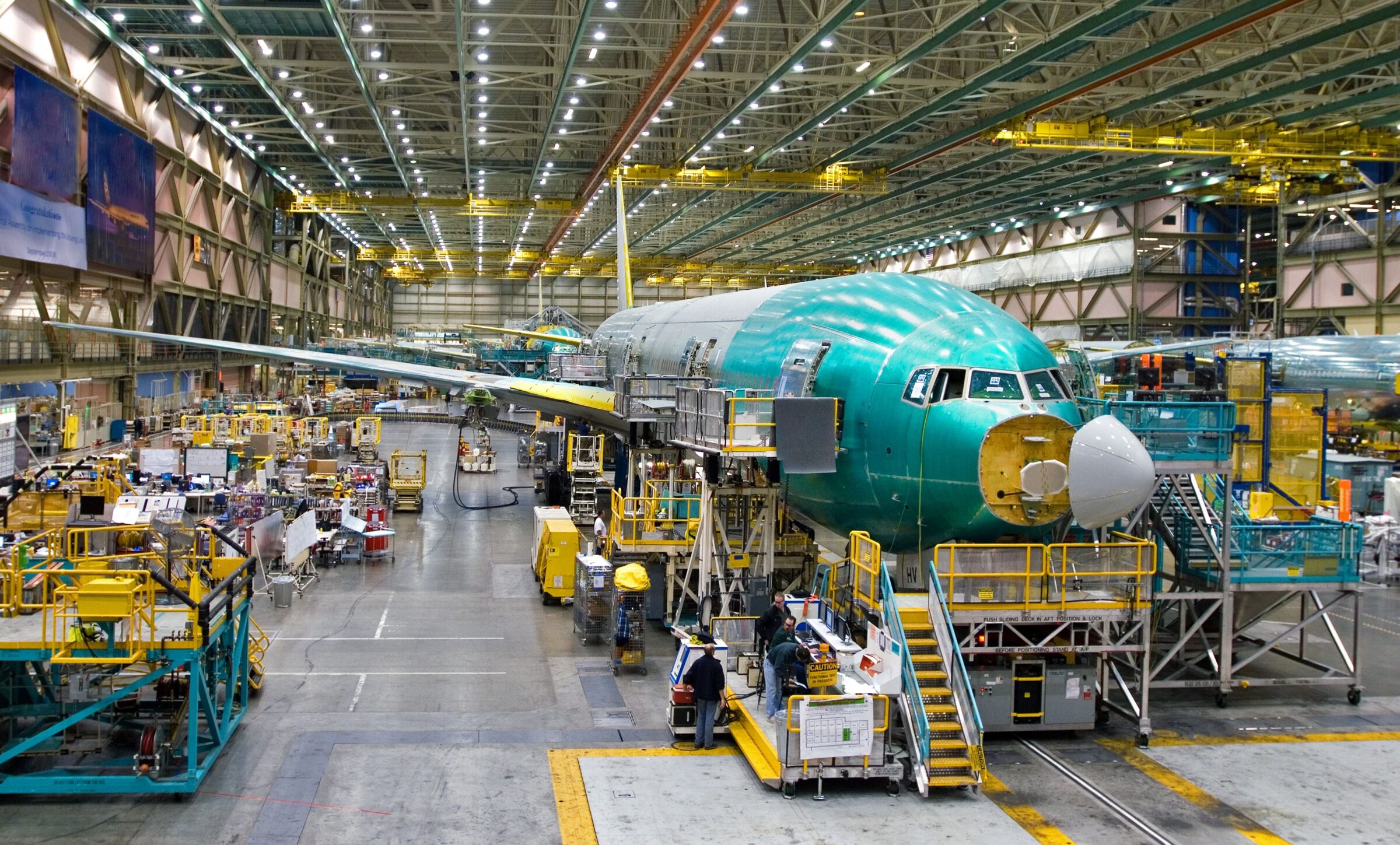
Boeing wants to converge advanced design and production processes from across the 7-Series platforms and the Defense unit into one commercial airplane–its Next Boeing Airplane, or NBA. Photo: Boeing.
July 12, 2021, © Leeham News: It may be an overstatement to say that Boeing CEO David Calhoun will be the future of Boeing Commercial Airplanes on a radical production makeover.
But it’s not an understatement to say that the production moonshot contemplated is critical to BCA.
However, advanced production processes are only part of the challenge facing Boeing. A radical shift in employee culture is also required for success.
Boeing Defense, Space & Security (BDS) is doing good things with respect to the T-7 Redhawk Trainer Integration. BDS slid the first fuselage together in 30 minutes. But the question before us is this. Is this 30 minute join process a revolutionary process change that Boeing can scale for transport category aircraft, or a byproduct of Great Hardware Variability Control in a simple non-variable end item. Fighter-sized aircraft are simple to build. Highly variable Commercial aircraft are another story completely.
Calhoun, and before him CEOs Dennis Muilenburg and Jim McNerney, would lead you to believe that some new magic occurred in the digital design and that this new magic will transfer to the next Boeing airliner and new engines are not necessary. That’s a bold position to take, so let’s look at what might be involved behind his thinking.
Pontifications: The reshaped commercial aviation sector

By Scott Hamilton
July 12, 2021, © Leeham News: With Washington State and the US open for business following nearly 18 months of COVID-pandemic shut-down, there is a lot of optimism in commercial aviation.
In the US, airline passenger traffic headcounts are matching or exceeding pre-pandemic TSA screening numbers. Airlines are placing orders with Airbus, Boeing and even Embraer in slowly increasing frequency.
The supply chain to these three OEMs looks forward to a return to previous production rates.
It’s great to see and even feel this optimism. But the recovery will nevertheless be a slow if steady incline.
Here’s why China needs Boeing as much as Boeing needs China
Subscription Required
Now open to all readers.
July 7, 2021, © Leeham News: China’s government policy of operating commercial aircraft that generally are no more than 12-15 years old means the carriers face a replacement bubble that the home market can’t possibly meet.
According to data reviewed by LNA, there are just 303 COMAC C919s on order. Delivery is supposed to begin this year with one airplane. Currently, the peak year for deliveries is 2027 with 55 aircraft scheduled.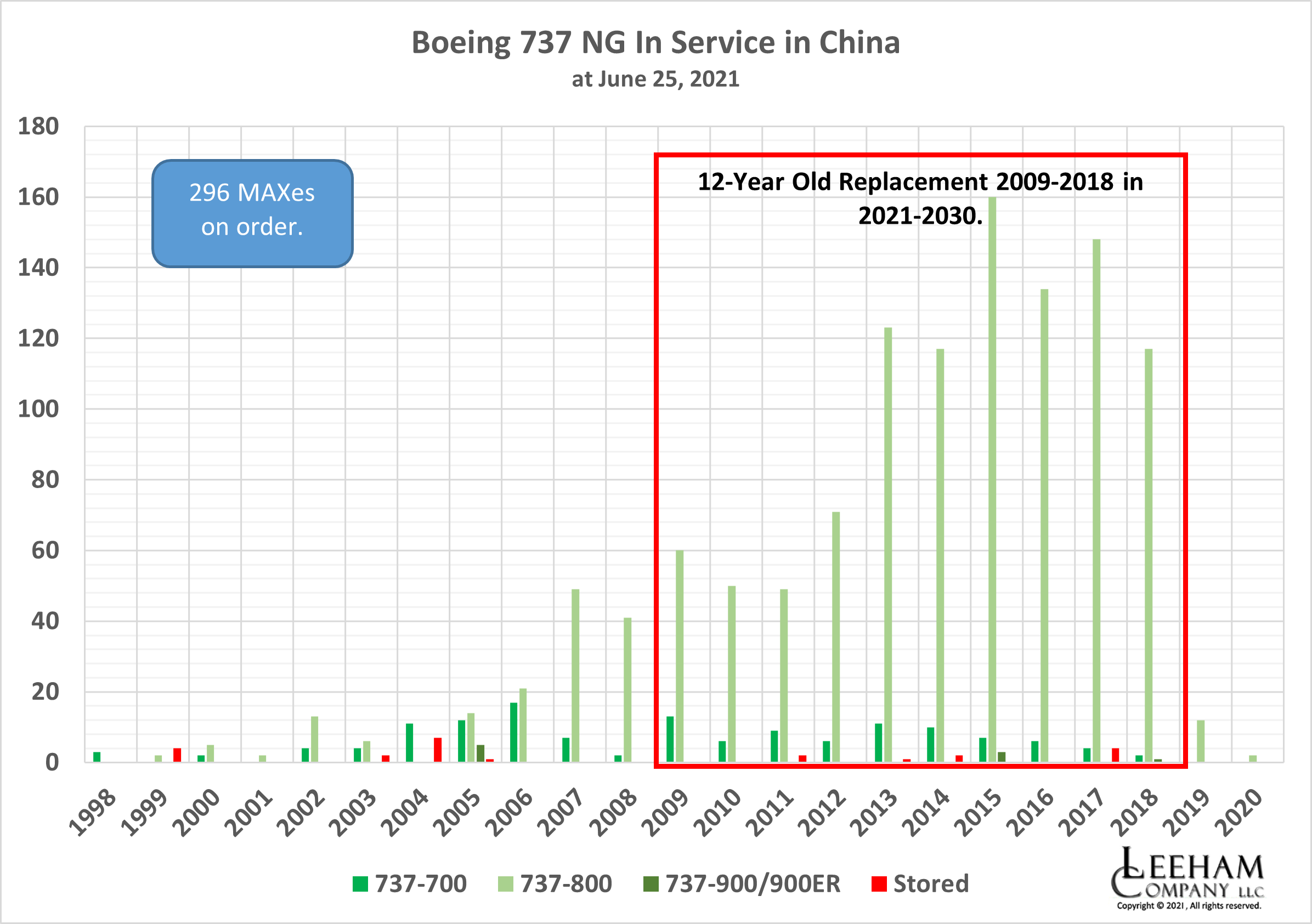
There are about 1,116 Boeing 737 NGs built between 2008-2018 operated and stored by Chinese carriers. China has just 296 737 MAXes on order—a deficit of 820 aircraft needed for replacement of these aging airplanes. (Boeing’s website shows just 104 outstanding orders, but Chinese-owned lessors aren’t included in this tally.)
Podcast: 10 Minutes About SSTs
Scott Hamilton and Pontifications are taking the day off.
July 5, 2021, © Leeham News: Development of small supersonic transports (SSTs) seemed, for a time, a fad. Three companies announced plans to develop an SST business jet with two of them expanding the concepts to be small passenger airliners, each with less than 100 seats.
Today, only one company appears remaining. Aerion collapsed recently for lack of funding. Boom remains, announcing a “commercial agreement” with United Airlines early this month for 15 Overture SSTs and options for 35 more. The agreement, however, is highly conditional.
LNA discussed the agreement in a previous 10 Minutes About podcast. Today’s 10 Minutes About is a technical discussion about designing an SST.
Podcast: 10 Minutes About Airbus’ Design and Production transformation
June 30, 2021 © Leeham News: Yesterday’s 10 Minutes About discussed Boeing’s drive toward a dramatic new way to design and produce new airplanes. Today’s 10 Minutes About looks at how Airbus is approaching the same challenge.
United orders 200 Boeing 737 MAXes, 70 Airbus A321neos
By the Leeham News Team
June 29, 2021, © Leeham News: United Airlines today announced its order for 200 Boeing 737 MAXes and 70 Airbus A321neos.
The size and split of the order were first reported by Airfinance Journal.

Source: United Airlines
The deal is the carrier’s largest, as well as the industry’s largest “in a decade.”* The order is for 50 737 MAX 8s, 150 737 MAX 10s and 70 A321neos. “United will replace older, smaller mainline jets and at least 200 single-class regional jets with larger aircraft,” the airline said.
Podcast: 10 Minutes About the Boeing Design and Production Moonshot
June 29, 2021, © Leeham News: “Most often when a new airplane is developed by either side, it is usually developed around a propulsion package that offers 15% to 20% improvement with respect to efficiency versus the one it’s displacing. That’s the way it’s happened over a long period of time,” Boeing CEO David Calhoun said on the most recent earnings call.
“I don’t believe the next generation of an engine can deliver that kind of performance. Therefore, whatever cost-efficiency ultimately and whatever performance advantages are derived from the next airplane in my view are going to come from the way it’s engineered and the way it’s manufactured. All [will be] with a focus on a lower cost per seat when we get it to the marketplace. And, yes, [it will have] a more sustainable package with respect to the environment.”
Just how practical is this approach? Today’s 10 Minutes About discusses Boeing’s moonshot in design and production for its next airplane, whatever it is.
China distorts progress in Boeing 737 MAX return to service
Subscription Required
By Scott Hamilton
Introduction
June 28, 2021, © Leeham News: There are now 265 Boeing 737 MAXes in airline service, according to data reviewed by LNA.
There are 263 MAXes in storage that appear to be previously delivered airplanes. This number is artificially inflated by the 95 MAXes that are grounded in China. China’s regulator hasn’t recertified the MAX, a move widely considered political due to the long-running trade war between the US and China initiated by the Trump Administration.
When the MAX was grounded in March 2019, there were 387 in service. The math indicates 147 MAXes were delivered from inventory or new production since the airplane was recertified by the Federal Aviation Administration in November 2020 and other regulators shortly afterward.
There were 400 MAXes in inventory at the end of the first quarter, down from 425 at the end of the year. Boeing resumed production in the single digits. Boeing does not reveal its rate, but it is believed to be about 10-14/mo going to 16/mo in the third quarter.
In contrast, there are 106 A320neos and 38 A321neos in storage as of last Friday.
Pontifications: The WTO Airbus/Boeing standstill and pursuing China
June 28, 2021, © Leeham News: The US and European Union agreed on June 15 to a standstill in the 17-year old trade dispute over illegal subsidies to Airbus and Boeing.
The World Trade Organization (WTO) found each violated international rules. By the time all was said and done, the US was authorized to levy tariffs on $7.5bn worth of European goods. The EU received authorization to levy tariffs on $4bn of US goods.
Tariffs on goods went beyond Airbus and Boeing products. But it was 15% tariffs on Airbus planes imported into the US and Boeing planes imported into the EU that were the highest-profile and most costly.
Despite initial reports in some uninformed media that the long-running dispute was “resolved,” in fact, only a standstill was agreed. The US and EU now have five years to negotiate a permanent settlement to Airbus’ “reimbursable launch aid” and Boeing’s benefits from tax breaks and NASA.
The two sides also agreed to put China’s commercial aerospace industry in the crosshairs.
HOTR: USAF prepares for new tanker competition, pitting Lockheed Martin/Airbus and Boeing against each other
By the Leeham News Team
June 22, 2021, © Leeham News: The US Air Force appears to be preparing a new round of competition for the next phase of its aerial refueling tanker recapitalization.
The first, KC-X, took more than 10 years to award a contract that didn’t get overturned. Boeing initially was awarded a lease deal in 2001 that was canceled in the wake of a scandal that sent two Boeing officers to jail and led to the resignation of CEO Phil Condit.
Round two pitted Boeing against Northrop Grumman and EADS, which was the name of the parent of Airbus’ commercial unit. Northrop won, but this award was overturned when USAF improprieties were revealed in the debriefing.
Round three pitted Boeing against EADS alone after Northrop bowed out. Boeing won this contract with a price 10% below EADS, which didn’t contest the decision. Boeing since has written off about $5bn on the KC-46A tanker, which still doesn’t work as required and which was delivered nearly two years late.
Related stories: