
Leeham News and Analysis
There's more to real news than a news release.


Airbus’ A350-1000 dilemma
Airbus has a dilemma with what to do about the A350-1000.
.
Does the OEM stick with the -1000 as it is, ceding the 400 seat segment to Boeing with its new 777-9X? Or does it stretch the -1000 (we’ll call it the “1100” for a placeholder) for what appears to be a very limited market segment?
.
If Airbus does stretch the -1000, what does this stretch look like? One that will match the 9X range and capacity? Or one that matches the capacity but not the range?
Here are the implications of the dilemma facing Airbus.
.
Stay the Course
For a long time, Airbus officials said they were satisfied with the design, once tweaked, of the -1000 and they didn’t need to respond to a “paper” airplane. The characterization had a ring to it, for that’s what Boeing officials often said about the -1000: it wasn’t a “real” airplane, they didn’t know what it was, it was a “paper” airplane or some variation thereto.
.
Of course, this was rhetoric by both parties. Lufthansa Airlines ordered 34 777-9s. A huge order+option commitment is anticipated at the Dubai Air Show from Emriates Airlines for the -9 and the smaller, ultra-long range (ULR) -8 that is sized directly across from the -1000. Airbus is now faced with the prospect of Boeing once more having a monopoly position with the 777-9 as it did for many years with the 777-300ER.
.
Does Airbus want to cede the 400-seat segment to a Boeing monopoly? The question is, how big is this segment? Is there a business case to build the airplane, or one that’s big enough for two airplanes?
.
Boeing’s current 20 year forecast indicated there is a need for 4,530 “small” twin aisle, 200-300 seat jets and 3,300 for “medium” twin aisle jets, 300-400 seats, for a total 7,830. Airbus forecasts a need for 4,694 250-300 seat jets and 2,085 350-400 seaters, for 6,779 jets, a difference of nearly 1,100-but, then, Airbus doesn’t have a competitor to the 787-8 at the lower end of the small jet sector.
.
Airbus further breaks out its forecast: 2,438 250-seat and 2,256 300-seat jets within the “small” twin; and 1,306 350-seat and 779 400-seat jets within the “medium” twin category. Boeing doesn’t subdivide its forecast.
.
The 777-9 will kill the near-dormant 747-8 Intercontinental and will likely eat into sales of the Airbus A380. Does Airbus avoid cannibalizing its own product or does it allow Boeing the monopoly to do so?
Source: Great Circle Mapper
Match the 777-9
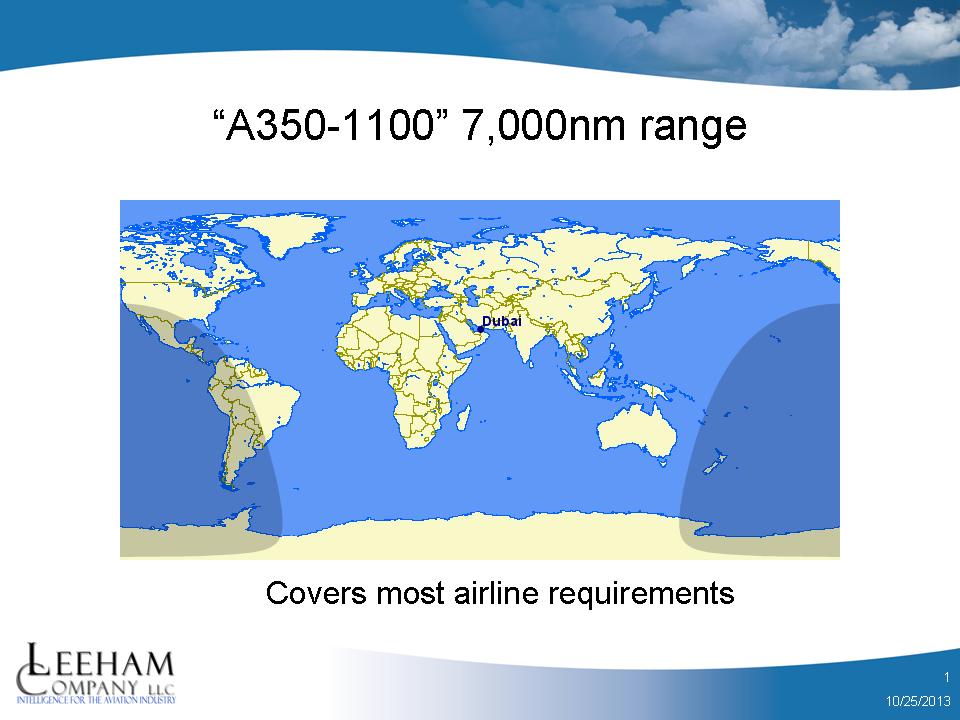
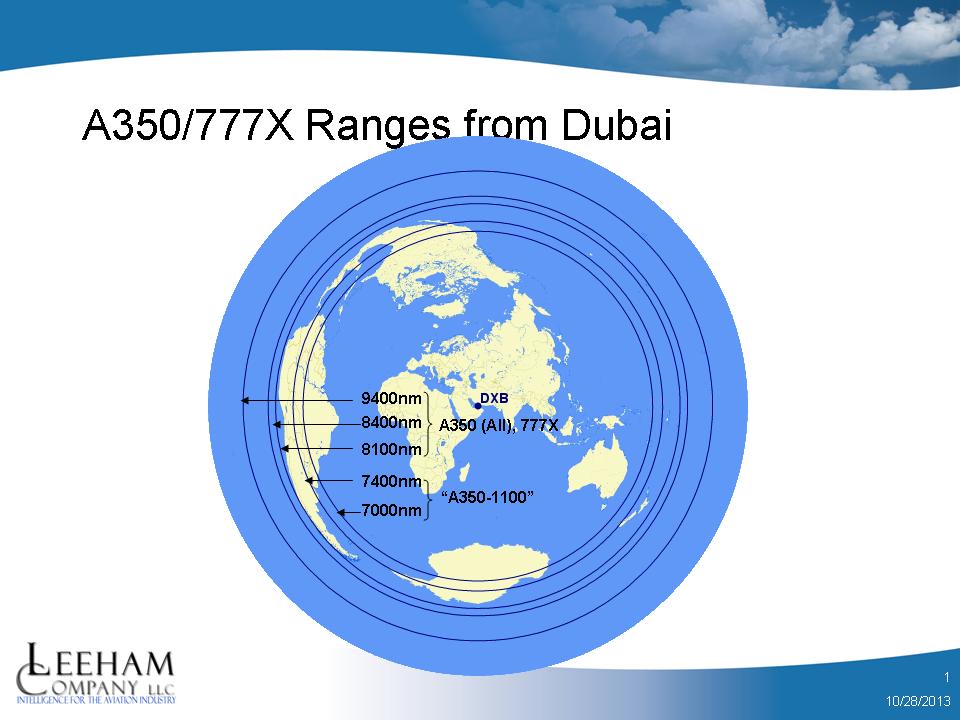
Airbus could decide that, despite a its own narrow forecast for a 400 seat segment, it would be better to play in this sandbox, whatever the impact on the A380, than to cede this segment to Boeing. The question then arises, does an A350-1100 match the 777-9 in seats (or come close to it) and range, around 8,100nm-8,400nm?
To match means a major undertaking for a small number of airlines that need a plane with this range. It means a new wing–typically a $3bn project, more or less–and new engines in the 104,000-105,000 lb thrust range. The Rolls-Royce Trent XWB on the A350-1000 is 97,000 lbs and it can’t be pushed any farther, our information tells us. The cost of developing an entirely new engine for such a narrow market doesn’t have a business case. One might exist on the presumption that engines have to get bigger, and a new engine design would provide the basis for an entirely new generation of engines. After all, the Trent fundamentally has been around since the A330. It may well be time, but is an A350-1100 the product from which to develop it? Furthermore, it takes at least seven years to develop a new engine and probably a lot longer. The engine is the pacing item, far more than the airframe. Even if the go-ahead were given this minute, Airbus and RR would be hard-pressed to come up with an A350-1100 by 2020, when the 777-9 EIS is anticipated. So…
The 787-10 Approach
The most viable option for stretching the A350-1000 appears to be following the approach Boeing took with the 787-10: a couple of simple fuselage plugs, some enhancements to the existing engines, the same wing and reduced range that covers 90% of the markets required by the airlines–foregoing the miniscule need by Emirates Airlines for that last 5%-10%.
Source: Great Circle Mapper
An A350-1100 with reduced range of 7,000nm-7,500nm and a 400 seat capacity would have highly favorable cost per available seat miles. It wouldn’t get you from Paris to Tahiti, but how big is this market? It wouldn’t get you from Dubai to Los Angeles, but are billions of dollars worth of R&D to do so going to get the return on investment to make sense for this airplane?
The clear choice, the financially responsible choice, and the expeditious choice appears to follow the Boeing approach and develop an A350-1100 (or, perhaps, the “A350-1000-10”).
Odds and Ends: Repairing the Ethiopian 787; more on A350-1000 stretch; new RR engine study
Ethiopian 787: Dominic Gates at The Seattle Times has a detailed story about how Boeing is repairing the Ethiopian Airlines 787 damaged by a fire at London Heathrow Airport earlier this year. Boeing doesn’t comment for the story–nor for any others–but Gates’ detail in his piece makes for quite interesting reading.
Stretching the A350-1000: More on this topic from Aviation Week. Aside from the technical considerations for the airframe, Rolls-Royce would need to bump up the thrust of the engine to around 104,000 lbs, we’re told. Also: there is the matter of production. Airbus is considering a second production line for the A350, but no decision has been made.
Rolls-Royce studies new engines: Rolls-Royce is studying a new line of engines, according to this Bloomberg article.
Asiana 777 crashes in SFO
An Asiana Airlines Boeing 777 crash-landed at San Francisco Airport Saturday, killing at least two. This is the first fatal crash involving a 777.
Investigators will certainly look at whether fuel line icing may be a factor, which was traced to be the cause of the only other 777 accident, British Airways at London several years ago, also a crash-landing situation. Early news reports seem to reflect a similarity in the flight profile between the two flights. As readers know, we’re traveling and we don’t have access to our files to determine if Asiana uses Rolls-Royce engines, which are those used on BA and which were susceptible to icing.
GE engines on the 777-300ER have more recently come under some scrutiny for issues, and we’d expect investigators to consider whether there is any connection if Asiana uses GE on its 777-200s. This would be a natural course of considering all possible factors.
Other factors that will be looked at: human error, mechanical problems and controlled flight into terrain (CFIT).
Update, 5pm GMT: With the knowledge now that the engines are PW, fuel icing as a cause seems pretty unlikely, but CVR and FDR readouts will indicate engine performance parameters. Although weather doesn’t appear to be a factor, it will be evaluated for the prospect of any clear air windshear or other conditions that could be a contributing cause.
Statements by the airline officials at this point that there wasn’t any pilot error or mechanical issues are entirely premature, given when the statements were made the data recorders hadn’t been recovered much less read.
Closely looking at a photo seems to indicate the aft pressure bulkhead in place, meaning the tail severed aft it it.
737 MAX may share NG improvements still to come, which might include more seats
Boeing’s 737 MAX, still weeks away from design configuration freeze and still with lots of detailed design to come, may share improvements still to come on the current 737 NG.
The head of the MAX program, Keith Leverkuhn, vice president and general manager, wouldn’t confirm or deny a report by Aspire Aviation that the MAX family will have 6-9 more seats through interior changes, the use of slim line seats and door changes when asked during Boeing’s MAX briefing yesterday with an international crowd of journalists.
Citing unidentified Boeing sources, Aspire reported:
- Boeing to modify 737 MAX 8 doors to add around 9 seats;
- 737 MAX 8 to meet 13% fuel burn reduction per seat target after door modification;
- Door modification has negligible impact on MEW; and
- 737 MAX 7 & MAX 9 also likely to have around 9 more seats.
Leverkuhn told the media that Boeing was satisfied with the current configuration of the airframe of the NG and MAX shares this configuration. Although Leverkuhn said Boeing had no intentions of changing, it still would talk with customers–leading to the obvious conclusion that Boeing wasn’t saying a firm “no” to the possibility.
We talked with him a few minutes alone later in which he clarified his earlier comments. Leverkuhn told us that while there will be no changes to the doors on the MAX which would allow more seats, the NG program is considering interior configurations that could lead to more seats and the MAX and NG programs closely follow developments and determine what can be shared between NG improvements still to come and the final MAX design.
Airbus in January announced a space-flex program that includes two new doors, enabling high density capacity to grow to 236 from 220. Airbus previously began offering a revised aft galley/lav combination in the A320 to permit three more seats, to 153 in two-classes. Boeing has been studying similar changes, according to our market intelligence.
Sizing up engine market share on the A320 family
While competition between Airbus and Boeing snares nearly all the headlines and all the “sex,” competition for engine orders is less sexy and receives less attention.
Part of this is because of the increasing trend toward sole-sourcing. The Boeing 737 has been sole-sourced by CFM International since the creation of what is now called the Classic series: the 737-300/400/500. Pratt & Whitney believed at the time Boeing was upgrading the 737-200 that airplanes were up-gauging and bet its future on the Boeing 757 size. It was one of the classic corporate blunders of all time.
Shut out of the 737, P&W joined with Rolls-Royce and MTU to build the International Aero Engine V2500 for the Airbus A320 family. IAE came to the table late, giving CFM a solid head start on the program with a variant of the CFM 56 that powers the 737 Classic and later the 737 NG.
IAE trails to this day, but has done a remarkable job of coming from behind. CFM tends to be favored on the A319 and A320 while IAE is the preferred engine on the larger A321. IAE offers more thrust and better economics on the A321 while the CFM has better economics for the smaller Airbuses. CFM’s reliability is legendary and tends to be better than the V2500.
The blog PDXlight has done a marvelous job of dissecting the engine market share of the A320 family for the New Engine Option. We asked PDXlight to do the same exclusively for us for the A320ceo family. The results are below the jump.
Odds and Ends: RR–We lost 777X; 787 webcast on battery fix
Engine Selection on 777X: Rolls-Royce tells us it’s out as a supplier for the Boeing 777X. Pratt & Whitney earlier withdrew from the competition, deciding there wasn’t a business case to be second fiddle to GE, which was presumed by RR and PW to a sure bet to be a supplier even if Boeing went with a dual source engine option. All this means, of course, that GE and its GE9X will be the sole source engine on the new airplane.
Marc Birtel, in an email statement, neither confirmed or denied the news.
“We are following a disciplined development process for the 777X and will make announcements regarding suppliers at the appropriate time. Our decision regarding engine options will be based on the right technical solutions available at the right time under the right business arrangements to meet our customers’ requirements.”
Boeing webcast on battery fix: Boeing has a webcast open to all at 6pm PDT today about the battery fix for the 787.